How the lab measures fabric weight (GSM), step by step, with the formula, a worked example, the tolerances buyers use, and what 93 real lab tests on new knit developments showed.
About this guide. The method below is written from the public ISO and AATCC standards in plain words. The data comes from our own lab reports on 95 new knit developments, each tested by an accredited lab to the buyer’s standard, so you can see what real results look like.
At a glance
93Lab GSM tests in our data
62%Passed
±5%Usual tolerance
+5.5%Lab vs factory GSM (median)
What the test measures
GSM is the mass of one square metre of fabric, in grams. It is the first number on every fabric order, because it decides the hand feel, the cost (fabric is sold by weight) and how the garment hangs. The lab test checks that the delivered fabric matches the weight that was ordered, within the buyer’s tolerance.
Equipment
- A circular GSM cutter that cuts a specimen of exactly 100 cm² (or a template and scissors for a larger square).
- A balance reading to 0.01 g, or better.
- A conditioning room or cabinet at 20 ± 2°C and 65 ± 4% relative humidity.
- A cutting mat or board.
How the test is done, step by step
- Condition the fabric. Lay it flat and free of tension in the standard atmosphere (20 ± 2°C, 65 ± 4% RH) for at least 24 hours. Fabric straight off the compactor is warm, dry and stretched; it weighs less than it will after it rests.
- Choose the places. Take specimens across the width and along the length, at least 10 cm from the selvedge or fold line, avoiding creases and faults.
- Cut the specimens. Press the cutter straight down in one firm action so the edge is clean. Take at least three specimens; five is better for an uneven or textured fabric.
- Weigh each specimen on the balance, still in the conditioned atmosphere.
- Calculate the GSM of each specimen and the average.
Calculating the result
For a 100 cm² specimen, GSM = mass in grams × 100. For any other size, GSM = mass in grams ÷ area in m².
Worked example. Five 100 cm² specimens weigh 2.11 g, 2.14 g, 2.09 g, 2.16 g and 2.12 g. The average mass is 2.124 g, so the GSM is 2.124 × 100 = 212.4 g/m². If the order says 210 GSM ±5%, the allowed range is 199.5 to 220.5, so the fabric passes.
Most of our reports cite EN 12127; some cite ISO 3801 or ASTM D3776. They differ in specimen size and how many specimens are taken, but the principle is the same.
The tolerances buyers use
| Tolerance | Reports |
|---|---|
| ±5% | 62 |
| -5%/+8% | 27 |
| ±4% | 3 |
| ±3% | 1 |
±5% is the usual limit. A −5% / +8% tolerance gives more room on the heavy side, which suits texture fabrics that gain weight as they relax.
What real results look like
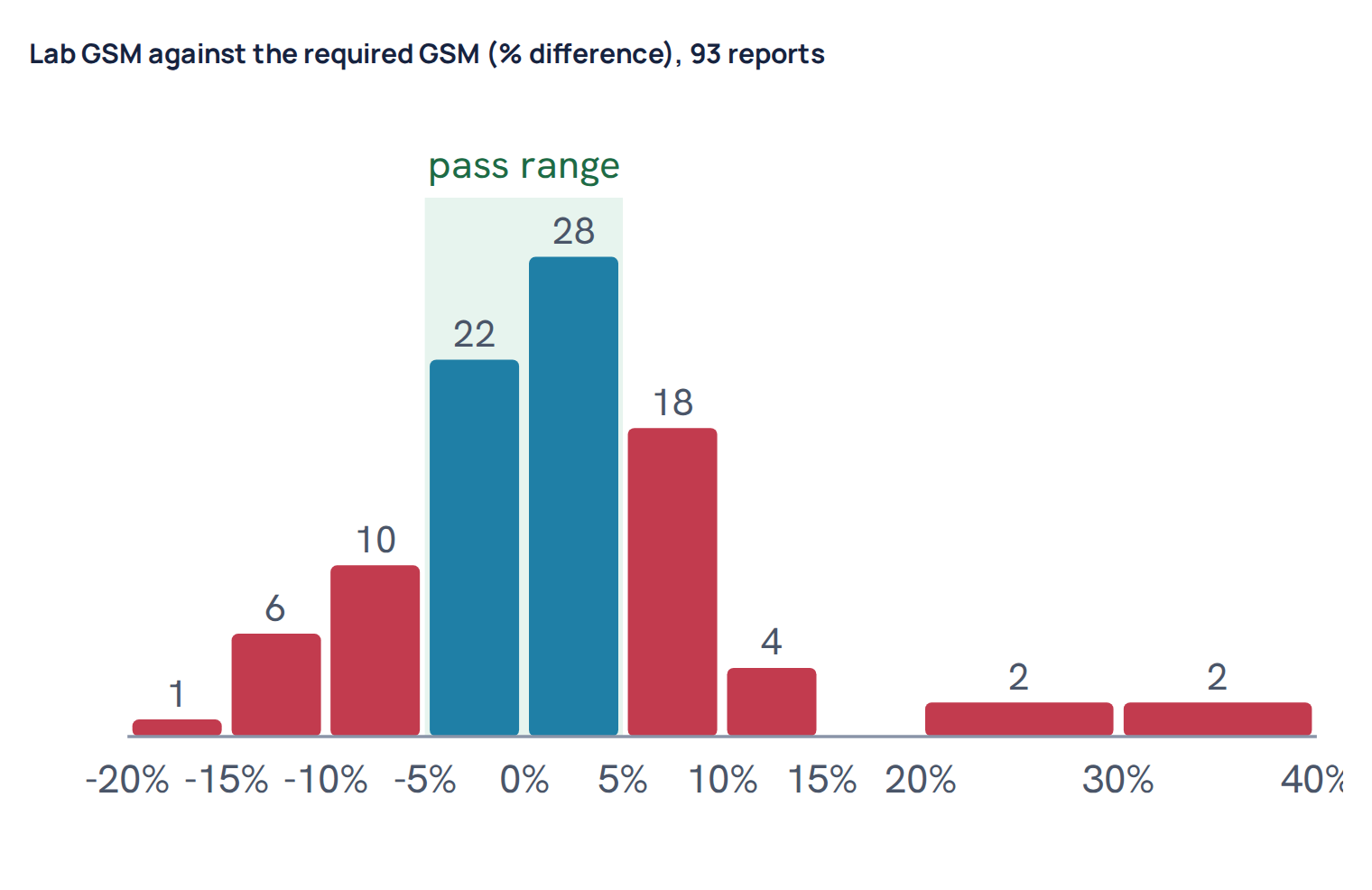
58 of 93 batches passed. The spread is wide on both sides: light single jerseys fell below, and texture fabrics such as design rib and waffle went well above.
| Fabric group | Tested | Passed |
|---|---|---|
| Single jersey | 18 | 7 (38%) |
| Rib | 23 | 14 (60%) |
| Interlock | 10 | 6 (60%) |
| Terry | 12 | 8 (66%) |
| Waffle | 10 | 8 (80%) |
| Fleece | 17 | 14 (82%) |
| Pique and lacoste | 3 | 1 (33%) |
Checking GSM in the factory before the lab
In our records the lab GSM was a median 5.5% higher than the GSM the factory measured straight after finishing. The factory checks warm, dry fabric that is still under finishing tension; the lab checks rested, conditioned fabric. So a factory check gives a true picture only if the swatch has rested flat for some hours first, ideally in the same atmosphere the lab uses. For texture fabrics, also check GSM after a wash: that is the weight the garment will have.
Common mistakes that change the result
- Cutting fabric that has not been conditioned, or weighing it in a dry, hot room.
- Cutting near the selvedge, the fold line or a crease, where the fabric is denser or stretched.
- A blunt cutter that frays or stretches the edge, so the area is not exactly 100 cm².
- Pulling the fabric flat on the board, which stretches it and lowers the GSM.
- Taking one specimen instead of an average of several.
If a batch fails, see why knit fabric fails the GSM test: 35 real cases.
From the floor
- Reach the required GSM. The closer the fabric is to its GSM, the better it performs in the lab, in bursting as well.
- A tightly knitted fabric holds its GSM and pills less; a loosely knitted one goes light and pills more.
- Heat setting is decided partly by GSM and construction: a tight knit is heat set whatever its GSM, and design fabrics are heat set to fix the design at the width where it shows.
- Let the fabric relax 12 to 24 hours before cutting, so the GSM you measure is the GSM the garment will have.
Questions
How do you calculate GSM from a 100 cm² cutter?
Multiply the mass in grams by 100. A specimen of 2.12 g is 212 GSM.
Why must fabric be conditioned before a GSM test?
Cotton takes up and loses moisture, and fabric just off the compactor is still stretched. Conditioning at 20°C and 65% RH gives a fair, repeatable weight.
What is the GSM tolerance for knit fabric?
Usually ±5% of the ordered GSM; some buyers allow −5% / +8%.
Related: knit GSM from stitch length calculator · shrinkage and GSM after wash calculator.

Textile engineer with 14+ years in dyeing and fabric development. He writes every guide on Dyeing Solution from real production work. Full profile