Sorona is a polyester, but it dyes at 110°C instead of 130°C. Here is the cotton-Sorona process we use: the scour, the full disperse curve for the Sorona part, the two reduction clears, and the finishing set.
At a glance
110°CDisperse dyeing (PET: 130°C)
pH 4–4.5Dyebath
2 ×Reduction clear, 90°C × 20 min
160°C × 45 sFinal set on the stenter
Sorona is the trade name of a PTT polyester (polytrimethylene terephthalate), partly made from plant-based material. It takes disperse dyes like ordinary PET polyester, but its structure is more open, so it dyes at a lower temperature: 110°C instead of 130°C. It also has a natural stretch and soft handle, which is why it is blended with cotton in knits.
The route for cotton-Sorona
Process flow: cotton-Sorona
- Scour at 98°C for 30 minutes with caustic (1 g/L).
- Cold wash, neutralise, cold wash.
- Disperse dyeing of the Sorona at 110°C for 30 minutes, pH 4–4.5.
- Cold wash.
- Reduction clearing with hydrose and caustic (2 g/L) at 90°C for 20 minutes, done twice.
- Cold wash, neutralise, cold wash.
- Enzyme (bio-polishing), when required.
- Reactive dyeing of the cotton part in a separate bath, then soaping.
- Softener, and unload.
- Finishing: softener padded at 70–80% pick-up, final set at 160°C for 45 seconds.
The cotton part is dyed with reactive dyes in its own bath, after the Sorona dyeing and the reduction clears, the same order as CVC. The enzyme, when it is needed, goes before the cotton dyeing, as part of the cotton preparation.
The disperse curve for the Sorona part
Step by step
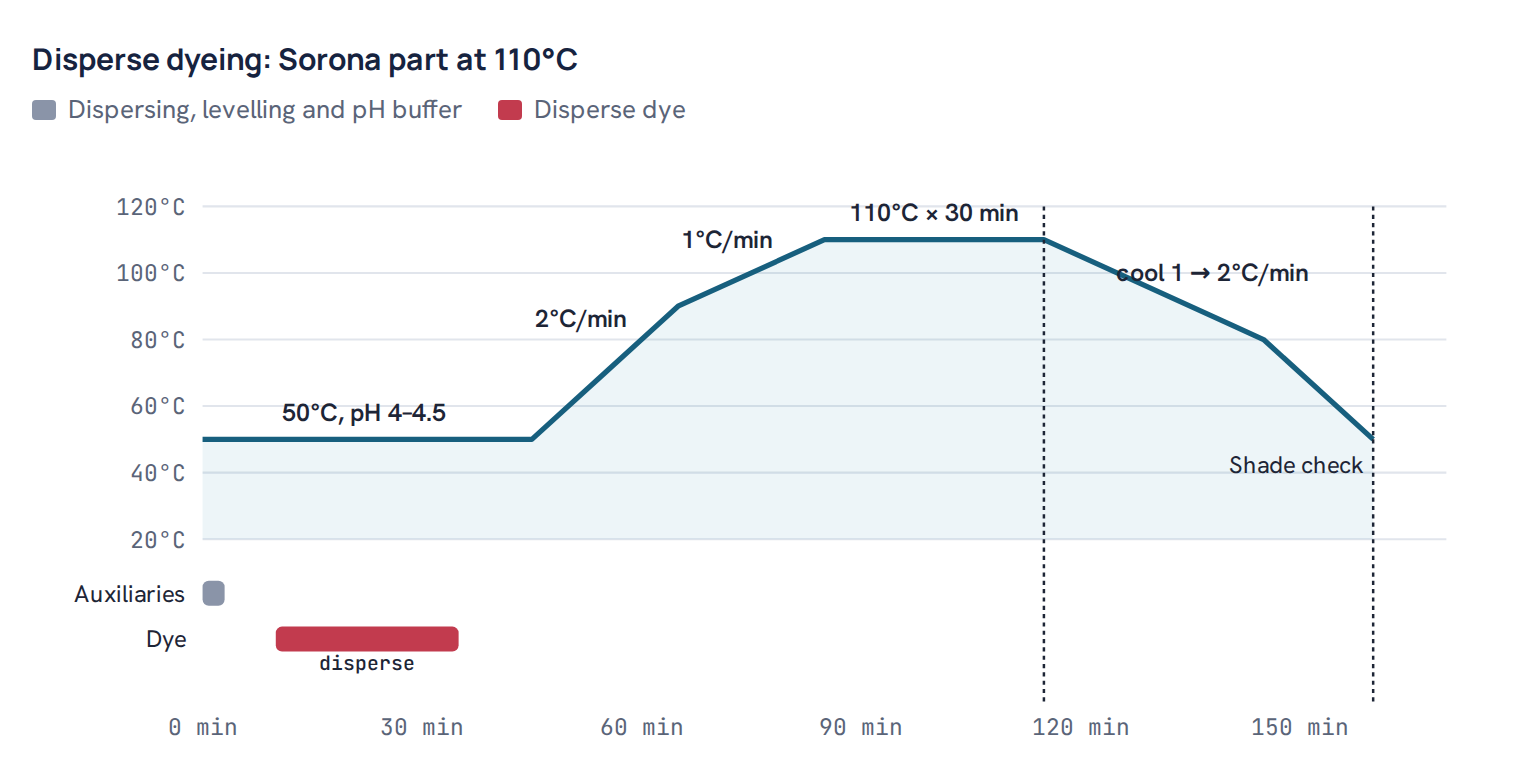
- Set the bath to pH 4–4.5 at 50°C with a dispersing agent (1 g/L), a levelling agent (1 g/L) and a pH buffer (0.5 g/L). Run 10 minutes.
- Dose the disperse dye over 25 minutes and run 10 minutes.
- Heat to 70°C at 2°C per minute, then to 90°C at 2°C per minute.
- Heat to 110°C at 1°C per minute.
- Run 30 minutes at 110°C and check the shade.
- Cool to 80°C at 1°C per minute, then to 50°C at 2°C per minute, and check the shade.
Tip: slow the heating to 1°C per minute above 90°C. Sorona starts taking up disperse dye at a lower temperature than PET, and a fast rise in this zone gives an uneven shade.
Reduction clearing, twice
After a cold wash, the loose disperse dye on the surface is removed with hydrose and caustic (2 g/L) at 90°C for 20 minutes. This is done twice, with cold washes and a neutralisation after it. On regular CVC one reduction clear at 80°C is enough; the Sorona process calls for two at 90°C.
Sorona needs a more thorough removal of the unfixed disperse dye on the surface. Two clears at 90°C clean it better and cut the risk of staining the cotton and of poor rubbing fastness.
Finishing
The softener is padded on the stenter at 70–80% pick-up, and the fabric gets a final set at 160°C for 45 seconds. That is far below the 180–190°C used to heat set cotton-elastane.
See the CVC dyeing process for the regular cotton-polyester route at 130°C.
Sorona compared with regular polyester
| Sorona (PTT) | Regular polyester (PET) | |
|---|---|---|
| Disperse dyeing temperature | 110°C | 130°C |
| Hold time | 30 min | 45 min |
| Reduction clear | 2 × 90°C × 20 min | 1 × 80°C × 10 min |
| Dyebath pH | 4–4.5 | 4.5 |
Regular polyester figures are from our CVC process. Our finishing records hold no Sorona batches in the study period, so there are no GSM or shrinkage figures yet.
Limitations of cotton-Sorona
- Shade variation and shade matching. The most common buyer complaint, often together with dimensional change. First check the Sorona dye uptake, the temperature ramp, the liquor circulation and the balance between the cotton and Sorona shades, and correct the dyeing profile rather than adding more dye.
- Staining and rubbing fastness. Handled by the two reduction clears at 90°C.

Textile engineer with 14+ years in dyeing and fabric development. He writes every guide on Dyeing Solution from real production work. Full profile