Reactive dyes bond chemically with cotton and other cellulose. Here is how the molecule is built, why salt and alkali are added in that order, why some dye always hydrolyses, and how wash-off removes it.
At a glance
CovalentBond with cellulose
pH 10.5–11.5Typical fixation range
~60–90%Typical fixation, varies by dye
Wash-offRemoves hydrolysed dye
Reactive dyes are the main dyes for cotton and every other cellulose fibre: viscose, modal, lyocell, linen. They are the only common dye class that forms a true chemical (covalent) bond with the fibre. That bond is why reactive shades are bright and have very good wash fastness. It also explains the shape of almost every cotton dyeing curve: dye and salt first, alkali later, then a long wash-off at the end.
This article explains what happens inside the machine at each of those steps. Once you understand the chemistry, the rules on the floor stop being rules to memorise. They become the obvious way to work.
A short history
Before the 1950s, cotton was dyed mainly with direct, vat and sulphur dyes, which are held by weak physical forces or trapped as insoluble pigment. In 1956 the first commercial reactive dyes, based on the dichlorotriazine group, reached the market in Britain, and for the first time a dye could be bonded chemically to cellulose in a simple aqueous process.
What a reactive dye molecule is made of
Every reactive dye can be pictured as four parts joined together. The exact chemistry differs from dye to dye, but the job of each part is always the same.
- Chromophore. The coloured part. It is usually an azo, anthraquinone, phthalocyanine or formazan structure, and it decides the hue, brightness and much of the light fastness.
- Bridging group. A short link, often an amino (–NH–) group, that joins the chromophore to the reactive group. It affects how reactive the dye is and how stable the final bond is.
- Reactive group. The part that forms the covalent bond with the fibre. This is what makes the class “reactive”, and it decides the dyeing temperature and the alkali needed.
- Solubilising groups. Sulphonate (–SO₃⁻) groups, usually two or more. They make the dye soluble in water and give it a negative charge in the bath.
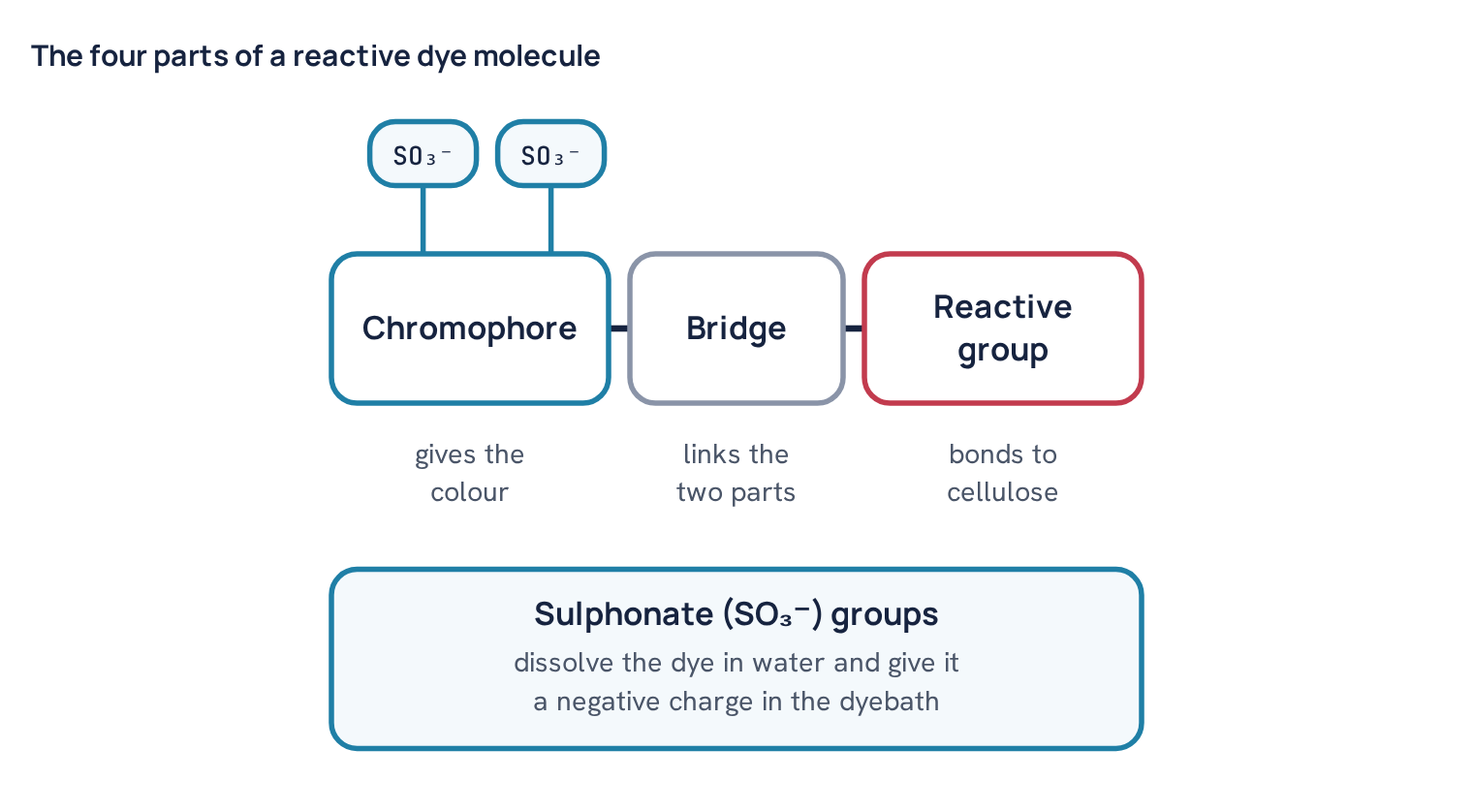
Notice that the sulphonate groups create a problem as well as solving one. They keep the dye dissolved, which is essential for level dyeing, but their negative charge pushes the dye away from cotton, which is also negative in water. Salt is the answer to that problem, as we will see.
The fibre side: cellulose and its hydroxyl groups
Cellulose is a long chain of glucose units. Each unit carries three hydroxyl (–OH) groups, so a cotton fibre offers a huge number of possible reaction sites. In neutral water these hydroxyl groups are not reactive enough to bond with the dye.
When the bath is made alkaline, a small fraction of the hydroxyl groups lose a hydrogen ion and become cellulosate anions (Cell–O⁻). This is a strong nucleophile: a group that is attracted to electron-poor atoms and attacks them. The reactive group of the dye contains exactly such an electron-poor carbon. That is why the bond forms only after the alkali goes in. Below about pH 10, very few cellulosate anions exist and fixation is slow; in the typical range of pH 10.5–11.5 there are enough for a practical rate.
Viscose, modal and lyocell are also pure cellulose, so the chemistry is the same. They differ in how open their structure is and how fast they take up dye, which is why their curves are often adjusted, as described later.
Two kinds of reaction: substitution and addition
All reactive groups react with the cellulosate anion, but they do it in one of two ways.
Nucleophilic substitution: the halo-triazines
Triazine dyes carry a six-membered ring of carbon and nitrogen atoms with one or two chlorine atoms attached. The cellulosate anion attacks the carbon that holds a chlorine. The chlorine leaves as a chloride ion and the cellulose takes its place. One group is swapped for another, so this is called substitution.
- Dichlorotriazine (DCT) dyes have two chlorines. They are very reactive and fix at 30–40°C with mild alkali. The price of that reactivity is fast hydrolysis, both in the bath and in stock solutions.
- Monochlorotriazine (MCT) dyes have one chlorine. The ring is less electron-poor, so the dye is less reactive and needs about 80°C to fix in exhaust dyeing. It is more stable in solution and levels well.
Nucleophilic addition: vinyl sulphone
Vinyl sulphone dyes are not sold in the vinyl form. They are supplied as a stable precursor, the sulphatoethylsulphone group (–SO₂–CH₂–CH₂–OSO₃⁻). When alkali is added, this group loses its sulphate and becomes the vinyl sulphone group (–SO₂–CH=CH₂), which has a reactive carbon–carbon double bond. The cellulosate anion then adds across that double bond. Nothing leaves at this final step, so it is called addition. Vinyl sulphone dyes typically fix at 40–60°C.
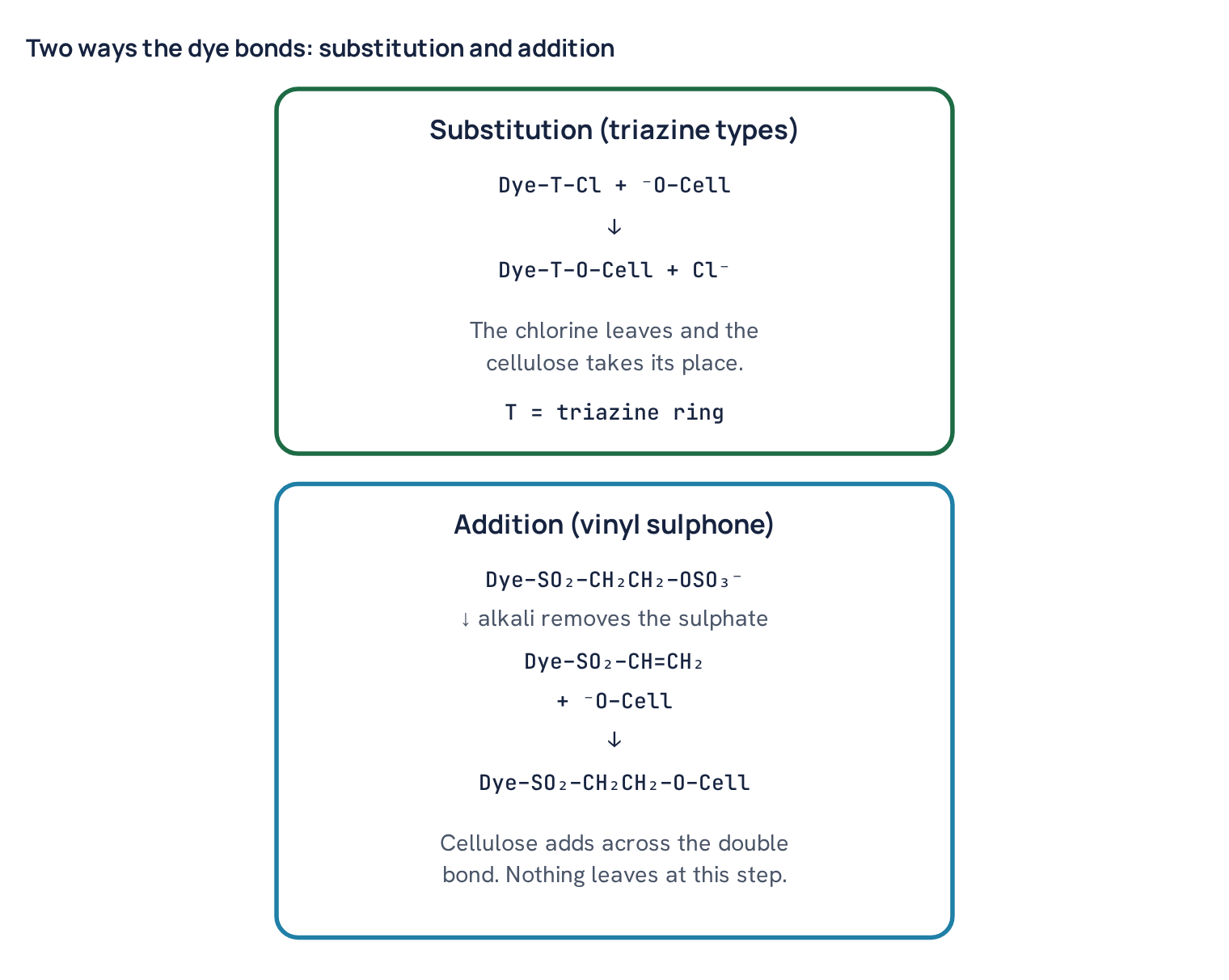
The two bonds also behave differently after dyeing. The bond from a triazine dye is more sensitive to acid, while the bond from a vinyl sulphone dye can be broken by hot alkali. This is one reason the fabric is neutralised before the hot washing steps.
Bifunctional and heterobifunctional dyes
Many modern dyes carry two reactive groups. When both are the same (for example two monochlorotriazine groups) the dye is bifunctional; when they are different (typically one monochlorotriazine and one vinyl sulphone) it is heterobifunctional. The advantage is simple probability. If one group is lost to hydrolysis, the dye still has a second group that can bond with the fibre. As a result, fixation is usually higher and more consistent than with single-group dyes, and heterobifunctional dyes are often less sensitive to small changes in temperature, because the two groups work best in slightly different conditions.
Stage 1: exhaustion with salt
In the first stage the dye and salt are in the bath, but there is no alkali. The aim is to move as much dye as possible onto and into the fibre, evenly, while it is still free to move.
Why salt is needed
In water, cotton develops a negative surface charge. This is measured as the zeta potential, the electrical potential at the boundary between the fibre surface and the water. The dye anion carries negative sulphonate groups too, so the fibre and dye repel each other. Without salt, a reactive dye has quite low substantivity (attraction to the fibre) and much of it would simply stay in the water.
When salt is added, its sodium ions crowd around the negative fibre surface and shield the charge. The zeta potential moves closer to zero, the repulsion drops, and the dye can approach the fibre, adsorb on it and diffuse into it. More salt gives more shielding and more dye uptake, up to a limit. Common salt (sodium chloride) and Glauber’s salt (sodium sulphate) are both used; the second is preferred for some dyes and to avoid chloride in the effluent.
How much salt
Deeper shades need more dye in the fibre, so they need more salt. The ranges below are general guidance only. The right amount varies with the dye (some low-salt dyes need much less), the liquor ratio, the fibre and the machine, so always start from the dye maker’s recommendation.
| Shade depth (% on weight of fabric) | Salt, g/L (guide) | Soda ash, g/L (guide) |
|---|---|---|
| Pale, below about 0.5% | 10–30 | 5–10 |
| Medium, about 0.5–2% | 30–60 | 10–15 |
| Deep, about 2–4% | 60–80 | 15–20 |
| Very deep, above 4% | 80–100 | 20, sometimes with a little caustic soda |
Salt and soda are dosed in grams per litre, not per kilogram of fabric. A longer liquor ratio therefore means more salt for the same fabric weight, and also more dye left in the water at the end.
Worked example. A batch of 400 kg of cotton jersey is dyed at a liquor ratio of 1:8, so the bath holds 3,200 litres. For a medium-deep shade the recipe calls for 60 g/L salt and 15 g/L soda ash. Salt: 3,200 × 60 g = 192 kg. Soda ash: 3,200 × 15 g = 48 kg. If the same fabric were dyed at 1:10, the bath would be 4,000 litres and the salt alone would rise to 240 kg, for the same shade.
During this stage no bond has formed. Dye can still leave a heavy area and move to a lighter one, which is called migration. That is why the shade check belongs here, before the alkali.
Stage 2: fixation with alkali
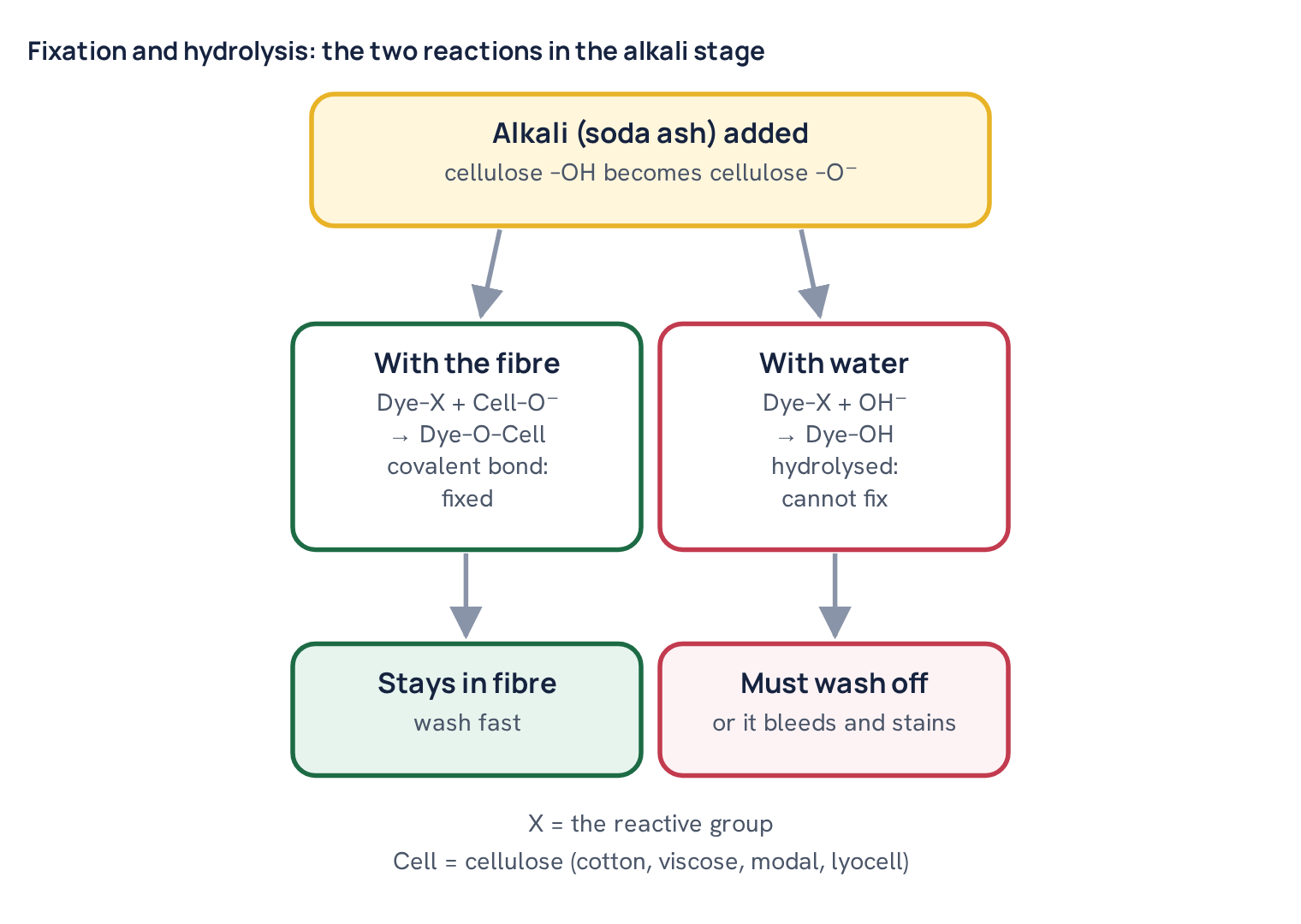
Once the dye has exhausted and the shade has been checked, alkali is added. Soda ash (sodium carbonate) is the usual choice, sometimes with a little caustic soda for deep shades or less reactive dyes. The pH rises to around 10.5–11.5 in most processes, the cellulosate anions form, and the dye begins to bond.
Fixation also has a second effect. As dye in the fibre reacts and is taken out of the equilibrium, more dye moves in from the bath. Uptake rises again after the alkali goes in, which is often called secondary exhaustion. This rapid strike is exactly why alkali must be added slowly.
The fixing temperature depends on the reactive group. Highly reactive groups fix at low temperature; less reactive groups need heat to react at a useful speed. Temperature is matched to the dye, not chosen freely.
Hydrolysis: the reaction you cannot avoid
Alkaline water contains hydroxide ions (OH⁻), and hydroxide is also a nucleophile. It attacks the reactive group in the same way the cellulosate anion does. When it wins, the reactive group is converted into a harmless hydroxyl group. The dye is now hydrolysed: it still has full colour, but it can never bond with the fibre.
Hydrolysis cannot be stopped, only kept small. Water is everywhere in the bath and it greatly outnumbers the fibre’s reactive sites. Fixation wins mainly because the dye is concentrated in and on the fibre, close to the cellulosate anions, after the salt stage. Anything that leaves dye in the water while alkali is present, or speeds up all reactions, shifts the balance toward hydrolysis:
- High temperature beyond what the dye needs. Hydrolysis speeds up with heat faster than useful fixation does.
- High pH. More hydroxide means more attack on the dye in the water.
- Long time in alkali, especially holding the bath far beyond the needed fixation time.
- Long liquor ratio. More water means more of the dye stays in solution, where hydrolysis happens.
- Poor exhaustion before the alkali, for example from too little salt.
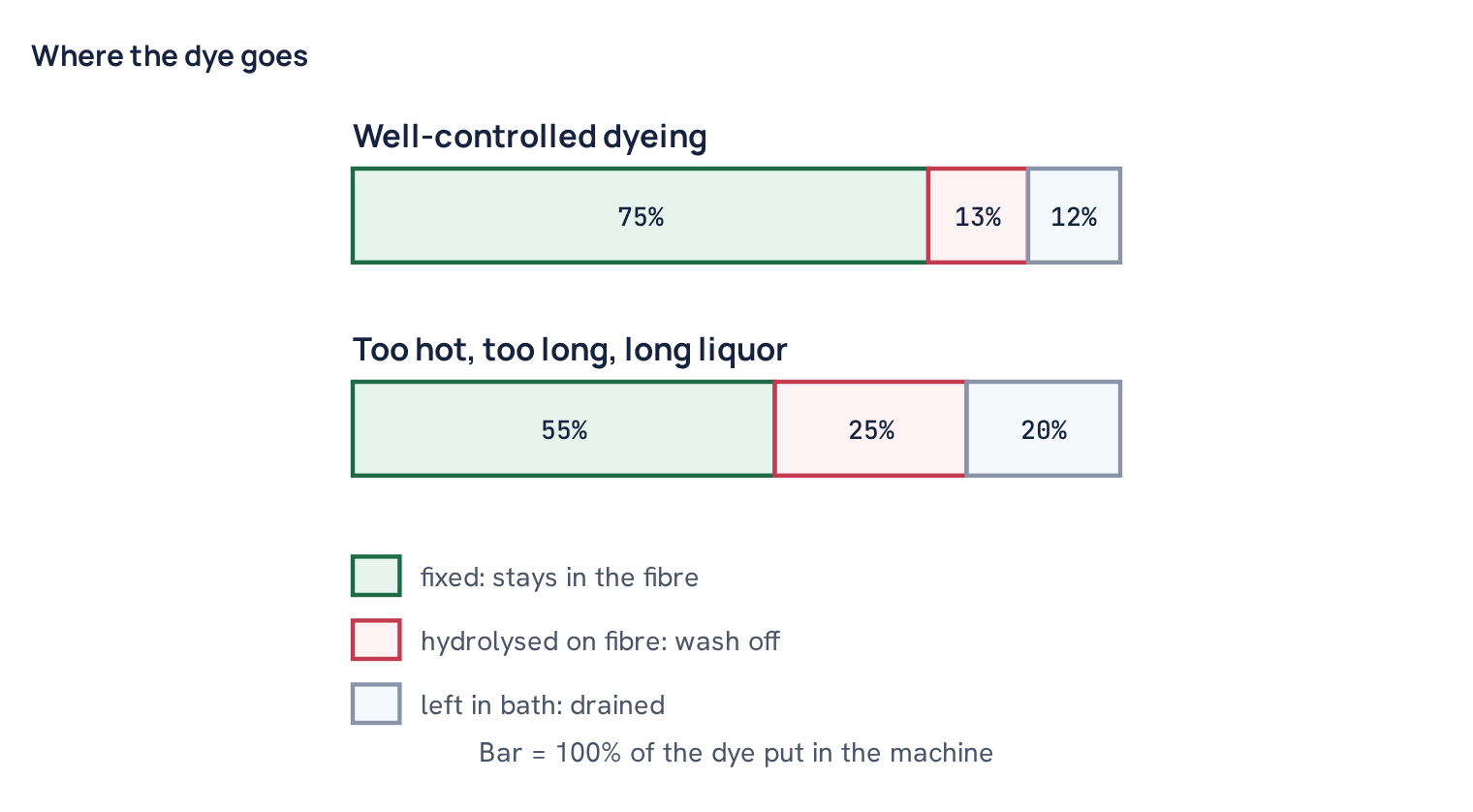
The hydrolysed dye has to be removed. It sits loosely on and in the fibre, held only by the same weak forces as a direct dye. If it stays, it comes out in the customer’s wash, stains white fabrics, and rubs off when the fabric is wet. Good fixation reduces this problem, but it never removes it.
Fixation efficiency is the share of the dye that ends up chemically bonded. For exhaust dyeing of cotton it is typically somewhere around 60–90%, depending on the dye, the reactive group, the shade depth and the process. Single-group dyes tend toward the lower end; good bifunctional dyes toward the upper end. The rest is hydrolysed or left in the bath and becomes coloured effluent.
Cold, warm and hot reactive dyes
Dye makers and dyers group reactive dyes by the temperature they need for fixation. The table gives typical values; individual dyes vary, so the dye maker’s data always comes first.
| Type | Typical fixing temperature | Main reactive group | Notes |
|---|---|---|---|
| Cold | 30–40°C | Dichlorotriazine | Very reactive; mild alkali; hydrolyses quickly |
| Warm | 40–60°C | Vinyl sulphone; bifunctional (chlorotriazine + vinyl sulphone) | Most common class for cotton knits |
| Hot | 80°C | Monochlorotriazine; bis-monochlorotriazine | Less reactive; good migration; stronger alkali or heat needed |
Dyes from different groups should not be mixed in one recipe without care. A cold dye and a hot dye fix at very different speeds, so in a combination shade one component fixes early and the other late, and the shade can change from batch to batch. Choose dyes that are designed to work together.
Dyeing methods: all-in, migration and isothermal dosing
The same chemistry can be run in different ways. The difference lies in when the salt and alkali go in and at what temperature.
- All-in method. Dye, salt and alkali are added at the start, or very close together. It is quick and simple but gives little time for levelling, so it suits highly reactive dyes in pale shades or very even-running machines and fabrics.
- Migration method. Dye and salt are run at a higher temperature (often around 80°C) with no alkali. The dye migrates and levels out. The bath is then brought to the fixing temperature and the alkali is added. This gives excellent levelness and is common for fibres that take up dye fast.
- Isothermal, progressive dosing. The whole process runs at the fixing temperature. Salt is added in portions, then alkali is dosed in steps or by a metering pump along a progressive curve, slowly at first and faster later. This controls the rate of strike and is the most common approach for warm dyes on cotton knits.
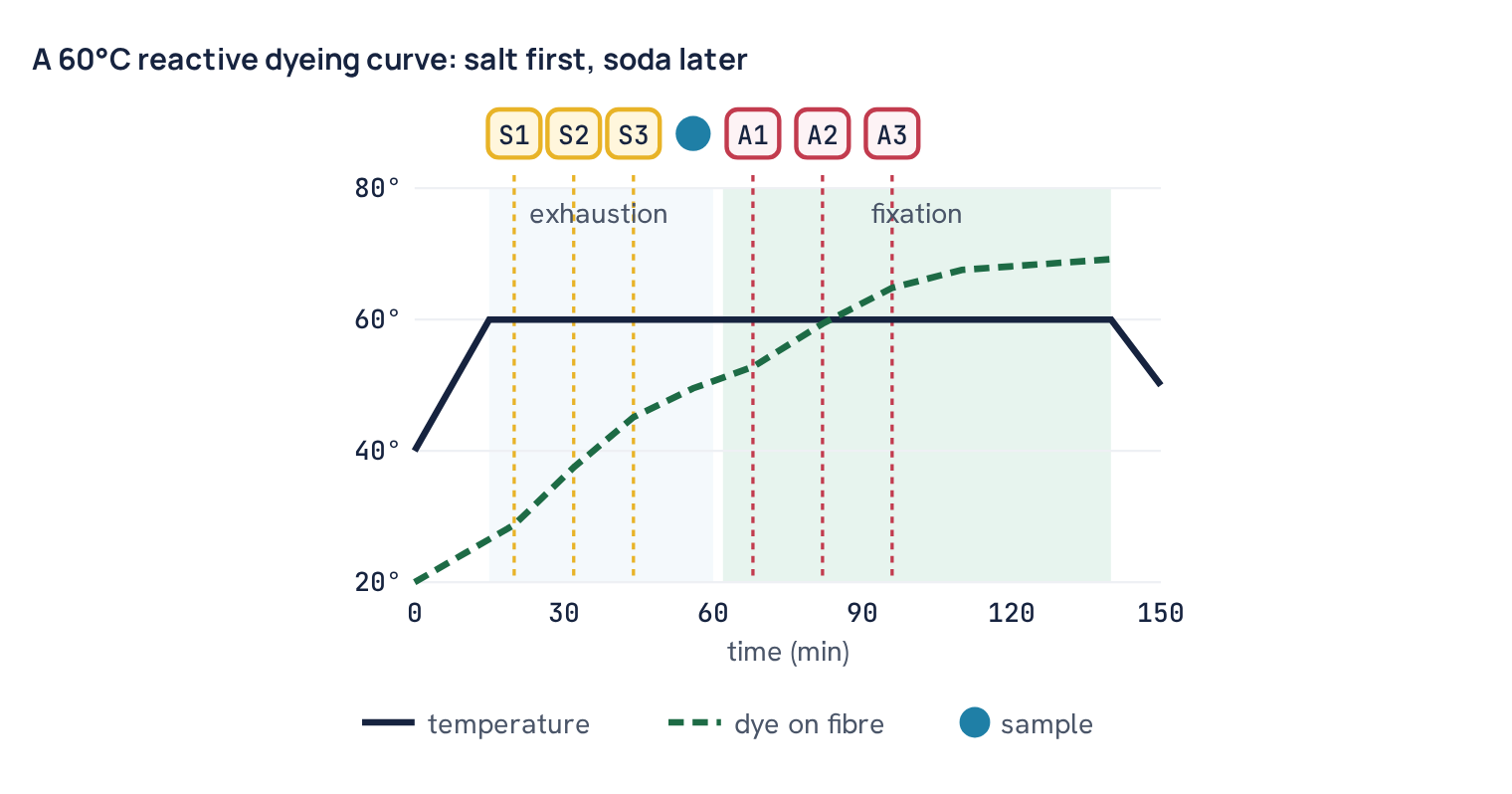
- Salt goes in three portions and the soda in steps, so the dye goes on slowly and evenly.
- Always take the salt sample before the soda. After the soda the dye is fixed and there is little room to correct the shade.
- On our floor most cotton is dyed on a 60°C curve. For cotton-modal, lyocell, viscose and modal, the salt goes in at 80°C and the bath is cooled to 60°C for the soda.
- For deep shades, soap twice at 80°C and give hot washes at 70°C and 60°C before fixing, then a wet rubbing improver before unloading. That is what gets wet rubbing to grade 3.
The floor practice above is a combination of these ideas. The 60°C curve for cotton is isothermal dosing. The regenerated fibres use the migration principle: salt at 80°C to level, then cooling to 60°C before the soda. Viscose, modal and lyocell absorb dye faster and more unevenly than cotton, so the extra levelling time pays off.
Turquoise and bright blue shades
Some shades do not follow the standard curve. Turquoise dyes are usually built on large phthalocyanine chromophores. The big molecule diffuses slowly into the fibre, so it often needs a higher temperature, more salt or a longer time than the rest of the range. Some bright blues behave differently too, being more sensitive to temperature or pH. In combination shades with these dyes, check the dye maker’s recommended conditions and make sure the other dyes in the recipe are compatible with them.
Wash-off: removing what did not fix
At the end of fixation the fabric holds three things: fixed dye, hydrolysed dye and some unfixed dye, plus a lot of salt and alkali. Wash-off removes everything except the fixed dye. It is not a cleaning step to be shortened when the machine is needed. It decides the wash, water and rubbing fastness of the finished fabric.
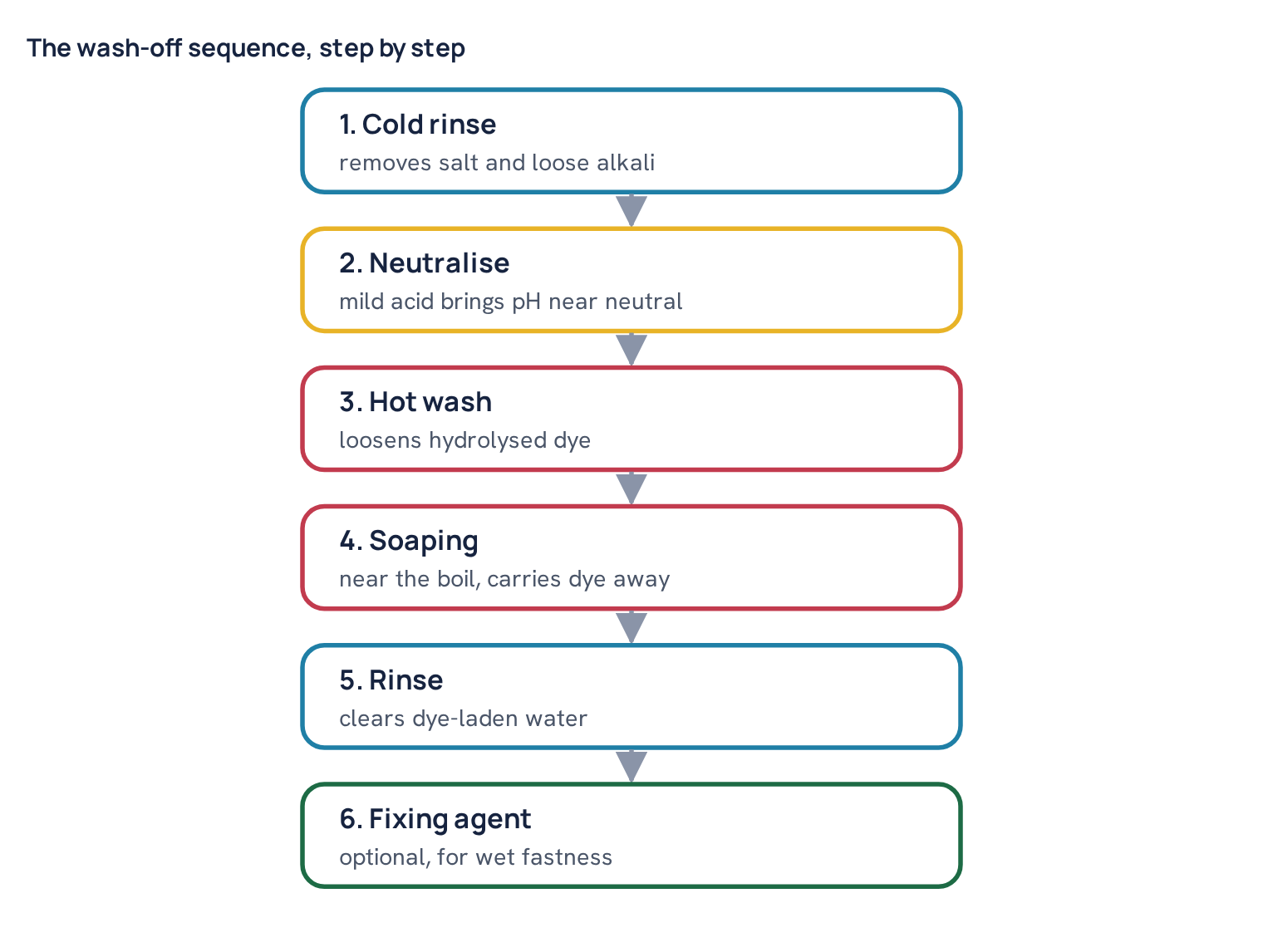
- Cold or warm rinse. Removes salt and loose alkali. Salt has to come out first: while the bath is full of electrolyte, the hydrolysed dye stays attracted to the fibre and will not wash away.
- Neutralise. A mild acid, usually acetic acid, brings the pH close to neutral. This protects the dye–fibre bond (especially vinyl sulphone bonds) from hot alkali in the next steps and gives a stable shade.
- Hot wash. Hot water swells the fibre and loosens the hydrolysed dye.
- Soaping. A wash near the boil with a soaping agent, often 80–95°C depending on the dye and the process. This carries the loose dye away and keeps it from re-depositing. Deep shades often need two soaping baths.
- Rinse. Clears the dye-laden water, with hot and then warm rinses until the water runs reasonably clear.
- Fixing agent (optional). A cationic fixing agent binds the last traces of unfixed dye and improves wet fastness. It does not replace proper washing, it can dull the shade slightly, and some types reduce light fastness, so it is used only where needed.
Common faults and their causes
Most reactive dyeing faults trace back to one of the reactions above happening at the wrong time or in the wrong place.
Common mistake: adding the soda too fast. The dye fixes on the first surfaces it meets, so the shade comes out uneven or streaky, and more dye hydrolyses instead of fixing. Dose alkali in steps or along a progressive curve.
Common mistake: judging the shade before soaping. Loose hydrolysed dye makes the fabric look deeper and sometimes duller. After soaping the shade becomes lighter and often brighter. Shade matching must be done on a sample that has been soaped the same way as production.
Common mistake: shortening the wash-off for deep shades. The fabric passes shade but fails wet rubbing and colour staining, because hydrolysed dye is still on the surface. Extra hot washes and a second soaping usually help far more than adding chemicals at the end.
Common mistake: mixing dye and alkali in the stock tank, or dissolving the dye in very hot water and leaving it standing. The dye hydrolyses before it reaches the fabric, so the shade comes out light and varies from batch to batch. Dissolve dye at a moderate temperature, keep it separate from the alkali, and use it promptly.
Other common causes of trouble are hard water (calcium and magnesium can reduce solubility and dull some shades), wrong salt quantity for the liquor ratio actually used, and poor pretreatment that leaves the fabric unevenly absorbent. The dyeing chemistry can only be as even as the fabric that goes into it.
Further reading
For the general four-step model of dye uptake, see how dyeing works: transport, adsorption, diffusion and fixation. To see where reactive dyes sit among other classes, read dye classes: which dye for which fibre. For full process sequences, see the 100% cotton knit dyeing process and the cotton-modal knit dyeing process. If wet rubbing is your problem, the guide to wet rubbing fastness fails, causes and remedies goes deeper into wash-off.
Questions
Why is salt added before the alkali in reactive dyeing?
Salt shields the negative charge on cotton so the dye can move onto the fibre, while it can still migrate and level out. The alkali then fixes the dye in place, after which the shade can hardly be corrected.
What is hydrolysed reactive dye?
It is dye whose reactive group has reacted with hydroxide in the water instead of with the fibre. It keeps its colour but can never bond, so it must be washed off or it will bleed and stain.
What pH is needed for reactive dye fixation?
Most processes run at around pH 10.5–11.5, usually with soda ash. The exact value depends on the dye type, temperature and shade depth.
What is the difference between vinyl sulphone and monochlorotriazine dyes?
Monochlorotriazine dyes bond by substitution and typically fix at about 80°C. Vinyl sulphone dyes are formed from a precursor in alkali, bond by addition and typically fix at 40–60°C.
Why do bifunctional reactive dyes give higher fixation?
They carry two reactive groups. If one is lost to hydrolysis, the second can still bond with the fibre, so more of the dye ends up fixed.

Textile engineer with 14+ years in dyeing and fabric development. He writes every guide on Dyeing Solution from real production work. Full profile