Disperse dyes dissolve into polyester like sugar into hot water, with no chemical bond. Here is the fibre structure, the mechanism, why we dye at 130°C and pH 4.5, how reduction clearing works and why hot finishing can undo a good dyeing.
At a glance
Non-ionicSmall, water-insoluble dye
130°CHigh-temperature dyeing under pressure
pH 4.5–5.5Keeps dye and fibre stable
90–115°CCritical zone: heat slowly
Polyester is the easiest fibre to dye level and one of the hardest to dye fast. It has no charged sites, it hardly takes up water, and its molecular chains are packed so tightly that at room temperature almost nothing can get in. The dyes that work on cotton or nylon have nothing to hold on to. Disperse dyes solve this in a simple way: they are small, non-ionic molecules that dissolve into the polyester itself, much as sugar dissolves into hot water. There is no chemical bond. The dye is simply trapped inside the fibre once it cools.
That one idea explains almost every rule of polyester dyeing: why the bath goes to 130°C under pressure, why the pH sits at 4.5–5.5, why the heating rate matters so much between about 90 and 115°C, why reduction clearing is needed on deeper shades, and why a hot stenter can undo a perfect dyeing. This article walks through each of them, from the fibre structure to the faults you will meet on the floor.
Polyester fibre structure: why it is hard to dye
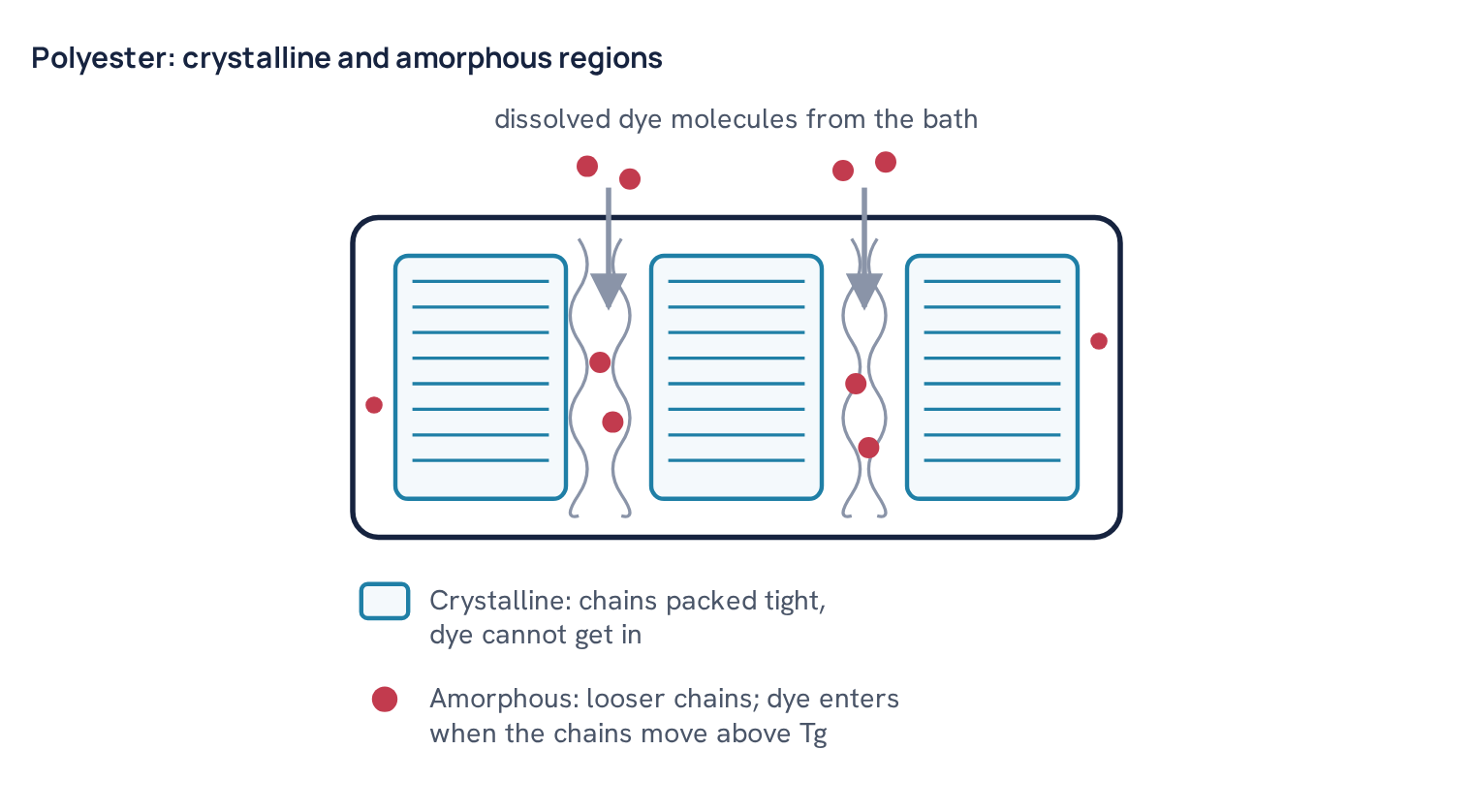
Textile polyester is mostly polyethylene terephthalate (PET). Its long chains are made of rigid benzene rings joined by ester groups. During spinning and drawing, the chains line up, and many of them pack into ordered, crystalline regions. Between these crystallites are less ordered, amorphous regions where the chains are looser and tangled.
Dye can only enter the amorphous regions. The crystalline regions are too tightly packed for any dye molecule. So the amount and openness of the amorphous part decides how much dye the fibre can take and how fast. This is why heat setting before dyeing, which changes the crystallinity, also changes the dye uptake. Two lots of fabric set at different temperatures can dye to different depths in the same bath.
Three other properties matter:
- Hydrophobic. Polyester takes up very little moisture, typically well under 1%. Water does not swell it the way it swells cotton, so water-soluble dyes cannot be carried in.
- No ionic sites. There are no amino or carboxylate groups in useful number, so ionic dyes (reactive, acid, direct) have no site to bond with.
- Glass transition. Below its glass transition temperature (Tg) the amorphous chains are frozen. Above Tg, segments of the chains start to move and open small, temporary gaps. For dry PET, Tg is usually quoted around 70–80°C. In hot water it is somewhat lower, because water acts as a mild plasticiser. Exact figures vary with the fibre, its drawing and its heat-setting history.
What a disperse dye is
A disperse dye is a small, non-ionic organic molecule with very low solubility in water. It has no sulphonate groups, which are what make acid, direct and reactive dyes water-soluble. Typical molecular weights are low, often in the range of about 300–500, so the molecule is small enough to slip between polyester chains once they move.
Chemically, most disperse dyes belong to two groups:
- Azo dyes (mono-azo and some dis-azo). They cover yellow, orange, red, rubine, navy and black, and they have good tinctorial strength, so they are economical. Most of the market is azo.
- Anthraquinone dyes. These give many bright reds, violets, blues and turquoises. They are usually weaker in colour strength and more expensive, but some have very good light fastness and brightness.
Smaller groups such as nitrodiphenylamine yellows, methine, quinophthalone and heterocyclic types fill special gaps in the shade range.
The dispersing agent and particle size
Because the dye will not dissolve, the dye maker mills it into very fine particles and mixes it with a dispersing agent, commonly a lignin sulphonate or a naphthalene sulphonate condensate. A large part of a commercial disperse dye powder is this dispersant, not dye. The dispersant coats each particle with negative charges, so the particles repel each other and stay suspended instead of settling or clumping.
Particle size matters. Fine, even particles (typically around one micrometre or less, depending on the product) dissolve quickly, stay dispersed at high temperature and pass through the fabric without being filtered out. Coarse or uneven particles dissolve slowly, can settle, and can be filtered by tightly wound packages or dense fabric, leaving spots or a lighter inside.
The mechanism: dissolve, adsorb, diffuse
The general steps of dyeing are explained in how dyeing works: transport, adsorption, diffusion and fixation. For disperse dyes on polyester, they look like this:
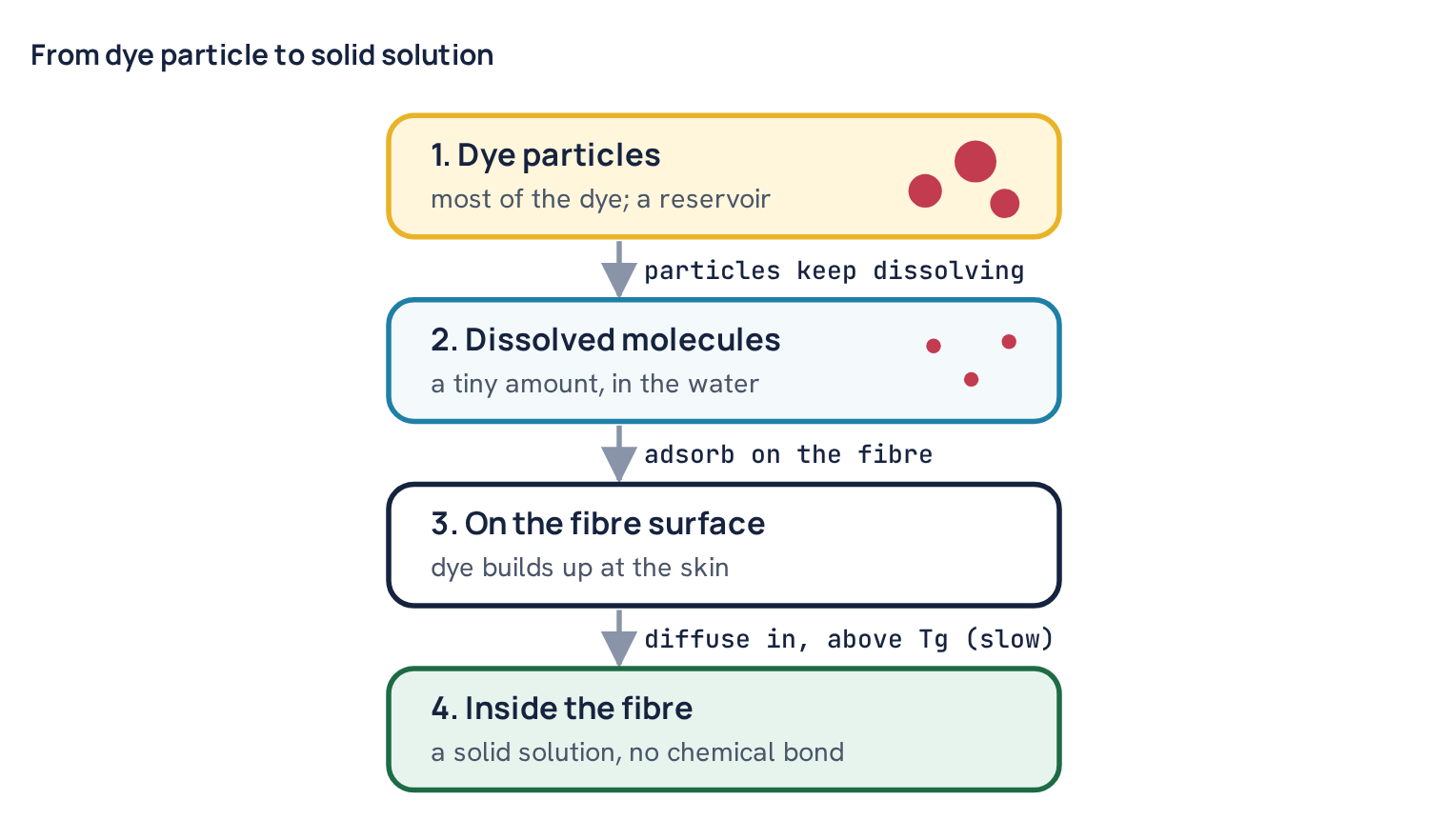
- Dissolution. In the bath, most of the dye is present as particles. Only a tiny amount is truly dissolved as single molecules. Solubility rises sharply with temperature, but even at 130°C it stays low.
- Adsorption. Dissolved single molecules move to the fibre surface and are taken up there.
- Diffusion. Above Tg, the dye diffuses from the surface into the amorphous regions. This is the slow step, and it controls the time the dyeing needs.
- Fixation as a solid solution. When the bath cools, the chains freeze again and the dye stays inside, held by weak forces (van der Waals forces, dipole interactions and some hydrogen bonding). It is dissolved in the fibre, not bonded to it.
The key point is that the dye leaves the bath only as dissolved molecules. Particles never go into the fibre. As dissolved dye moves into the polyester, the water loses some of its dissolved dye, and more particles dissolve to replace it. The particles act as a reservoir. This continues until the particles are used up or the fibre is close to saturation.
Nernst partition
The balance between dye in the fibre and dye dissolved in the water follows a simple partition law, called the Nernst isotherm: at equilibrium, the concentration in the fibre is a fixed multiple of the concentration in the water. The multiple, called the partition coefficient, is large, because the dye “prefers” the hydrophobic polyester to water. This is the same law that describes a solute shared between two liquids that do not mix, like oil and water. It is the reason disperse dyeing is often described as solid-solution dyeing. The isotherm stays linear until the fibre approaches its saturation value, which differs from dye to dye.
Why temperature controls everything
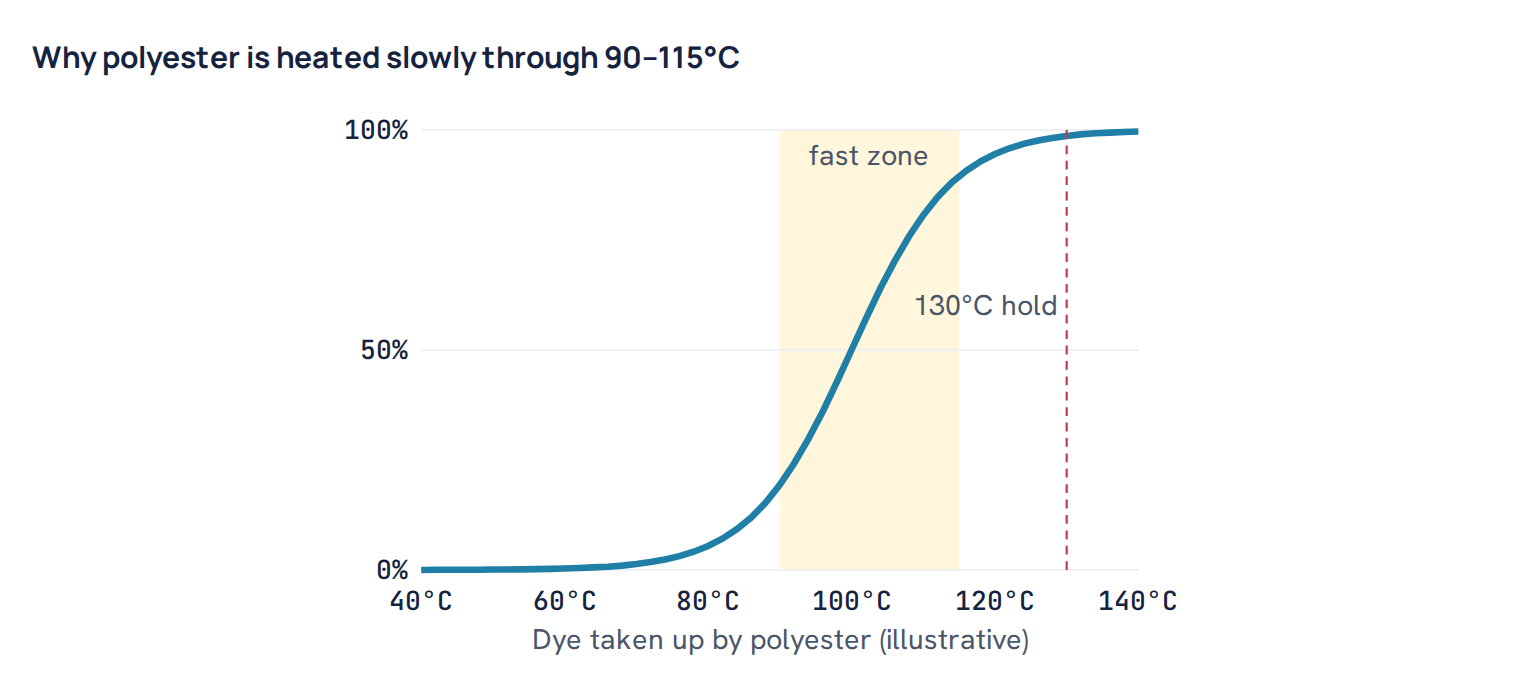
Below Tg, the chains are frozen and the dye can only sit on the surface. As the bath passes Tg, chain movement starts and diffusion speeds up very quickly. In practice, polyester takes almost no disperse dye below about 80–90°C, and most of the uptake happens in a narrow band above that. At the boil, diffusion is still too slow for medium and deep shades in a practical time. At 130°C, the chains move freely, the dye’s solubility in water is higher, and diffusion is many times faster. This is why polyester is dyed in pressurised high-temperature machines.
Energy levels: low, medium and high energy dyes
Disperse dyes are grouped by “energy”, which really means how much heat they need to dye and how easily heat moves them again. Small, less polar molecules diffuse fast and level well, but they also escape easily as vapour when the fabric is heated (sublimation). Larger, more polar molecules diffuse slowly and level poorly, but once inside they stay put. Every dye is a compromise between levelling and heat fastness. Dye makers label their ranges in different ways, but the three broad groups are similar everywhere.
| Group | Molecule | Levelling and migration | Sublimation fastness | Typical use |
|---|---|---|---|---|
| Low energy | Small, low polarity | Very good, dyes at lower temperature | Poor | Carrier dyeing, pale shades, items not heat-treated later |
| Medium energy | Medium size | Good | Moderate to good | General high-temperature exhaust dyeing |
| High energy | Larger, more polar | Poor, needs 130°C and careful control | Very good | Thermosol, deep shades, fabric heat set or pleated after dyeing |
A practical rule: build a recipe from dyes of the same energy group. If one dye in a combination is low energy and another is high energy, they go on at different temperatures and move differently in finishing, so the shade can drift on heating, cooling and stentering.
Three ways to dye polyester
1. Carrier dyeing at the boil
Before pressurised machines were common, polyester was dyed at about 98–100°C with a carrier. Carriers are aromatic organic compounds (for example, chlorinated benzenes, biphenyl or methylnaphthalene types) that are absorbed by the fibre, plasticise it and lower its effective Tg, so the dye can diffuse at the boil. The method is now mostly abandoned. Many carriers are toxic or smell strongly, they load the effluent, they can leave residues that reduce light fastness, and they must be removed afterwards. Some carrier use remains in special cases, such as blends with fibres that cannot stand 130°C, but with alternatives where possible.
2. High-temperature exhaust dyeing at 130°C
This is the standard method for polyester knits, yarn and garments. The machine is sealed, and the bath is heated to around 125–135°C, most often 130°C, under pressure. No carrier is needed. Dyeing time at top temperature is commonly 30–60 minutes depending on depth and dye. Process details for knits are in 100% polyester knit dyeing process.
3. Thermosol continuous dyeing
For long runs of woven fabric, especially polyester-cotton, the fabric is padded with a dye dispersion, dried carefully, then heated in dry heat at roughly 190–210°C for about a minute (the time varies with the range and the dye). At that temperature, the dye moves into the polyester from the dried film within seconds. High energy dyes are preferred because low energy ones would sublime away. Thermosol is rarely used for knits, because knit fabric does not run well under the tension of a continuous padding and drying range.
Why pH 4.5–5.5
Polyester is dyed in a mildly acidic bath, normally pH 4.5–5.5, set with acetic acid, a buffer or an acid donor. There are two reasons:
- Dye stability. Many disperse dyes contain groups (for example ester, amide or cyano groups) that can hydrolyse or change in hot alkaline conditions. At 130°C, even a bath that drifts to pH 7–8 can change the shade or reduce the colour yield of sensitive dyes. Some dyes are also sensitive to reduction, which is worse in alkali.
- Fibre protection. Hot alkali attacks the ester groups at the polyester surface and slowly dissolves the fibre from the outside. This loss of weight and strength is used on purpose in alkali weight reduction finishing for a softer, silk-like handle, but in dyeing it is damage.
The pH must hold through the whole cycle, not only at the start. Alkali carried over from scouring, alkaline water or some auxiliaries can push it up as the bath heats. Special alkaline dyeing processes for polyester do exist, using selected alkali-stable dyes, but they are a deliberate choice, not the default.
The high-temperature dyeing cycle step by step
A typical cycle looks like this. Details vary by machine, fabric and recipe, but the logic is the same everywhere.
- Load and set the bath. Fabric in, bath at a moderate temperature, add dispersing and levelling agents, set pH 4.5–5.5 and check it.
- Dose the dye. Add the pre-dispersed dye slowly, so that it spreads evenly before the fibre starts taking it.
- Heat. Raise the temperature at a controlled rate, slowest through the critical zone.
- Hold. Hold at 130°C long enough for the dye to diffuse in and level.
- Cool. Cool at a controlled rate. Fast cooling above and around Tg can set creases into polyester.
- Check the shade, drain, rinse, then reduction clear if needed.
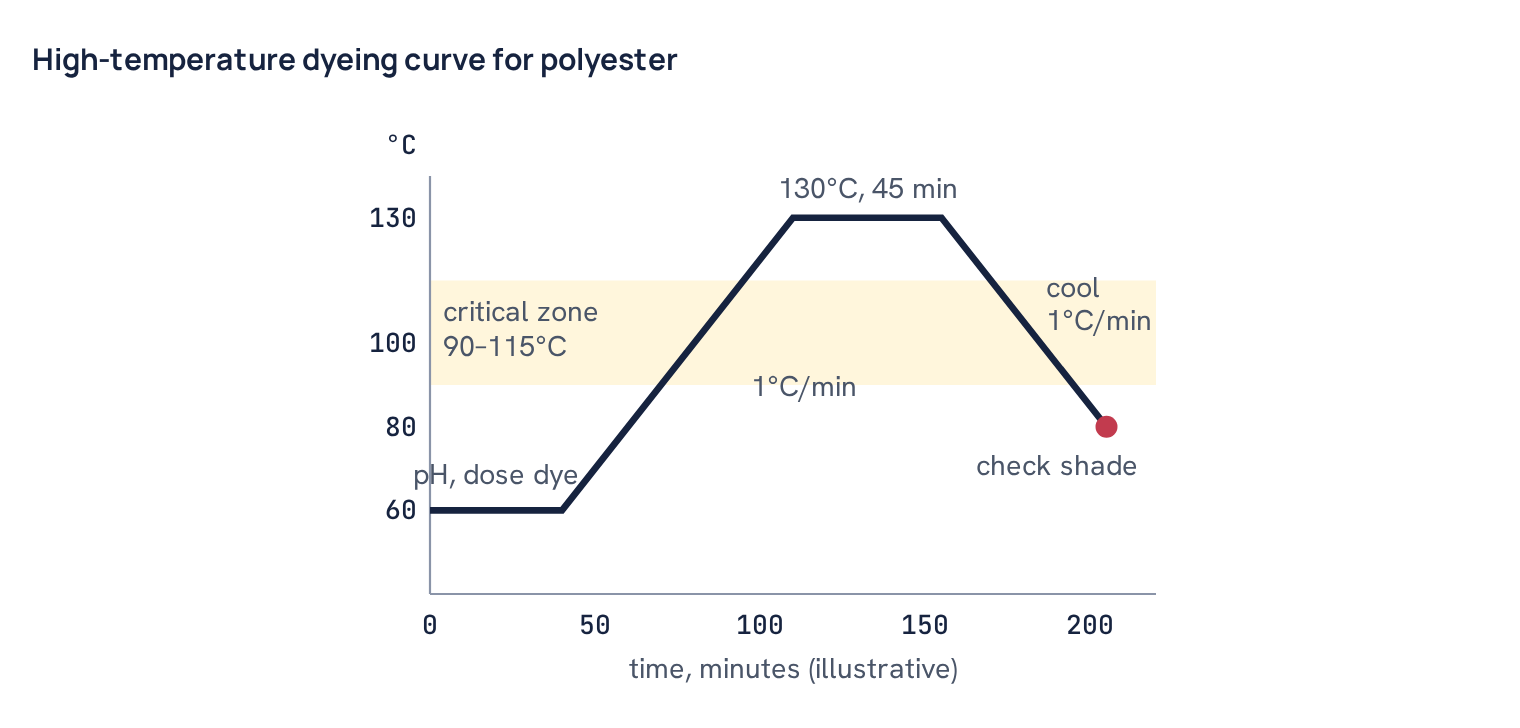
- On polyester we set the pH at 4.5, dose the dye over 30 minutes, heat at 1°C per minute to 130°C and hold 45 minutes, then cool at 1°C per minute to 78–80°C before checking the shade.
- Reduction clearing is a must on dark and medium shades; on polyester-elastane we do it on every shade.
- Fabric with polyester must be finished at 100–110°C, not at the 140–150°C used for cotton. Hotter than that and the dye bleeds and the fastness fails.
- Polyester fastness also depends on using high-fastness disperse dyes; low-quality disperse dyes give poor fastness.
Worked example. Suppose the bath starts at 60°C. Heating at 1°C per minute to 130°C takes 70 minutes. The hold adds 45 minutes. Cooling at 1°C per minute from 130°C to 80°C takes another 50 minutes. With 10 minutes for setting the bath and 30 minutes of dosing, the cycle from loading to shade check is about 3 hours and 25 minutes, before draining, rinsing and reduction clearing.
Heating rate and the critical zone
Look again at the uptake curve. Very little happens below about 90°C, and most of the dye goes on between roughly 90 and 115°C. This is the critical zone. If the temperature rises fast here, the dye rushes onto the parts of the fabric that see the most liquor first, and it is fixed in place before it can even out. The result is streaks, patchiness, or a lighter inside of a rope or package.
Common practice is to heat at about 1–2°C per minute overall and at 1°C per minute or less through the critical zone, especially for pale shades, compact fabrics and dyes with poor levelling. Faster rates can be used with good-levelling dyes, good circulation and an effective levelling agent. The hold at 130°C then gives migration time: dye moves from heavy areas to light ones and the shade evens out. High energy dyes migrate less, so with them the rate control matters even more.
Common mistake: heating too fast through 90–115°C to save time. Most of the dye goes on in that band, and a fast rise there gives an uneven, streaky shade that a longer hold at 130°C will not fully correct.
Levelling agents and dispersion stability
A levelling agent for polyester is usually a blend of non-ionic and anionic surfactants. It slightly increases the solubility of the dye in the bath and slows the initial strike, and it helps dye migrate during the hold. Too much of it holds dye in the bath and reduces the final depth, so the amount is kept to the recipe.
The dispersion must survive the whole cycle. At high temperature, some dispersants lose effectiveness, and particles can grow or stick together (agglomeration). Agglomerates are too big to dissolve quickly and get filtered onto the fabric. Causes include poor-quality dye, hard water, too much electrolyte, incompatible auxiliaries (for example a cationic product meeting an anionic dispersant), sudden temperature changes, and high shear in the pump. The typical faults are:
- Dye spots and specks. Small dark points, often visible on pale shades, from undissolved or agglomerated dye.
- Tarring. Sticky, tar-like deposits formed when dye agglomerates combine with oligomers, spinning oils or knitting oils. They show as dark, smeared spots and also foul the machine.
- Lighter inside of packages or beams. The tightly wound material filters the particles.
Good scouring before dyeing, a stable dispersing agent, soft water, correct dosing and a clean machine prevent most of these.
Oligomers: the white powder problem
PET always contains a small fraction of short chains, mostly a cyclic trimer (three repeat units joined in a ring). The amount is often quoted at around 1–3% of the fibre, depending on the polymer. At dyeing temperature, some oligomer migrates out of the fibre and dissolves or disperses in the hot bath. When the bath cools, it becomes less soluble and crystallises as a fine white powder. This powder deposits on the fabric surface, on yarn packages and inside the machine and heat exchanger.
On fabric, oligomer shows as a white dusting or a chalky look on dark shades, and it can cause problems in later processes. In the machine, it builds up as a hard white scale. This is why some dye houses drain the bath while it is still hot, sometimes above 100°C in machines built for it, so the oligomer leaves with the water before it can crystallise. Others cool first to avoid creases and use an oligomer dispersing agent instead. The best choice depends on the fabric, the machine and the shade, and practice varies. Regular machine cleaning with an alkaline cleaning cycle is usual where oligomers are a known issue.
Reduction clearing: what it does and when it is needed
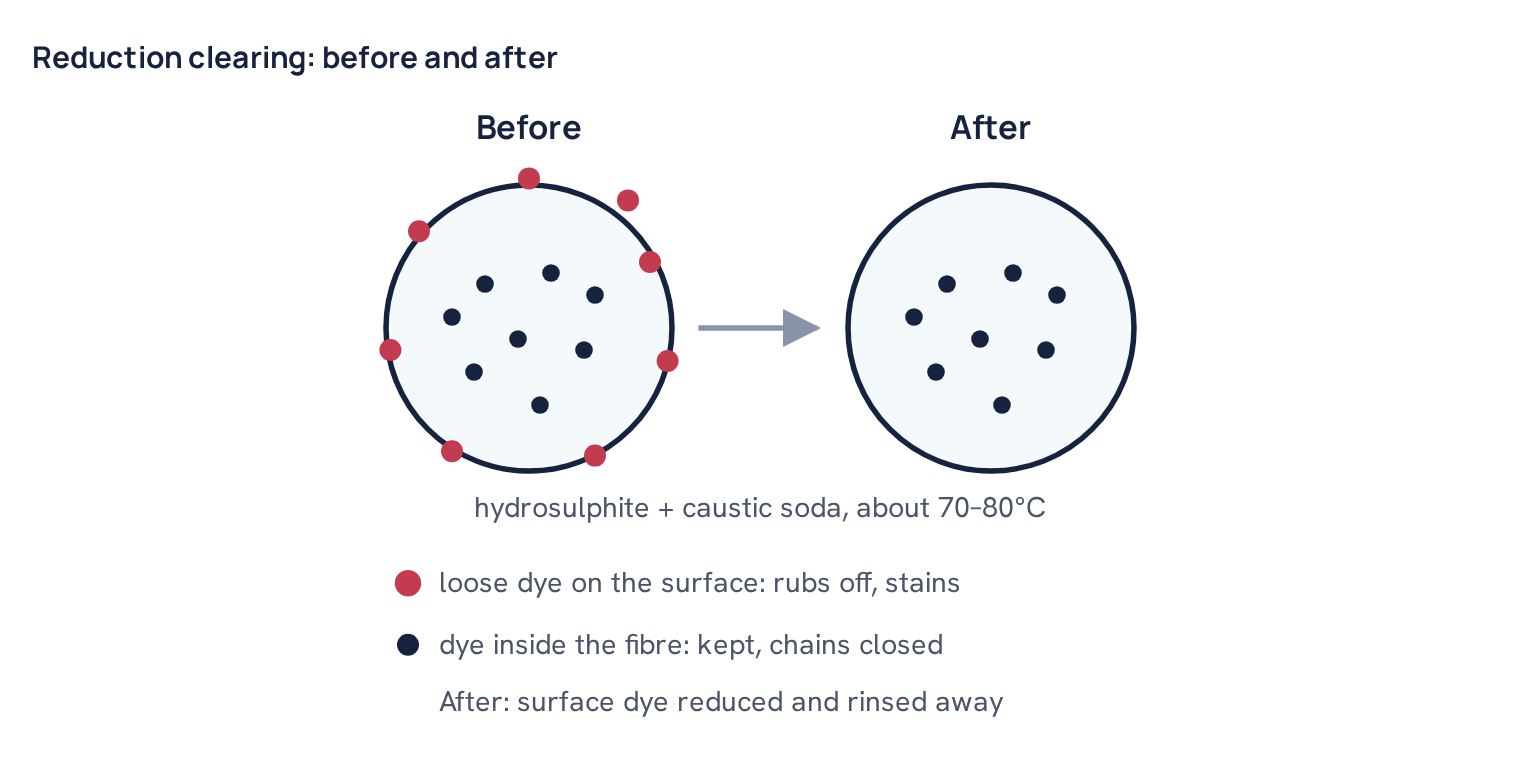
At the end of dyeing, some disperse dye is left loosely on the fibre surface instead of inside it. This surface dye has poor fastness. It rubs off, it transfers to other fabrics in washing, and it stains white fibres in the multifibre strip of a wash or perspiration test. Reduction clearing removes it.
In simple words: the fabric is treated in a bath of a reducing agent, usually sodium hydrosulphite, together with caustic soda, at around 70–80°C for 15–20 minutes. Typical amounts are about 1–3 g/L of each, depending on depth and practice. The reducing agent breaks the azo dye molecules (or reduces anthraquinone dyes) on the surface into small, colourless or nearly colourless, more water-soluble products that rinse away. Because the polyester has cooled below Tg, its chains are closed, so the dye inside is protected and the shade hardly changes. After clearing, the fabric is rinsed hot and then neutralised with a mild acid.
When is it needed? On medium and dark shades, nearly always. On pale shades, often a soaping or a hot rinse is enough. On blends where disperse dye has stained the second fibre, such as elastane, nylon or cotton, it is needed more often, because that stain is loosely held. There are also acid-side reduction clearing processes using reducing agents that work at acidic pH, which can save a bath change. Whatever method is used, the shade check should be done after clearing on critical colours, because some dyes shift slightly.
Thermomigration in heat setting and stenter finishing
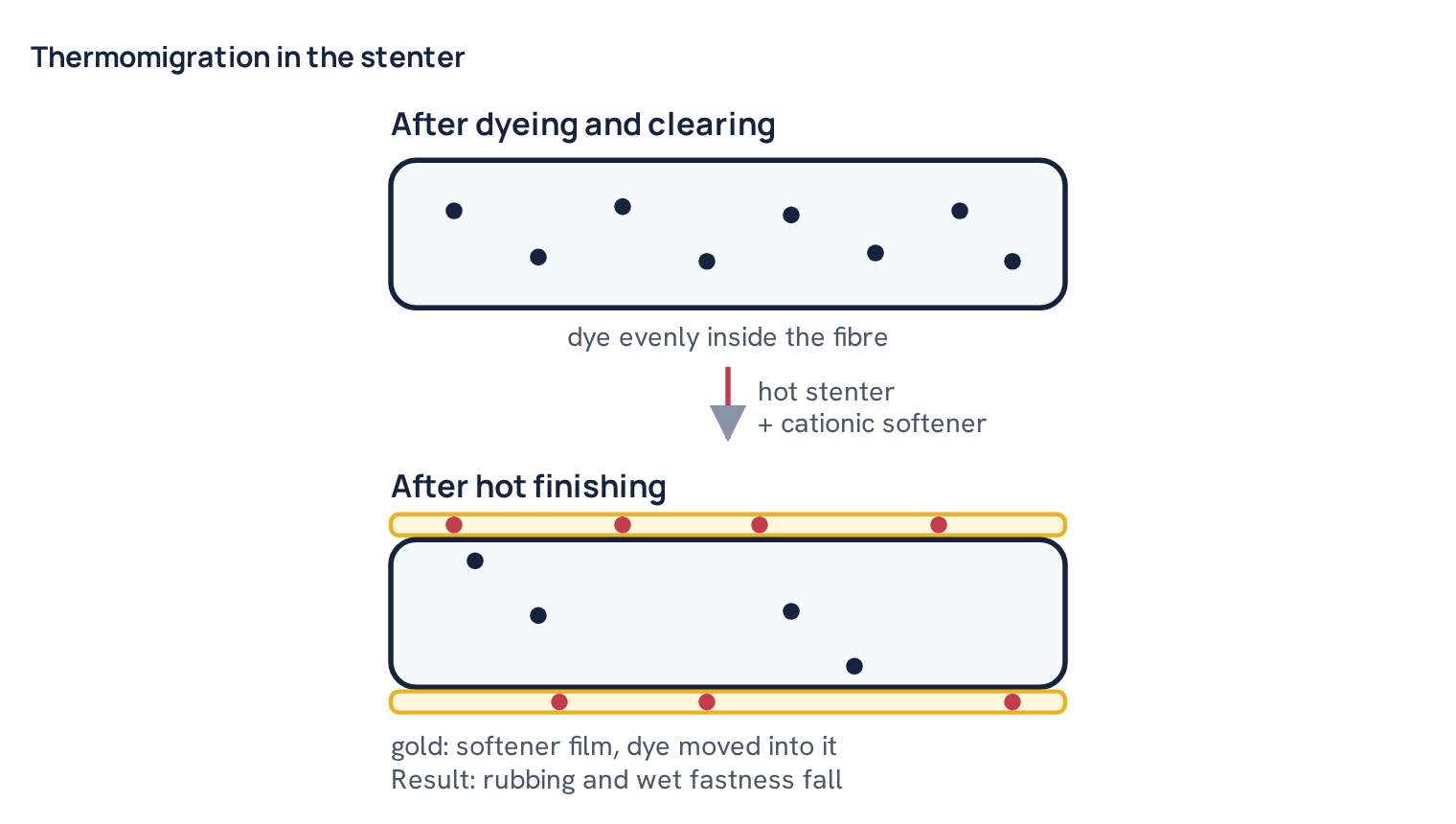
Because the dye is only dissolved in the fibre, heat can move it again. During drying, heat setting or curing on a stenter, the polyester goes above its Tg once more, and dye can diffuse outwards toward the fibre surface. This is thermomigration. It is different from sublimation, where dye leaves the fibre as vapour; in thermomigration the dye stays on the fabric but moves to the surface, where it has poor fastness again. Rubbing, wash fastness and staining can all fail, even though the dyeing and reduction clearing were correct.
Finishing chemicals make it worse. Many softeners, especially cationic and some non-ionic types, form a thin film on the fibre surface in which disperse dye dissolves well. At high temperature, the dye moves from the polyester into this film. Higher temperature, longer dwell time, deeper shades and lower energy dyes all increase the effect.
The usual defences are: finish polyester-containing fabric at the lowest temperature that does the job; choose softeners known to cause little migration; use medium or high energy dyes for shades that will be finished hot; and, where heat setting is needed, do it before dyeing (pre-setting) when the product allows. If the fabric must be heat set after dyeing, the dye selection has to be made for that from the start.
Disperse dye on elastane, nylon and cotton
Disperse dyes are not selective. They will go into any fibre that is hydrophobic enough and open enough, and they stain several fibres that are often blended with polyester.
- Elastane. Elastane (spandex) takes up disperse dye readily, but holds it only loosely. The stain bleeds in washing and perspiration tests and transfers to other fabrics. Elastane also loses power if it is held too long at very high temperature, so polyester-elastane is often dyed at a slightly lower top temperature, for example 120–125°C, with practice varying by elastane type. Thorough reduction clearing is the main defence. See polyester-elastane knit dyeing process.
- Nylon. Disperse dyes dye nylon easily, and level well on it, but their wet fastness on nylon is poor. In polyester-nylon blends, the nylon stain must be cleared, and nylon itself is dyed with acid dyes when it needs real fastness.
- Cotton. Disperse dye does not dye cotton, but it stains the cotton surface in polyester-cotton and CVC blends. Reduction clearing or a good soaping removes it before or after the cotton is dyed with reactive dyes. See CVC fabric dyeing process and dye classes: which dye for which fibre.
Dye quality and fastness
A correct process cannot make a weak dye fast. Disperse dyes differ widely in wash fastness, sublimation fastness, light fastness and thermomigration behaviour, and so do commercial products of the same chemistry, because of purity, particle size and dispersant quality. For export work with strict wash and perspiration tests, dye selection is as important as the cycle. Choose dyes with published data for the fastness you need, test them on your own fabric and finish, and keep recipe combinations within one energy group.
Common faults and their usual causes
| Fault | Likely cause | Prevention |
|---|---|---|
| Streaks, patchy or unlevel shade | Fast heating in 90–115°C, poor circulation, low-levelling dyes | Slow rate in critical zone, levelling agent, good liquor flow |
| Dark spots or specks | Agglomerated or undissolved dye, hard water, incompatible auxiliaries | Stable dispersant, soft water, correct dosing |
| Tar spots | Dye agglomerates with oligomer or oils | Good scouring, clean machine, dispersing agent |
| White powder or dusty look | Oligomer crystallised on cooling | Hot draining where possible, oligomer dispersant, machine cleaning |
| Poor rubbing or wash fastness | No or weak reduction clearing, low-quality dyes, thermomigration | Clear medium and dark shades, select dyes, finish cooler |
| Shade changes in the stenter | Thermomigration, sublimation, mixed energy recipes | Lower finishing temperature, matched dye energies |
| Weak or off shade | pH drifted up, alkali carried over, dye hydrolysis | Check pH through the cycle, rinse well before dyeing |
| Lot-to-lot depth difference | Different heat-setting history of the fabric | Keep heat setting consistent before dyeing |
| Crease marks | Fast cooling around Tg, overloaded machine | Controlled cooling, correct load |
Common mistake: finishing polyester and its blends at the same high stenter temperature used for cotton. The dyeing passes in the lab, then fails rubbing and staining after finishing because the dye has migrated to the surface.
If a finished polyester or blend fails staining, work backwards: was the shade reduction cleared, what were the stenter temperature and softener, and were the dyes suited to the fastness asked? A systematic approach is in knit fabric staining: wash, perspiration and water fastness fail.
Questions
Why is polyester dyed at 130°C?
Disperse dye only diffuses into polyester at a useful speed well above the fibre’s glass transition. At the boil it is too slow for medium and deep shades, so the bath is heated to about 130°C in a pressurised machine.
Why is the dye bath kept at pH 4.5–5.5?
Many disperse dyes change shade or lose strength in hot alkali, and hot alkali also attacks the polyester surface. A mildly acidic bath protects both the dye and the fibre.
What is reduction clearing?
A treatment after dyeing with sodium hydrosulphite and caustic soda, usually around 70–80°C, that destroys the loose disperse dye on the fibre surface. It improves rubbing and wash fastness without removing the dye inside the fibre.
What is thermomigration?
Disperse dye moving back to the fibre surface when the fabric is heated above its glass transition in finishing, often helped by softeners. It lowers rubbing and wet fastness, so polyester fabrics are finished at lower temperatures.
What are oligomers in polyester dyeing?
Short cyclic chains, mainly a cyclic trimer, that come out of the fibre at high temperature and crystallise as white powder when the bath cools. They cause white dusting on fabric and scale in machines.

Textile engineer with 14+ years in dyeing and fabric development. He writes every guide on Dyeing Solution from real production work. Full profile