Reactive, direct, vat, sulphur, azoic, disperse, acid, cationic and pigment: which fibres each one colours, what holds it in the fibre, the conditions it needs, the fastness to expect, and how blends are dyed with two classes.
At a glance
8 + pigmentMain dye classes covered
Fibre firstThe fibre decides the dye
2 bathsFor most polyester blends
PigmentNot a dye: needs a binder
A dye is chosen by the fibre, not by the colour. A buyer may ask for “navy”, but navy on cotton, navy on polyester and navy on nylon are three different dyeings with three different dye classes, three different recipes and three different fastness results. Each fibre has its own chemistry, and only certain dye classes can be held by it. So the first question for any order is the fibre content, and for a blend, which dye class each fibre needs.
This article explains the main dye classes one by one: which fibres they dye, what holds them in the fibre, the conditions they need, how fast they are, and where they are used today. It ends with how blends are dyed, how to choose a class, and the mistakes that cause most trouble.
How dyes are classified
There are two ways to group dyes, and it helps to keep them apart.
- By application class. This groups dyes by how they are applied and which fibre they suit: reactive, direct, vat, sulphur, azoic, disperse, acid and cationic. This is the grouping a dyer uses every day, and it is the one this article follows.
- By chemical structure. This groups dyes by the colour-giving part of the molecule (the chromophore): azo, anthraquinone, phthalocyanine, triarylmethane, indigoid and so on. A chemist uses this grouping. One structure can appear in several application classes; for example, azo chromophores are found in reactive, direct, acid and disperse dyes.
Colour Index generic names
The Colour Index is the international reference list of dyes and pigments. It gives each dye a generic name made of three parts: the application class, the hue and a number. “C.I. Reactive Red 195”, “C.I. Disperse Blue 79” and “C.I. Acid Yellow 49” are examples. The class tells you which fibre it is for, the hue tells you the colour family, and the number identifies the dye. Many companies may sell the same dye under different trade names, but the generic name stays the same, so it is the safest way to compare dyes from different suppliers. The Colour Index also gives a constitution number based on chemical structure, where the structure is published.
Fibre chemistry comes first
A dye stays in a fibre only if something holds it there. What can hold it depends on the chemical groups the fibre carries and on how open or closed its structure is in water.
Cellulose: hydroxyl groups
Cotton, viscose, modal, lyocell and linen are all cellulose. Their chains carry many hydroxyl (–OH) groups. In water these groups attract water, so the fibre swells and opens, and water-soluble dyes can enter. Under strong alkali some hydroxyl groups lose a proton and become reactive sites, which is what reactive dyes use. The long, flat cellulose chains can also hold long, flat dye molecules by hydrogen bonds and van der Waals attraction, which is how direct dyes work. In neutral water cellulose carries a slight negative surface charge, which is why salt is needed with anionic dyes.
Protein and polyamide: amine and carboxyl groups
Wool, silk and nylon carry amine groups and carboxyl groups. In acid, the amine groups take a proton and become positively charged (–NH₃⁺). These positive sites attract negatively charged acid dyes. Wool has many such sites. Nylon has far fewer, only at the ends of its chains, so it reaches saturation earlier and is more sensitive to small differences between yarn lots.
Polyester: no ionic sites, hydrophobic
Polyester has no charged groups and takes up almost no water. Its chains are tightly packed. Below its glass transition temperature (roughly 70–80°C in water, depending on the fibre) the structure is closed and almost nothing can enter. Above it, the chains start to move and small, non-ionic, water-insoluble molecules can slip in and dissolve in the fibre. That is the whole basis of disperse dyeing, and the reason polyester is dyed at high temperature.
Acrylic: anionic sites
Acrylic fibres are made with small amounts of comonomers that carry sulphonate or carboxylate groups. These are negative sites, and they attract positively charged cationic dyes. Cationic-dyeable polyester works the same way: a modified polyester with added anionic sites, so it can take cationic dye as well as disperse dye.
Which dye for which fibre
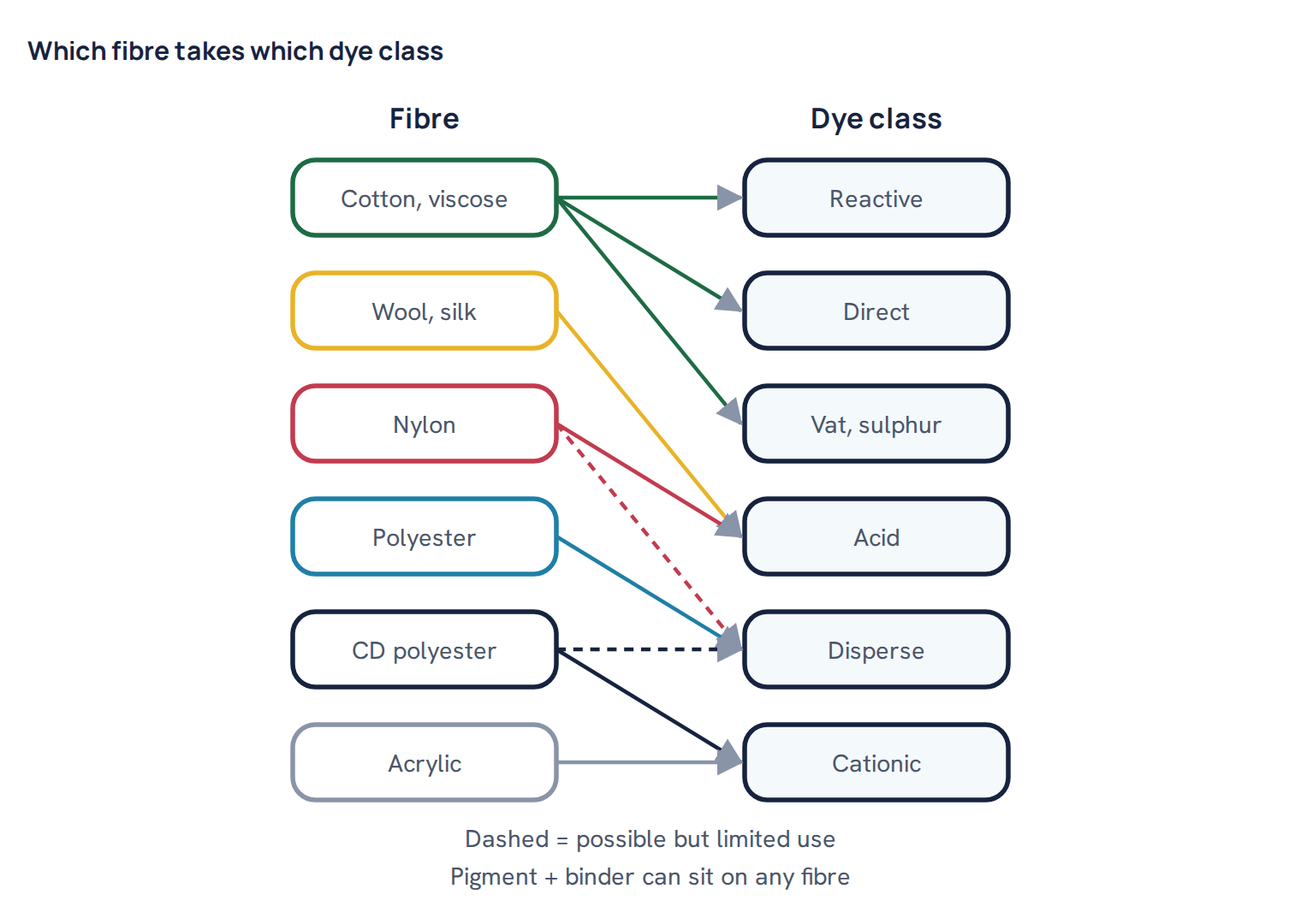
The table below is the short answer. The sections after it explain each class in more detail.
| Dye class | Fibres | Held by | Typical conditions | Fastness |
|---|---|---|---|---|
| Reactive | Cotton, viscose, modal, lyocell, linen | Covalent bond | Salt, then alkali (soda ash); often around 60°C, varies by dye type | Very good wash fastness; wet rubbing needs good wash-off |
| Disperse | Polyester, acetate; nylon for light shades | Solid solution in the fibre | pH 4.5, 130°C under pressure for polyester | Good, if reduction cleared and finished cool |
| Acid | Nylon, wool, silk | Ionic bond | Acid pH, up to 98°C | Good; better with a fixing after-treatment |
| Cationic (basic) | Acrylic, cationic-dyeable polyester | Ionic bond | Mild acid; about 110°C for CD polyester | Bright shades, good fastness on acrylic |
| Direct | Cotton and other cellulose | Hydrogen bonds and attraction | Salt, near the boil | Moderate wash fastness; cheap and simple |
| Vat | Cotton and other cellulose | Trapped insoluble pigment | Reduced with alkali and hydrosulphite, then oxidised | Excellent wash and light fastness |
| Sulphur | Cotton | Trapped insoluble pigment | Reduced, dyed, then oxidised | Good wash, poor chlorine; mostly black and dark shades |
How the dye is held
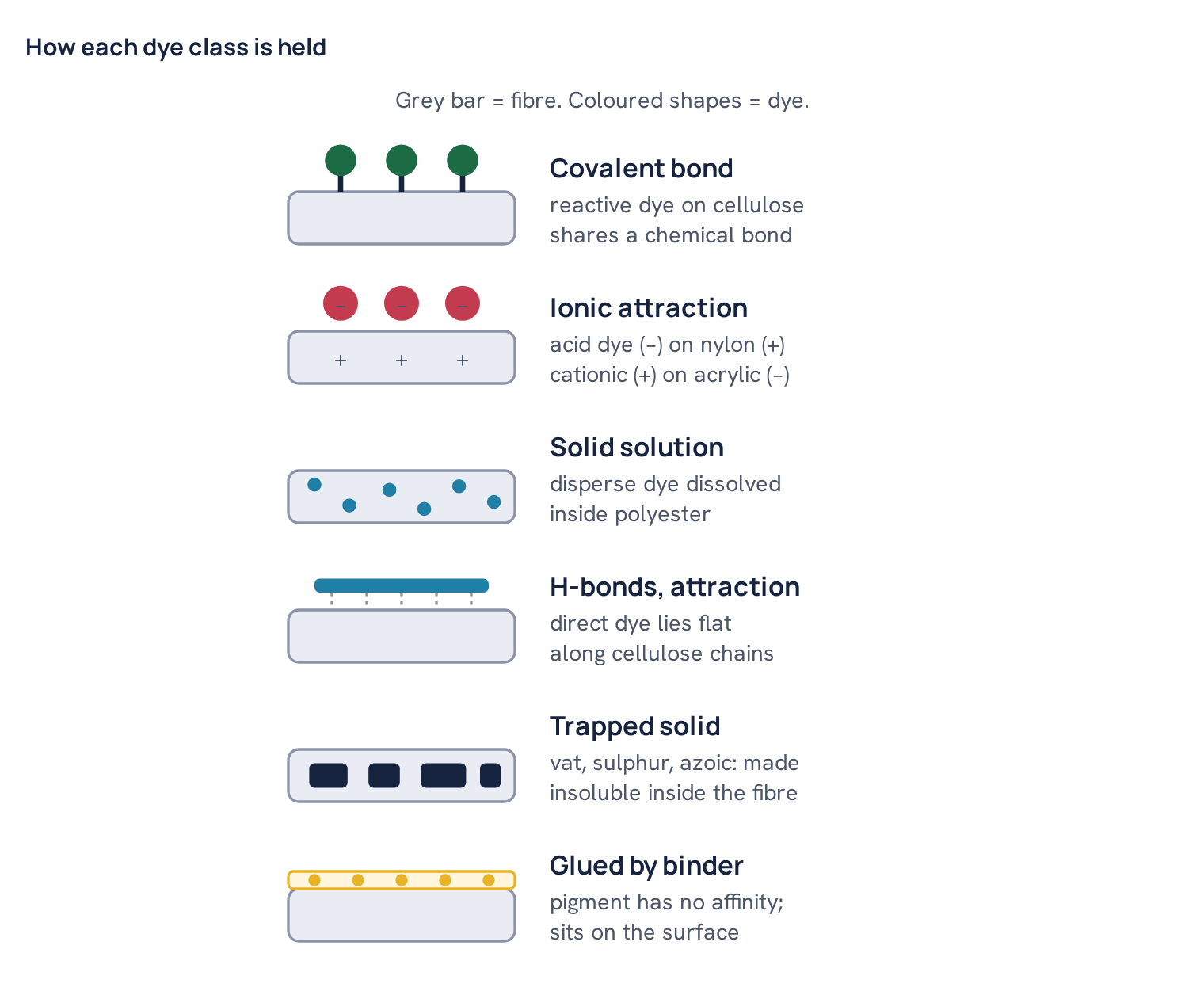
Each class is held by a different mechanism. This matters because the type of hold largely sets the wash fastness, and it also explains the process steps. A dye that bonds covalently needs an alkali to start the reaction. A dye held by ionic attraction needs the right pH to create charged sites. A dye that is trapped as an insoluble solid needs a reduce and oxidise cycle. For the general stages that all dyeing follows, see how dyeing works: transport, adsorption, diffusion and fixation.
The dye classes one by one
Reactive dyes
Fibres: cotton, viscose, modal, lyocell, linen and other cellulose. Special reactive dyes also exist for wool and nylon, but they are a small market.
How it is held: a reactive dye has a colour part, sulphonate groups for solubility, and a reactive group such as vinyl sulphone or monochlorotriazine. Under alkali the reactive group forms a covalent bond with an ionised hydroxyl group of the cellulose. This is a true chemical bond, which is why reactive dyes are so wash fast.
Conditions: salt first, to push the dye onto the fibre while it can still level; then alkali, usually soda ash, to start fixation. The temperature depends on the reactive group: some types fix at 30–40°C, many common types near 60°C, and others near 80°C. A thorough wash-off and soaping at the end removes dye that reacted with water (hydrolysed dye) instead of the fibre.
Strengths: a full colour range including bright shades, very good wash fastness, and flexible processes (exhaust, pad-batch, continuous). Weaknesses: part of the dye always hydrolyses and is lost, deep shades need much salt and much rinsing water, and poor wash-off gives weak wet rubbing fastness and bleeding. Reactive dyes are the main cellulose dye class today, used for most cotton knitwear, T-shirts, polos, towels and cotton fashion. More on the chemistry in how reactive dyes work.
Direct dyes
Fibres: cotton and other cellulose. How it is held: direct dyes are long, flat, anionic molecules. They line up along the cellulose chains and are held by hydrogen bonds and van der Waals attraction. There is no chemical bond, so the dye can come out again in washing.
Conditions: neutral bath, salt added in portions, dyeing near the boil. No alkali and no reaction step, so the process is short and simple. Fastness: wash fastness is moderate on its own and is often improved with a cationic fixing agent after dyeing. Light fastness varies a lot from dye to dye.
Strengths: cheap, simple, good for level dyeing. Weaknesses: limited wet fastness and duller shades than reactive. Today direct dyes are used where cost matters more than wet fastness: linings, some low-cost cellulose goods, paper and some viscose and cotton parts of blends.
Vat dyes
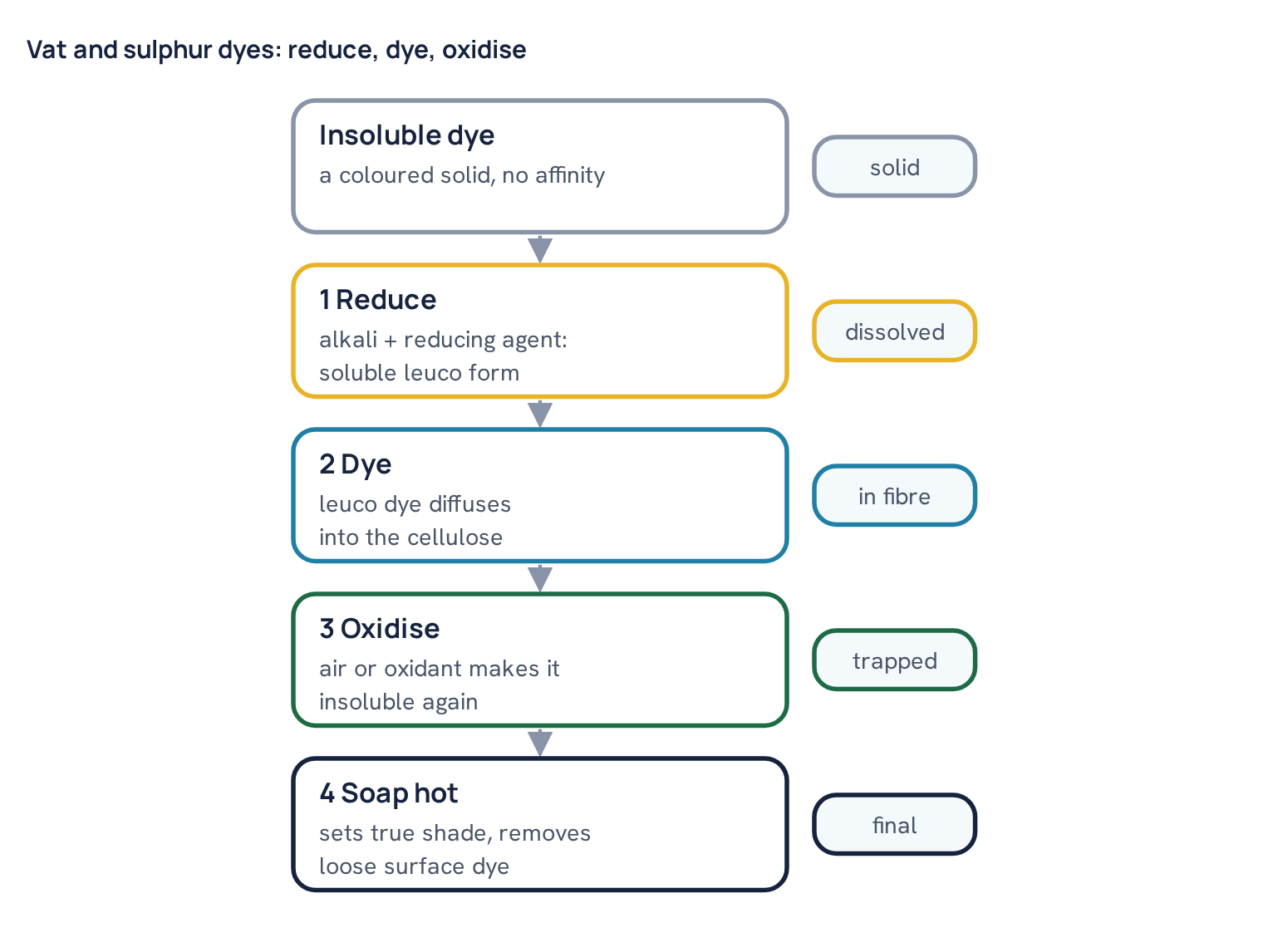
Fibres: cotton and other cellulose. How it is held: a vat dye is insoluble in water. It is reduced with caustic soda and sodium hydrosulphite to a soluble “leuco” form that has affinity for cellulose. After the leuco dye has entered the fibre, it is oxidised back to the insoluble form and stays trapped inside. A hot soaping at the end sets the final shade.
Fastness: excellent wash fastness, very good to excellent light fastness, and good fastness to chlorine and peroxide bleaching. Weaknesses: expensive, a complex process that needs careful control of reduction, and a limited range of bright shades. Rubbing can be weak in deep shades if the dye is not fully inside the fibre. Vat dyes are used where fastness matters most: workwear, uniforms, towels and hospital textiles that face chlorine, and some furnishing fabrics. Indigo, the dye of denim, is a vat dye, although it is applied in many short dips to build a surface (“ring”) dyeing.
Sulphur dyes
Fibres: mainly cotton. How it is held: like vat dyes, sulphur dyes are insoluble. They are reduced (traditionally with sodium sulphide, now often with less polluting reducing agents), dyed, then oxidised so they become insoluble again inside the fibre.
Fastness: good wash fastness, moderate to good light fastness, poor fastness to chlorine. Strengths: the cheapest way to dye deep blacks, navies and browns on cotton. Weaknesses: a dull, limited range; effluent needs care; and some sulphur blacks can slowly weaken cotton in storage if the fabric is not properly washed and buffered. Sulphur dyes are used today for black and dark denim, workwear, and low-cost black cotton goods.
Azoic dyes (naphthol dyes)
Azoic dyes are formed inside the fibre from two parts. The cotton is first treated with a naphthol (the coupling component) in alkali. It is then passed through a cold bath of a diazotised base. The two react in the fibre and form an insoluble azo pigment. Azoic dyes gave bright reds, oranges and bordeaux shades on cotton with good wash fastness, at a time when reactive dyes did not exist. The process is labour-heavy, needs cold conditions, and gives poor rubbing fastness if surface pigment is not soaped off. Some components are also restricted under modern chemical rules. Today azoic dyes are mostly historical and are rarely used in knit dyeing.
Disperse dyes
Fibres: polyester, acetate and triacetate; nylon for light shades only, because wet fastness on nylon is limited. How it is held: disperse dyes are small, non-ionic molecules with very low water solubility. They are applied as a fine dispersion with a dispersing agent. A tiny amount dissolves in the hot water, moves to the fibre and dissolves in the polyester. The fibre acts like a solvent: this is called a solid solution.
Conditions: polyester is usually dyed at pH 4.5–5.5 (acetic acid or an acid donor) and 130°C in a pressurised high-temperature machine. Acetate is dyed much lower, around 80–85°C, because it is damaged at high temperature. Continuous dyeing of woven polyester can use dry heat at about 190–220°C (thermosol). After dyeing, medium and deep shades are reduction cleared with sodium hydrosulphite and caustic soda to strip dye from the fibre surface.
Fastness: generally good to very good wash and light fastness once reduction cleared. A known risk is thermomigration: during heat-setting or finishing above about 150°C, dye can move to the fibre surface and lower wash and rubbing fastness. Strengths: the only practical class for regular polyester, wide shade range. Weaknesses: needs high-temperature equipment, and polyester blends need a second process for the other fibre. More in how disperse dyes work on polyester.
Acid dyes
Fibres: nylon, wool and silk. How it is held: acid dyes are anionic, carrying sulphonate groups. In acid the fibre’s amine groups become positive, and the dye is held by ionic attraction, helped by van der Waals forces. The bath is usually heated to 98°C or near the boil. There are three practical groups:
- Levelling acid dyes: small molecules dyed at strongly acid pH. They level and migrate very well, but their wet fastness is low.
- Milling acid dyes: larger molecules dyed at weakly acid pH. Better wash fastness, but harder to level, so the temperature rise and pH must be controlled.
- Metal-complex acid dyes: dye molecules complexed with a metal, usually chromium or cobalt. They give very good light and wash fastness, with somewhat duller shades. They are common for wool and for nylon that needs high light fastness, such as car interiors and swimwear.
Weaknesses: nylon has few dye sites, so deep shades can hit saturation, and yarn differences show as stripes (barré). Wet fastness in deep shades is often improved with a fixing after-treatment (a syntan). Acid dyes are the standard class for nylon sportswear, swimwear, lingerie, hosiery and wool. More in how acid dyes work on nylon.
Cationic (basic) dyes
Fibres: acrylic and cationic-dyeable polyester; also modified nylon types. How it is held: cationic dyes carry a positive charge and are held by ionic attraction to the anionic sites in the fibre.
Conditions: mildly acid bath (acetic acid), with a retarder to slow the strike. On acrylic, dyeing starts above the fibre’s glass transition point, roughly 75–85°C, and the temperature is raised slowly toward the boil, because once taken up the dye hardly migrates. Cationic-dyeable polyester is dyed at higher temperature, around 110°C.
Fastness and use: very bright, strong shades with good wash and light fastness on acrylic. On cotton, where early basic dyes were used, light and wash fastness were poor, and they are no longer used there. Weaknesses: level dyeing is hard, so control of the temperature rise and the retarder matters a lot, and acrylic has a fixed number of sites, so deep shades can saturate. Cationic dyes are used for acrylic knitwear, blankets, faux fur and for cationic-dyeable polyester in sportswear and two-tone effects.
Pigments: not dyes at all
A pigment is an insoluble coloured particle with no affinity for any fibre. It cannot enter the fibre on its own. It is fixed to the surface by a binder, usually an acrylic-type polymer, which is cured with heat to form a thin film. Because the hold does not depend on fibre chemistry, pigments work on any fibre and any blend. This is why pigment printing is the most common printing method on cotton and blends. Pigment dyeing of garments gives the popular washed, faded look. Weaknesses: rubbing fastness, especially wet, is the limiting factor; deep shades need more binder, which stiffens the handle. Light fastness is usually very good.
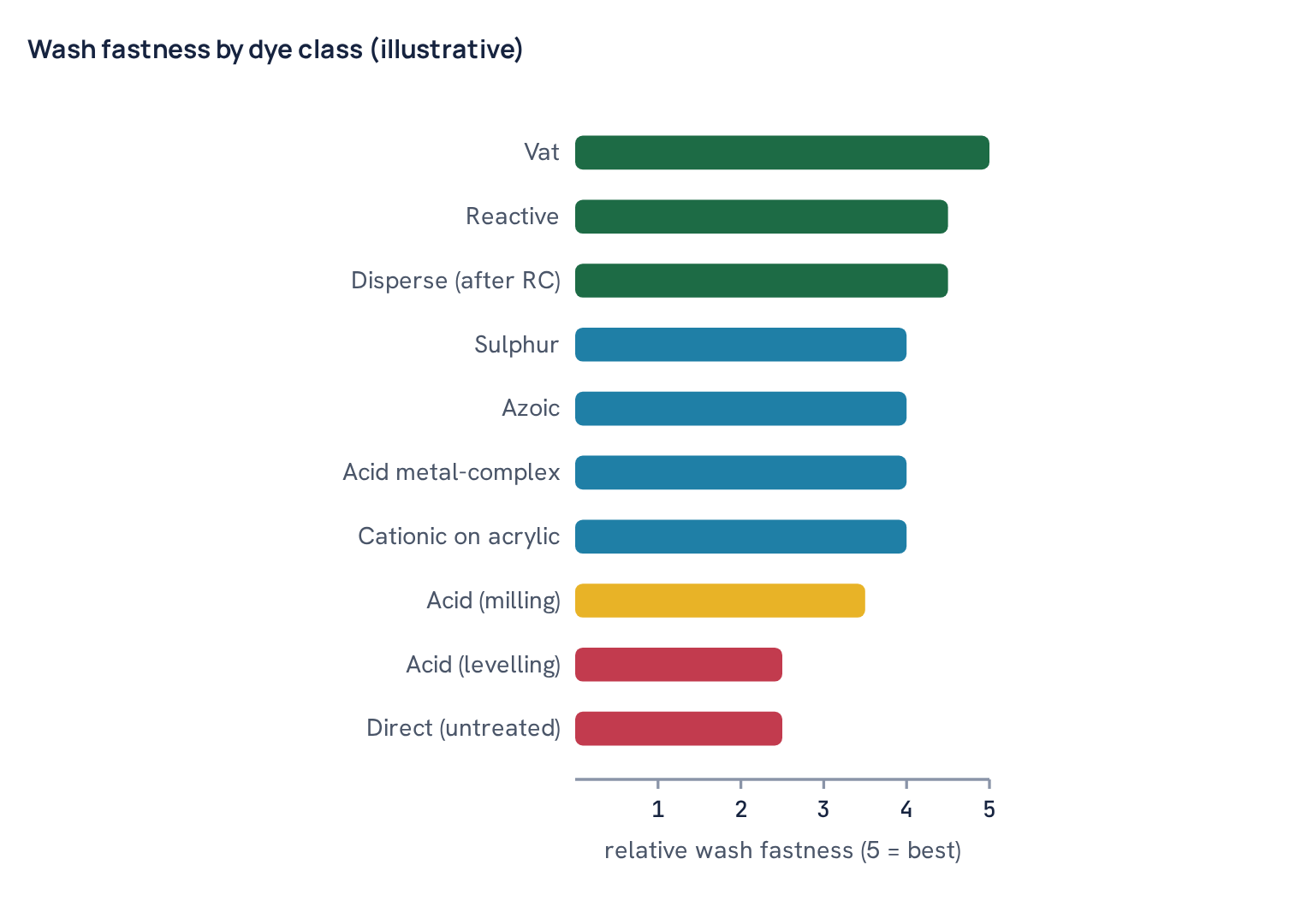
Fastness compared
The table gives relative ratings only. Real fastness depends on the specific dye, the depth of shade, the after-treatment and the test method, and some dyes in a weak class outperform some dyes in a strong one. Use it to understand the general pattern, not as test results.
| Dye class | Wash | Light | Rubbing | Cost and simplicity |
|---|---|---|---|---|
| Reactive | Very good | Good to very good | Good dry; wet depends on wash-off | Moderate cost; long process, much water |
| Direct | Moderate (better after fixing) | Variable | Good | Cheap and simple |
| Vat | Excellent | Very good to excellent | Moderate to good | Expensive; complex process |
| Sulphur | Good | Moderate to good | Moderate | Cheap for dark shades |
| Azoic | Good | Good | Often weak unless well soaped | Labour-heavy; little used now |
| Disperse on polyester | Good to very good after clearing | Good to very good | Good | Needs HT equipment |
| Acid on nylon | Moderate to good, by type | Moderate to very good, by type | Good | Simple; levelling needs care |
| Cationic on acrylic | Good | Good | Good | Simple, but level dyeing is hard |
| Pigment + binder | Moderate to good | Very good | Limiting factor | Simple; any fibre; stiffer handle |
Blends and two-bath dyeing
When a fabric mixes fibres that take different dyes, each fibre is dyed with its own class. One dye class cannot do the job: disperse dye leaves cotton almost uncoloured, and reactive dye barely touches polyester. Most blends are therefore dyed in two baths, one after the other.
| Blend | Dye classes | Order |
|---|---|---|
| Cotton-polyester (CVC, PC) | Disperse + reactive | Polyester first at 130°C, reduction clear, then cotton |
| Polyester-viscose (PV) | Disperse + reactive | Polyester first, reduction clear, then viscose at 60°C |
| Polyester-nylon | Disperse + acid | Polyester first, reduction clear, then nylon |
| Cotton-modal, cotton-viscose | Reactive only | One bath: both fibres are cellulose |
| Cotton-elastane, polyester-elastane | Same as the main fibre | Elastane mostly stays white unless it is a dyeable type |
For cotton-polyester and polyester-viscose, the polyester is dyed first. There are two reasons. First, the 130°C bath for polyester would damage or strip much of any reactive dye already on the cellulose. Second, disperse dye stains the cotton, and that stain must be removed by reduction clearing before the cellulose is dyed, or the final shade will be dull and fastness will suffer. Shade matching on a blend means matching two colours at once, so the polyester shade is checked after the first bath before the second dye is chosen. For full process routes, see the CVC fabric dyeing process and the polyester-viscose knit dyeing process.
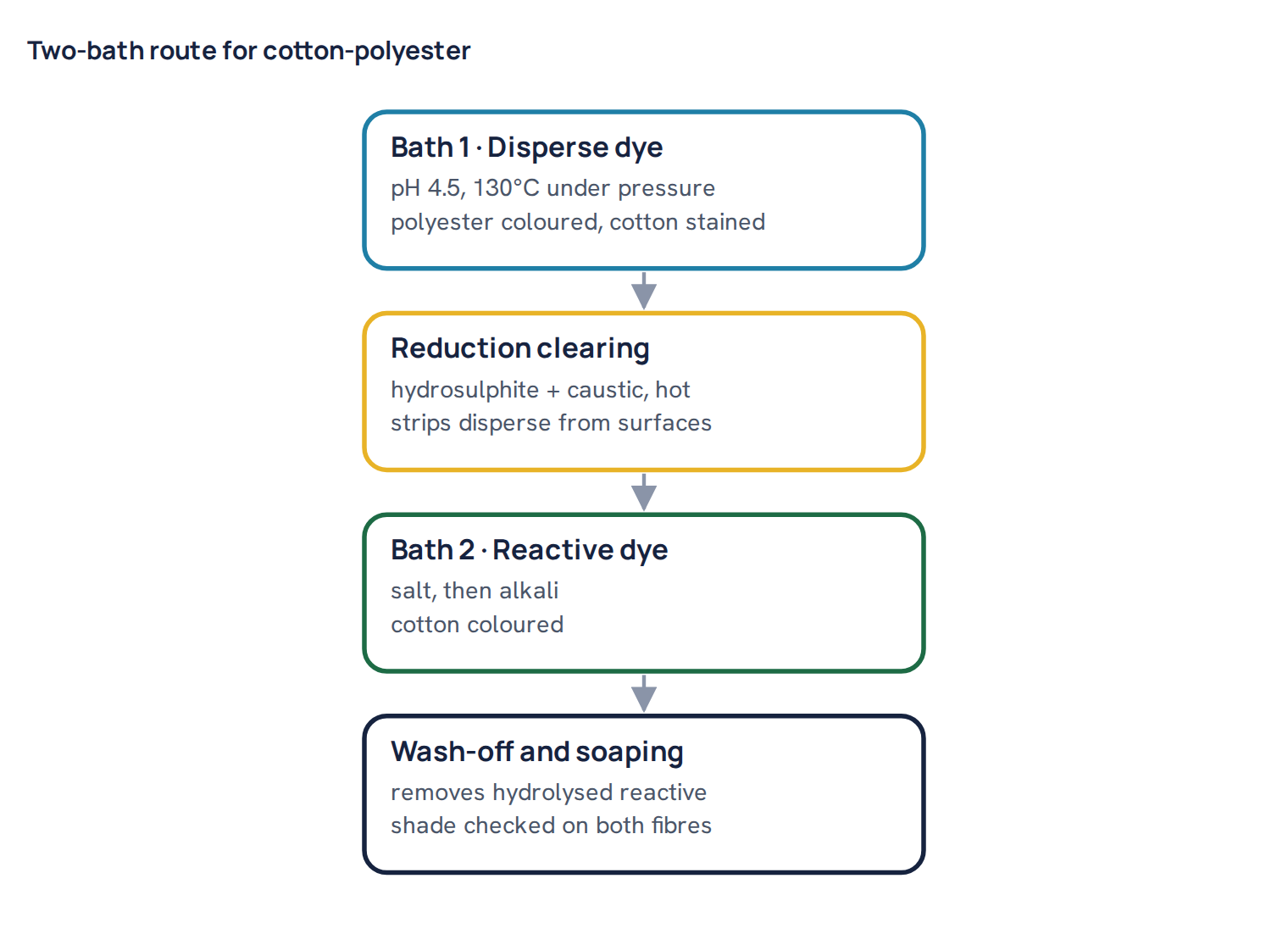
- Every dyeing starts from the fibre content. Polyester takes disperse dye, cotton, viscose and other cellulose take reactive dye, and nylon takes acid dye.
- In a blend, each part follows its own process: polyester first, then reduction clearing, then the cotton or viscose part.
- Cationic-dyeable polyester is dyed with cationic dye at 110°C.
- On polyester the dyebath pH is 4.5 and the dyeing temperature is 130°C.
One-bath methods for cotton-polyester exist, using dyes and auxiliaries chosen to survive together, and they save time and water. They need careful dye selection and are more limited in shade and fastness, so two-bath dyeing remains the safe standard for most knit blends. Blends of fibres from the same family are easier: cotton with modal or viscose is all cellulose and takes reactive dye in one bath, although each fibre may take up dye at a slightly different rate.
How to choose a dye class
Choosing a dye class is a narrowing process. Ask the questions in order.
- Fibre content. This decides which classes are possible at all. Polyester means disperse; nylon means acid; acrylic means cationic; cellulose leaves a choice between reactive, direct, vat and sulphur. In a blend, choose one class per fibre.
- End use. A towel faces many hot washes and perhaps chlorine. A swimsuit faces chlorinated water and sunlight. A fashion top may be worn a season. The end use tells you which fastness properties matter.
- Fastness needs. The buyer’s test standard sets the target: wash, light, rubbing, perspiration, chlorine. A chlorine requirement on cotton may point to vat dyes; a high light fastness need on nylon may point to metal-complex acid dyes.
- Cost. Count not only the dye price but also time, water, energy, salt, chemicals and effluent treatment. Sulphur black is cheap; vat colours are expensive; reactive sits between.
- Process available. A class is only useful if the plant can run it: high-temperature machines for polyester, reduction and oxidation control for vat and sulphur, enough wash-off capacity for deep reactive shades.
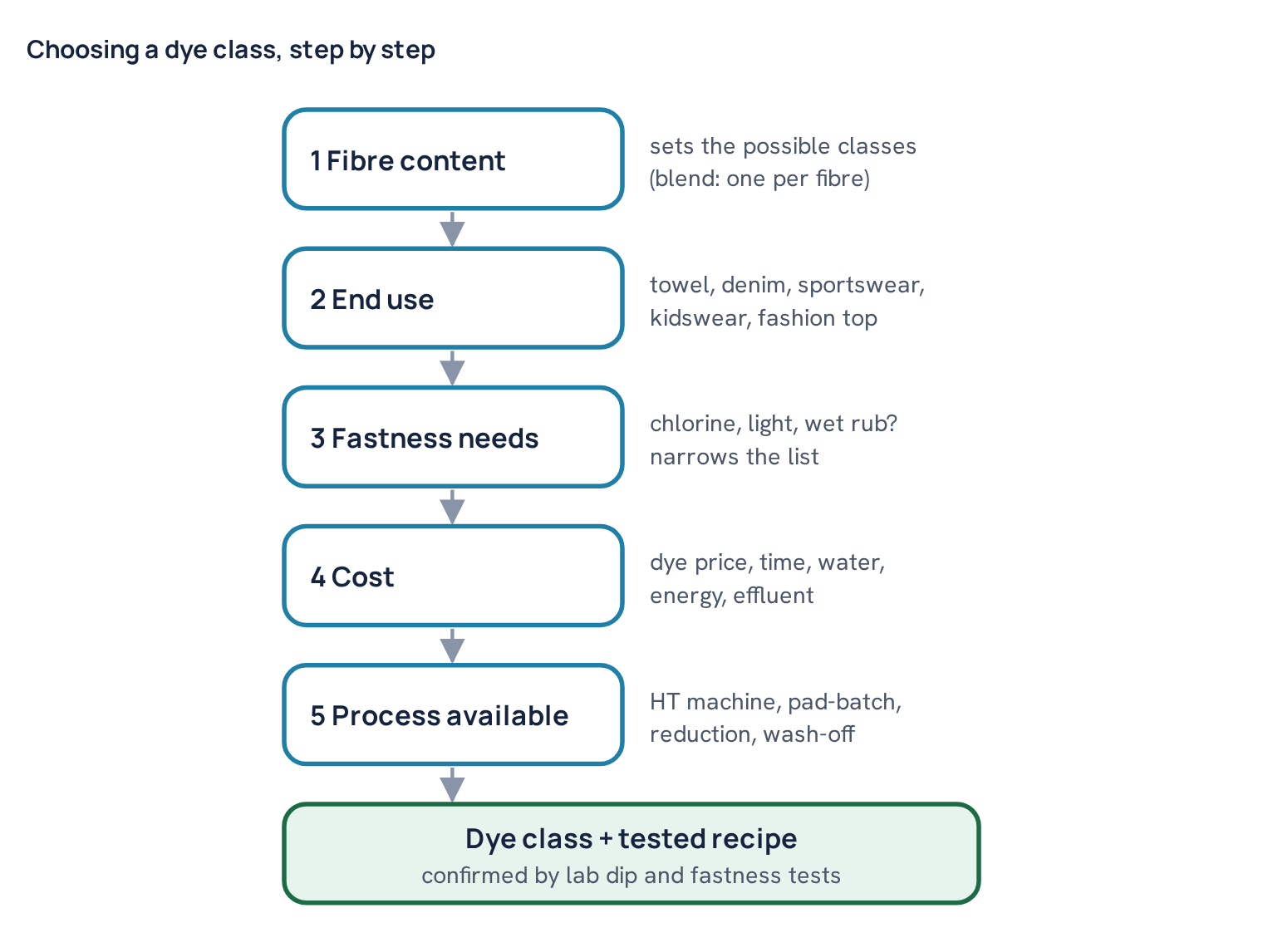
Worked example. An order is a 60% cotton, 40% polyester (CVC) jersey in navy for a school polo that must pass home washing. The fibres need disperse dye for the polyester and a cellulose dye for the cotton. Washing matters more than chlorine, so reactive dye is the natural choice for cotton. The route is disperse at 130°C, reduction clearing, then reactive, then a full wash-off. Both parts are matched to the same navy.
Common mistakes
Common mistake: assuming one dye will colour a blend. A cotton-polyester fabric dyed only with reactive dye will come out with pale, almost white polyester. In a heather or melange look this may even pass at first glance, then the customer sees “grinning” white fibres when the fabric stretches.
Common mistake: skipping reduction clearing on a blend or on deep polyester shades. Loose disperse dye on the surface gives poor wash and rubbing fastness and stains the cotton or the adjacent fabric in testing.
Common mistake: reading the fibre content from the order sheet instead of checking it. Undeclared elastane, a polyester content different from the label, or cationic-dyeable polyester treated as regular polyester all lead to wrong shades. A quick burn or solubility test on the fabric before dyeing can prevent this.
Common mistake: judging a dye by its colour, not its class. Two dyes of the same hue from different classes behave completely differently. Compare dyes by their Colour Index class and the fibre they are made for.
Common mistake: expecting the same fastness from every class. Direct dye will not match reactive wash fastness, and sulphur black will not pass a chlorine test. If the buyer’s requirement is fixed, the dye class must be chosen to meet it.
The fibre always comes first. Once you know what the fibre can hold, the dye class, the process and the fastness you can promise all follow from it. For full routes by fibre, see 100% cotton knit dyeing, 100% polyester knit dyeing and 100% nylon knit dyeing.
Questions
Which dye is used for cotton?
Mostly reactive dye, because it bonds chemically with cellulose and has very good wash fastness. Direct, vat and sulphur dyes also dye cotton for cheaper or specialist needs.
Which dye is used for polyester?
Disperse dye, usually at about 130°C under pressure. Cationic-dyeable polyester can also take cationic dye.
Why does a cotton-polyester blend need two dyes?
Polyester only takes disperse dye and cotton only takes cellulose dyes such as reactive. Each fibre is dyed with its own class, usually polyester first, then reduction clearing, then the cotton.
What does a name like C.I. Reactive Red 195 mean?
It is a Colour Index generic name: the application class (reactive), the hue (red) and a reference number. It identifies the dye regardless of the trade name it is sold under.
Is a pigment the same as a dye?
No. A pigment is an insoluble particle with no affinity for the fibre. It is held on the surface by a binder, so it works on any fibre but rubbing fastness is its weak point.

Textile engineer with 14+ years in dyeing and fabric development. He writes every guide on Dyeing Solution from real production work. Full profile