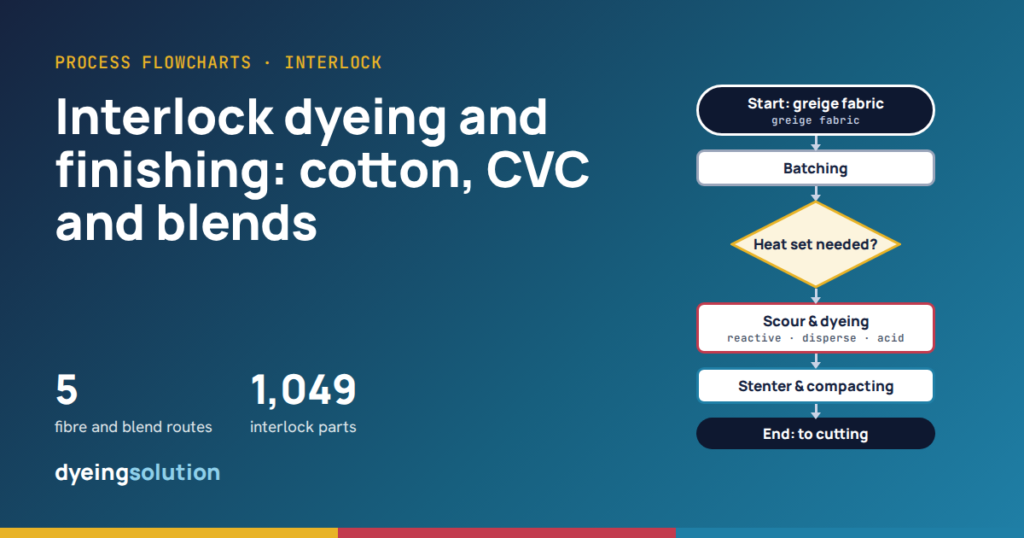
Interlock runs through dyeing almost exactly like single jersey, but it behaves like a different fabric: thicker, smoother on both faces, and far more stable. Here is the route for each fibre, from greige interlock to the cutting table, with what our records show.
At a glance
1,049Interlock parts in our records
62%Within GSM tolerance
2%Of cotton interlock heat set
6%Median length shrinkage
Interlock is a double knit: two rib fabrics knitted into each other, so both faces look like the face of single jersey. It is thicker and firmer than single jersey, it does not curl at the edges, and it barely twists. In our records 683 of 1,049 interlock parts are 100% cotton and 243 are CVC or PC. About one interlock part in seven is yarn-dyed. Yarn-dyed and mercerised interlock follow their own processes, which we cover in separate articles.
- Interlock and single jersey run almost the same process.
Interlock by fibre: what our records show
| Fibre or blend | Parts | Median required GSM | Within ±5% GSM | More than 5% light | Median length shrinkage | Median width shrinkage | Heat set |
|---|---|---|---|---|---|---|---|
| 100% cotton | 683 | 220 | 63% | 32% | 7% | 3% | 2% |
| CVC / PC | 243 | 200 | 63% | 29% | 4% | 2% | 47% |
| Cotton-elastane | 44 | 260 | 68% | 30% | 5% | 3% | 98% |
| Cotton + lyocell / modal | 26 | 200 | 56% | 16% | 8% | 3% | 12% |
| Polyester | 16 | 257 | 60% | 13% | 2% | 2% | 88% |
Interlock holds GSM much better than single jersey: 62% of parts finish within tolerance, against 41% for single jersey. Cotton interlock still shrinks 7% in length, more than cotton single jersey. CVC interlock shrinks 4%.
Before dyeing: heat setting and back sewing
A fabric that is not heat set is simply batched, turned inside out and loaded. A fabric that is heat set takes a longer road: after greige inspection it is batched, slit open, heat set in open width, and then sewn back into a tube (back sewing) so it can run in the dyeing machine. The seam is made so the face side ends up inside and the back side outside, the same protection that turning gives the other fabrics. Heat-set fabric is not turned at batching: it is already open, and the back sewing decides which side faces out.
When interlock is heat set
Heat setting is decided on the fibre content, elastane, GSM, construction, the width and stability requirement, and design. Interlock is stable by construction, so 100% cotton interlock is almost never heat set: only 2% of parts in our records, at a median 220 GSM. Cotton-elastane interlock always is, polyester interlock almost always, and CVC interlock about half the time, when its polyester part is dyed or it carries elastane.
- Cotton interlock is a stable double-knit structure, like rib, so it is almost never heat set.
- We heat set it when it is heavy GSM or has Lycra.
Enzyme, singeing and mercerising
Cotton interlock gets the normal enzyme for a clean, smooth face. When a fabric cannot take an enzyme but the buyer needs a clean face, it is singed instead, in open width after slitting (and after heat setting when it is heat set), once you have checked that the flame cannot damage it: polyester cannot be singed, and CVC only when the face is cotton yarn. In our records 18% of cotton interlock and more than half of cotton-lyocell interlock was singed: lyocell is very hairy, and cotton is hairy too. 12% of cotton interlock was mercerised, on the buyer’s requirement.
- Cotton-lyocell interlock we often singe, because lyocell is very hairy and cotton is hairy too. But not every time: it depends on the buyer requirement.
- Mercerising is done on the buyer requirement. Mercerised and yarn-dyed fabrics have their own processes.
The sequence before the dyeing machine
Every chart below follows the same sequence before dyeing. Steps a fabric does not need simply drop out; they are drawn dashed.
- Greige inspection, then batching. A fabric that stays a tube is turned inside out here.
- If it needs heat setting, singeing or mercerising: slitting first. None of these is ever done on a tube.
- If it needs heat setting: heat setting in open width.
- If it needs singeing: singeing in open width, after checking the flame cannot damage the fabric.
- If it is mercerised: mercerising, then drying.
- If the fabric was opened: back sewing, to make it a tube again with the face side inside (the loop side, for terry).
- Loading into the dyeing machine, then scouring, bleaching and dyeing, single part or double part as the fibre needs.
Flowcharts by fibre
- 100% cotton interlock
- CVC and PC interlock
- Cotton-elastane interlock
- Cotton-lyocell and cotton-modal interlock
- Polyester and polyester-elastane interlock
100% cotton interlock
Two-thirds of all interlock. A double-knit, so it is stable and smooth on both sides, and in our records it is almost never heat set. In our records: 683 parts, 63% within GSM tolerance, median length shrinkage 7%. Full process: 100% cotton dyeing process.
Dyeing and finishing: 100% cotton interlock
CVC and PC interlock
Two baths when the polyester part is dyed: disperse at 130°C first, then reactive for the cotton. In our records: 243 parts, 63% within GSM tolerance, median length shrinkage 4%. Full process: CVC / PC dyeing process.
Dyeing and finishing: CVC and PC interlock
Cotton-elastane interlock
Always heat set before dyeing, with a cooler 80°C scour to protect the elastane. In our records: 44 parts, 68% within GSM tolerance, median length shrinkage 5%. Full process: cotton-elastane dyeing process.
Dyeing and finishing: Cotton-elastane interlock
Cotton-lyocell and cotton-modal interlock
One reactive bath for both fibres. In our records more than half of it was singed. In our records: 26 parts, 56% within GSM tolerance, median length shrinkage 8%. Full process: cotton + modal / lyocell dyeing process.
Dyeing and finishing: Cotton-lyocell and cotton-modal interlock
Polyester and polyester-elastane interlock
Heat set, disperse dyeing at 130°C, reduction clearing on every shade, and a cool stenter. In our records: 16 parts, 60% within GSM tolerance, median length shrinkage 2%. Full process: polyester dyeing process.
Dyeing and finishing: Polyester and polyester-elastane interlock
Common faults and buyer complaints
Interlock has the same kinds of faults as other cotton fabrics. The ones buyers comment on most:
- Shrinkage, mainly on 100% cotton interlock (7% median in length).
- Hairiness on the face, which the enzyme or singeing has to clean.
- Shade variation. Both faces of interlock are cotton, and the stenter and compactor press the fabric and make the shade lighter, so the shade can vary between dyeing and finished fabric.
- Interlock gets the same kinds of faults as cotton fabric.
- Buyers sometimes complain about shrinkage, and sometimes comment on hairiness.
- Shade variation is high, because both faces of interlock are cotton. When we stenter and compact it, the shade goes much lighter, so there is some shade variation.

Textile engineer with 14+ years in dyeing and fabric development. He writes every guide on Dyeing Solution from real production work. Full profile