Plain polyester feels hot and sticky because it absorbs almost no sweat, but technical polyester knits stay cool during exercise by moving sweat outward. Why polyester feels hot, fashion vs sports polyester, polyester vs cotton and linen in heat, odour and staying cool.
At a glance
0.4%water uptake
Clammyfashion polyester
Wickingsports polyester
Nofabric softener
Ordinary polyester is not ideal for hot weather, but technical polyester can be. Polyester absorbs almost no moisture, so a plain polyester shirt or dress tends to trap heat and leave sweat sitting on your skin, which feels hot and sticky. Polyester sportswear is engineered differently: thin, open knits and specially shaped fibres pull sweat away from the skin and spread it so it evaporates fast. That is why polyester running tops feel fine in summer while a polyester office blouse can feel like a sauna.
This guide explains why polyester feels hot, whether polyester makes you sweat more, the difference between fashion polyester and technical polyester, how polyester compares with cotton, linen and rayon in heat, how to pick a polyester garment that stays cool, and how to deal with odour. It draws on how we dye and finish polyester knits, including the sportswear fabrics that are built to move moisture.
Why does polyester feel hot?
Several properties work together:
- Very low absorbency. Polyester’s moisture regain is about 0.4%, against about 8% for cotton and 13% for rayon. Sweat cannot soak into the fibre, so it stays on the skin or sits in the fabric surface.
- Dense, smooth fabrics. Many fashion polyesters, such as satin, crepe and chiffon-look fabrics, are made from fine filament yarns packed closely, which lets little air through.
- Clinging. A damp, smooth fabric sticks to the skin and cuts off airflow.
- Static. In dry, air-conditioned rooms polyester can build static and cling more.
The result is a garment that holds a warm, humid layer of air against your body. You do not actually produce more sweat because of polyester, but you feel it more because it cannot escape.
Does polyester make you sweat?
Not directly. Your body sweats in response to heat and effort. What polyester does is change what happens to that sweat. A cotton or rayon shirt absorbs it into the fibre; a plain polyester shirt does not, so the sweat stays on your skin and on the fabric surface. That feels wetter and stickier, and if the fabric is dense, the warm, damp air cannot leave, so you feel hotter and may sweat a little more as a result. Sweat marks can also show more on smooth polyester because the fabric does not spread the moisture into the fibre.
Fashion polyester vs technical polyester
| Point | Fashion polyester | Technical (sports) polyester |
|---|---|---|
| Typical fabrics | Satin, crepe, chiffon, dense woven | Light jersey, mesh, bird’s-eye and pique knits |
| Yarn | Smooth filament, closely packed | Fine or shaped filaments with channels |
| Finish | Softener, sometimes none | Moisture-moving (hydrophilic) finish |
| Feel in heat | Hot, clammy, clingy | Dry, light, fast-drying |
| Best use | Evening and office wear in air conditioning | Running, gym, outdoor work in heat |
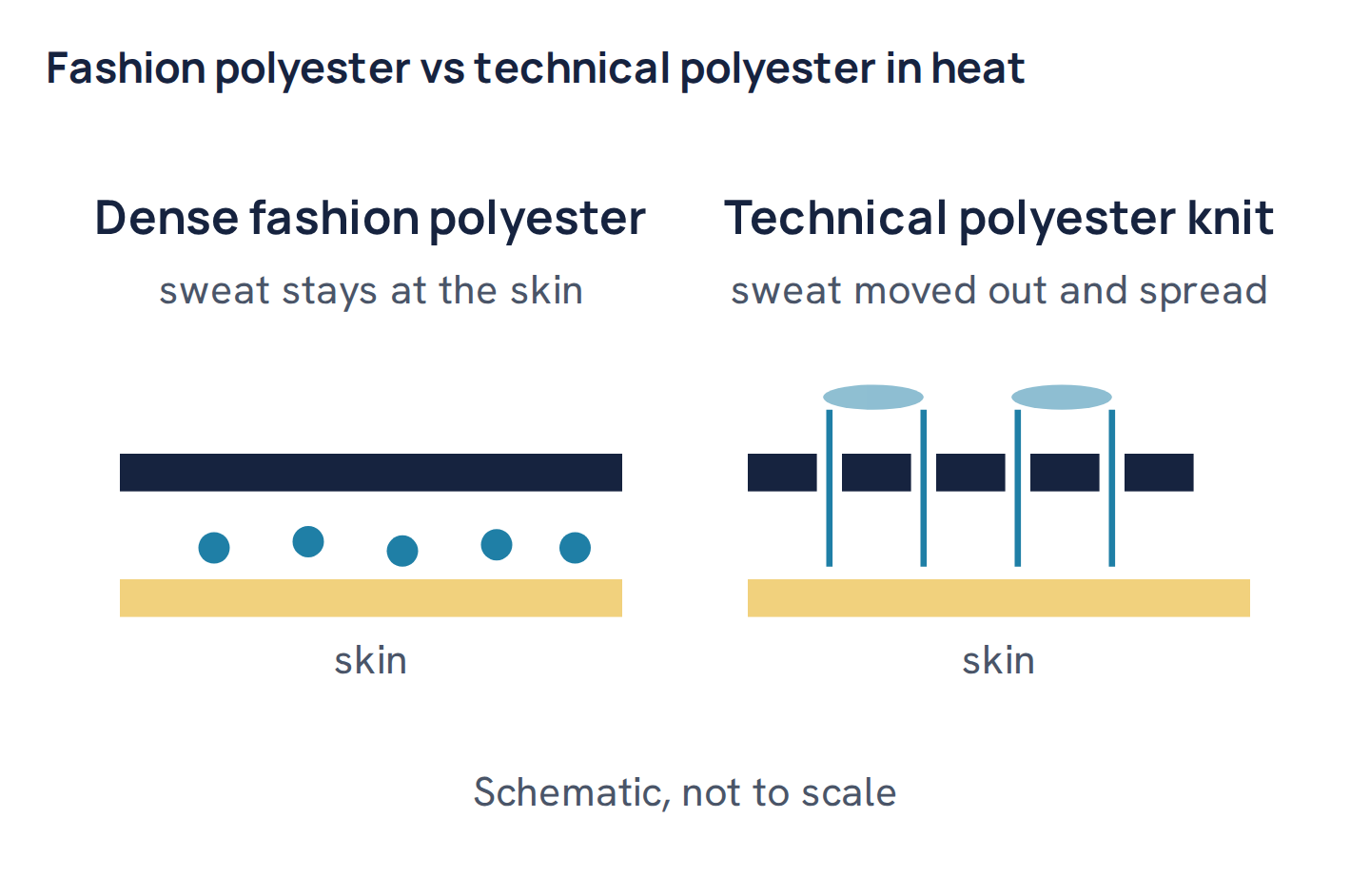
The fibre is the same; construction and finish make the difference. Technical polyester uses wicking: tiny gaps between fine filaments draw sweat along by capillary action, spreading it over a large area on the outside where it evaporates quickly.
Is polyester good for hot weather?
For exercise and active outdoor work, a technical polyester knit is one of the best choices: it dries in minutes, stays light, does not cling when wet and does not shrink. For sitting, walking around a city or office wear in heat without air conditioning, plain polyester is usually uncomfortable, and cotton, linen, rayon or modal feel cooler. Light colours, loose cuts and open weaves help any fabric.
Polyester vs cotton, linen and rayon in heat
| Fabric | Casual wear in heat | Exercise in heat | Drying speed |
|---|---|---|---|
| Linen | Excellent | Fair | Fast for a natural fibre |
| Cotton (light) | Very good | Poor when soaked | Slow |
| Rayon / modal | Very good, cool | Poor when soaked | Slow |
| Technical polyester | Fair to good | Excellent | Very fast |
| Plain fashion polyester | Poor | Poor | Fast, but clammy |
How polyester sportswear is finished to stay cool
In the dye house, polyester sportswear goes through the same disperse dyeing as other polyester, at about 130°C, followed by reduction clearing. The cooling performance is added at finishing. A hydrophilic finish is applied on the stenter so the fibre surface attracts water and spreads it, instead of letting it bead. The fabric is finished at moderate temperatures, around 100–110°C for polyester, because hotter finishing makes disperse dye migrate and fastness fail. Some fabrics also use special yarns with grooved cross-sections or mixed fine and coarse filaments that pull moisture outward. See the 100% polyester knit dyeing process.
Common mistake: using fabric softener on sports polyester. Softener coats the fibres with a water-repelling film that blocks the moisture-moving finish, so the shirt starts to feel hot and clammy like fashion polyester. Wash sportswear without softener.
Why polyester smells in hot weather
Polyester tends to hold body odour more than cotton. Oily compounds in sweat cling to the polyester surface, and the bacteria that break them down thrive in the warm, damp layer. The smell can survive a cool wash. To reduce it:
- Wash sportswear soon after use instead of leaving it in a bag.
- Turn it inside out and wash with a good detergent, without softener.
- Use a pre-soak with a little vinegar or a sports detergent for persistent odour.
- Air dry in sunlight and fresh air when possible.
- Choose sportswear with an odour-control finish if odour is a recurring problem.
How to stay cool in polyester
- Choose light, open knits or mesh rather than dense, smooth fabrics.
- Look for “moisture-wicking” or “quick-dry” on sportswear, and avoid softener.
- Wear loose fits that let air circulate.
- Pick light colours for sun exposure.
- Consider blends: polyester-cotton feels less clammy than pure polyester for casual wear; see what is poly cotton.
Does polyester shrink in the heat?
Normal summer heat does not affect it. Polyester barely shrinks in washing, a median 3% in length in our finishing records of polyester knits, because it absorbs little water and is heat set in the factory. Very high heat, such as a hot dryer, iron or car dashboard in direct sun, can shrink or distort it, and polyester melts if it gets too hot. See does polyester shrink.
Polyester in hot-weather workwear
Many uniforms for hot climates, such as polo shirts and hi-vis tops, use polyester or polyester-cotton because they dry quickly, keep their colour in strong sun, resist wrinkles and survive frequent washing. A breathable polyester pique or bird’s-eye knit with a moisture-moving finish can be comfortable for outdoor work. A dense woven polyester uniform shirt without such a finish is usually the least comfortable option in heat.
Worked example. On a 34°C humid day, a smooth polyester satin blouse at an outdoor lunch feels hot and sticky within minutes. A light polyester running tee with a wicking finish, worn for a run in the same heat, stays fairly dry and light. For the lunch, a linen or cotton voile blouse would have been the comfortable choice.
Polyester blends for warm weather
Blends can soften polyester’s weaknesses. A cotton-polyester T-shirt absorbs more sweat than pure polyester and feels less clammy, while drying faster than cotton and keeping its size better. A polyester-viscose blend drapes and breathes better than pure polyester for summer dresses and shirts. A polyester-linen blend gives some of linen’s coolness with fewer wrinkles. The higher the natural fibre share, the cooler the fabric usually feels in casual wear.
Does colour matter in hot weather?
Yes, outdoors. Dark colours absorb more sunlight and get hotter in direct sun; light colours reflect more. This applies to every fibre, but because plain polyester does not absorb sweat to cool you, a dark polyester garment in strong sun can feel especially hot. For outdoor heat, pick light colours in an open polyester knit, or a light natural fibre.
Summary
- Plain polyester feels hot because it absorbs almost no sweat and often comes in dense fabrics.
- Polyester does not make you sweat more, but you feel the sweat more.
- Technical polyester with open knits and wicking finishes stays cool during exercise.
- For casual heat, linen, cotton, rayon or modal feel cooler.
- Avoid softener on sportswear and wash it promptly to control odour.
Questions
Is polyester good for hot weather?
Technical polyester is good for exercise in heat because it dries fast. Plain fashion polyester feels hot and clammy for casual wear; cotton or linen feel cooler.
Does polyester make you sweat more?
Not directly, but it does not absorb sweat, so sweat stays on your skin and you feel hotter and stickier.
Why does polyester feel hot?
It absorbs almost no moisture and is often made into dense, smooth fabrics that let little air through and cling when damp.
Is polyester or cotton better in summer?
For casual wear, cotton. For running or heavy sweating, technical polyester, because it dries much faster.
Why does polyester smell after sweating?
Body oils cling to polyester and bacteria thrive in the warm, damp layer. Wash promptly, inside out, without softener.

Textile engineer with 14+ years in dyeing and fabric development. He writes every guide on Dyeing Solution from real production work. Full profile