
Socks pill because every step rubs them against your shoe and skin, and acrylic and polyester socks hold their pills on. Where socks pill, which materials pill most, cotton vs polyester socks, how to remove pills and how to wash socks so they stay smooth.
At a glance
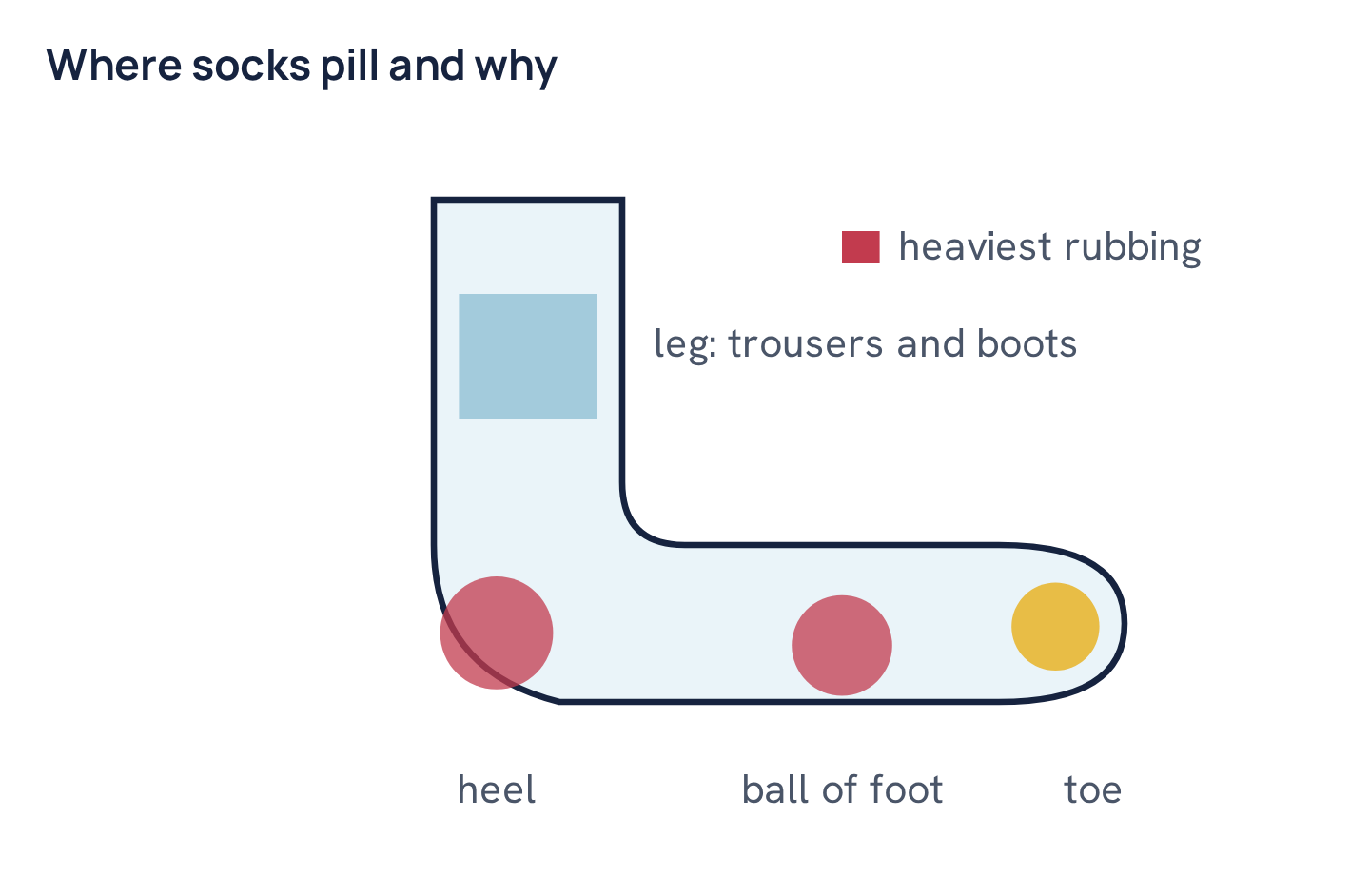
Heeland ball of foot
Acrylicpills worst
Inside outto wash
Shavenever pull
Socks pill because they take more rubbing than almost any other garment. Every step rubs the sock against your shoe and your skin, especially at the heel, ball of the foot and toes, and the soft, lightly twisted yarns used for comfortable socks release loose fibres that roll into pills. Socks with acrylic, polyester or nylon pill most visibly, because these strong fibres hold the pills on instead of letting them break away. Fibre, yarn, knit density, shoes and washing all change how quickly socks pill.
This guide explains why socks pill, where they pill and why, which sock materials pill most and least, cotton vs polyester and wool socks, how to remove pills, how to wash socks to keep them smooth, and what to look for when buying socks that last. It is written from the knitting and textile-testing side, where pilling is a standard check on knit fabrics.
Why do socks pill?
Pilling follows the same three steps on any knit: friction pulls loose fibre ends to the surface, the loose fibres tangle into small balls, and the balls either break off or stay anchored and grow. Socks go through this faster because:
- Constant friction: thousands of steps a day, with pressure from body weight.
- Soft, bulky yarns: comfortable sock yarns are often lightly twisted and fluffy.
- Terry cushioning: many socks have terry loops inside the foot for comfort, which add loose fibre.
- Blends with synthetics: nylon is added for strength, and acrylic or polyester for cost and softness; these fibres anchor the pills.
- Washing: socks are often washed hot, in heavy loads with jeans and towels, and tumble dried, which all add rubbing.
Which sock materials pill the most?
| Sock fibre | Pilling | Notes |
|---|---|---|
| Acrylic and acrylic blends | High, pills stay on | Soft and cheap, but short, loosely spun fibre anchored strongly |
| Polyester blends | High, pills stay on | Strong fibre holds pills |
| Cotton (with nylon and elastane) | Medium | Cotton pills tend to wear off; nylon reinforcement may hold some |
| Merino wool (with nylon) | Low to medium | Fine long fibres, good recovery; pills often fall away |
| Combed or mercerised cotton | Low | Long, smooth fibres, fewer loose ends |
| Nylon-rich dress socks | Low | Smooth filament yarns have few fibre ends |
The pattern is the same as for sweaters and fleece: soft, short, loosely held fibres create pills, and strong synthetic fibres keep them on. See why fleece and sweatpants pill.
Cotton vs polyester socks for pilling
Cotton socks usually look smoother over time, because cotton fibres are relatively weak and the pills break off and wash away. Polyester and acrylic socks often show tight, hard pills on the sole and heel that stay until shaved. On the other hand, synthetic socks dry faster and keep their shape and colour better. Many socks blend cotton for comfort, nylon for strength and a little elastane for fit, which is a good balance.
What our lab data says about pilling
In knit testing, fabrics are rubbed under controlled conditions and graded from 5 (no pilling) to 1 (very severe). In our 316 outside lab reports on knit developments, 266 included a pilling result and only 19 failed, but most fails were in soft, looped or brushed fabrics such as fleece and terry around 330 GSM tested at 2,000 Martindale rubs, where 9 of 16 failed. The terry cushioning inside many socks is a similar looped structure, which is one reason socks pill where they are cushioned. See how pilling tests work.
Do expensive socks pill less?
Often, but not because of the price itself. Better socks usually use longer-staple combed or mercerised cotton, fine merino, more twist in the yarn and a denser knit, with nylon reinforcement where it matters. These choices cost more and reduce pilling. A cheap sock made from short, loosely spun acrylic will almost always pill fast. Check the fibre content and feel the density rather than relying on the brand or price alone.
Why sports socks pill under the foot
Sports socks are designed with thick terry cushioning on the inside of the sole. Those loops add comfort but also loose fibre right where pressure and friction are highest. Running in shoes with a rough insole speeds this up. Pilling inside the sock is mostly a comfort issue: the pills can feel lumpy under the foot. Turning sports socks inside out to wash them and drying them on low heat helps the cushioning last.
Pilling vs thinning: when to replace socks
Pills are a surface problem; thinning is a structural one. If the heel or ball of the foot looks shiny, see-through or feels thin when stretched, the fibres are wearing away and a hole is coming. De-pilling at that stage removes even more material. Replace socks once the heel or sole has thinned, especially for sport, where thin socks cause blisters.
How sock makers reduce pilling
- Better yarn: combed, ring-spun or compact cotton yarns with fewer loose fibre ends.
- More twist: slightly more twisted yarns hold fibres in better.
- Denser knitting: finer gauge and tighter knitting leave less room for fibres to escape.
- Reinforced heels and toes: nylon added where wear is heaviest.
- Finishing: enzyme or singeing on cotton yarns, and anti-pill finishes.
- Mercerised cotton: treated cotton that is smoother and more lustrous; see what is mercerized cotton.
Common mistake: washing socks with jeans and towels on a hot cycle, then tumble drying them hot. The heavy, rough items rub the sock surface throughout the cycle, and the heat weakens the elastane, so the socks pill and lose their grip at the same time.
How to remove pills from socks
- Fabric shaver: quick and effective; stretch the sock over your hand or a flat object and shave lightly.
- Sweater comb or pumice stone: good for wool socks; stroke gently.
- Disposable razor: works on cotton and synthetic socks if used very lightly over a flat surface.
- Never pull pills off by hand; it drags more fibre out.
How to stop socks pilling
- Turn socks inside out before washing, so the outer surface rubs less.
- Wash at 30–40°C; hot water is rarely needed for socks.
- Wash with similar light items, not with jeans, towels or anything with zips.
- Use a mesh laundry bag for wool and fine socks.
- Air dry, or tumble on low heat.
- Rotate pairs so each pair rests between wears.
- Check shoes: rough insoles and worn heel linings speed up pilling.
Wool socks and pilling
Wool hiking and winter socks are usually knitted from merino or a wool blend with nylon. Fine merino fibres are relatively long and springy, so they pill less than many cheaper wools, and any pills tend to work loose. The bigger risk with wool socks is felting: washed hot and tumbled, they shrink and thicken. Wash wool socks inside out on a wool cycle at 30°C and dry them flat or on a low heat if the label allows.
Choosing socks that pill less
- Read the fibre content: combed cotton, mercerised cotton or merino with nylon pill less than acrylic-rich blends.
- Feel the knit: denser, smoother socks last longer than loose, fluffy ones.
- Look for reinforced heels and toes.
- For sport, choose socks designed for it, with dense cushioning and moisture-moving fibres.
Worked example. Two packs of grey socks: one 80% acrylic, 18% polyester, 2% elastane; the other 75% combed cotton, 23% nylon, 2% elastane. After two months of daily rotation and hot washing, the acrylic pair shows hard pills on the sole and heel; the cotton-nylon pair looks slightly worn but mostly smooth, because cotton pills fall away and the nylon is in smooth filament form. Washed cool and inside out, both would last longer.
Summary
- Socks pill because of constant friction against shoes and skin.
- Pills form at the heel, ball of the foot, toe and leg.
- Acrylic and polyester socks pill most and keep their pills; combed cotton and merino pill less.
- Remove pills with a shaver or comb, never by pulling.
- Wash inside out, cool, with soft items, and dry low.
Questions
Why do my socks pill?
Constant friction against shoes and skin pulls loose fibres out of the soft yarn and rolls them into pills, especially at the heel and ball of the foot.
Which socks pill the least?
Socks made from combed or mercerised cotton, or merino wool with nylon, in a dense knit, pill less than loose acrylic or polyester blends.
Do cotton socks pill?
Yes, but cotton pills tend to break off and wash away, so cotton socks usually look smoother than acrylic or polyester socks.
How do I remove pills from socks?
Use a fabric shaver, a sweater comb or a light disposable razor with the sock stretched over a flat surface. Do not pull pills off.
How do I stop socks pilling?
Wash them inside out at 30 to 40°C with soft items only, air dry or tumble low, and rotate pairs.

Textile engineer with 14+ years in dyeing and fabric development. He writes every guide on Dyeing Solution from real production work. Full profile