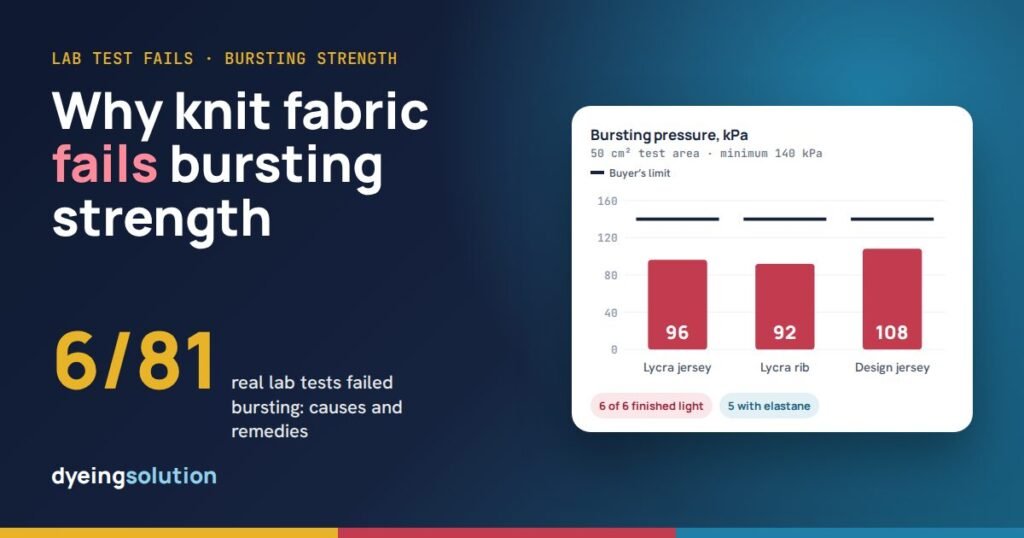
Over 95 new fabric developments, each one tested in the lab, bursting strength was tested 81 times and failed 6 times, every time on a stretch rib or a light single jersey. Here they are case by case: how each was knitted, dyed and finished, what the lab found, and the cause and remedy.
About this series. These findings come from 95 development batches: new and uncommon knit fabrics such as Lycra rib, Lycra single jersey, slub jersey and design jersey. Each batch was knitted, dyed and finished as a development sample, then tested by an accredited lab to the buyer’s standard. When a test failed, we found the actual cause on the floor and changed the next batch until it passed.
At a glance
6 of 81Reports failed bursting
6 of 6Finished under the required GSM
5 of 6Contained elastane
kPaCompare at the same test area
How the lab tests bursting strength
Bursting strength is the pressure a fabric takes before it bursts when pushed from below, the way a knee or elbow pushes a garment. In the pneumatic method (ISO 13938-2), the fabric is clamped over a flexible diaphragm and air pressure is raised until the fabric bursts. The result is the pressure at bursting, in kilopascals (kPa). ASTM D3786 is the hydraulic version, reported in psi.
The test area changes the number: a 7.3 cm² test area gives a much higher kPa than a 50 cm² area on the same fabric. So a minimum of 125 or 140 kPa (usual on 50 cm²) and 200 to 350 kPa (usual on 7.3 cm²) can mean a similar fabric. Always compare the result with the minimum for the same area.
Which fabrics fail
| Fabric | Failed |
|---|---|
| Finished more than 5% under the required GSM | 6 of 38 |
| Finished at or near the required GSM | 0 of 43 |
| With elastane | 5 of 22 |
| Without elastane | 1 of 59 |
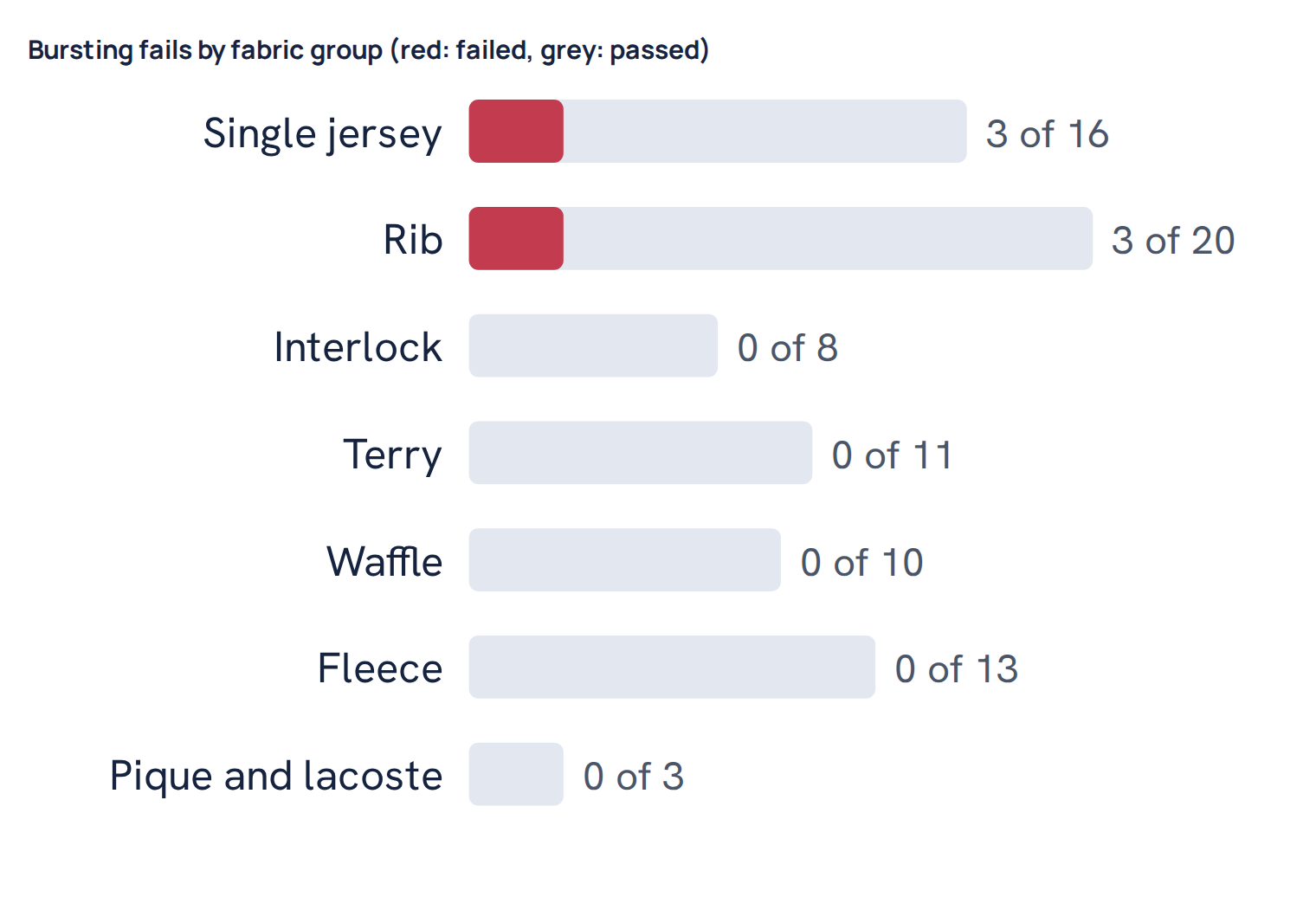
Every bursting fail in our records was a stretch rib or a single jersey, and every one was finished under its required GSM. Fleece, terry, interlock and waffle did not fail: they carry far more yarn per square centimetre.
How to read each case
Each case shows the fabric as it was knitted, the route it took through dyeing and finishing, the bursting pressure against the buyer’s minimum, and the cause and remedy.
Single jersey: 3 cases
Single jersey is dyed as a tube turned inside out unless it is heat set or singed; then it is slit, processed open width and back sewn before dyeing.
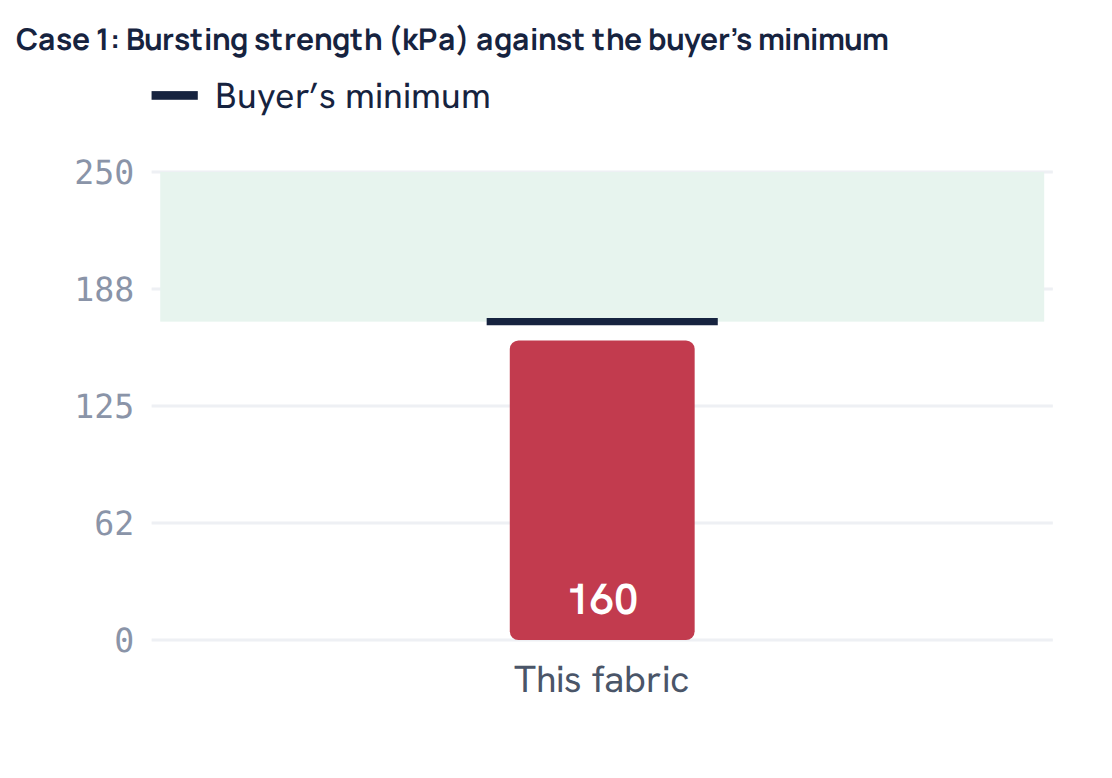
Case 1: Slub single jersey, 180 GSM, 160 against 170 kPa
- Yarn: 40/1 cotton + 22/1 cotton slub
- Fibre (declared): 100% Cotton
- Stitch length: 20.5+21
- Machine: 38″ × 20G
- Required: 180 cm, 180 GSM
- Finished: 150 cm, 146 GSM
Lab test: ISO 13938-2, 7.3 cm², as received
Route: Greige → Dyeing → Stenter → Compacting
Results
- Bursting strength: 160 kPa
- Minimum: 170 kPa
- Finished / required GSM: length 146, width 180
- Test area: 7.3 cm²
Other tests that failed in the same lab report: GSM.
Cause and remedy
Cause: The fabric burst at 160 kPa against a minimum of 170 kPa (-6%).
Cause: It was finished light: 146 GSM against 180 required (-19%). Less yarn in each square centimetre means less strength.
Cause: The ground yarn is a fine single count. Bursting depends on yarn strength, and a fine single yarn has little of it.
Cause: Slub yarn has thin, weak places between the slubs, and the fabric bursts at the weakest one.
Remedy: Reach the required GSM. The closer the fabric is to its GSM, the better the bursting strength.
Remedy: Use a stronger yarn: a coarser count or a ply yarn in the ground.
Remedy: Do not over-treat with enzyme: excess enzyme weakens cotton and can leave holes.
Remedy: Keep the dyeing time normal. A long or repeated dyeing cycle (re-dyeing, extra additions) weakens the yarn, so get the shade right the first time.
Remedy: Do not knit it loose: a loose knit fabric bursts at a lower pressure.
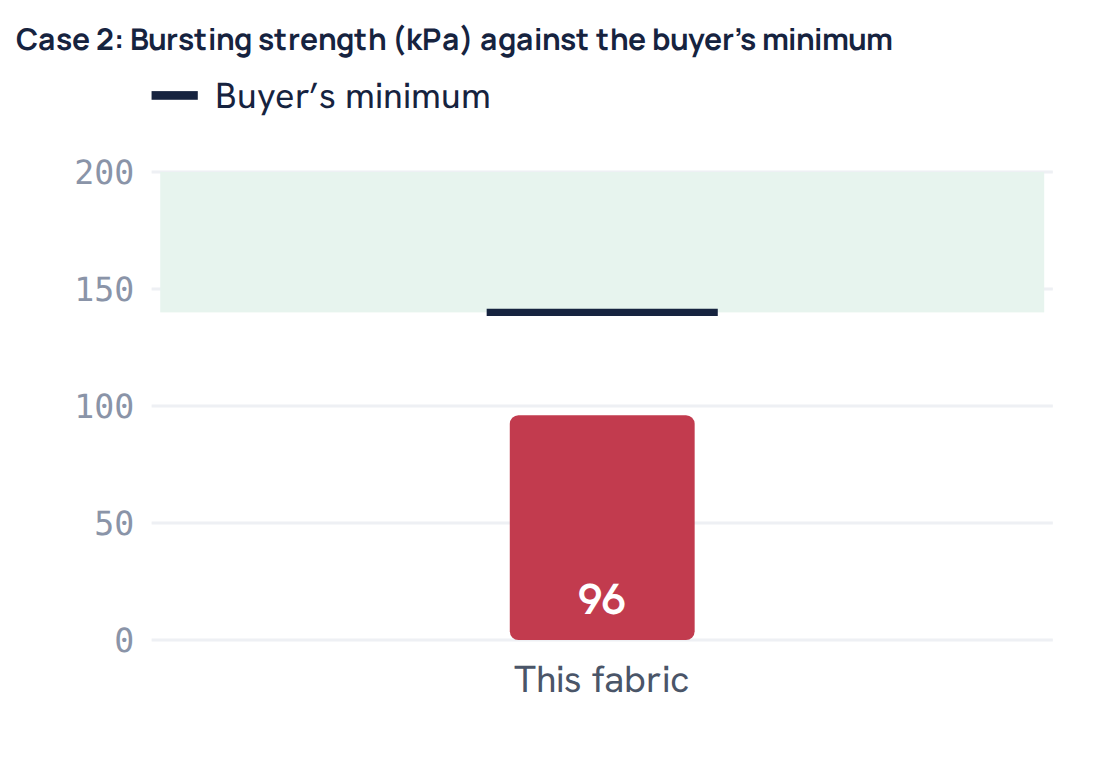
Case 2: Lycra single jersey, 180 GSM, 96 against 140 kPa
- Yarn: 34/1 organic cotton + 30D Lycra
- Fibre (declared): 93% Cotton 7% Elastane
- Stitch length: 29
- Machine: 30″ × 28G
- Required: 180 cm, 180 GSM
- Finished: 180 cm, 168 GSM
Lab test: ISO 13938-2, 50 cm², as received
Route: Greige → Slitting → Heat setting → Singeing → Back sewing → Dyeing → Stenter → Compacting
Results
- Bursting strength: 96 kPa
- Minimum: 140 kPa
- Finished / required GSM: length 168, width 180
- Test area: 50 cm²
Other tests that failed in the same lab report: Shrinkage, GSM.
Cause and remedy
Cause: The fabric burst at 96 kPa against a minimum of 140 kPa (-31%).
Cause: It was finished light: 168 GSM against 180 required (-7%). Less yarn in each square centimetre means less strength.
Cause: Cotton is knitted together with a filament (elastane or polyester). In a combination like this the two yarns do not share the load evenly: the cotton takes it at full stretch and breaks first.
Cause: It was singed. If the flame is too strong or the fabric runs too slowly, the fibres are scorched and the fabric loses strength.
Remedy: Reach the required GSM. The closer the fabric is to its GSM, the better the bursting strength.
Remedy: Singe at the right flame and speed so the fabric is never scorched.
Remedy: Do not over-treat with enzyme: excess enzyme weakens cotton and can leave holes.
Remedy: Keep the dyeing time normal. A long or repeated dyeing cycle (re-dyeing, extra additions) weakens the yarn, so get the shade right the first time.
Remedy: Do not knit it loose: a loose knit fabric bursts at a lower pressure.
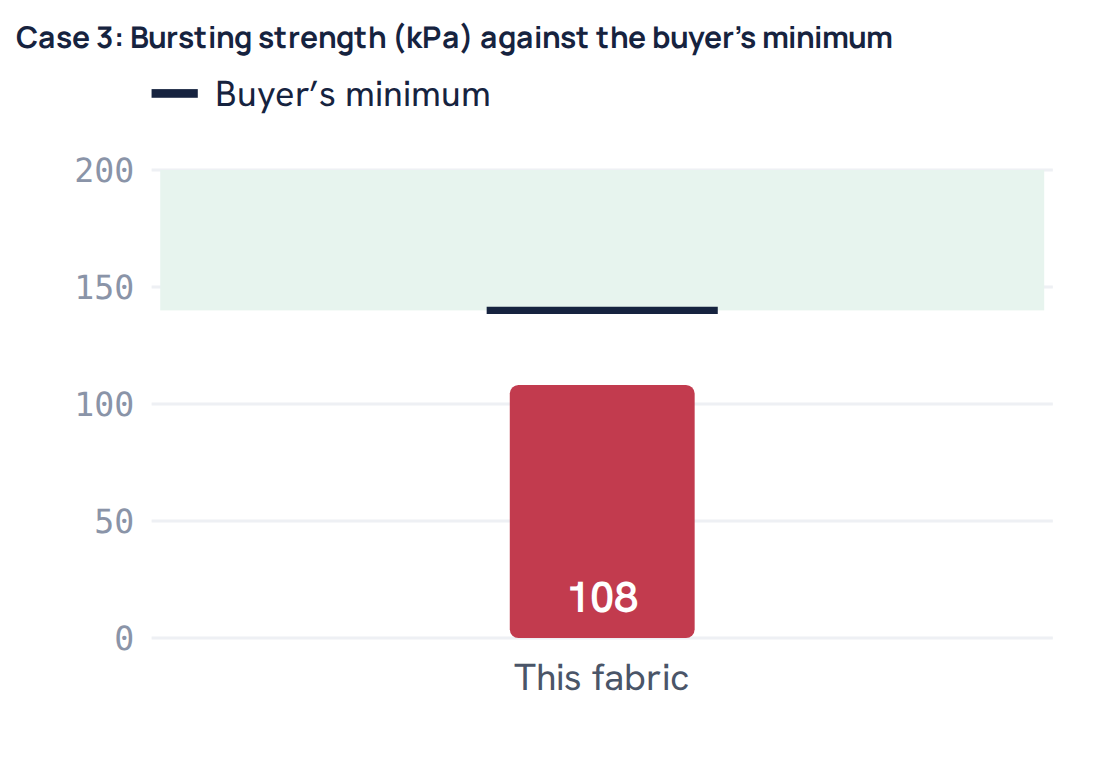
Case 3: Lycra design single jersey, 260 GSM, 108 against 140 kPa
- Yarn: 30/1 organic cotton + 75D air-covered
- Fibre (declared): 86% Org Cotton 12% Recy Polyester 2% Elastane
- Stitch length: 26+16
- Machine: 34″ × 24G
- Required: 110 cm, 260 GSM
- Finished: 120 cm, 215 GSM
Lab test: ISO 13938-2, 50 cm², as received
Route: Greige → Slitting → Heat setting → Back sewing → Dyeing → Stenter → Compacting
Results
- Bursting strength: 108 kPa
- Minimum: 140 kPa
- Finished / required GSM: length 215, width 260
- Test area: 50 cm²
Other tests that failed in the same lab report: none.
Cause and remedy
Cause: The fabric burst at 108 kPa against a minimum of 140 kPa (-23%).
Cause: It was finished light: 215 GSM against 260 required (-17%). Less yarn in each square centimetre means less strength.
Cause: Cotton is knitted together with a filament (elastane or polyester). In a combination like this the two yarns do not share the load evenly: the cotton takes it at full stretch and breaks first.
Remedy: Reach the required GSM. The closer the fabric is to its GSM, the better the bursting strength.
Remedy: Do not over-treat with enzyme: excess enzyme weakens cotton and can leave holes.
Remedy: Keep the dyeing time normal. A long or repeated dyeing cycle (re-dyeing, extra additions) weakens the yarn, so get the shade right the first time.
Remedy: Do not knit it loose: a loose knit fabric bursts at a lower pressure.
Rib: 3 cases
Rib is a stable double knit. It is heat set only when heavy, tight, Lycra body rib or a design rib that needs its width fixed.
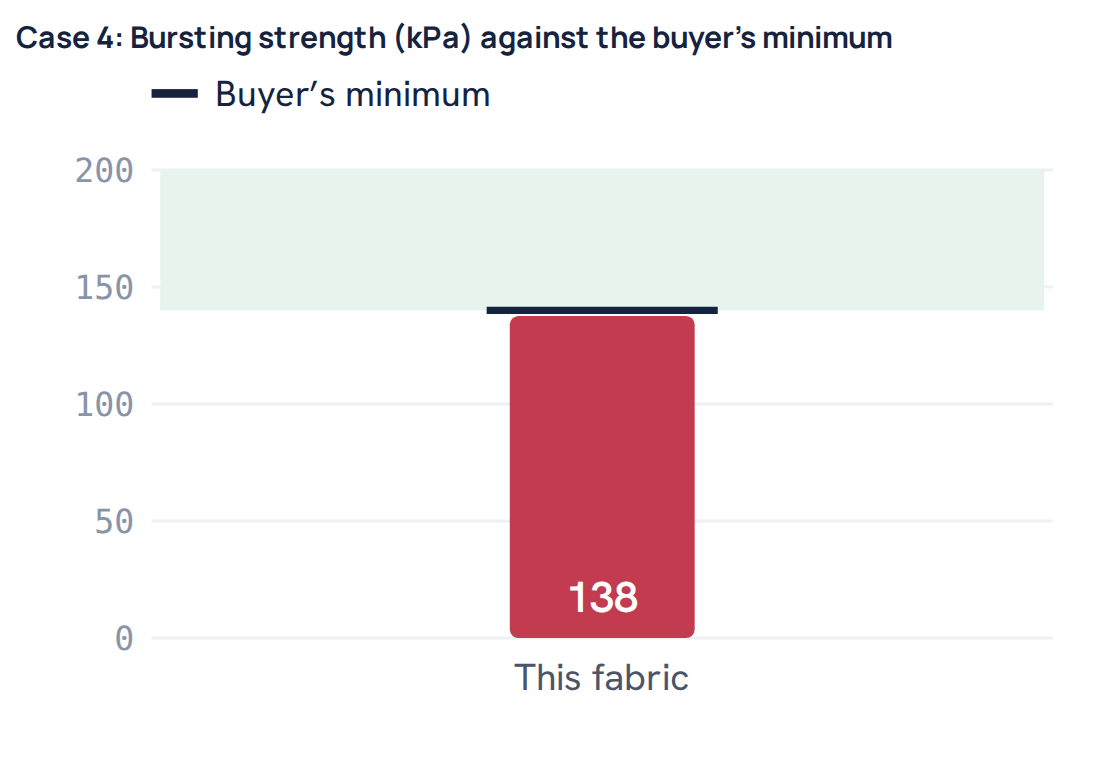
Case 4: Yarn-dyed 2×1 lycra rib, 215 GSM, 138 against 140 kPa
- Yarn: 34/1 organic cotton yarn-dyed + 30D Lycra
- Fibre (declared): 95% Cotton 5% Elastane
- Stitch length: 28
- Machine: 36″ × 18G
- Required: 115 cm, 215 GSM
- Finished: 112 cm, 202 GSM
Lab test: ISO 13938-2, 50 cm², as received
Route: Greige → Dyeing → Stenter → Compacting
Results
- Bursting strength: 138 kPa
- Minimum: 140 kPa
- Finished / required GSM: length 202, width 215
- Test area: 50 cm²
Other tests that failed in the same lab report: Shrinkage.
Cause and remedy
Cause: The fabric burst at 138 kPa against a minimum of 140 kPa (-2%).
Cause: It was finished light: 202 GSM against 215 required (-6%). Less yarn in each square centimetre means less strength.
Cause: Cotton is knitted together with a filament (elastane or polyester). In a combination like this the two yarns do not share the load evenly: the cotton takes it at full stretch and breaks first.
Remedy: Reach the required GSM. The closer the fabric is to its GSM, the better the bursting strength.
Remedy: Do not over-treat with enzyme: excess enzyme weakens cotton and can leave holes.
Remedy: Keep the dyeing time normal. A long or repeated dyeing cycle (re-dyeing, extra additions) weakens the yarn, so get the shade right the first time.
Remedy: Do not knit it loose: a loose knit fabric bursts at a lower pressure.
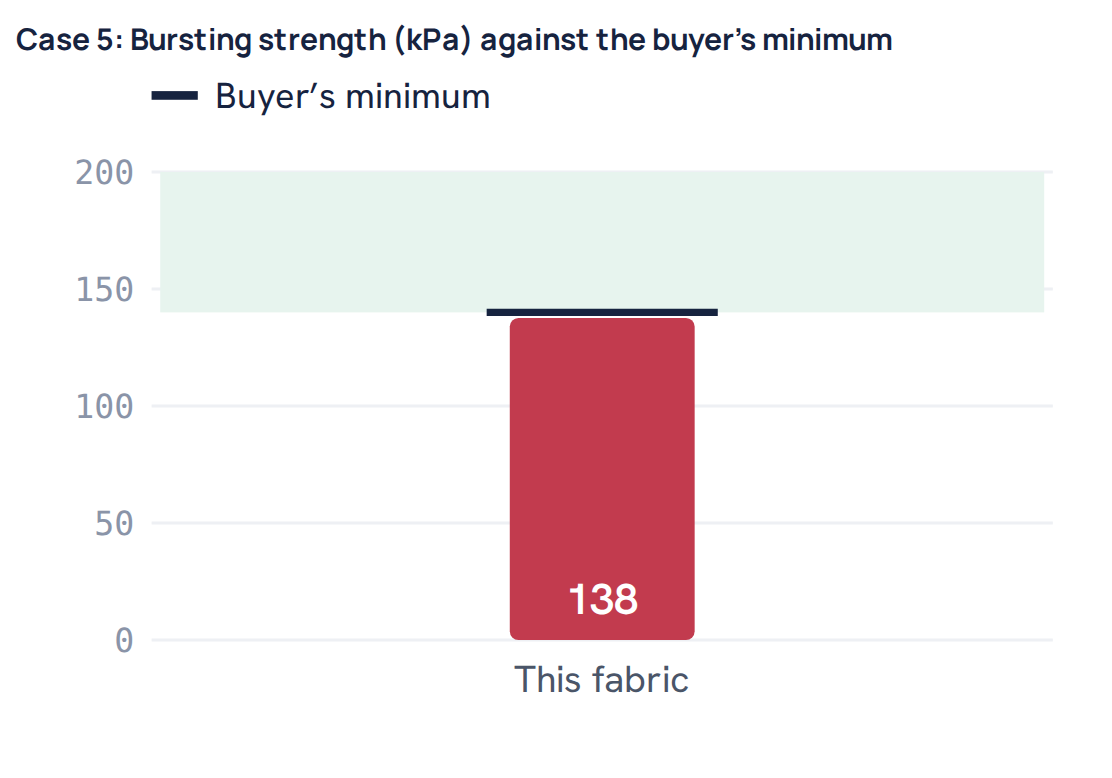
Case 5: 2×1 lycra rib, 200 GSM, 138 against 140 kPa
- Yarn: 40/1 organic cotton + 30D Lycra
- Fibre (declared): 95% Cotton 5% Elastane
- Stitch length: 27
- Machine: 42″ × 18G
- Required: 120 cm, 200 GSM
- Finished: 130 cm, 185 GSM
Lab test: ISO 13938-2, 50 cm², as received
Route: Greige → Slitting → Heat setting → Singeing → Back sewing → Dyeing → Stenter → Compacting
Results
- Bursting strength: 138 kPa
- Minimum: 140 kPa
- Finished / required GSM: length 185, width 200
- Test area: 50 cm²
Other tests that failed in the same lab report: none.
Cause and remedy
Cause: The fabric burst at 138 kPa against a minimum of 140 kPa (-2%).
Cause: It was finished light: 185 GSM against 200 required (-8%). Less yarn in each square centimetre means less strength.
Cause: The ground yarn is a fine single count. Bursting depends on yarn strength, and a fine single yarn has little of it.
Cause: Cotton is knitted together with a filament (elastane or polyester). In a combination like this the two yarns do not share the load evenly: the cotton takes it at full stretch and breaks first.
Cause: It was singed. If the flame is too strong or the fabric runs too slowly, the fibres are scorched and the fabric loses strength.
Remedy: Reach the required GSM. The closer the fabric is to its GSM, the better the bursting strength.
Remedy: Use a stronger yarn: a coarser count or a ply yarn in the ground.
Remedy: Singe at the right flame and speed so the fabric is never scorched.
Remedy: Do not over-treat with enzyme: excess enzyme weakens cotton and can leave holes.
Remedy: Keep the dyeing time normal. A long or repeated dyeing cycle (re-dyeing, extra additions) weakens the yarn, so get the shade right the first time.
Remedy: Do not knit it loose: a loose knit fabric bursts at a lower pressure.
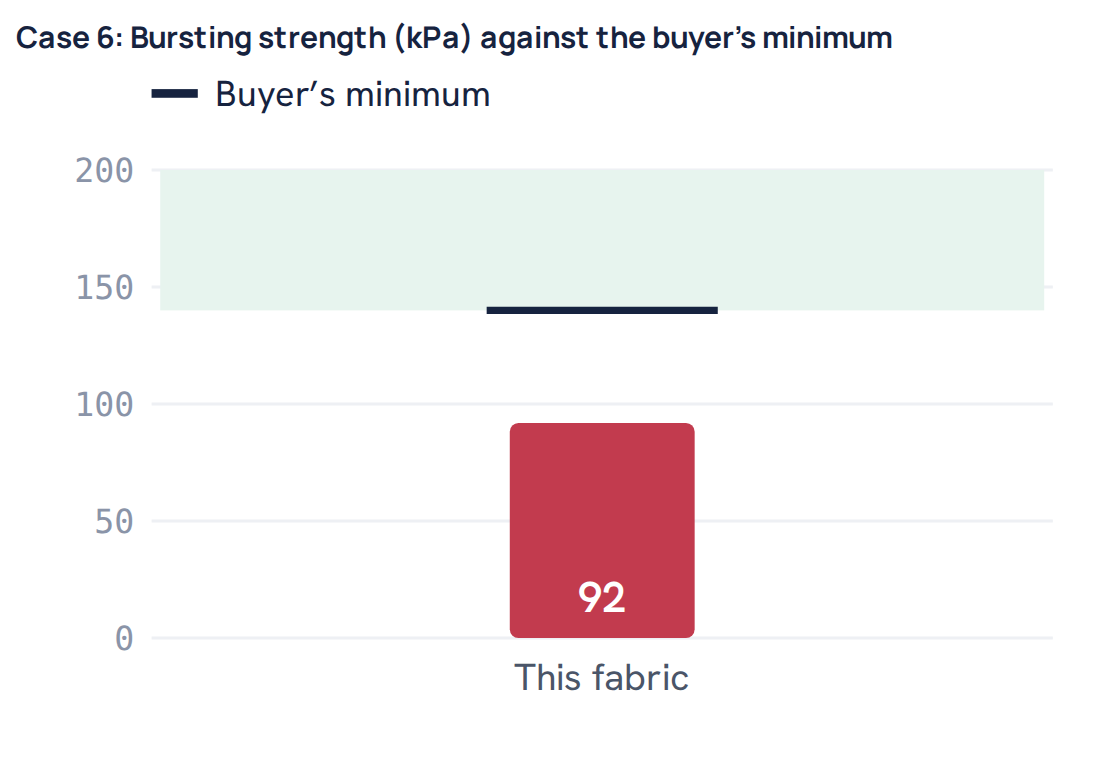
Case 6: 2×1 lycra rib, 200 GSM, 92 against 140 kPa
- Yarn: 40/1 organic cotton + 30D Lycra
- Fibre (declared): Lyocell lyocell+ Elastane
- Stitch length: 27
- Machine: 42″ × 18G
- Required: 120 cm, 200 GSM
- Finished: 130 cm, 185 GSM
Lab test: ISO 13938-2, 50 cm², as received
Route: Greige → Slitting → Heat setting → Singeing → Back sewing → Dyeing → Stenter → Compacting
Results
- Bursting strength: 92 kPa
- Minimum: 140 kPa
- Finished / required GSM: length 185, width 200
- Test area: 50 cm²
Other tests that failed in the same lab report: Shrinkage.
Cause and remedy
Cause: The fabric burst at 92 kPa against a minimum of 140 kPa (-34%).
Cause: It was finished light: 185 GSM against 200 required (-8%). Less yarn in each square centimetre means less strength.
Cause: The ground yarn is a fine single count. Bursting depends on yarn strength, and a fine single yarn has little of it.
Cause: Cotton is knitted together with a filament (elastane or polyester). In a combination like this the two yarns do not share the load evenly: the cotton takes it at full stretch and breaks first.
Cause: It was singed. If the flame is too strong or the fabric runs too slowly, the fibres are scorched and the fabric loses strength.
Remedy: Reach the required GSM. The closer the fabric is to its GSM, the better the bursting strength.
Remedy: Use a stronger yarn: a coarser count or a ply yarn in the ground.
Remedy: Singe at the right flame and speed so the fabric is never scorched.
Remedy: Do not over-treat with enzyme: excess enzyme weakens cotton and can leave holes.
Remedy: Keep the dyeing time normal. A long or repeated dyeing cycle (re-dyeing, extra additions) weakens the yarn, so get the shade right the first time.
Remedy: Do not knit it loose: a loose knit fabric bursts at a lower pressure.
From the floor: what I learned from these 6 cases
- Bursting fails when the yarn strength is poor, when the fabric is under its GSM, or when it is knitted loose.
- Cotton combined with polyester or elastane in one fabric can fail bursting, because the yarns do not take the load together.
- The process can take the strength away: excess enzyme, singeing that scorches the fabric, or a dyeing cycle that runs far longer than normal.
- So reach the required GSM, choose the yarn count and ply for strength, keep enzyme and singeing under control, and get the shade right the first time.
Questions
What is a good bursting strength for knit fabric?
On a 50 cm² test area most buyers ask for 125 to 140 kPa; on a 7.3 cm² area the minimum is usually 200 to 350 kPa.
Why does Lycra rib fail bursting?
The elastane lets the fabric balloon far before it breaks, so the cotton yarn takes the full load at full stretch; with a fine count and a light GSM it breaks early.
Does enzyme treatment lower bursting strength?
Yes. Too much enzyme weakens cotton and can leave holes. Over-strong singeing and long or repeated dyeing cycles also take strength away.

Textile engineer with 14+ years in dyeing and fabric development. He writes every guide on Dyeing Solution from real production work. Full profile