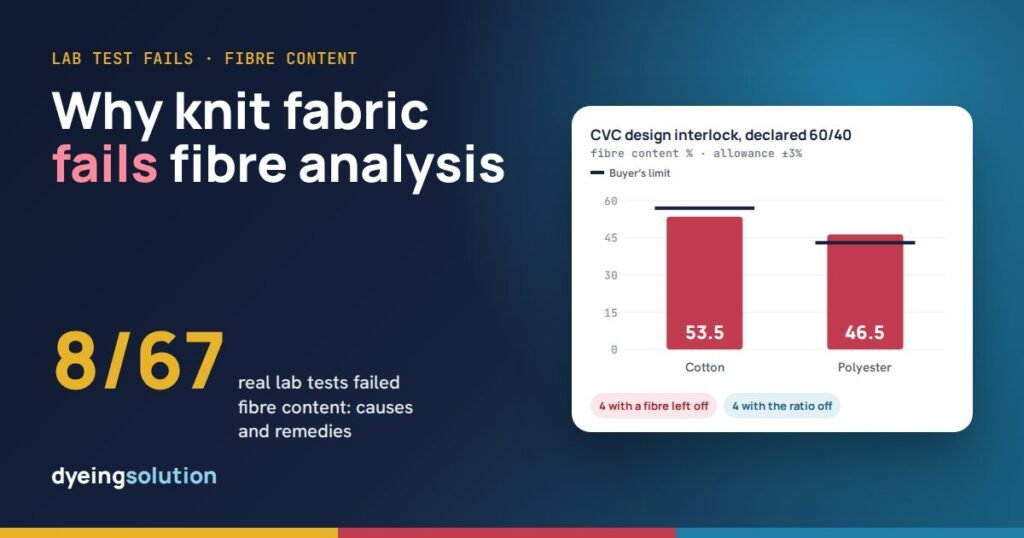
Over 95 new fabric developments, each one tested in the lab, fibre content was checked 67 times and failed 8 times. Most fails were not a lab problem but a declaration problem. Here they are case by case: the yarns used, what was declared, what the lab found, and the cause and remedy.
About this series. These findings come from 95 development batches: new and uncommon knit fabrics such as yarn-dyed design interlock, Lycra fleece and terry, three-thread fleece and jacquard rib. Each batch was knitted, dyed and finished as a development sample, then tested by an accredited lab to the buyer’s standard. When a test failed, we found the actual cause on the floor and changed the next batch until it passed.
At a glance
8 of 67Reports failed fibre content
4Fibre left off the declaration
4Blend ratio more than 3% off
±3%Usual allowance on blends
How the lab tests fibre content
The lab first identifies each fibre (by microscope, burning behaviour or solubility) and then measures how much of each there is. For cotton-polyester and cotton-elastane blends the usual method is chemical separation (ISO 1833, or AATCC 20A): a weighed specimen is treated with a solvent that dissolves one fibre and leaves the other, and the residue is dried and weighed again. The result is given in percent by weight, corrected for moisture.
Most buyers allow ±3% on each fibre in a blend and no allowance on a single-fibre claim: a fabric sold as 100% cotton must contain nothing else.
Two ways to fail
| Type of fail | Cases | What happened |
|---|---|---|
| Undeclared fibre | 4 | A fibre in the knit was left off the declaration: the elastane core of an air-covered yarn, the polyester in a blended tie or loop yarn, or a declaration that did not match the yarns at all. |
| Blend ratio off | 4 | Every fibre was declared, but the measured share moved more than 3 points from the declared ratio. |
Cotton reads lower after processing
In 11 of the 19 cotton-polyester fabrics tested, the lab found less cotton than declared. Cotton loses weight in scouring and bleaching (natural waxes, pectins and short fibre come out); polyester does not. In the failed 60/40 fabrics the cotton share dropped 3.5 to 6.5 points, enough to go past the ±3% allowance on its own.
How to read each case
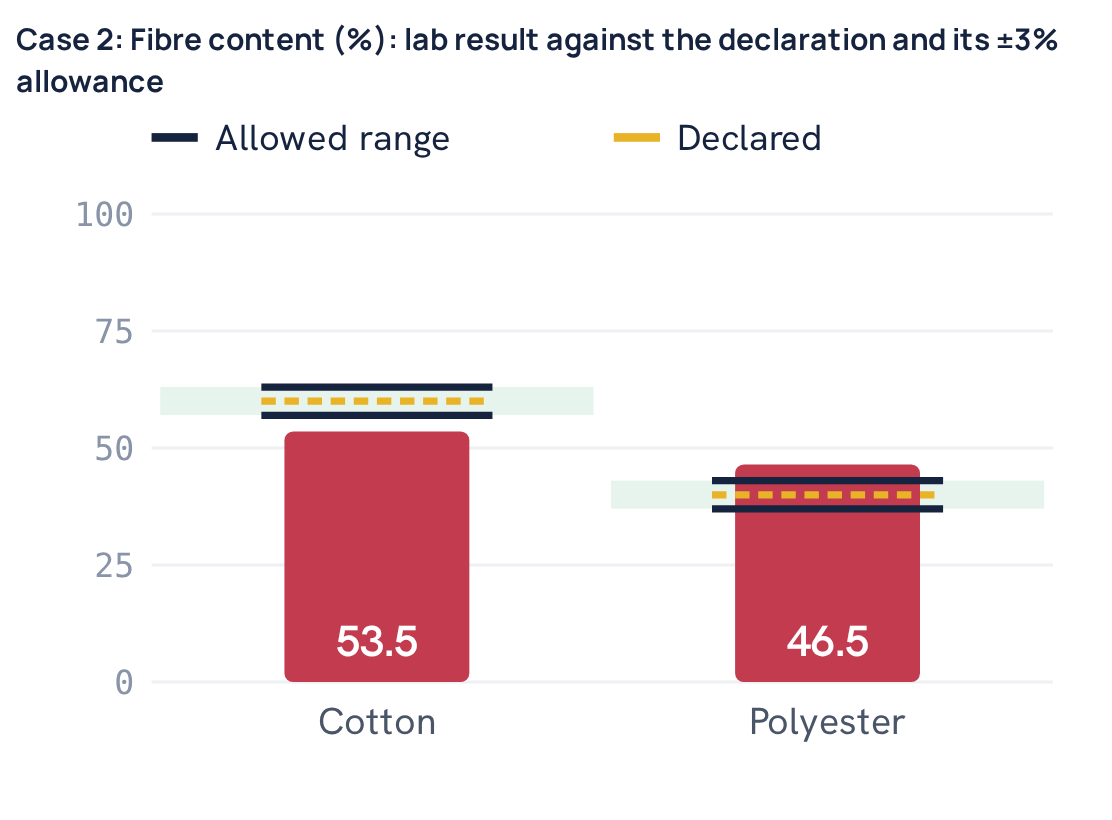
Each case shows the yarns in the fabric, the declaration, what the lab found, and the cause and remedy. In the chart, the bar is the measured share of each fibre, the gold dashed line is the declared share and the green band is the ±3% allowance.
Rib: 1 case
Rib is a stable double knit. It is heat set only when heavy, tight, Lycra body rib or a design rib that needs its width fixed.
Case 1: Jacquard rib, 240 GSM, undeclared fibre
- Yarn: 34/1 combed + 75D polyester air-covered
- Fibre (declared): 100% Polyester
- Stitch length: 45+27.5
- Machine: 34″ × 18G
- Required: 150 cm, 240 GSM
- Finished: 165 cm, 175 GSM
Lab test: ISO 1833 / AATCC 20A, chemical separation
Route: Greige → Slitting → Heat setting → Back sewing → Dyeing → Stenter → Compacting
Results
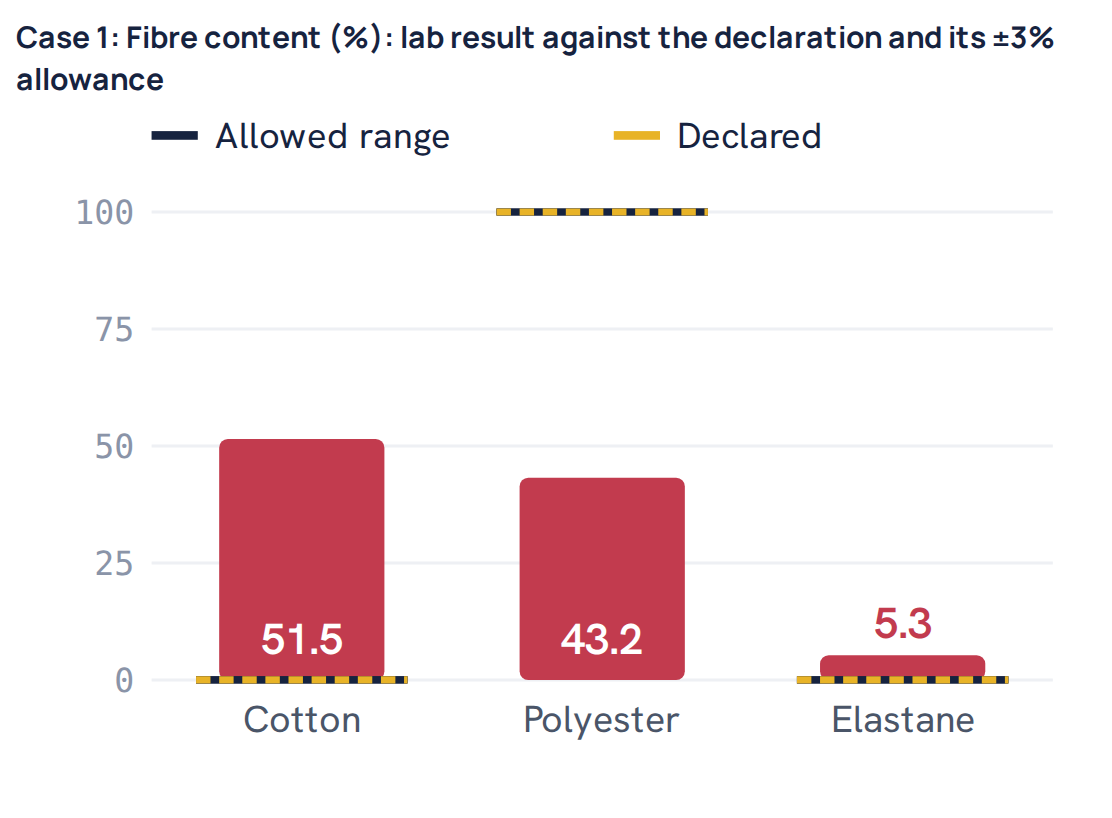
- Declared: 100% polyester
- Lab found: length 51.5% cotton, width 43.2% polyester / 5.3% elastane
- Allowance: none
Other tests that failed in the same lab report: GSM, Snagging.
Cause and remedy
Cause: The lab found 51.5% cotton in a fabric declared as 100% polyester. The declaration did not match the yarns used at all.
Cause: The lab found 5.3% elastane that was not on the declaration. It came from the air-covered yarn: an air-covered polyester carries an elastane core, and that core counts in the fibre content.
Remedy: Work out the declaration from every yarn in the fabric and its share of the fabric weight (from the stitch lengths and counts), including the elastane core of covered yarns and the polyester inside blended yarns, and send it to the buyer before the test.
Remedy: When a declaration is close to the ±3% edge, send a finished swatch for an in-house or lab fibre test before the bulk test.
Interlock: 2 cases
Interlock is a stable double knit; Lycra interlock is always heat set to fix the stretch and width.
Case 2: Yarn-dyed design interlock, 180 GSM, blend ratio off
- Yarn: 40/1 CVC 60/40 + 50D polyester yarn-dyed
- Fibre (declared): 60% Cotton 40% Polyester
- Stitch length: 25.5+22.0
- Machine: 36″ × 28G
- Required: 180 cm, 180 GSM
- Finished: 185 cm, 180 GSM
Lab test: ISO 1833 / AATCC 20A, chemical separation
Route: Greige → Dyeing → Stenter → Compacting
Results
- Declared: length 60% cotton, width 40% polyester
- Lab found: length 53.5% cotton, width 46.5% polyester
- Allowance: ±3%
Other tests that failed in the same lab report: Shrinkage.
Cause and remedy
Cause: The blend ratio moved: declared 60% cotton, found 53.5% (-6.5 points), outside the ±3% allowed.
Cause: Cotton loses weight in scouring and bleaching, while polyester does not, so after dyeing a cotton-polyester fabric carries a lower cotton share than the yarn did.
Cause: This fabric also has a separate polyester filament knitted with the blended yarn, and its weight was not added into the declared ratio.
Remedy: Declare the ratio from the yarn consumption of the finished fabric, not from the main yarn’s label, and allow for the cotton weight lost in scouring.
Remedy: When a declaration is close to the ±3% edge, send a finished swatch for an in-house or lab fibre test before the bulk test.
Case 3: Yarn-dyed design interlock, 180 GSM, blend ratio off
- Yarn: 40/1 CVC 60/40 + 50D polyester yarn-dyed
- Fibre (declared): 60% Cotton 40% Polyester
- Stitch length: 25.5+22.0
- Machine: 36″ × 28G
- Required: 180 cm, 180 GSM
- Finished: 193 cm, 185 GSM
Lab test: ISO 1833 / AATCC 20A, chemical separation
Route: Greige → Dyeing → Stenter → Compacting
Results
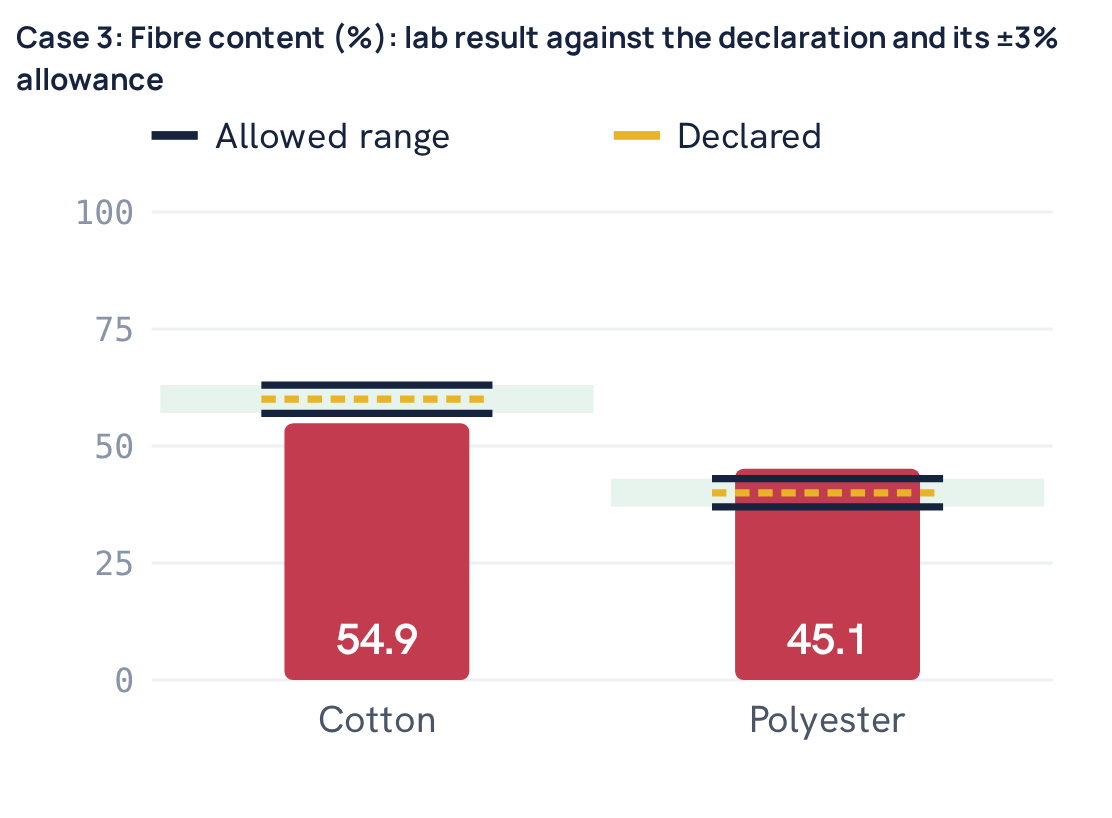
- Declared: length 60% cotton, width 40% polyester
- Lab found: length 54.9% cotton, width 45.1% polyester
- Allowance: ±3%
Other tests that failed in the same lab report: GSM.
Cause and remedy
Cause: The blend ratio moved: declared 60% cotton, found 54.9% (-5.1 points), outside the ±3% allowed.
Cause: Cotton loses weight in scouring and bleaching, while polyester does not, so after dyeing a cotton-polyester fabric carries a lower cotton share than the yarn did.
Cause: This fabric also has a separate polyester filament knitted with the blended yarn, and its weight was not added into the declared ratio.
Remedy: Declare the ratio from the yarn consumption of the finished fabric, not from the main yarn’s label, and allow for the cotton weight lost in scouring.
Remedy: When a declaration is close to the ±3% edge, send a finished swatch for an in-house or lab fibre test before the bulk test.
Terry: 2 cases
Terry is dyed loop side inside. Heavy terry (350 GSM and up) is heat set before dyeing.
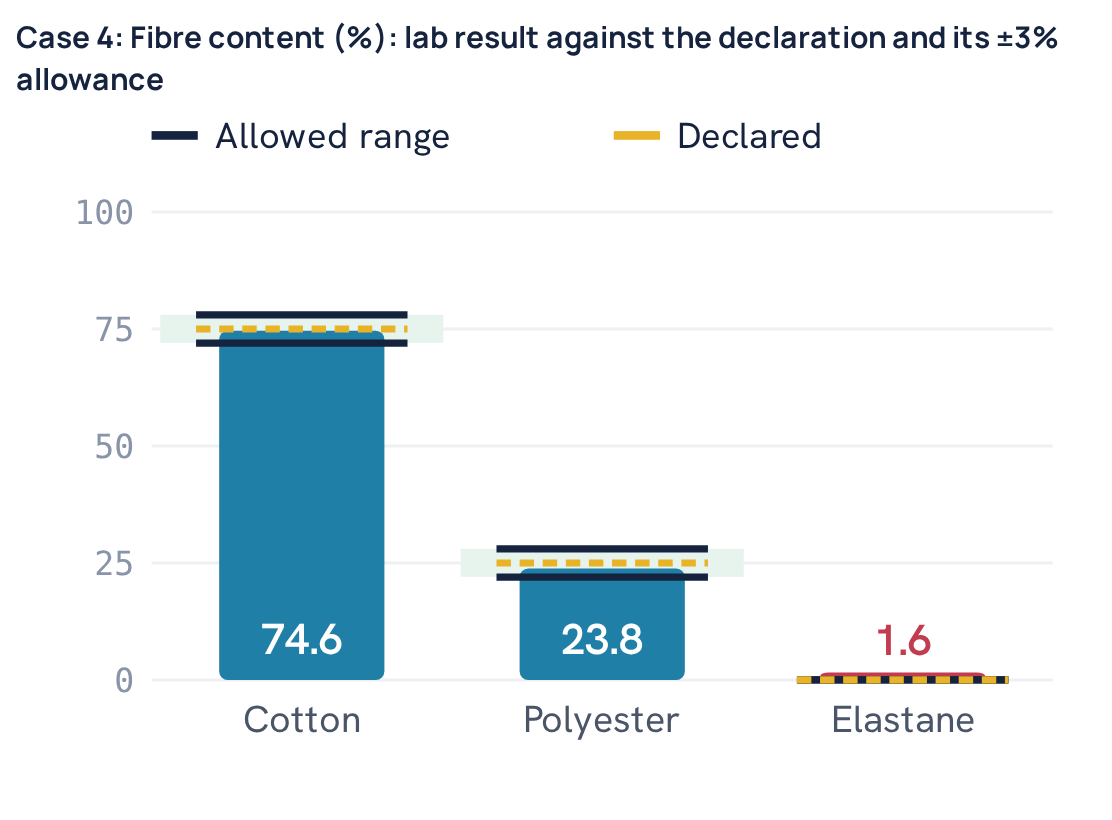
Case 4: Lycra terry, 380 GSM, undeclared fibre
- Yarn: 30/1 cotton + 75D polyester + 10/1 CVC 75/25
- Fibre (declared): 75% Cotton 25% Polyester
- Stitch length: 46+30+15.5
- Machine: 30″ × 20G
- Required: 170 cm, 380 GSM
- Finished: 175 cm, 372 GSM
Lab test: ISO 1833 / AATCC 20A, chemical separation
Route: Greige → Dyeing → Stenter → Compacting
Results
- Declared: length 75% cotton, width 25% polyester
- Lab found: length 74.6% cotton, width 23.8% polyester / 1.6% elastane
- Allowance: ±3%
Other tests that failed in the same lab report: none.
Cause and remedy
Cause: The lab found 1.6% elastane that was not on the declaration. It came from the air-covered yarn: an air-covered polyester carries an elastane core, and that core counts in the fibre content.
Remedy: Work out the declaration from every yarn in the fabric and its share of the fabric weight (from the stitch lengths and counts), including the elastane core of covered yarns and the polyester inside blended yarns, and send it to the buyer before the test.
Remedy: When a declaration is close to the ±3% edge, send a finished swatch for an in-house or lab fibre test before the bulk test.
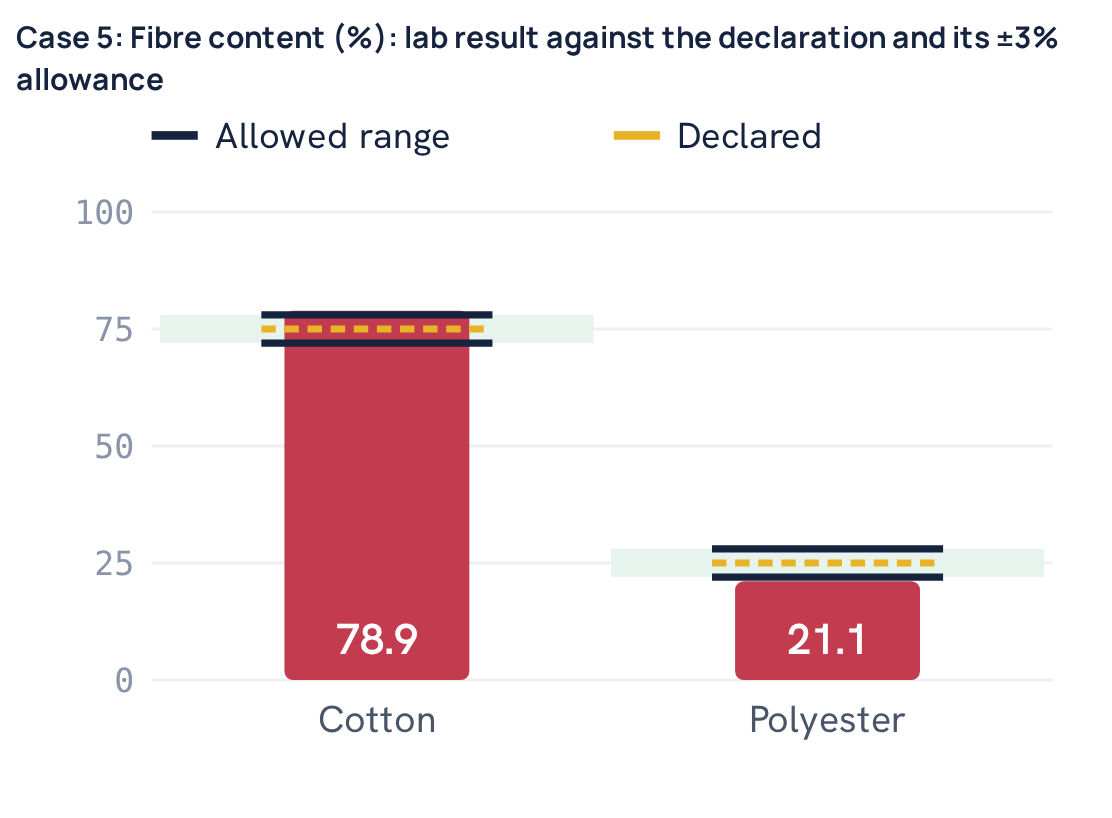
Case 5: Terry, 330 GSM, blend ratio off
- Yarn: 28/1 cotton + 75D polyester + 10/1 CVC 75/25
- Fibre (declared): 75% Cotton 25% Polyester
- Stitch length: 46+29+16
- Machine: 30″ × 20G
- Required: 160 cm, 330 GSM
- Finished: 173 cm, 325 GSM
Lab test: ISO 1833 / AATCC 20A, chemical separation
Route: Greige → Dyeing → Stenter → Compacting
Results
- Declared: length 75% cotton, width 25% polyester
- Lab found: length 78.9% cotton, width 21.1% polyester
- Allowance: ±3%
Other tests that failed in the same lab report: Pilling.
Cause and remedy
Cause: The blend ratio moved: declared 75% cotton, found 78.9% (+3.9 points), outside the ±3% allowed.
Cause: The polyester yarn’s share of the fabric weight was lower than planned, so the cotton share went up.
Remedy: Declare the ratio from the yarn consumption of the finished fabric, not from the main yarn’s label, and allow for the cotton weight lost in scouring.
Remedy: When a declaration is close to the ±3% edge, send a finished swatch for an in-house or lab fibre test before the bulk test.
Waffle: 1 case
Waffle is a loose texture knit: no enzyme, singed when a clean face is needed, and its GSM must be checked after washing.
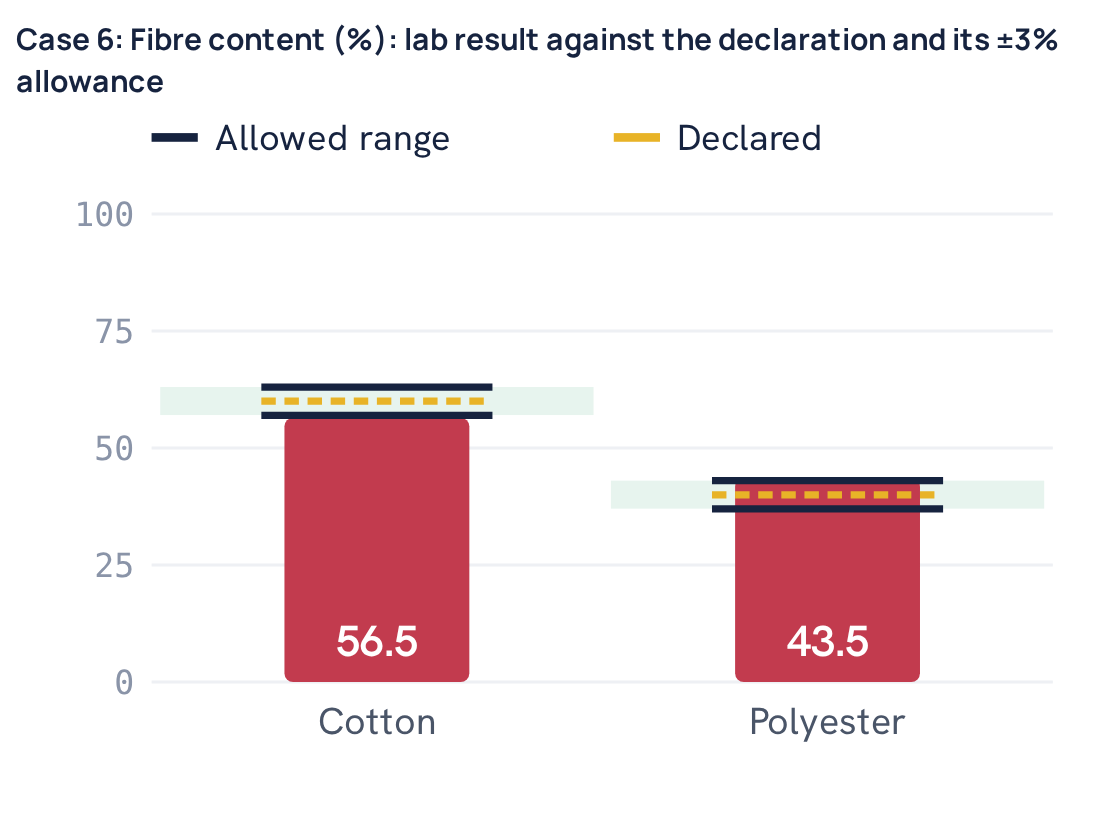
Case 6: Waffle, 220 GSM, blend ratio off
- Yarn: 34/1 CVC 60/40
- Fibre (declared): 60% Cotton 40% Polyester
- Stitch length: 28.5+18.0
- Machine: 38″ × 18G
- Required: 145 cm, 220 GSM
- Finished: 148 cm, 210 GSM
Lab test: ISO 1833 / AATCC 20A, chemical separation
Route: Greige → Slitting → Heat setting → Back sewing → Dyeing → Stenter → Compacting
Results
- Declared: length 60% cotton, width 40% polyester
- Lab found: length 56.5% cotton, width 43.5% polyester
- Allowance: ±3%
Other tests that failed in the same lab report: Wash fastness, Perspiration fastness.
Cause and remedy
Cause: The blend ratio moved: declared 60% cotton, found 56.5% (-3.5 points), outside the ±3% allowed.
Cause: Cotton loses weight in scouring and bleaching, while polyester does not, so after dyeing a cotton-polyester fabric carries a lower cotton share than the yarn did.
Remedy: Declare the ratio from the yarn consumption of the finished fabric, not from the main yarn’s label, and allow for the cotton weight lost in scouring.
Remedy: When a declaration is close to the ±3% edge, send a finished swatch for an in-house or lab fibre test before the bulk test.
Fleece: 2 cases
Fleece is dyed loop side inside; fleece of 350 GSM and up is heat set before dyeing.
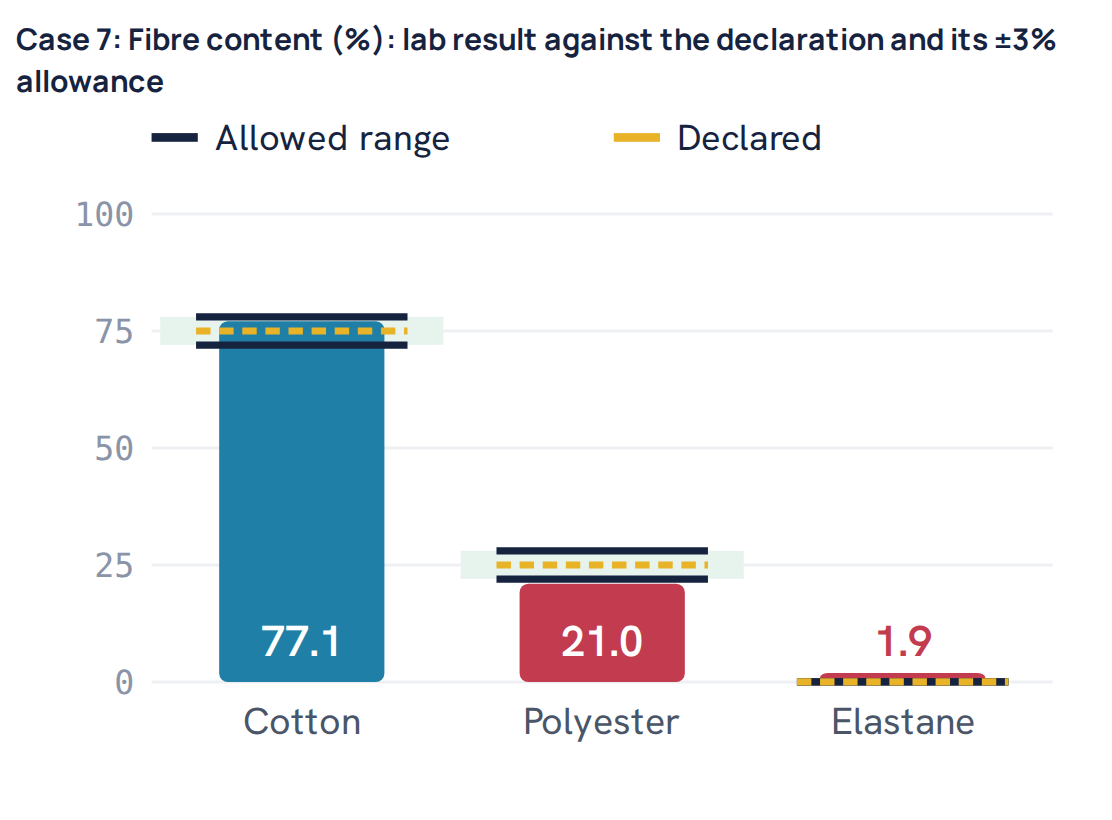
Case 7: Lycra fleece, 380 GSM, undeclared fibre
- Yarn: 30/1 cotton + 75D polyester + 10/1 CVC 60/40
- Fibre (declared): 75% Cotton 25% Polyester
- Stitch length: 46+30+15.5
- Machine: 30″ × 20G
- Required: 170 cm, 380 GSM
- Finished: 165 cm, 340 GSM
Lab test: ISO 1833 / AATCC 20A, chemical separation
Route: Greige → Dyeing → Stenter → Compacting
Results
- Declared: length 75% cotton, width 25% polyester
- Lab found: length 77.1% cotton, width 21.0% polyester / 1.9% elastane
- Allowance: ±3%
Other tests that failed in the same lab report: none.
Cause and remedy
Cause: The lab found 1.9% elastane that was not on the declaration. It came from the air-covered yarn: an air-covered polyester carries an elastane core, and that core counts in the fibre content.
Remedy: Work out the declaration from every yarn in the fabric and its share of the fabric weight (from the stitch lengths and counts), including the elastane core of covered yarns and the polyester inside blended yarns, and send it to the buyer before the test.
Remedy: When a declaration is close to the ±3% edge, send a finished swatch for an in-house or lab fibre test before the bulk test.
Case 8: Fleece, 330 GSM, undeclared fibre
- Yarn: K-30/1 combed + T-26/1 CVC 60/40 RING + L-8/1 carded
- Fibre (declared): 100% Cotton
- Stitch length: 47.5+39.5+20
- Machine: 36″ × 14G
- Required: 175 cm, 330 GSM
- Finished: 180 cm, 330 GSM
Lab test: ISO 1833 / AATCC 20A, chemical separation
Route: Greige → Dyeing → Stenter → Compacting
Results
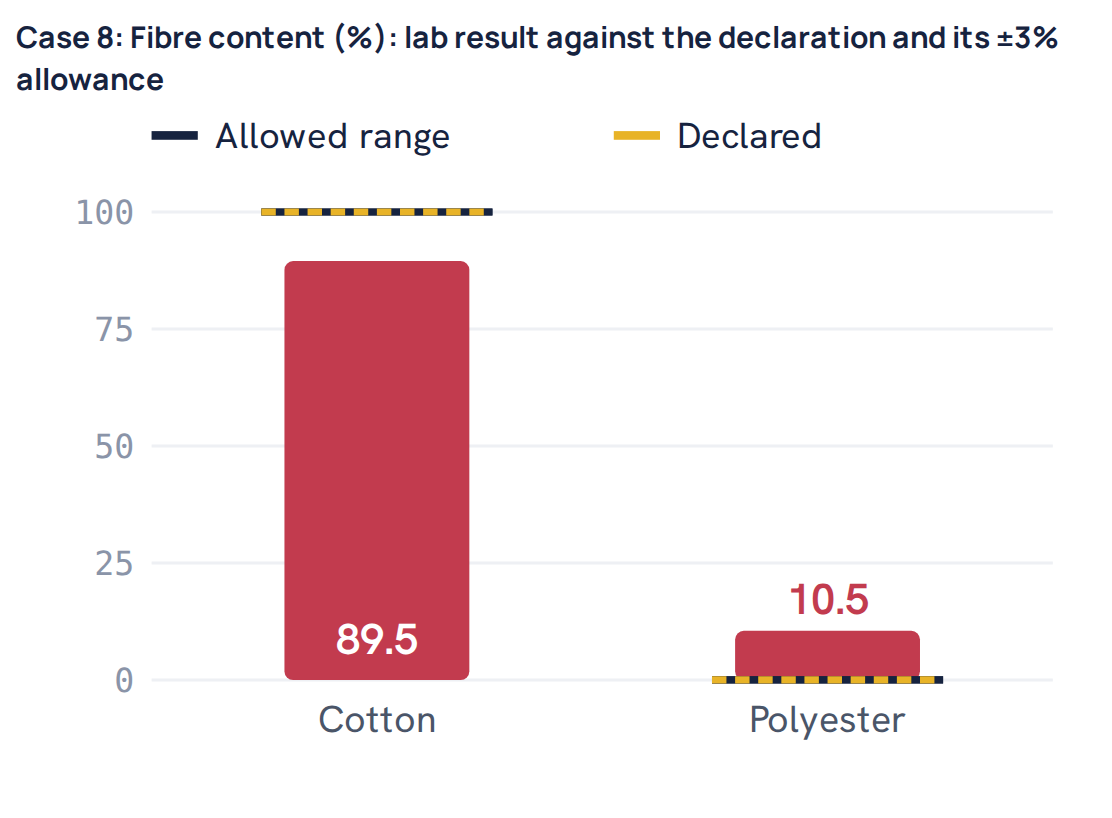
- Declared: 100% cotton
- Lab found: length 89.5% cotton, width 10.5% polyester
- Allowance: none
Other tests that failed in the same lab report: Pilling.
Cause and remedy
Cause: The lab found 10.5% polyester in a fabric declared without it. One of the yarns in the knit is a cotton-polyester blend, and its polyester was left off the declaration.
Remedy: Work out the declaration from every yarn in the fabric and its share of the fabric weight (from the stitch lengths and counts), including the elastane core of covered yarns and the polyester inside blended yarns, and send it to the buyer before the test.
Remedy: When a declaration is close to the ±3% edge, send a finished swatch for an in-house or lab fibre test before the bulk test.
From the floor: what I learned from these 8 cases
- Fibre content fails when the declaration does not match the actual yarn composition of the fabric.
- Declare the composition from the yarn combination, from what each yarn actually contributes to the fabric, and allow for the weight cotton loses in scouring.
Questions
What is the fibre content tolerance for knit fabric?
Usually ±3% on each fibre in a blend, and no tolerance on a single-fibre claim such as 100% cotton.
Why does CVC fabric test with less cotton than the yarn?
Cotton loses weight in scouring and bleaching and polyester does not, so the finished fabric carries a lower cotton share.
Does air-covered polyester count as elastane?
Yes. An air-covered yarn has an elastane core, and the lab reports that elastane in the fibre content.

Textile engineer with 14+ years in dyeing and fabric development. He writes every guide on Dyeing Solution from real production work. Full profile