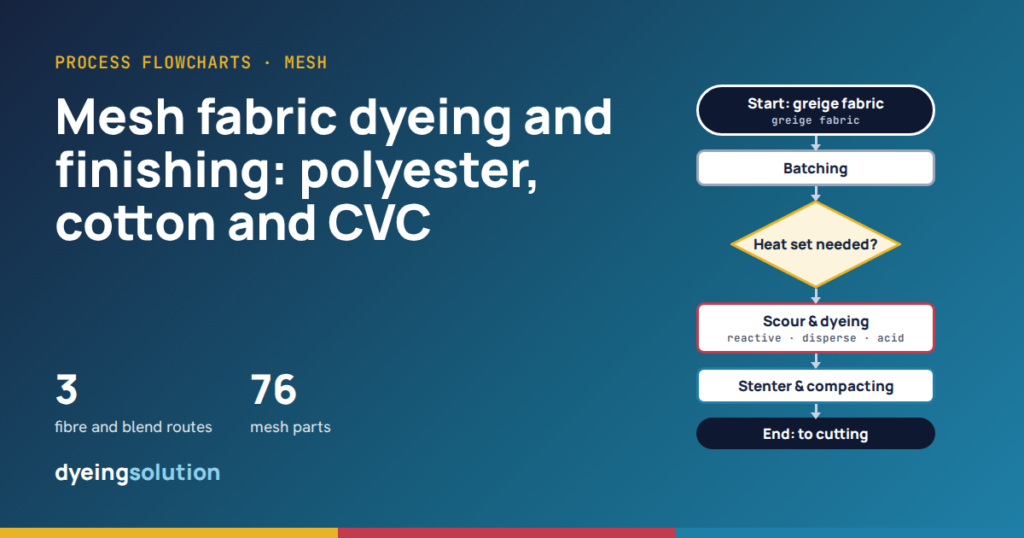
Mesh is the open, breathable knit of sportswear, and in our records two out of three mesh parts are 100% polyester. Here is the dyeing and finishing route for each fibre, from greige mesh to the cutting table.
At a glance
76Parts in our records
180Median required GSM
19%Within GSM tolerance
76%Polyester mesh heat set
Mesh is a knit with a regular pattern of open holes, made with tuck stitches or needle transfers. Plain mesh, micro mesh, spider mesh and design mesh differ in the size and shape of the holes. It is light and breathable, which is why most of it goes into sportswear and linings.
| Type in our records | Parts |
|---|---|
| Mesh | 51 |
| Design Mesh | 10 |
| Spider Mesh | 5 |
| D.Mesh | 3 |
| Micro Mesh | 3 |
| Y/D Mesh | 2 |
| Ly Mesh | 1 |
| Ly Spider Mesh | 1 |
By fibre: what our records show
| Fibre or blend | Parts | Median required GSM | Within ±5% GSM | More than 5% light | Median length shrinkage | Median width shrinkage | Heat set |
|---|---|---|---|---|---|---|---|
| Polyester | 51 | 150 | 18% | 69% | 3% | 2% | 76% |
| 100% cotton | 15 | 220 | 20% | 33% | 7% | 7% | 20% |
| CVC / PC | 6 | 210 | 17% | 33% | 2% | 2% | 100% |
Polyester mesh makes up 51 of 76 mesh parts. Only 18% of it finishes within GSM tolerance, and 76% is heat set.
Our records hold fewer parts of this fabric than of the common knits, so read the figures as a guide, not a rule.
When mesh is heat set
- 100% polyester mesh is heat set, 99 times out of 100. We skip it only for a special buyer requirement or for swatch development.
- Mesh made from yarn-dyed polyester is not heat set.
- Most cotton mesh is not heat set.
Holding mesh GSM
- Mesh is a loose, open design, so GSM is hard to hold within tolerance.
- For polyester mesh we control GSM through heat setting, or we discuss the GSM with the buyer.
- Polyester mesh does not need a wash test for GSM. Cotton mesh does: we check its GSM after washing.
The sequence before the dyeing machine
Every chart below follows the same sequence before dyeing. Steps a fabric does not need simply drop out; they are drawn dashed.
- Greige inspection, then batching. A fabric that stays a tube is turned inside out here.
- If it needs heat setting, singeing or mercerising: slitting first. None of these is ever done on a tube.
- If it needs heat setting: heat setting in open width.
- If it needs singeing: singeing in open width, after checking the flame cannot damage the fabric.
- If it is mercerised: mercerising, then drying.
- If the fabric was opened: back sewing, to make it a tube again with the face side inside (the loop side, for terry).
- Loading into the dyeing machine, then scouring, bleaching and dyeing, single part or double part as the fibre needs.
Flowcharts by fibre
Polyester mesh fabric
In our records: 51 parts, 18% within GSM tolerance, median length shrinkage 3%, heat set 76%. Full process: Polyester dyeing process.
Dyeing and finishing: Polyester mesh fabric
100% cotton mesh fabric
In our records: 15 parts, 20% within GSM tolerance, median length shrinkage 7%, heat set 20%. Full process: 100% cotton dyeing process.
Dyeing and finishing: 100% cotton mesh fabric
CVC / PC mesh fabric
In our records: 6 parts, 17% within GSM tolerance, median length shrinkage 2%, heat set 100%. Full process: CVC / PC dyeing process.
Dyeing and finishing: CVC / PC mesh fabric
Common faults and buyer complaints
Mesh faults follow from its open structure.
Holes distorted or width off. The open structure pulls out of shape easily. Fix the width at heat setting and hold the same width on the stenter, without overstretching.
GSM out of tolerance. Set GSM through heat-setting width and overfeed on polyester mesh, check cotton mesh after washing, and agree the GSM with the buyer before bulk when the design makes it hard.
Crease marks on polyester mesh. Heat set before dyeing and load the fabric straight; polyester creases set hard at 130°C.

Textile engineer with 14+ years in dyeing and fabric development. He writes every guide on Dyeing Solution from real production work. Full profile