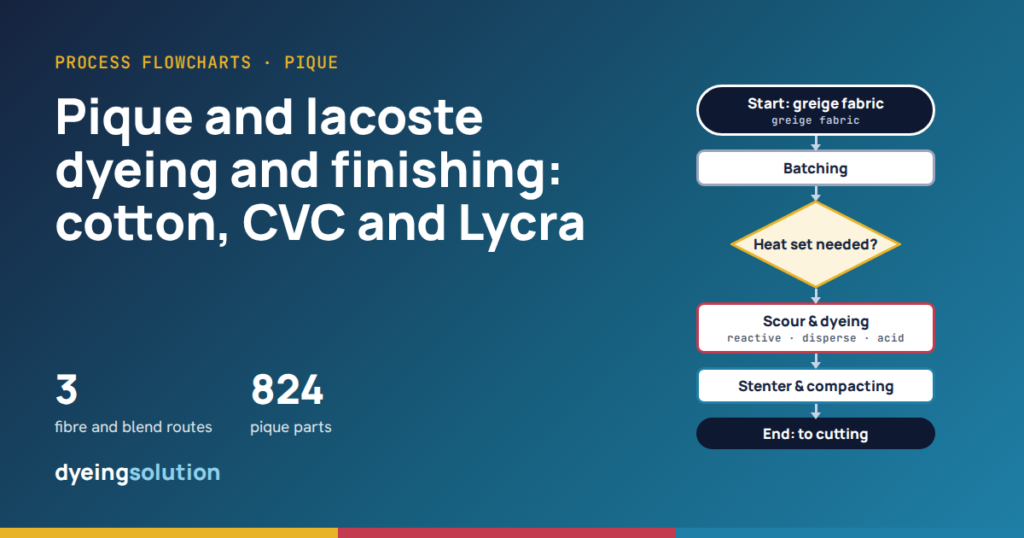
Pique is the polo-shirt knit, and in our records it shrinks more in length than any other common fabric. Here is the dyeing and finishing route for each fibre, from greige pique to the cutting table.
At a glance
824Parts in our records
220Median required GSM
40%Within GSM tolerance
10%Cotton pique median length shrinkage
Pique is a single jersey based knit with tuck stitches that build a raised honeycomb or diamond texture on the face. Single pique (single lacoste) and double pique (double lacoste) differ in how many tuck courses make up the pattern. It is the classic polo-shirt fabric, firm and breathable.
| Type in our records | Parts |
|---|---|
| Pique | 254 |
| Design Pique | 68 |
| Y/D Pique | 52 |
| Micro Pique | 51 |
| Ly Pique | 48 |
| L/Pique | 43 |
| Pk | 36 |
| Flat Back Pique | 28 |
By fibre: what our records show
| Fibre or blend | Parts | Median required GSM | Within ±5% GSM | More than 5% light | Median length shrinkage | Median width shrinkage | Heat set |
|---|---|---|---|---|---|---|---|
| 100% cotton | 518 | 220 | 39% | 58% | 10% | 2% | 3% |
| CVC / PC | 165 | 220 | 49% | 47% | 5% | 2% | 56% |
| Cotton-elastane | 115 | 220 | 37% | 59% | 10% | -2% | 96% |
Pique is the hardest common fabric to hold in length. Cotton and cotton-elastane pique both shrink a median 10% in length; CVC pique shrinks 5%. Only 3% of cotton pique is heat set in our records.
What makes pique different
- Pique is a special design fabric, but its dyeing and finishing follow the same rules as single jersey, fibre by fibre.
- Pique shrinks a lot in length. We control it in finishing: after the stenter we dry it on the relax dryer, so the fabric shrinks there and not in the garment.
When pique is heat set
- Cotton pique is normally not heat set. Pique is usually a loose construction, not a tight one, so it does not need it.
- Pique with Lycra is always heat set.
- Some design pique, or pique that is tightly knitted, is heat set.
The sequence before the dyeing machine
Every chart below follows the same sequence before dyeing. Steps a fabric does not need simply drop out; they are drawn dashed.
- Greige inspection, then batching. A fabric that stays a tube is turned inside out here.
- If it needs heat setting, singeing or mercerising: slitting first. None of these is ever done on a tube.
- If it needs heat setting: heat setting in open width.
- If it needs singeing: singeing in open width, after checking the flame cannot damage the fabric.
- If it is mercerised: mercerising, then drying.
- If the fabric was opened: back sewing, to make it a tube again with the face side inside (the loop side, for terry).
- Loading into the dyeing machine, then scouring, bleaching and dyeing, single part or double part as the fibre needs.
Flowcharts by fibre
100% cotton pique and lacoste
In our records: 518 parts, 39% within GSM tolerance, median length shrinkage 10%, heat set 3%. Full process: 100% cotton dyeing process.
Dyeing and finishing: 100% cotton pique and lacoste
CVC / PC pique and lacoste
In our records: 165 parts, 49% within GSM tolerance, median length shrinkage 5%, heat set 56%. Full process: CVC / PC dyeing process.
Dyeing and finishing: CVC / PC pique and lacoste
Cotton-elastane pique and lacoste
In our records: 115 parts, 37% within GSM tolerance, median length shrinkage 10%, heat set 96%. Full process: Cotton-elastane dyeing process.
Dyeing and finishing: Cotton-elastane pique and lacoste
Common faults and buyer complaints
- The common pique faults are bursting failure, then shrinkage, then a slight shade variation.
Bursting failure. Pique is often loose, so too much enzyme drops the bursting strength. Keep the enzyme dose low and test bursting in the lab on finished fabric against the buyer’s kPa requirement.
Length shrinkage. Finish through stenter and relax dryer before compacting, and check shrinkage after washing before delivery.
Shade variation. Usually slight. Check every batch against the approved shade before the fabric leaves dyeing.

Textile engineer with 14+ years in dyeing and fabric development. He writes every guide on Dyeing Solution from real production work. Full profile