Jet, soft-flow, airflow and winch machines for knit fabric; jigger, beam and pad ranges for woven; package machines for yarn and drums for garments. How each works, typical temperatures and liquor ratios, and how to choose one for cotton.
At a glance
Soft-flowstandard for cotton knit
130°CHT machine for polyester
1:3–1:5airflow liquor ratio
≤ 80%safe machine load
The textile industry uses different dyeing machines for each form of material: loose fibre, yarn, fabric and finished garments. For knit fabric, the workhorses are jet and soft-flow machines, which circulate a rope of fabric through the dye liquor; woven cotton fabric is mostly dyed open-width on jiggers, beam machines or continuous pad ranges; yarn is dyed on packages; garments in drum or paddle machines. Each type suits certain fabrics, temperatures and lot sizes.
This guide explains the main types of dyeing machine in the textile industry, how each one moves the fabric and the liquor, which fabrics they suit, and how to choose a dyeing machine for cotton and knit fabric. No brand names: the principles are the same whoever builds the machine.
Three ways a dyeing machine can work
Every exhaust dyeing machine must bring dye liquor and material together evenly. There are three basic ways to do it:
- Move the material, keep the liquor still: the winch and the jigger.
- Move the liquor, keep the material still: package, beam and loose-stock machines, where liquor is pumped through a packed load.
- Move both: jet, soft-flow and airflow machines, where a nozzle drives liquor and fabric round together.
Machines are also either atmospheric (up to about 98°C, for cotton and other cellulose fibres, nylon and wool) or high-temperature (HT), pressurised to about 130–140°C for polyester and its blends. The general methods, exhaust, continuous and semi-continuous, are compared in dyeing methods explained.
Machines for knit fabric
Jet dyeing machine
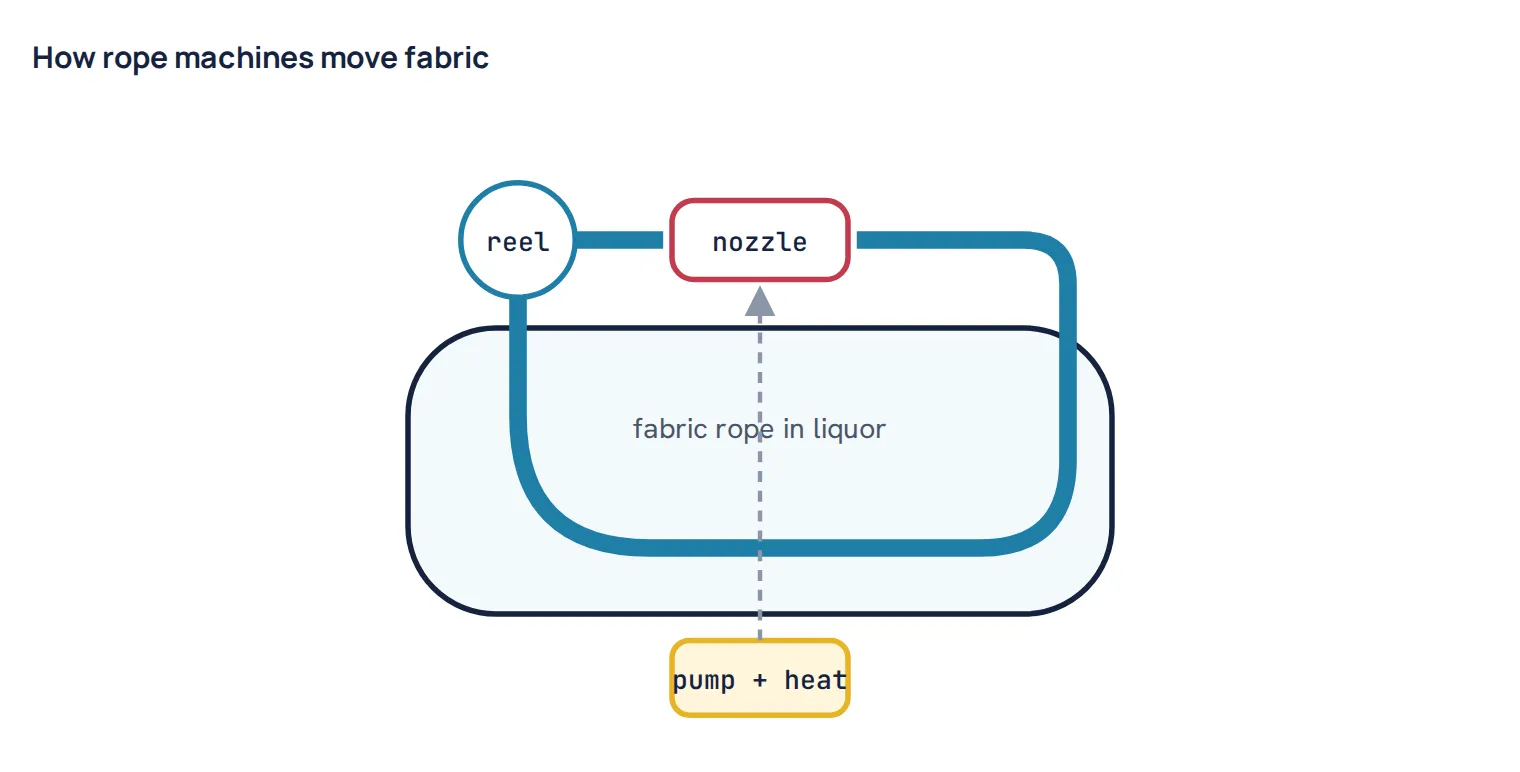
A jet machine has a closed tube or chamber. A powerful nozzle pushes liquor at high speed, and the liquor drags the fabric rope round the machine. It moves fabric fast and gives good levelness, and HT versions dye polyester at 130°C. The force of the jet can stress delicate fabrics and cause crease marks or pilling on loose knits.
Soft-flow (overflow) machine
A soft-flow machine also moves the fabric with liquor, but gently: the liquor flows over a weir or through a wide, low-pressure nozzle, and a reel helps lift the fabric. This is the standard machine for cotton and blended knit fabric in most knit dye houses, with liquor ratios of roughly 1:5 to 1:10. It treats the fabric more gently than a hard jet and is available in atmospheric and HT versions.
Airflow machine
An airflow (aerodynamic) machine moves the fabric with a stream of air and only a small amount of liquor, giving very low liquor ratios, around 1:3 to 1:5. It saves water, energy and chemicals and is gentle on the fabric surface, but costs more to buy and needs good process control.
Winch
The winch is the oldest rope machine: an open tank with a reel that lifts the fabric out and drops it back. It is gentle and simple, but slow, uses a lot of water (high liquor ratio) and is limited to about 98°C. Today it is used mainly for delicate or bulky fabrics and in small units.
Machines for woven fabric, yarn and garments
- Jigger: open-width woven fabric wound from one roller to another through a small liquor trough. Good for woven cotton and fabrics that must not crease; not for knits, which stretch under tension.
- Beam dyeing: fabric wound on a perforated beam, liquor pumped through it. Used for woven polyester, light fabrics and some warp knits; no creasing, but the fabric must be permeable.
- Pad (continuous) ranges: fabric passes through a pad trough and squeeze rollers, then is fixed by steam, heat or cold batching. Very productive for long runs of woven fabric; see pad-batch in dyeing methods.
- Package dyeing: yarn wound on perforated cones or tubes, liquor pumped through. Used for yarn-dyed stripes and melange components.
- Hank dyeing: yarn in loose skeins, for bulky or fancy yarns.
- Garment machines: rotary drum or side-paddle machines for finished garments, used in garment dyeing and washing; see garment dyeing vs fabric dyeing.
| Machine | Material | Max temp | Liquor ratio (typical) |
|---|---|---|---|
| Soft-flow | Knit and woven rope | 98°C or 135°C (HT) | 1:5–1:10 |
| Jet | Knit and woven rope | Up to about 140°C | 1:5–1:10 |
| Airflow | Knit and woven rope | Up to about 140°C | 1:3–1:5 |
| Winch | Knit, delicate fabric | 98°C | 1:15–1:30 |
| Jigger | Woven open width | 98°C (HT versions exist) | 1:3–1:6 |
| Beam | Woven, warp knit | About 135°C | 1:6–1:10 |
| Package | Yarn | About 135°C | 1:6–1:12 |
Liquor ratios vary a lot by machine design and load; the figures are typical ranges.
Which dyeing machine for cotton fabric?
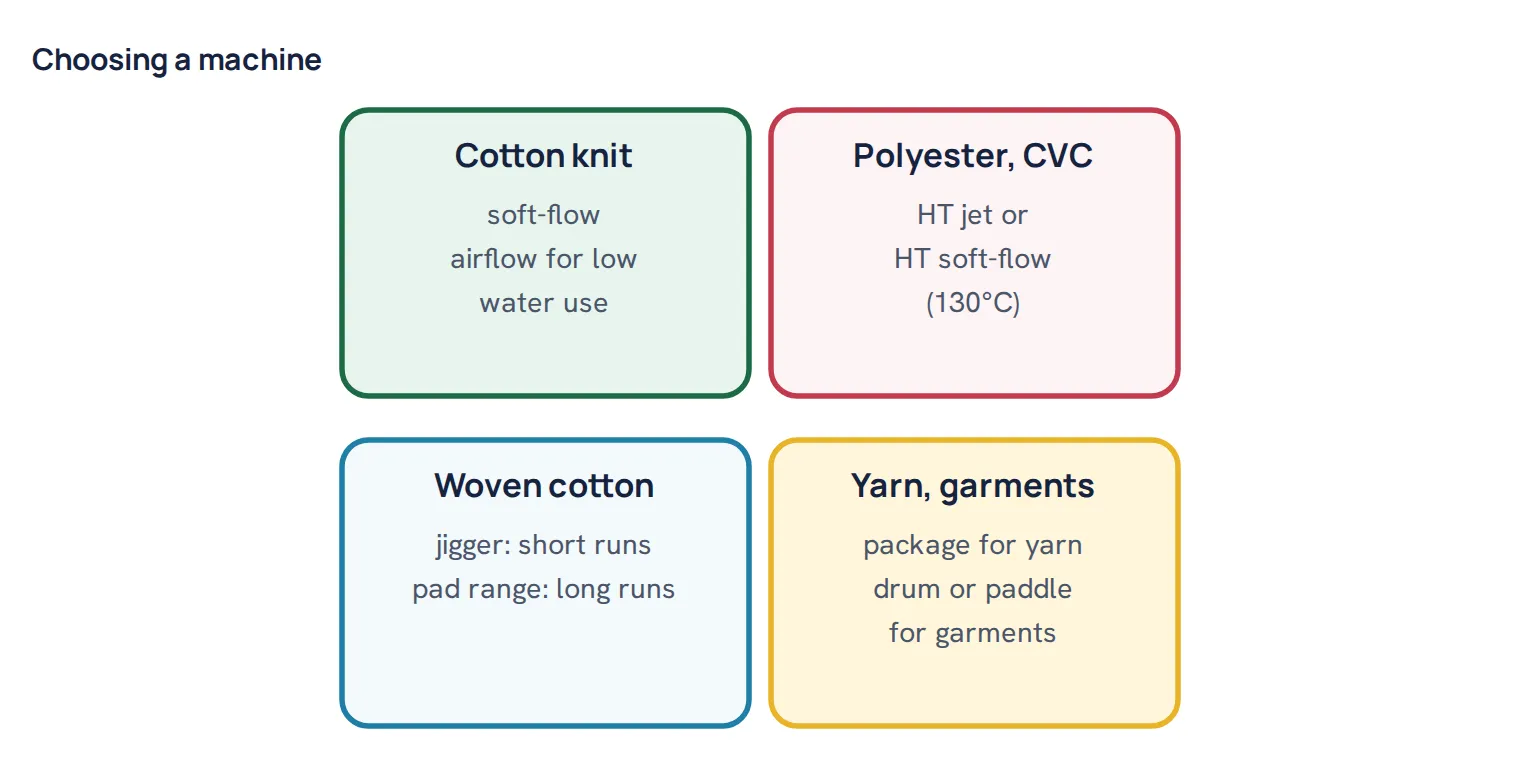
For cotton knit fabric, the usual choice is an atmospheric or HT soft-flow machine; HT is needed only if the same machine must also run polyester blends. Airflow suits mills that want low water use and gentle handling. For woven cotton, jiggers suit short runs and pad-batch or continuous ranges suit long runs. For cotton garments, drum or paddle machines.
Running a knit dyeing machine well
Most knit dyeing faults that are blamed on the dye are really machine faults: overloading, a nozzle set too tight, a slow fabric cycle or rapid cooling. In our crease mark work, the key settings were loading at no more than 80% of capacity, loading the rope straight, an open nozzle, a fabric cycle of about three minutes per round, and keeping heavy fabric at or below 80°C where the process allows; see crease marks in knit dyeing. You can check the cycle time for a given rope length and speed with the dyeing machine cycle time calculator.
Common mistake: filling a soft-flow machine to its full nominal capacity with a heavy fleece to save a batch. The rope moves too slowly, sits folded in the same places for too long and comes out with crease marks that no finishing will remove.
Worked example. A dye house has 400 kg of CVC jersey to dye in a navy shade. It needs an HT machine for the polyester part at 130°C. In a two-chamber HT soft-flow machine rated at 600 kg, loading 400 kg keeps it under 80% of capacity, so the rope cycles quickly and evenly; the same lot in a 400 kg machine would be at full load and at higher risk of crease marks.
Summary
- Machines move the material, the liquor or both; they are atmospheric (98°C) or HT (about 130–140°C).
- Knit fabric is dyed mainly in soft-flow, jet and airflow machines.
- Woven fabric uses jiggers, beams and pad ranges; yarn uses package machines; garments use drums or paddles.
- Choose by material form, the hottest fibre in the blend and lot size, then load and run the machine correctly.
Questions
What are the main types of dyeing machines?
For fabric in rope form: jet, soft-flow, airflow and winch. For open-width woven fabric: jigger, beam and pad ranges. For yarn: package and hank machines. For garments: drum and paddle machines.
Which dyeing machine is used for cotton knit fabric?
Most knit dye houses use soft-flow machines for cotton knit; airflow machines are used where low water use is wanted. HT versions are needed only for polyester blends.
What is the difference between a jet and a soft-flow machine?
Both move a fabric rope with liquor. A jet uses a strong nozzle and moves fabric fast; a soft-flow machine uses a gentler liquor flow and a reel, which is kinder to knit fabric.
What is an HT dyeing machine?
A high-temperature machine is pressurised so the bath can reach about 130–140°C, which is needed to dye polyester with disperse dyes.
What is liquor ratio in a dyeing machine?
It is the ratio of fabric weight to bath volume, such as 1:8, meaning 8 litres of liquor for each kilogram of fabric. Lower ratios save water, energy and chemicals.

Textile engineer with 14+ years in dyeing and fabric development. He writes every guide on Dyeing Solution from real production work. Full profile