Reactive dye bonds to cotton; vat dye is reduced, absorbed and oxidised back to a solid inside it. How the two compare on shade range, cost, light and chlorine fastness, and when vat is worth it.
At a glance
Bondreactive: covalent
Trappedvat: insoluble inside
Chlorinevat’s big strength
Rangereactive’s big strength
Reactive dyes and vat dyes both colour cotton, and both can give excellent fastness. Yet almost every knit T-shirt is reactive dyed, while vat dyes are kept for workwear, uniforms, hospital textiles, outdoor fabrics and denim. The difference is in how each dye gets into the fibre and how it is held there: a reactive dye bonds to cotton, a vat dye is locked inside it as an insoluble pigment. That changes the process, the cost, the shade range and the fastness profile.
This guide compares the two from a dye-house point of view, so you know when a buyer’s requirement really calls for vat dye and when reactive will do.
How reactive dye holds on cotton
A reactive dye is water soluble and carries a reactive group. In the bath, salt drives the dye onto the cotton; then soda ash raises the pH and the reactive group forms a covalent bond with the hydroxyl groups of the cellulose. Some dye reacts with water instead, and that hydrolysed dye must be washed out with hot rinses and soaping. The finished colour is chemically joined to the fibre. See how reactive dyes work for the full sequence.
How vat dye holds on cotton
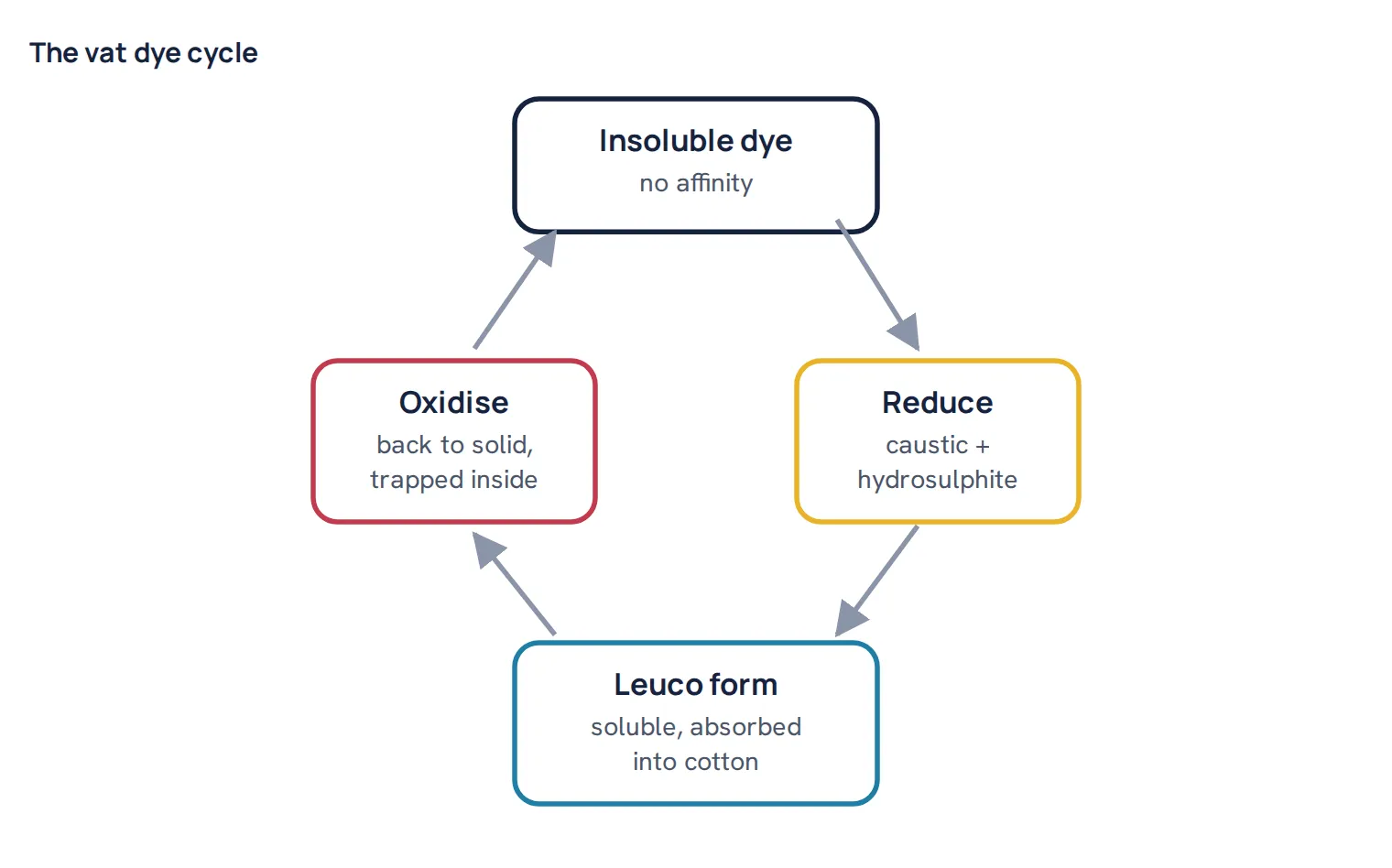
A vat dye starts as an insoluble coloured solid. It has no attraction for cotton in that form. To dye with it, the dyer reduces it in a strongly alkaline bath, usually with caustic soda and sodium hydrosulphite. Reduction turns the dye into its soluble “leuco” form, which has a different colour and good affinity for cotton. The leuco dye is absorbed into the swollen fibre. Then the fabric is oxidised, with air or a mild oxidising agent, and the dye returns to its original insoluble form, now trapped inside the fibre. A hot soaping at the end removes loose particles and develops the final shade. The same idea applies to sulphur dyes; both are covered in how vat and sulphur dyes work.
Reactive vs vat dye at a glance
| Point | Reactive dye | Vat dye |
|---|---|---|
| Form in the bath | Water soluble | Reduced leuco form (made soluble) |
| How it holds | Covalent bond with cellulose | Insoluble pigment trapped in the fibre |
| Key chemicals | Salt, soda ash | Caustic soda, sodium hydrosulphite, oxidiser |
| Shade range | Very wide, bright and deep | Narrower; some bright shades hard to reach |
| Wash fastness | Good to very good after wash-off | Excellent |
| Light fastness | Moderate to good, varies by dye | Very good to excellent |
| Chlorine / bleach | Often weak to moderate | Usually very good |
| Process control | Moderate | Demanding: reduction and oxidation must be right |
| Cost | Lower | Higher dye and chemical cost |
| Typical use | Knit basics, fashion, most cotton | Workwear, uniforms, hospital, outdoor, denim (indigo) |
Why most knit fabric is reactive dyed
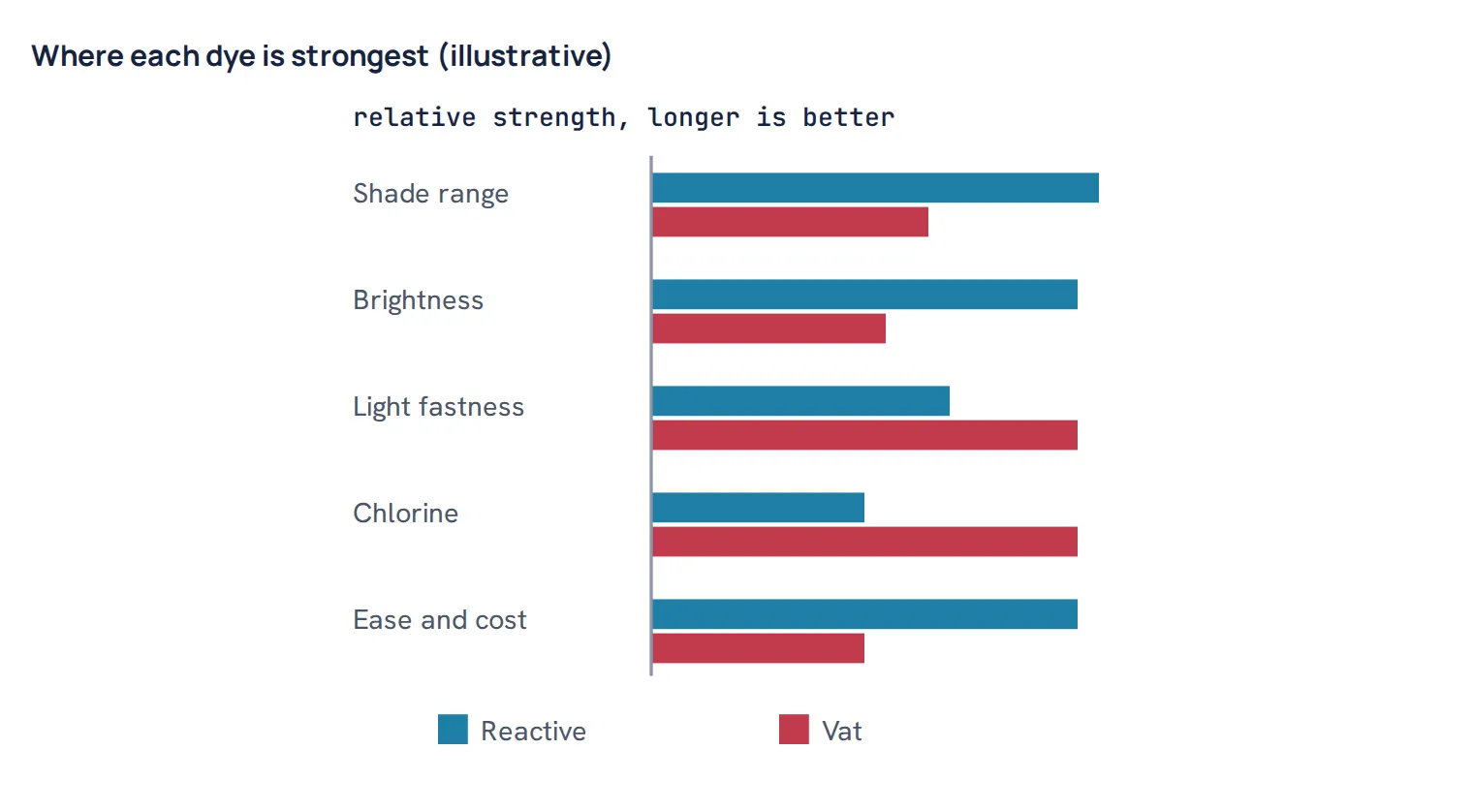
For a knit dye house, reactive dye wins on almost every practical point. The shade range covers everything from pastel to fluorescent-looking brights and deep black. The process runs in standard jet and soft-flow machines at moderate temperatures without a reduction step, and shade matching from lab to bulk is predictable when the process is controlled. Cost per kilo is lower. And for most fashion and basics, the fastness of a properly washed-off reactive shade meets the buyer’s wash, perspiration and rubbing requirements.
The weak points of reactive dyes are the ones vat dyes fix: resistance to chlorine and to repeated hot, harsh laundering, and light fastness in some colours, especially certain blues, turquoises and bright pinks.
When a buyer really needs vat dye
Vat dyes earn their extra cost when the garment will be washed hard, bleached or left in the sun. Typical cases:
- Hospital and hotel textiles washed at high temperature with chlorine-based disinfection.
- Workwear and uniforms that go through industrial laundering for years and must keep the company colour.
- Outdoor and awning fabrics that need the highest light fastness.
- Denim, where indigo, a vat dye, is applied in many dips to build up the ring-dyed yarn that fades in the familiar way.
If the specification asks for chlorine fastness or very high light fastness grades, check whether a reactive selection can meet it before you promise it. Some reactive dyes are much better than others, but a full shade range that passes chlorine is difficult in reactive.
Common mistake: accepting a uniform order on reactive dye because the lab dip passed wash fastness, without asking about chlorine or industrial laundering. The first commercial wash cycle bleaches the shade and the claim comes months later.
Process difficulties with vat dyes
Vat dyeing is less forgiving. The reduction must be complete and stay complete: if the bath loses its reducing power, from too much air or too little hydrosulphite, the leuco dye starts to oxidise early and deposits on the surface, giving poor rubbing and uneven shades. Temperature and caustic level must suit the dye group. Oxidation must be even, and the final soaping at a high temperature is needed to develop the true shade and fastness. Shade checks are harder because the reduced dye looks a different colour in the bath. All of this is why knit dye houses that run mostly reactive dyes rarely keep vat dyeing for small orders.
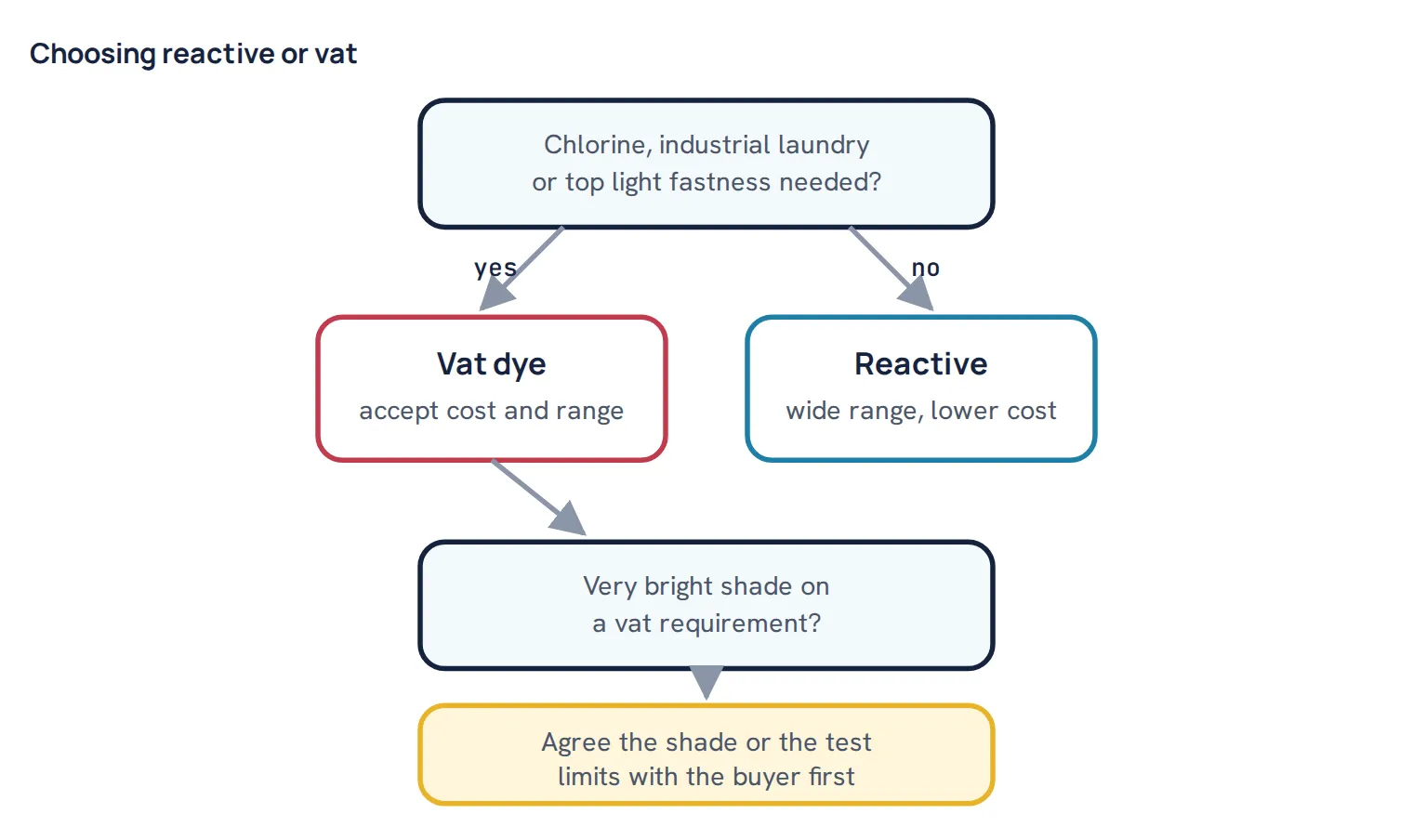
Worked example. A hospital buyer wants a bright turquoise scrub with chlorine fastness grade 4. Turquoise is one of the hardest reactive colours for chlorine, and bright turquoise is hard in vat. The honest options are a slightly duller vat turquoise that passes, or a reactive turquoise with a relaxed chlorine limit. Showing both lab dips with test results lets the buyer choose before bulk.
Environmental and safety side
Reactive dyeing uses a lot of salt and water for wash-off, and the effluent carries colour and salinity. Vat dyeing uses caustic soda and sodium hydrosulphite, which adds sulphur compounds to the effluent and needs careful handling and storage; hydrosulphite can heat up and release harmful gas if it gets damp. Both are manageable with good practice and effluent treatment, but neither is “clean” by default.
Summary
- Reactive dye forms a covalent bond with cotton; vat dye is reduced, absorbed and oxidised back to an insoluble pigment inside the fibre.
- Reactive wins on shade range, brightness, ease and cost; vat wins on light and chlorine fastness and harsh laundering.
- Most knit fabric is reactive dyed; vat is for workwear, uniforms, hospital, outdoor and denim.
- Read the buyer’s test list before choosing, especially chlorine and light fastness.
To see where both fit among all the dye classes, read dye classes explained.
Questions
What is the difference between reactive and vat dyes?
Reactive dye forms a covalent bond with cotton in an alkaline bath. Vat dye is insoluble; it is reduced to a soluble form, absorbed by the cotton, then oxidised back to an insoluble pigment trapped inside the fibre.
Which is more colourfast, vat or reactive?
Vat dyes are generally better for light fastness, chlorine and hard industrial laundering. Reactive dyes give good wash fastness after a proper wash-off and are good enough for most knit garments.
Why is most knit fabric dyed with reactive dye?
Reactive dyes give a wider and brighter shade range, run in standard machines without a reduction step, are easier to match from lab to bulk and cost less.
Is indigo a vat dye?
Yes. Indigo is a vat dye. It is reduced to its soluble leuco form, applied in repeated dips and oxidised in air, which builds the ring-dyed yarn used in denim.
When should I use vat dye instead of reactive?
When the buyer needs chlorine fastness, industrial laundering resistance or very high light fastness, such as hospital textiles, uniforms, workwear and outdoor fabrics.

Textile engineer with 14+ years in dyeing and fabric development. He writes every guide on Dyeing Solution from real production work. Full profile