French terry is a knit with a smooth face and soft unbrushed loops on the back. What it is made of, how it is knitted, French terry vs fleece, typical weights, and how it dyes and shrinks, from more than 1,000 terry parts in our records.
At a glance
Loopsunbrushed on the back
200–350typical GSM
6% vs 10%cotton terry vs fleece shrinkage
1,096terry parts in our records
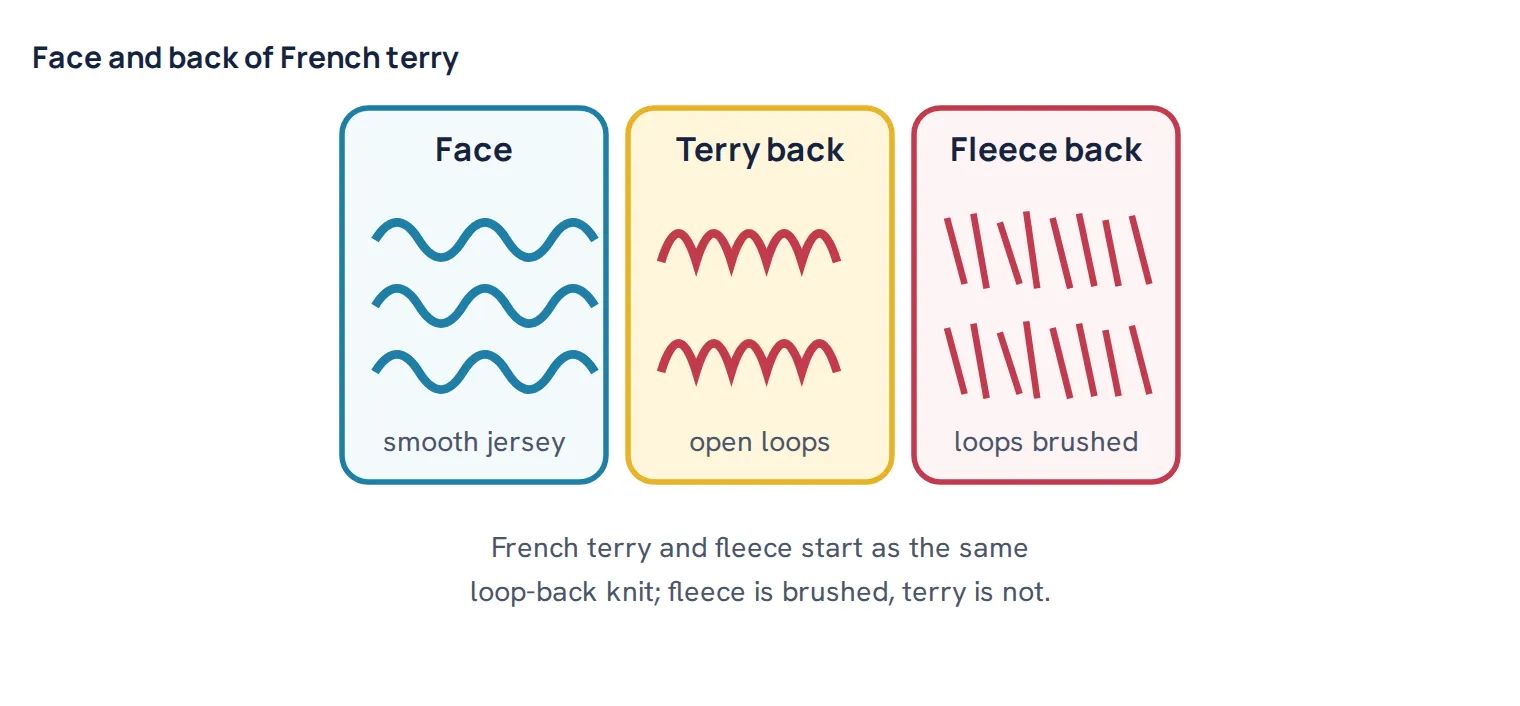
French terry is a knit fabric that is smooth on the face and has soft loops on the back. It is the fabric of many sweatshirts, hoodies, joggers and mid-weight tops. It is made from the same basic loop-back structure as fleece, but the loops are left as they are instead of being brushed. That makes French terry lighter, cooler and more breathable than fleece, and it absorbs moisture well, which is why it is so popular for loungewear and spring and autumn garments.
This guide explains what French terry is made of, how it is knitted, French terry versus fleece and other fabrics, typical weights, and how it behaves in dyeing and washing, using our own development and finishing records of more than a thousand terry fabric parts.
What French terry is made of
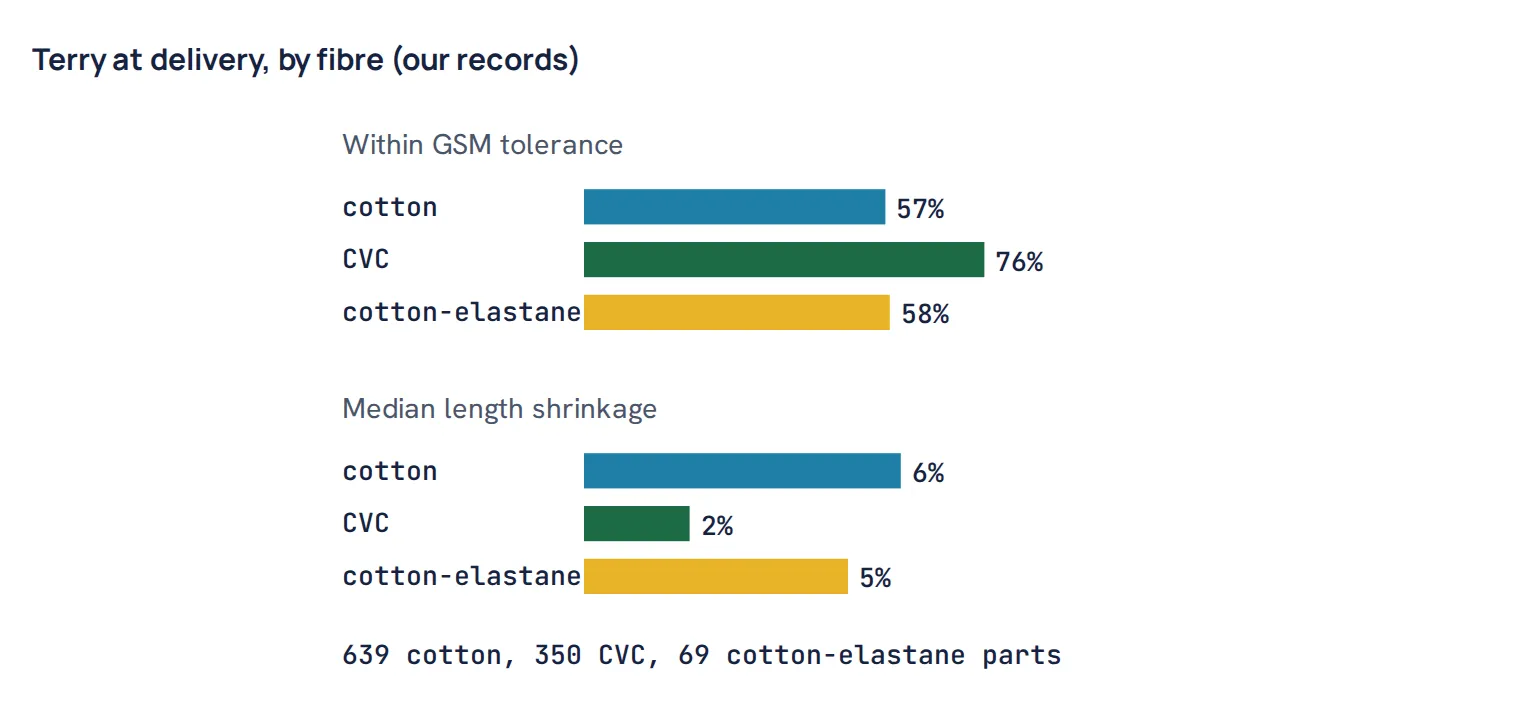
French terry is most often made from cotton or a cotton-polyester blend (CVC), sometimes with elastane for stretch, or with modal or viscose for a softer, drapier handle. In our records, 639 of 1,096 terry parts were 100% cotton and 350 were CVC, mostly 60/40, 75/25 and 80/20 cotton/polyester; a smaller group contained elastane.
The fibre changes the feel and behaviour: cotton gives the classic soft, absorbent terry; CVC holds its shape and size better; elastane adds stretch for fitted joggers and dresses.
How French terry is knitted
French terry is a weft knit made on a circular machine. A ground yarn forms a normal single jersey face, and a second, usually coarser, loop yarn is laid in so that it forms loops on the back. There are two main types:
- 2-thread terry: one ground yarn and one loop yarn. Lighter, with small loops; “baby terry” is a fine 2-thread terry.
- 3-thread terry: a face yarn, a fine tie yarn and a loop yarn. The tie yarn binds the loop yarn in, so heavier, more stable fabrics are possible.
In our two most common constructions, the ground yarn is 30/1 cotton for 3-thread terry and 24/1 cotton for 2-thread, and the most common loop yarn in 3-thread is 12/1 cotton. Full details are in the French terry development guide.
French terry vs fleece
| Point | French terry | Fleece |
|---|---|---|
| Back | Loops left intact | Loops brushed into a fluffy pile |
| Warmth | Moderate | Warmer: brushed pile traps air |
| Breathability | Better | Lower |
| Typical weight | About 200–350 GSM | About 250–400 GSM |
| Season | Spring, autumn, loungewear | Autumn, winter |
| Shrinkage (cotton, our median) | 6% length | 10% length |
| Pilling | Can pill on the loop side | Pills more on the brushed side |
In our finishing records, 100% cotton terry shrank a median 6% in length after the wash test, against 10% for cotton fleece, because brushing opens up fleece loops so they relax more. See the fleece development guide for the brushed version.
French terry vs other fabrics
- French terry vs cotton jersey: jersey is a single layer, lighter (typically 140–200 GSM) and smooth on both sides; terry is heavier and has loops on the back.
- French terry vs towelling terry: towel terry is usually a woven fabric with loops on both sides; French terry is a knit with loops on one side only.
- French terry cotton vs CVC terry: cotton is softer and more absorbent; CVC is steadier in size and weight.
Typical weights
Terry requests in our records were typically about 200 to 350 GSM, with baby terry at the light end. In one common 3-thread cotton construction, the median finished GSM equalled the required 300 GSM, and the middle half of lots sat between 290 and 315 GSM.
How French terry is dyed and finished
French terry is dyed in rope form in soft-flow machines, usually with the loop side inside to protect the loops. Tight or heavy terry is prone to crease marks, so heavy and tight qualities are often heat set first, and machine loading and temperature are kept under control. Cotton-elastane terry is almost always heat set (99% in our records). After dyeing, terry may be singed or given an enzyme treatment to reduce hairiness and pilling, then dried and compacted to control shrinkage. Some terry is given a light peach finish on the face. The full routes are in the French terry dyeing and finishing flowchart.
Common mistake: treating heavy cotton terry like single jersey in the jet. Its thick, stiff rope folds and sits in the same place, and crease marks appear that finishing cannot remove.
Caring for French terry
- Wash at 30–40°C, inside out, to protect the face and reduce pilling on the loops.
- Avoid very hot tumble drying, which increases shrinkage, especially on 100% cotton.
- Expect cotton terry to shrink a little in the first washes; CVC terry much less.
Worked example. A brand wants a light hoodie for spring that does not shrink much. A 280 GSM CVC 60/40 French terry is a good choice: lighter and more breathable than fleece, and in our records CVC terry shrank a median of only 2% in length. A 100% cotton terry would be softer but would need more careful compaction to stay within a typical 5% shrinkage limit.
Summary
- French terry is a knit with a smooth face and unbrushed loops on the back.
- It is usually cotton or CVC, sometimes with elastane, modal or viscose.
- Fleece is the same structure with the loops brushed; it is warmer, terry is more breathable.
- Typical weights are about 200–350 GSM.
- CVC terry is the most stable in size and weight; cotton terry shrinks more.
Towel terry: for the looped fabric of towels and robes, and how it compares with French terry and fleece, see what is terry cloth.
Questions
What is French terry fabric made of?
Usually cotton or a cotton-polyester blend (CVC), sometimes with elastane for stretch or modal and viscose for softness. In our records most terry was 100% cotton or CVC.
What is the difference between French terry and fleece?
Both start as the same loop-back knit. Fleece has its loops brushed into a fluffy pile, making it warmer; French terry keeps its loops, so it is lighter and more breathable.
Is French terry warm?
Moderately. It is warmer than jersey but cooler and more breathable than fleece, which makes it good for spring, autumn and loungewear.
Does French terry shrink?
Cotton French terry can shrink a few percent; in our records the median was 6% in length after washing. CVC terry shrank much less, a median of 2%.
What weight is French terry?
Typically about 200–350 GSM, with light baby terry at the low end and heavy 3-thread terry at the top.

Textile engineer with 14+ years in dyeing and fabric development. He writes every guide on Dyeing Solution from real production work. Full profile