
A step-by-step development guide for French terry, baby terry and diagonal terry: ground and loop yarns, sinker height, stitch lengths, low-tension dyeing and finishing, GSM and width control, skew and pilling, built on our real records.
At a glance
885terry entries in our register
-2.8%median finished vs required GSM
68%entries finished within ±5% GSM
+8.6%median GSM gain after the wash test
French terry is the fabric behind most lightweight sweatshirts, joggers, hoodies for warm climates and baby wear. On the face it looks like a clean single jersey. Turn it over and you find rows of small yarn loops. Those loops make it soft, absorbent and bulky without making it hot, and they are also what makes it harder to develop than plain jersey. The loops have to be the right height, they must survive dyeing and finishing without being pulled flat, and the fabric must still hit the buyer’s GSM, width, shrinkage and skew limits. This guide walks through terry development from yarn to tested fabric. It covers French terry (loop-back terry that is not brushed), including baby terry and diagonal terry, and it is built on real figures from our development records: 885 terry entries in our fabric register and 18 terry lab reports. Where a value comes from general practice rather than our records, it is marked as typical. If you are new to knit development, read the single jersey fabric development guide first, because terry is built on a single jersey ground.
What terry is
Structure: ground yarn, loop yarn and loops on the back
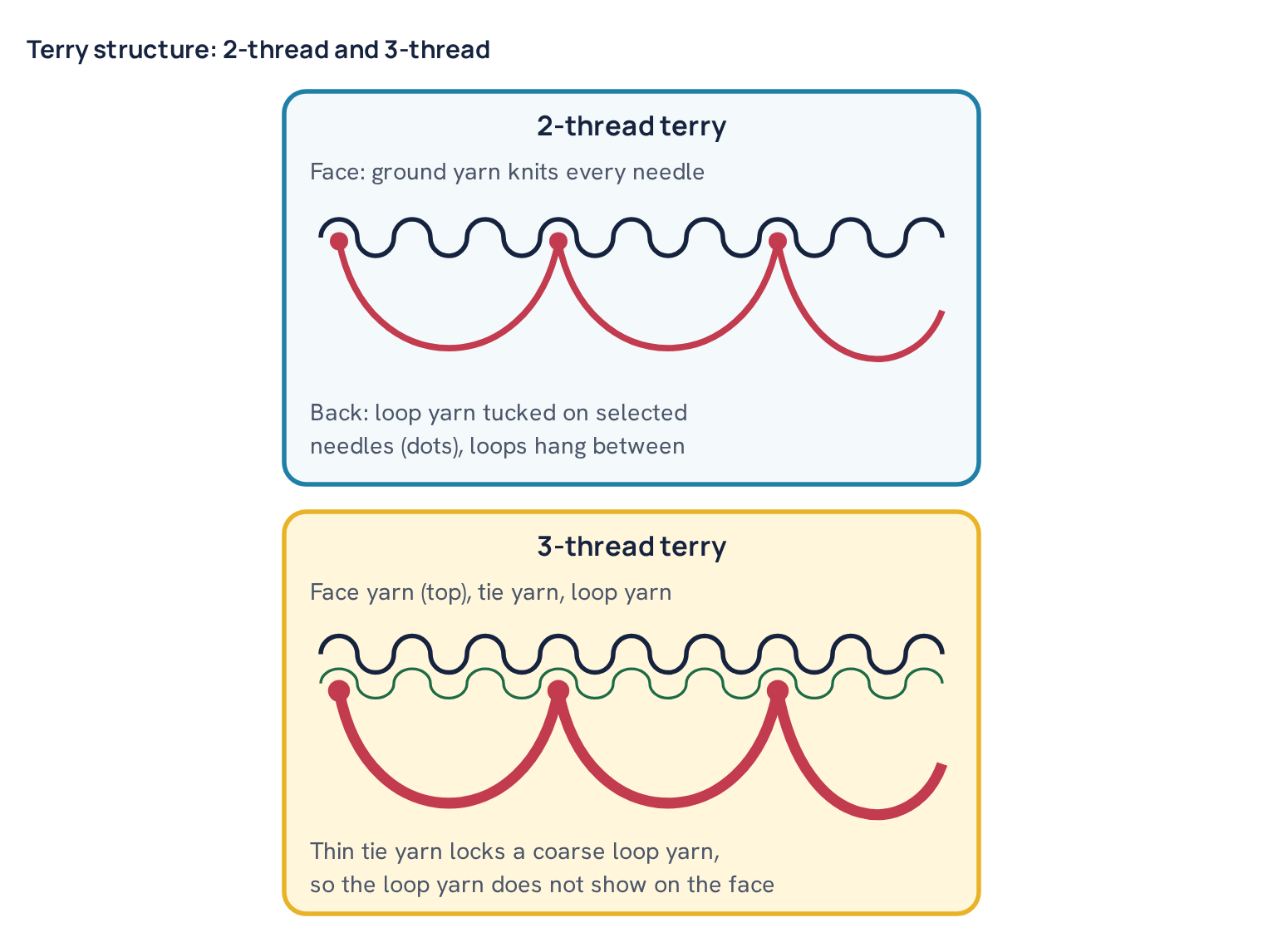
Terry in a knit dye house means a weft knitted loop-back fabric made on a single cylinder circular machine. It has two kinds of yarn:
- Ground yarn. It knits on every needle and forms a normal single jersey. This is the technical face, the smooth side of the garment.
- Loop yarn. It is not knitted into every loop. It is tucked into the ground on selected needles and lies across the other needles as a long loop or float on the technical back. This is the loop side.
Because the loop yarn only holds on at the tuck points, it can be thicker and softer than the ground yarn. It adds weight, bulk and absorbency on the back, while the face stays clean enough to print or to wear outside.
There are two main constructions:
- 2-thread terry. One ground yarn and one loop yarn. It is lighter and simpler. Baby terry is usually a fine 2-thread terry with small, short loops.
- 3-thread terry. A face yarn, a fine tie (binding) yarn and a loop yarn. The tie yarn locks the loop yarn into the ground, so a much coarser loop yarn can be used without it showing through on the face. This gives the heavier sweatshirt terry.
Why French terry is not brushed
Fleece starts from the same 3-thread loop-back structure. The difference is in finishing. For fleece, the loop side is brushed (raised) so the loops are torn open into a soft fibrous pile. For French terry, the loops are kept intact. The buyer wants them as they are:
- Intact loops absorb sweat and dry faster than a raised pile, which suits sportswear and summer sweatshirts.
- The fabric is cooler and lighter in feel than fleece of the same weight, because there is no trapped air layer in a pile.
- No raising means no raising loss in weight and strength, and fewer loose fibres to pill.
So the whole development aim for terry is different from fleece. For fleece you want a loop yarn that raises well. For terry you want loops that stay round, even and unbroken through every wet and dry process. A detailed comparison of the brushed fabric is in the fleece fabric development guide.
Variants in our register
Our register records terry under several names, including baby, Lycra, design, diagonal and 3-butt diagonal terry. They fall into these groups:
- French terry (2-thread or 3-thread). The standard loop-back sweatshirt and jogger fabric.
- Baby terry. A fine, light 2-thread terry with small loops, used for baby wear and light tops.
- Diagonal terry. The tuck points of the loop yarn move one needle along in each loop course, so the loops form diagonal lines on the back, like a twill. The “3-butt” name refers to the needle butt arrangement used to select the tucks. It looks attractive on the loop side but brings a skew risk, covered later.
- Lycra terry. Elastane is plated with the ground yarn for stretch and recovery. It needs heat setting.
- Design terry. Patterned loop arrangements using needle selection.
By fibre, our 885 terry entries are 498 cotton, 211 CVC or PC with elastane, 119 CVC or PC, 55 cotton with elastane and 2 other fibres with elastane. So cotton terry is the largest group, but about 8% of entries contain elastane and about 37% contain polyester.
Development inputs
The buyer’s request
Write down every requirement before choosing yarn. For terry the request usually contains:
- Finished GSM with tolerance, often ±5%. Terry requests are heavier than jersey, typically about 200 to 350 GSM, with baby terry at the light end.
- Finished width in cm or inches, open width.
- Composition, for example 100% cotton, CVC 60/40, or cotton/polyester with elastane. In terry the face and the loop yarn can be different fibres, so ask which composition is meant for the label.
- Loop side: plain terry, baby terry or diagonal, and whether the loop side may be singed or must stay untouched.
- Shade and the approval light source.
- Wash care, which decides the shrinkage and fastness test conditions.
- Tests: dimensional stability, spirality or skew, GSM, bursting strength, pilling (often on the loop side), colour fastness and fibre content.
Choosing the yarns
Ground or face yarn. This yarn makes the visible face, so it decides the surface look, print quality and most of the strength. Combed ring or compact cotton is the usual choice. In the two most common constructions in our records the ground yarn is 30/1 cotton (3-thread) and 24/1 cotton (2-thread).
Loop yarn. It is held only at the tuck points, so it can be coarse and soft. In our most common 3-thread construction the loop yarn is 12/1 cotton. A low-twist, soft loop yarn gives fuller, rounder loops and better absorbency, but it also sheds more fibre and pills more easily. Open-end loop yarn is used for cheaper terry because it is bulky and even, but it gives a harsher loop. Carded loop yarn is cheaper again but hairier.
Tie yarn (3-thread only). A fine yarn, often a fine cotton count or a polyester filament, that binds the loop yarn. It must be strong and even, because a weak or broken tie yarn lets loops pull out.
Twist and spirality. As in jersey, residual twist in the ground yarn leans the loops and causes spirality. In terry the loop yarn also has twist, and because it is coarse and lightly held it can twist the loops on the back. Balanced, lower-twist yarns reduce this. Spirality has not been a problem in our terry lab reports (0 fails in 20 results), so the usual knitting yarns are working.
Common mistake: switching to a cheaper or different-lot loop yarn between trial and bulk. The loop yarn carries a large share of the fabric weight, so a small count difference changes GSM, and a different twist or hairiness changes pilling and shade depth on the loop side.
Knitting
Gauge and diameter
Terry is knitted on single jersey circular machines fitted with loop-back (terry or fleece type) sinkers and a cam arrangement that can tuck the loop yarn on selected needles. In our register the gauge is mostly 20G (512 of 885 entries), then 24G (179) and 16G (159), with a few 14G and 12G entries for very heavy fabric. Coarser gauges carry the heavier 3-thread constructions; 24G carries finer 2-thread terry and baby terry.
Diameter decides the width. The most used diameters are 30 inch (430 entries) and 34 inch (278), then 32 inch (126), with a few 28 and 36 inch. The needle count is diameter × π × gauge, and the finished width is that needle count divided by the finished wales per cm, as explained in the single jersey guide.
Sinker height and loop length
Two different lengths matter in terry, and they are controlled differently.
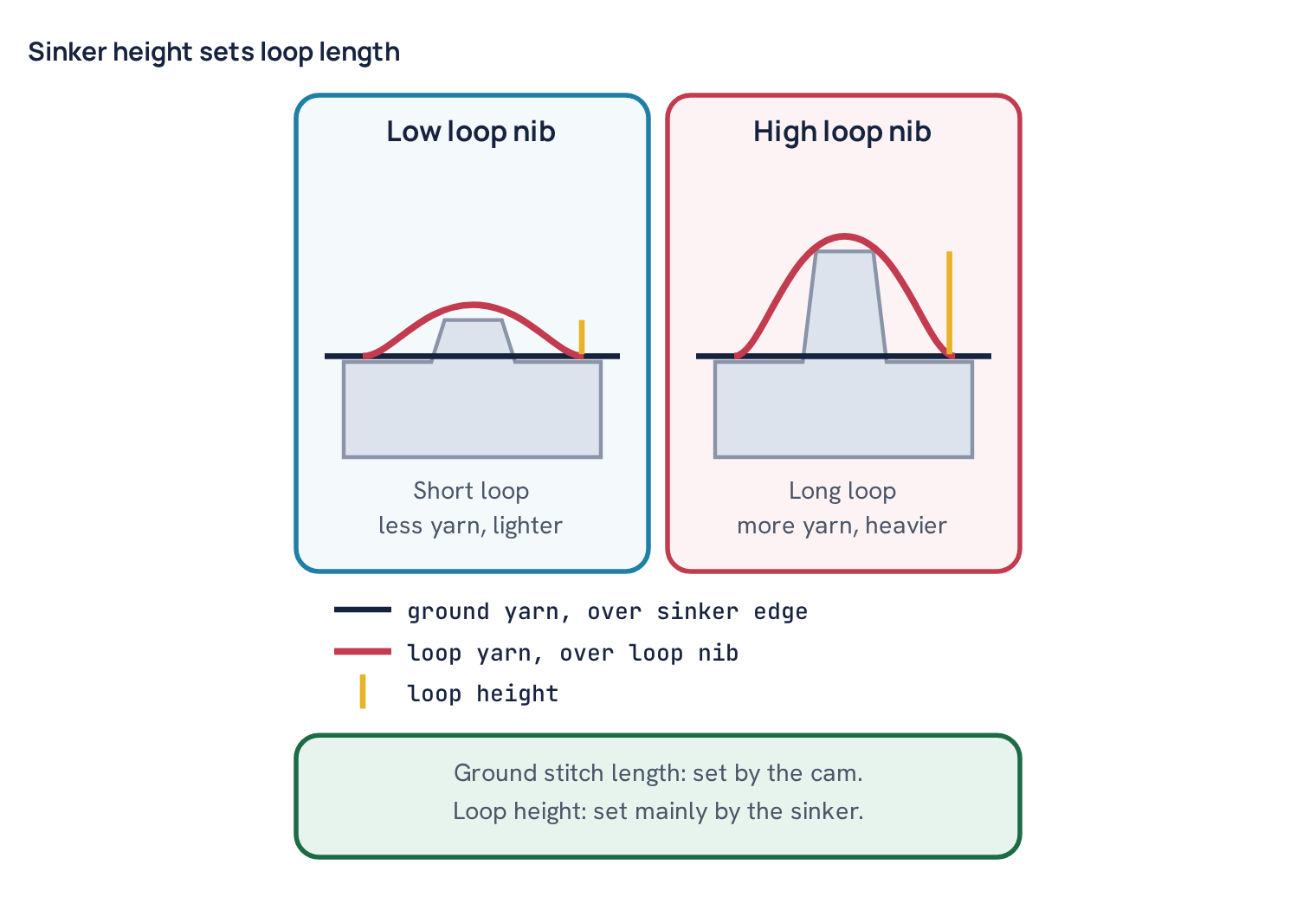
- Ground stitch length. The length of yarn in one ground loop. It is set by the stitch cam, as in jersey, and it controls the tightness of the face.
- Loop length (loop height). How much loop yarn hangs between tuck points. The loop yarn is drawn over a raised step on the sinker, often called the loop nib, while the ground yarn is drawn over the normal sinker edge. The height of that step mainly decides the loop height. A higher step gives a longer, fuller loop, more loop yarn per course and a heavier fabric.
The practical point is that loop height is a hardware choice. To change it substantially you change the sinker set, which takes time. Choose the sinker height for the target loop and GSM before the trial, and use the stitch cam for fine adjustment of the ground.
Stitch lengths as recorded
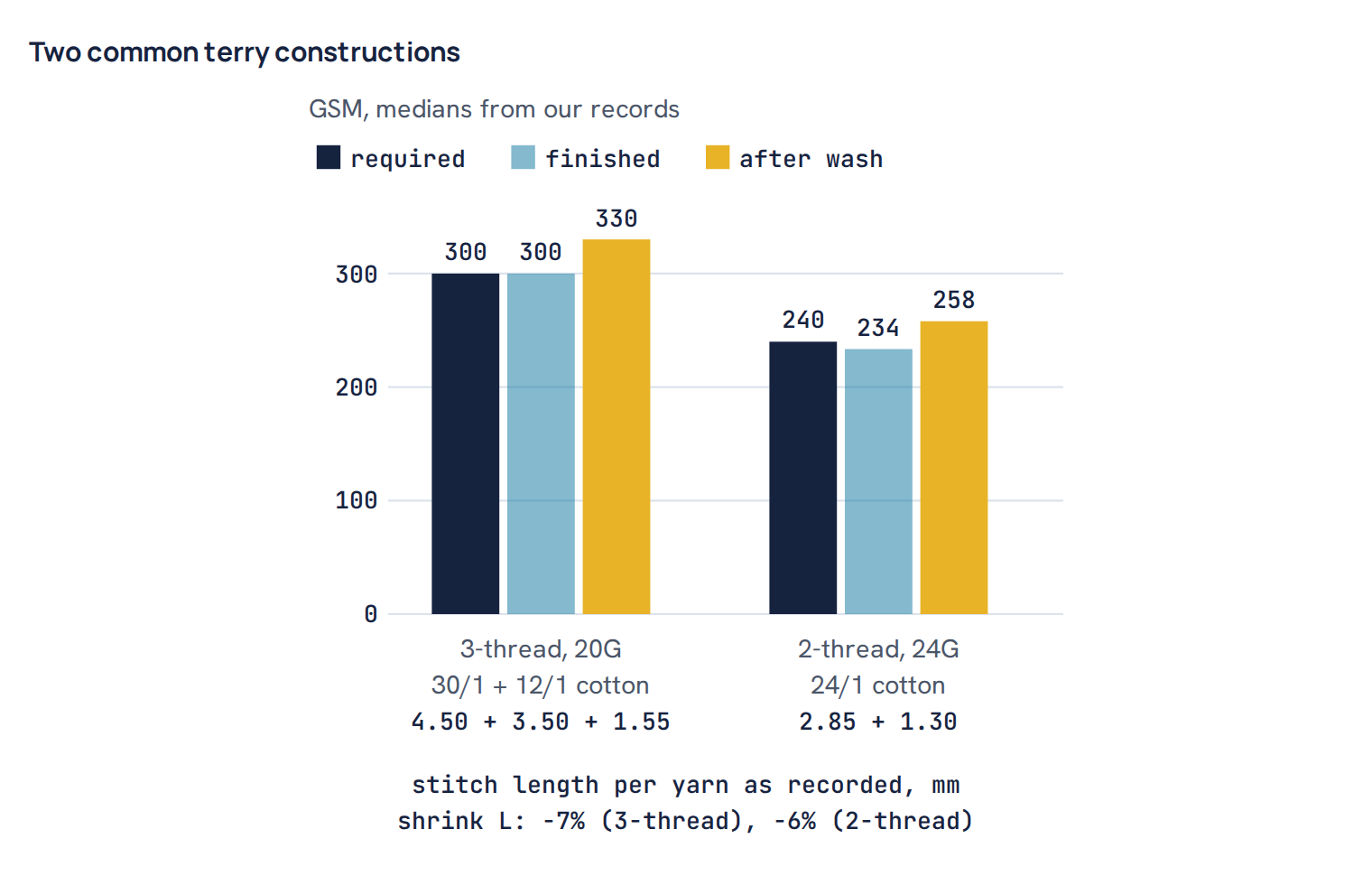
For multi-yarn fabrics our register records one stitch length per yarn, in yarn order, joined with a plus sign. For a 3-thread terry that means three values (face, tie and loop yarn), and for a 2-thread terry two values (ground and loop yarn). The values below are the stitch length per yarn as recorded.
Most terry entries in our register are spread across many different yarn combinations. Only two constructions appear often enough to summarise reliably, so the table is short:
| Yarn | Type | Gauge | Entries | Stitch length per yarn as recorded, mm | Required GSM | Finished GSM | GSM after wash | Finished dia, cm | Shrink L / W, % | Spirality, % |
|---|---|---|---|---|---|---|---|---|---|---|
| 30/1 cotton + 12/1 cotton | 3-thread | 20G | 44 | 4.50 + 3.50 + 1.55 (n=41) | 300 | 300 (290–315) | 330 | 188 | -7 / -2 | 2 |
| 24/1 cotton | 2-thread | 24G | 29 | 2.85 + 1.30 (n=29) | 240 | 233.5 (230–242) | 258 | 174 | -6 / -2 | 2 |
The finished GSM figures are medians with the interquartile range (the middle half of entries) in brackets. Shrinkage is from the dye-house wash test. Three things stand out:
- The heavy 3-thread terry finishes on target. The median finished GSM equals the required 300, and the middle half of lots sits between 290 and 315.
- The 2-thread 24/1 terry finishes slightly light, 233.5 against 240, which is about 3% light and inside a ±5% tolerance.
- Both gain weight in the wash test, to 330 and 258 GSM, and both shrink 6 to 7% in length. That is the loop-back fabric relaxing once it is free of the tension it carried through finishing.
GSM, counts and the calculator
For a single yarn fabric, GSM = courses per cm × wales per cm × stitch length (mm) × tex ÷ 100. For terry the same idea applies, but you add the mass of each yarn: ground yarn plus loop yarn (plus tie yarn), each with its own length per course and its own tex. You can use the knit GSM from stitch length calculator yarn by yarn and add the results, or check a finished swatch with the GSM calculator.
Terry-specific knitting points
- Tuck selection. Common repeats tuck the loop yarn on one needle in three or one in four. A closer repeat holds the loops more firmly and makes shorter floats; a wider one gives longer, freer loops that snag and pill more.
- Loop yarn tension. The loop yarn must be fed evenly at every loop feeder. A feeder that runs tighter gives short loops in that course, which shows as a horizontal bar on the loop side and as GSM variation. See barre in knit fabric.
- Grin-through. If the loop yarn is too coarse for the ground, or the tie yarn is too slack, the loop yarn shows through on the face as small dots.
- Elastane in Lycra terry. Elastane is plated with the ground yarn, usually at a positive feeder with a controlled draft. Record the draft at every feeder.
- Diagonal terry. The tuck point moves one needle per loop course, controlled by the butt arrangement. Record the butt set-up and the direction of the diagonal on the trial sheet, because it affects skew.
Machine settings to record
- Machine number, diameter, gauge, number of feeders and the feeder sequence (ground, tie, loop).
- Sinker type and loop nib height.
- Tuck repeat and butt arrangement (especially for diagonal and design terry).
- Count, type, supplier and lot of each yarn.
- Stitch length per yarn as measured, in yarn order.
- Yarn input tension per yarn, and elastane draft if used.
- Take-down tension, machine speed, greige tubular dia, greige GSM and roll weight.
Greige inspection
Inspect the greige on both sides. On the face, look for holes, needle lines, drop stitches, grin-through and oil stains. On the loop side, look for missing loops, short-loop bars, pulled loops and uneven loop height across the width. Measure greige GSM and dia after the roll has rested.
Dyeing and finishing route
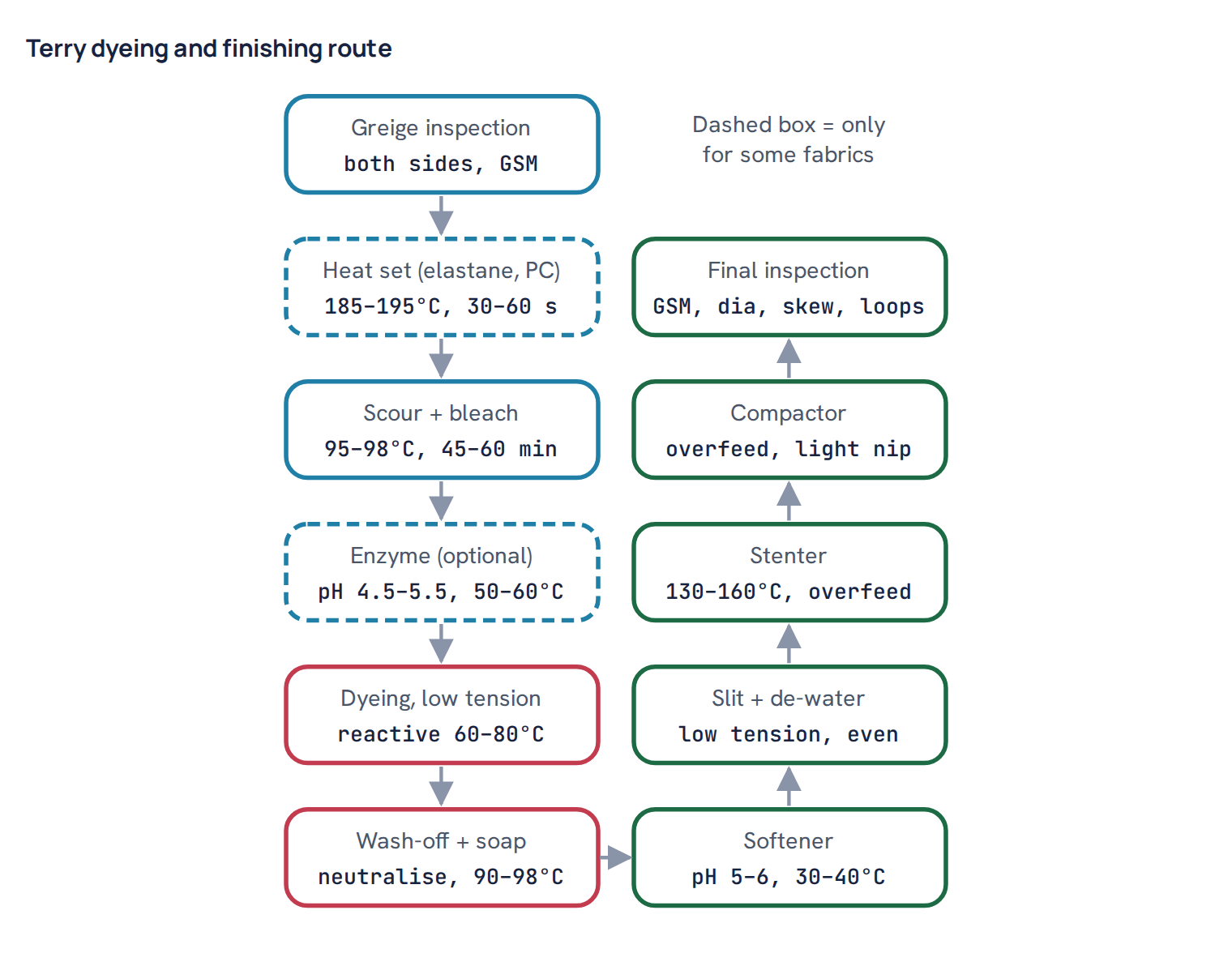
Almost every terry entry in our register, 884 of 885, follows the open-width route with stenter and compactor; one entry was dried on a relax dryer only. About a quarter of entries (24%) are flagged as heat-set, which matches the share of fabrics that contain elastane or polyester. A small number are flagged for singeing: 14 on the loop side, 5 general, and 4 with singeing, continuous scouring and a peach finish before dyeing. A shorter overview is in the French terry dyeing and finishing flowchart; the full wet processes are in 100% cotton knit dyeing process, CVC fabric dyeing process and cotton elastane (Lycra) knit dyeing process.
The main rule: protect the loops
Every step in terry processing should be judged by one question: does it pull, crush or rub the loops? Loops that are stretched in length become flat and long, the fabric loses bulk and GSM, and it shrinks more when the consumer washes it. Loops that are rubbed hard become fuzzy and pill. Loops that are crushed under heavy pressure lose their round, springy feel.
- Heat setting (elastane or polyester). Typically about 185 to 195°C for 30 to 60 seconds at the planned width, before wet processing. It fixes the elastane and stabilises the polyester so the fabric holds its width and does not curl. Keep the overfeed generous so the loops are not stretched in length on the pins.
- Scouring and bleaching. Caustic soda, hydrogen peroxide, stabiliser and wetting agent, typically 95 to 98°C for 45 to 60 minutes. The thick loop yarn needs good wetting; poor penetration into the loop yarn shows later as a lighter, uneven loop side.
- Enzyme (bio-polishing), if required. Acid cellulase at about pH 4.5 to 5.5 and 50 to 60°C, then deactivate. It cleans the loop surface and can improve pilling, but on terry it also attacks the soft loop yarn, so keep the dose and time moderate and check weight and bursting strength.
- Dyeing. Reactive dyes for cotton, with fixation typically 60 to 80°C at about pH 10.5 to 11 depending on the dye. CVC and PC terry need a disperse dyeing step for the polyester, typically at 130°C. Terry is heavy and bulky, so load the machine below its jersey capacity, use enough liquor, and run at moderate reel and nozzle speed. Too much speed and pressure abrade the loop side; too little circulation causes crease marks, which are a known risk on heavy knits. Running the tube with the loop side inside protects the loops from rubbing against the machine. For level results see level dyeing and uneven shades and how reactive dyes work.
- Wash-off. The thick loop yarn holds a lot of liquor and unfixed dye, so terry needs thorough rinsing and soaping near the boil. Poor wash-off shows as poor wet rubbing.
- Softener. Typically 30 to 40°C and pH 5 to 6.
- Slitting and de-watering. Slit on the marked needle line, and keep the squeeze or extraction even and gentle.
- Stenter. Typically 130 to 160°C for cotton, with good overfeed and only the width stretch you need. Do not dry elastane terry hotter than its heat set. This is also where skew is corrected if the stenter has a straightener.
- Compactor. Steam and overfeed compact the length. Use a light nip or blanket pressure so the loops are not crushed flat.
Common mistake: running terry through the stenter at the speed and width stretch used for jersey. The loops are pulled long, the finished GSM drops, and the length shrinkage in the customer’s wash rises sharply.
Hitting finished GSM and width
What our records show
Terry finishes closer to target than single jersey does. Across 861 terry entries with both values, the median finished GSM is 2.8% below the required GSM. 68% of entries finish within ±5% of the requirement, 28% finish more than 5% light, and only 4% finish more than 5% heavy. For comparison, cotton single jersey in our records finishes a median 5% light, with only about half within ±5%.
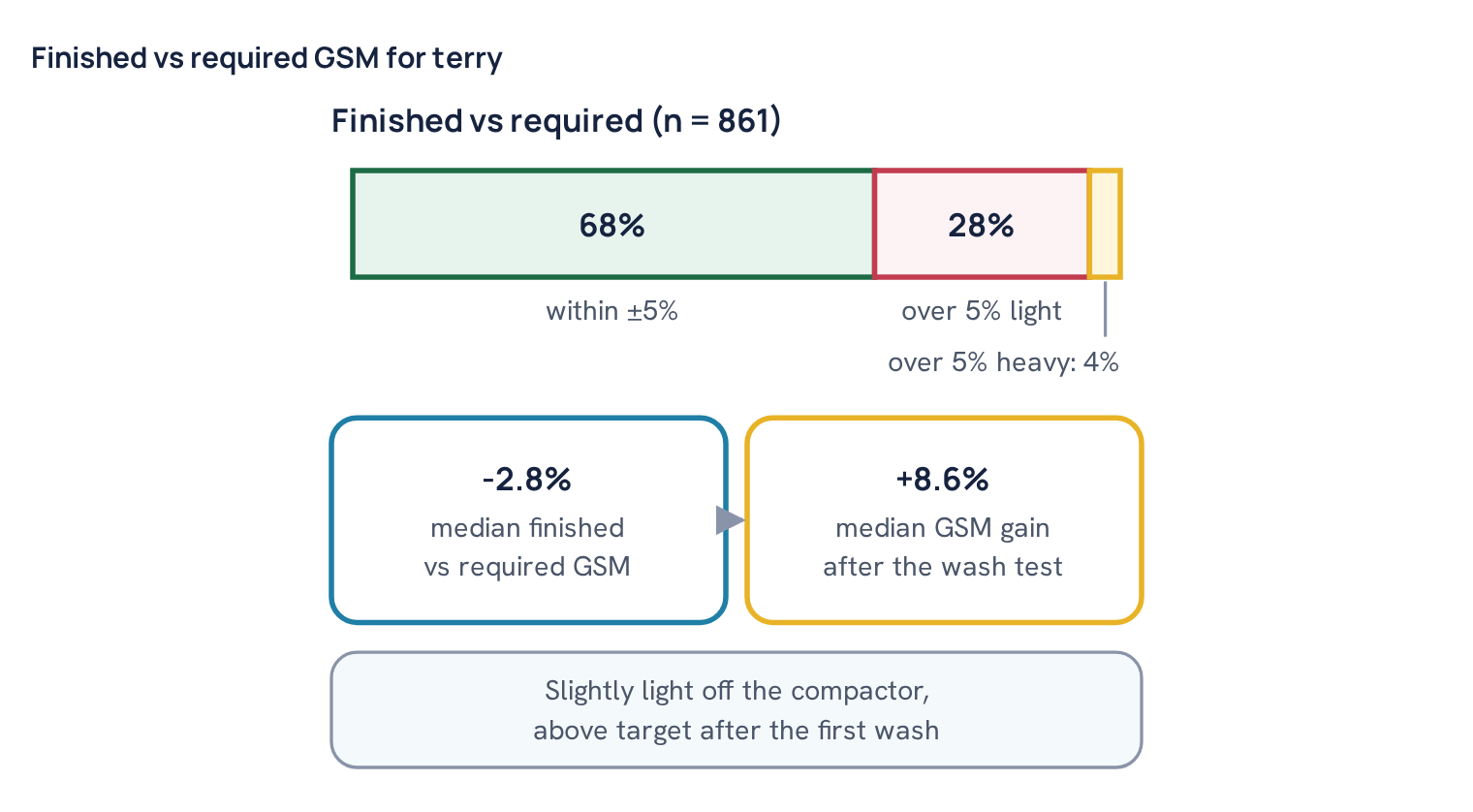
The other important number is the GSM change after the dye-house wash test: a median gain of 8.6% across 858 entries. In the two common constructions above, the 300 GSM 3-thread terry went to 330 after washing and the 240 GSM 2-thread terry to 258. So a terry lot that meets its finished GSM will usually be heavier than required after the first wash, and its length will shrink by 6 to 7% in the dye-house test.
Why terry behaves this way
- The loops store length. A loop-back fabric has a lot of yarn that is only loosely held. Under tension in wet processing and on the stenter, that yarn is pulled into the length of the fabric. When the fabric is washed and tumble dried, the loops recover and the fabric draws up in length, so GSM rises.
- Width stretch on the stenter. Width gained there is taken from GSM.
- Compaction limits. The compactor can remove only so much length before it starts to crush the loops. A finisher who protects the loops with a light nip may leave some shrinkage in.
Width and shrinkage
The two common constructions finish at 188 cm (3-thread, 20G) and 174 cm (2-thread, 24G) open width. Width shrinkage in the dye-house wash test is about -2% for both, while length shrinkage is -6% to -7%. The answer is more relaxation and compaction, not a heavier construction. Use the fabric shrinkage calculator to see what a given shrinkage does to garment size, and the fibre comparison in our knit GSM and shrinkage by fibre study.
How to plan greige GSM and dia
- Choose the construction (2-thread or 3-thread), gauge and sinker height that give the required GSM range, starting from a recorded construction where you have one.
- Knit a short trial and record the stitch length per yarn, greige GSM and greige dia.
- Run the trial through the full bulk route at low tension, not through a lab shortcut, because terry is sensitive to tension.
- Measure finished GSM, width and the GSM and shrinkage after the wash test.
- If finished GSM is low but after-wash GSM is above target, improve relaxation: more overfeed, less width stretch, more compaction within what the loops can take. If both are low, raise the loop height or ground tightness, or use a coarser loop yarn.
Skew on diagonal terry
All tubular knits tend to lean: the wales do not stay at right angles to the courses. In plain terry this is spirality from yarn twist and feeder count, and it is usually small. In diagonal terry there is an extra cause. The loop yarn’s tuck points move one needle along with each loop course, so the loops form a diagonal line on the back. That built-in diagonal can pull the fabric into a slight bias, and the result is skew: the courses are no longer square to the wales, and after washing the garment side seams can twist.
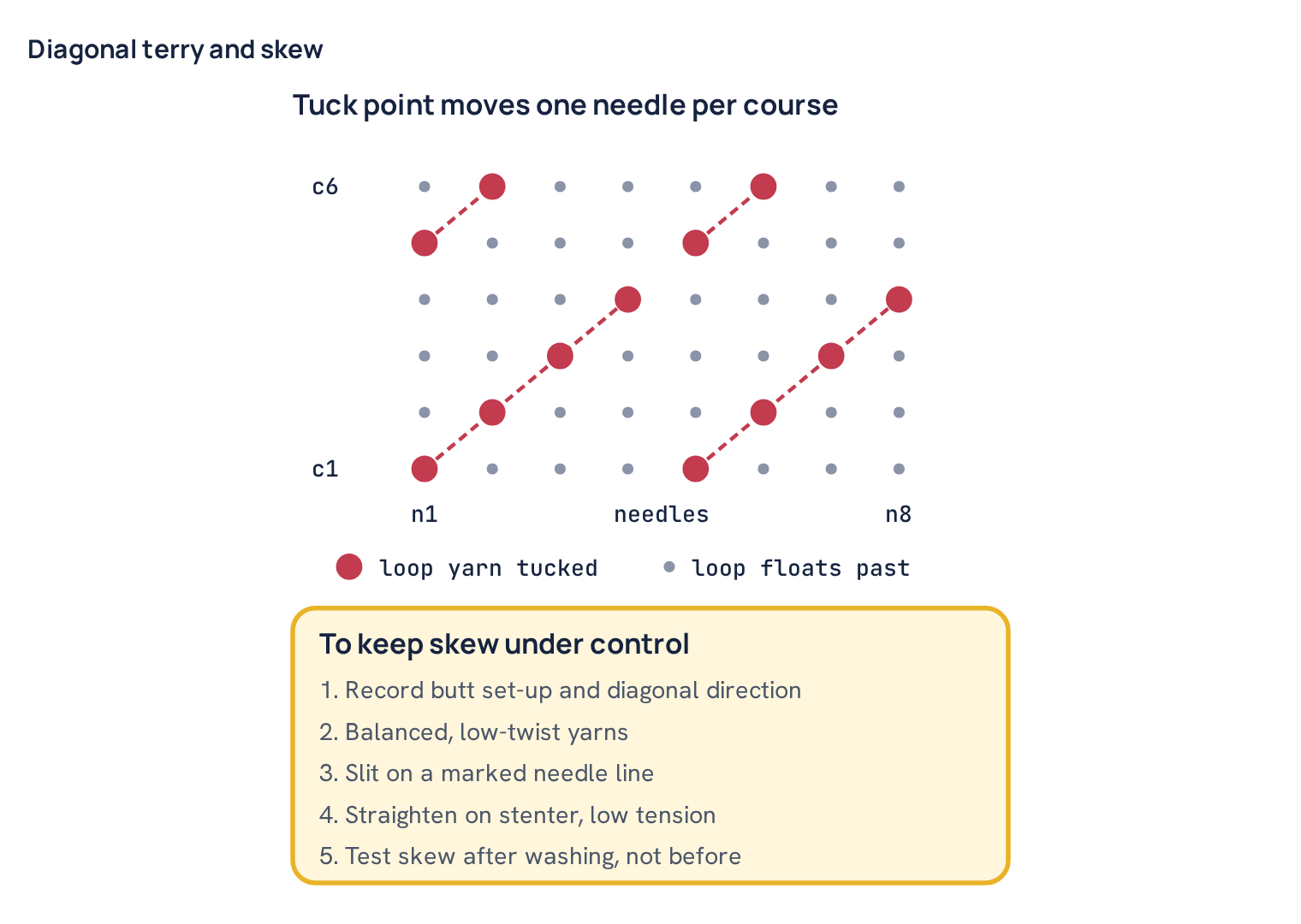
Our lab data on skew is very thin: only one skew result in the terry reports, and it failed. It is still a real buyer test, so check it alongside spirality. Beyond the checklist in the diagram:
- On the stenter, use the weft straightener if available to set the courses square, at low tension. Remember that a fabric forced square under tension may lean back after washing.
- Test skew after the buyer’s wash, the same way as spirality. See how to test spirality of knit fabric and spirality test fail: causes and remedies.
Testing the developed fabric
We have 18 terry lab reports. That is a small set, and the reports that reach our desk include many sent because of a problem, so their fail rates are higher than in normal production. Use the results below to see where the risk sits, not as production averages.
| Test | Typical buyer requirement (varies by buyer) | Our lab reports (terry) |
|---|---|---|
| Dimensional stability (shrinkage) | Often within ±5% L and W after the stated wash | 6 fails in 21 results; median after one wash L -1.0%, W -0.7% (n=17) |
| GSM | Often ±5% of the required GSM | 6 fails in 18 results |
| Spirality | Often 5% maximum after washing | 0 fails in 20; median 0.0%, max 3.3% |
| Skew | A maximum after washing, set by the buyer | 1 result, failed |
| Bursting strength | A minimum in kPa set by the buyer | 0 fails in 17; median 287 kPa, range 181–500 (n=13) |
| Pilling | Often grade 3–4 minimum | 1 fail in 16; mostly pilling 4–5, fuzzing 4 at 2,000 rubs; one result 2–3 |
| Fibre analysis | Within the label tolerance | 2 fails in 13 |
| Colour fastness to rubbing | Often dry 4, wet 2–3 or 3 | 3 fails in 8; wet grades seen from 2–3 to 4–5 |
| Colour fastness to washing, water, perspiration | Often 4 change, 3–4 staining | 0 fails in 7 results each |
| Colour fastness to light | Set by the buyer | 0 fails in 11 |
What the numbers say:
- Shrinkage and GSM are the main failures, 6 each, which fits what the register shows about loops relaxing in the wash. The median shrinkage in the lab, -1.0% in length, is much smaller than the dye-house wash test figure of -6 to -7% for the common constructions. The two tests use different methods and are not comparable; keep them apart.
- Bursting strength is comfortable. No fails and a median of 287 kPa. Terry is heavy, and the ground is a full jersey. See how to test bursting strength and, if a light terry does fail, bursting strength fail: causes and remedies.
- Wet rubbing needs care. 3 of 8 rubbing results failed, and wet grades of 2–3 appear. The thick, absorbent loop yarn holds unfixed dye; good soaping matters more on terry than on jersey. See wet rubbing fastness fail.
- Fibre analysis failed in 2 of 13. Terry can mix fibres between ground, tie and loop yarns, so the declared blend must be calculated from the actual yarn weights, not from the ground yarn alone.
Pilling on the loop side
Pilling in terry usually starts on the loop side. The loop yarn is coarse, soft and low in twist, and its loops stand proud of the fabric, so they rub first. Long floats from a wide tuck repeat are worse. In our reports most results were pilling 4–5 with fuzzing 4 at 2,000 rubs, and one result was 2–3. To keep pilling under control:
- Use combed or compact loop yarn where the price allows; carded and open-end loop yarns shed more fibre.
- Keep the tuck repeat close enough that loops are firmly held.
- Protect the loop side in dyeing: moderate speed, loop side inside, correct load.
- Consider enzyme bio-polishing, or loop-side singeing where the buyer allows it; a few entries in our register are singed on the loop side.
Make sure you know which side the buyer tests. See pilling test by box and Martindale and fleece and terry pilling test fail: causes and remedies.
Other test guides: how to test shrinkage, shrinkage test fail, how to test GSM and GSM test fail.
Worked example. A buyer asks for 240 GSM cotton baby terry. Our recorded 2-thread construction is 24/1 cotton on 24G with stitch length per yarn as recorded 2.85 + 1.30 mm. Its median finishes at 233.5 GSM, about 3% light and inside ±5%, but rises to 258 GSM after the dye-house wash test, with -6% length shrinkage. Before changing the construction, ask what the buyer measures. If they test GSM after washing, the fabric is already heavy, so improve relaxation and compaction instead of adding yarn. If they test as delivered, the construction works; just keep stenter width stretch low so lots do not slip into the light 28%.
How terry differs from fleece
| Point | French terry | Fleece |
|---|---|---|
| Loop side | Loops kept intact | Loops brushed into a pile |
| Main finishing step | Low-tension finishing to protect loops | Raising (brushing), often with shearing |
| Loop yarn aim | Round, even loops; low shedding | Raises easily into a soft pile |
| Feel and use | Absorbent, cooler; spring and summer sweats, baby wear | Warmer, softer; winter sweats and hoodies |
| Weight and strength after finishing | No raising loss | Raising removes some weight and strength |
| Main pilling risk | Abraded loops on the back | Loose fibres from the raised pile |
Developing a fleece means planning for the raising loss and the pile. That is covered in the fleece fabric development guide and the fleece dyeing and finishing flowchart.
Development record sheet and troubleshooting
Record sheet template
Use one sheet per trial. Keep the request and the actual values side by side, and change one thing per trial.
| Stage | Record |
|---|---|
| Request | Buyer, style, required GSM and tolerance, finished width, composition, terry type (2-thread, 3-thread, baby, diagonal), loop side finish allowed, shade, wash care, test standard and test side for pilling |
| Yarns | For ground, tie and loop yarn: count, fibre, combed/carded, ring/compact/open-end, supplier, lot; elastane denier if used |
| Knitting | Machine no., diameter, gauge, feeders and sequence, sinker type and loop nib height, tuck repeat and butt set-up, stitch length per yarn as measured, yarn tensions, elastane draft, take-down, speed |
| Greige | Greige GSM, tubular dia, roll weight, face faults, loop-side faults |
| Heat set | Temperature, time or speed, width, overfeed (elastane or polyester only) |
| Wet process | Machine, load, liquor ratio, reel/nozzle speed, loop side in or out, pretreatment, enzyme, dye recipe, fixation, wash-off, softener |
| Stenter | Temperature, speed, width, overfeed, straightener setting |
| Compactor | Overfeed, steam, nip or blanket pressure, exit width |
| Finished | Finished GSM, width, GSM after wash test, shrinkage L/W, spirality, skew, loop appearance, shade |
| Lab tests | Each result against requirement, pass or fail |
| Decision | Approved or adjust; what changes next and why |
Troubleshooting
| Problem | Likely cause | What to change |
|---|---|---|
| Finished GSM low, after-wash GSM above target | Loops stretched in length; stenter too wide | More overfeed, less width stretch, more compaction within loop limits |
| Finished and after-wash GSM both low | Loop height too low; ground too open; loop yarn too fine | Higher loop nib, slightly tighter ground, coarser loop yarn |
| High length shrinkage | Too much tension in wet process or stenter; too little compaction | Lower tension throughout; raise compactor overfeed |
| Flat, crushed loops | Heavy compactor nip; high stenter tension | Lighter nip, more overfeed, check dryer tension |
| Short-loop bars on the back | Uneven loop yarn tension at one feeder; mixed lots | Equalise feeder tensions; use one yarn lot |
| Loop yarn showing on face | Loop yarn too coarse; slack tie yarn; ground too open | Finer loop yarn or tighter tie yarn; tighter ground |
| Skew on diagonal terry | Diagonal tuck progression plus yarn torque; squared under tension | Balanced yarns, firmer ground, slit on needle line, straighten at low tension, test after wash |
| Pilling on loop side | Hairy, low-twist loop yarn; long floats; abrasion in dyeing | Combed or compact loop yarn, closer tuck repeat, gentler dyeing, enzyme or singeing |
| Uneven or lighter loop side | Poor wetting or penetration of the thick loop yarn | Better scouring and wetting; correct load and liquor |
| Wet rubbing low | Unfixed dye held in the loop yarn; deep shade | Longer, hotter soaping; review recipe and softener |
| Crease marks | Heavy fabric overloaded; poor circulation | Lower load, more liquor, correct speed |
Choose the loop height, yarns and tuck repeat before knitting, because they are hard to change later. Then treat the loops gently in every process and test the fabric after washing, the way the buyer will.
Questions
What is the difference between French terry and fleece?
Both are loop-back knits with a loop yarn tucked into a jersey ground. Fleece has its loops brushed into a pile; French terry keeps the loops intact, so it is more absorbent, cooler and loses no weight in raising.
What decides the loop height in terry?
Mainly the height of the loop nib on the sinker, over which the loop yarn is drawn. The stitch cam controls the ground loop, so changing loop height substantially means changing the sinker set.
What is the difference between 2-thread and 3-thread terry?
2-thread terry has a ground yarn and a loop yarn. 3-thread terry adds a fine tie yarn that binds a coarser loop yarn, giving a heavier fabric without the loop yarn showing on the face.
Why does terry gain GSM after washing?
The loosely held loop yarn is pulled into the fabric length under tension in processing, then recovers when washed, so the fabric shrinks in length and gets heavier. In our records the median gain after the dye-house wash test is 8.6%.
Why does diagonal terry skew?
The tuck points of the loop yarn move one needle per course, forming diagonal lines that can pull the fabric into a bias, on top of normal yarn-twist spirality. Balanced yarns, low-tension straightening and testing after washing help control it.

Textile engineer with 14+ years in dyeing and fabric development. He writes every guide on Dyeing Solution from real production work. Full profile