A development guide for 3-thread fleece in cotton and CVC, brushed and unbrushed: yarn roles, stitch length per yarn, two-bath dyeing, brushing and shearing, finished GSM and width, and testing, built on our real development records.
At a glance
1,688fleece entries in our register
-3.1%median finished vs required GSM
140–150 cmusual finished open width
10 of 20wet rubbing results at grade 2–3
Fleece is the fabric behind most sweatshirts, hoodies and joggers. The face is a clean jersey surface that takes print and embroidery well. The back carries a heavy loop yarn that is either left as loops or brushed into a soft, warm pile. It is harder to develop than single jersey: three yarns run through one fabric course, each with its own stitch length, brushing changes GSM, width and strength, and a CVC fleece with a polyester tie yarn needs two dye classes for one shade. This guide follows the whole route from the buyer’s request to a tested fabric. It is built on real figures: 1,688 fleece entries in our fabric register and 26 fleece test reports from our lab reports. Where a value comes from general practice and not from our records, it is marked as typical. If you have not read it yet, the single jersey fabric development guide explains the basic loop, gauge and stitch length ideas that this guide builds on.
What fleece is
The 3-thread structure
Standard sweatshirt fleece is a 3-thread fleece. It is knitted on a single-cylinder circular machine with special sinkers, and three yarns are fed in sequence to make each fabric course:
- Face yarn (knit yarn). A fine yarn, usually combed cotton, that knits on every needle. It forms the clean jersey face you see on the outside of the garment.
- Tie yarn (binding yarn). A thin yarn, very often a polyester filament in our register, that knits and lies behind the face yarn. Its job is to lock the loop yarn into the fabric. It is mostly hidden from the face.
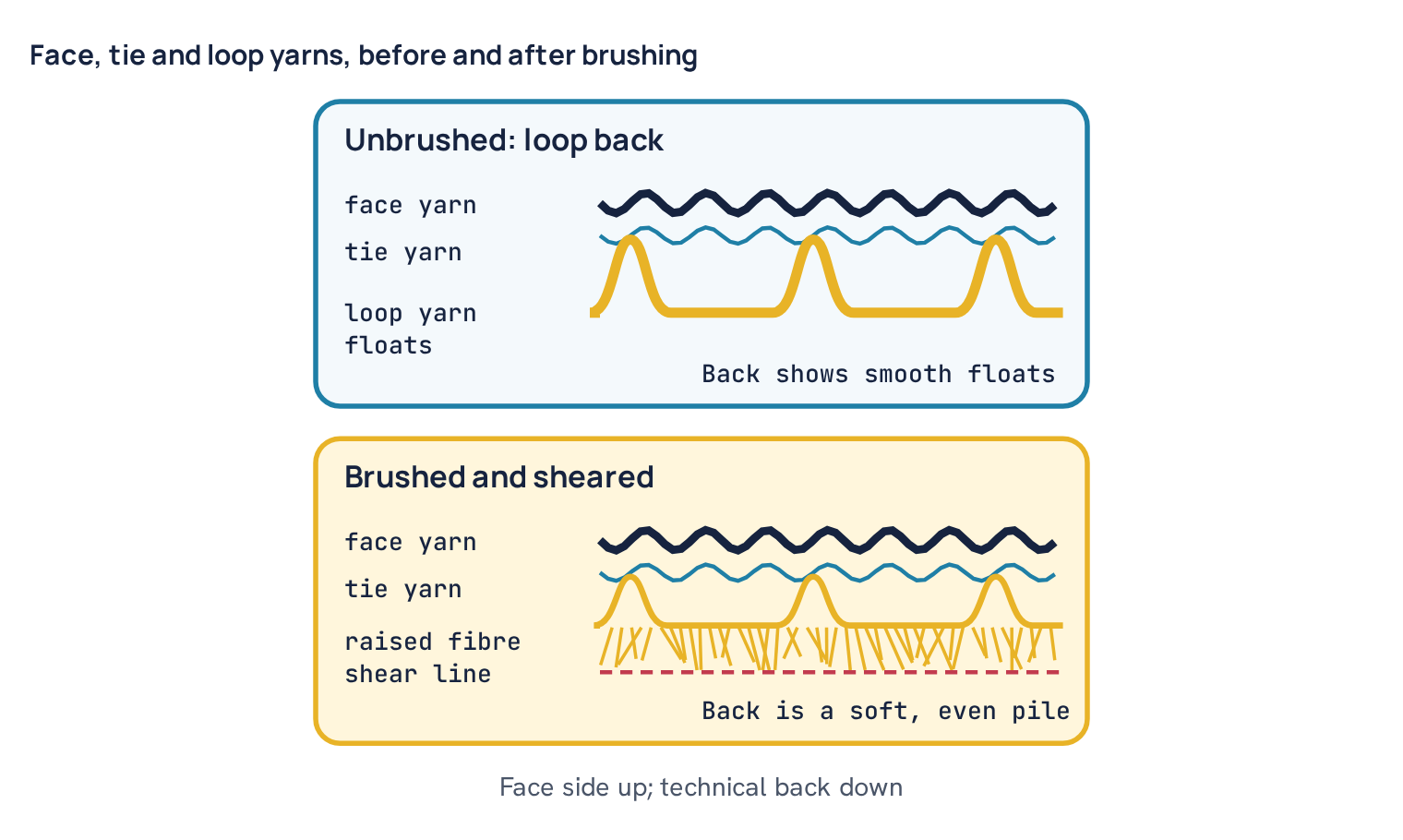
- Loop yarn (backing yarn, fleecy yarn). A thick, soft yarn, usually 12/1 CVC or cotton in our records, that does not knit. It tucks on selected needles and floats across the others on the technical back. These floats are the loops that are later brushed.
Because the loop yarn only tucks, it adds weight and warmth without changing the face, and its floats sit loose on the back where the brushing wires can reach them. If the tie yarn is too weak or too loose, the loop yarn pulls out during brushing or shows through to the face.
Notation
In needle notation each dot is a needle and each row is one feeder: a knit loop wraps round the needle, a tuck is an open arc, and a miss passes behind. The diagram shows one common arrangement, where the loop yarn tucks on one needle in four (often written 1:3) and misses the other three.
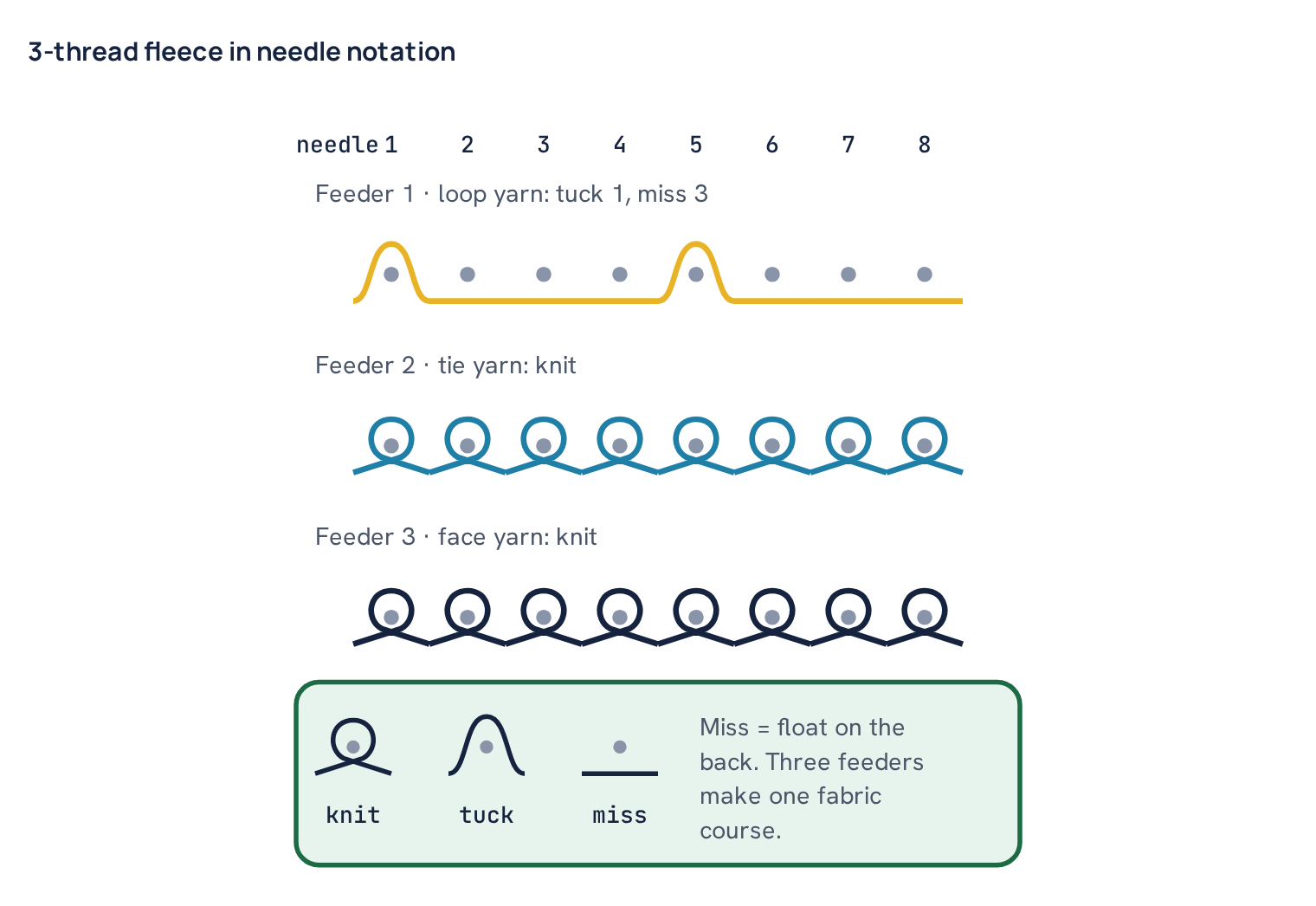
The tuck repeat is a design choice. A short repeat, such as one tuck in two, gives shorter floats, a firmer back and a lower pile. A long repeat gives a fluffier pile but more risk of snagging and pull-out. Mills use different tuck sequences, and the sequence often shifts by one needle from course to course so the tucks do not line up into visible lines.
Properties you must design around
- Heavy and stable in width. The loop yarn makes fleece much heavier than single jersey; our main fleece rows are required at 240 to 320 GSM. The floats also restrict width stretch, so fleece is less extensible than plain jersey.
- Two faces with different jobs. The face must take print and pass rubbing tests. The back must brush evenly and resist pilling and shedding.
- Spirality. Yarn twist and feeder count can lean the wales, as in any single-bed fabric, but in our lab reports it is rarely a problem on fleece.
Variants in our register
Our register files fleece under several type names: fleece, AD fleece, new AD fleece, double tuck fleece, LY fleece and L/fleece. In practice the development choices fall into a few groups:
- Brushed and unbrushed. The same greige fabric can be brushed into a pile or left with a clean loop back. Unbrushed fleece looks close to French terry on the back, but it keeps the tie yarn structure. Our register does not show which lots were brushed.
- Cotton and CVC. About 1,200 of our 1,688 fleece entries include polyester, mostly as a polyester filament tie yarn together with a 12/1 CVC loop yarn. The rest are cotton yarn descriptions.
- Elastane fleece. The LY fleece and L/fleece types carry an elastane yarn for stretch and recovery, for slim joggers and fitted tops. They need heat setting.
- Double tuck fleece. A variant in which the loop yarn is held by two tucks in each repeat instead of one. It binds the backing yarn more firmly; the exact cam set-up varies between mills.
Development inputs
Read the buyer’s request
Collect every requirement in one place before you choose yarn. For fleece, check in particular:
- Finished GSM with tolerance, and whether it is measured before or after brushing.
- Finished width, usually open width. Fleece in our register mostly finishes at about 140 to 150 cm.
- Composition of each yarn, not only the overall blend. “80/20 CVC fleece” can be made with several different face, tie and loop combinations, and the fibre content test will check the result.
- Brushed or unbrushed, and how heavy the brushing should be; ask for a physical standard.
- Shade, light source, and whether the back shade matters too.
- Wash care and tests, including pilling on face and back, and hot pressing if garments will be printed or pressed.
Choosing the three yarns
Face yarn. This is the yarn the customer sees and feels from the outside, so it is normally combed cotton, ring or compact. In our main rows it ranges from 34/1 for the lighter fleece around 270 GSM to 28/1 and 30/1 for the heavier qualities around 300 to 320 GSM. Compact yarn gives a cleaner face, better print and better face pilling.
Tie yarn. Our register mostly uses polyester filament: 50 denier (sometimes written 50/36f, meaning 50 denier in 36 filaments) with 34/1 face yarn, and 75 denier with 28/1 and 30/1 face yarn. Filament binds firmly without adding bulk, but it is a second fibre that needs a second dye class. A cotton tie yarn avoids that but is thicker for the same strength.
Loop yarn. The loop yarn carries most of the weight and decides how the back brushes. In our records it is 12/1 CVC at 55/45, 60/40 or 75/25 (cotton/polyester). A coarse, low-twist yarn opens easily under the brushing wires and gives a full pile. More polyester gives better strength and shape after washing, but polyester fibres on the brushed back can pill and must be dyed to match. Open-end loop yarn is common for economy; ring yarn gives a softer pile.
Twist. Lower face yarn twist reduces spirality but weakens the yarn. Low loop yarn twist helps brushing, but too low gives shedding and pilling.
Common mistake: confirming the overall blend without writing down the blend of each yarn. Two fleece fabrics both called “CVC” can differ a lot in polyester content, and that changes the dye recipe, the fibre content result and the pilling behaviour.
Knitting
Gauge and diameter
In our register most fleece is knitted on 20 gauge machines (1,099 entries), then 24 gauge (301) and 16 gauge (176), with small groups on 10 and 14 gauge for heavy, coarse qualities. All five main 3-thread rows in the table below use 20 gauge. The two cotton rows that record two stitch lengths use 24 gauge.
The most used diameter is 30 inch (658 entries), followed by 34 inch (507), 36 inch (256), 32 inch (195) and 28 inch (47). As with any circular fabric, the number of needles is diameter × π × gauge, and the finished width depends on how many wales per cm the finished fabric holds.
Worked example. A 30 inch, 20 gauge machine has 30 × 3.1416 × 20 = about 1,885 needles. For a finished open width of 140 cm, the fabric must finish at about 1,885 ÷ 140 = 13.5 wales per cm. If the stenter and compactor leave it at 12.6 wales per cm, the width becomes about 150 cm, and the GSM drops.
Stitch length per yarn, count and GSM
Fleece has a separate stitch length for each yarn. The register writes them in yarn order, face + tie + loop, and this guide shows them exactly as recorded, as the stitch length per yarn as recorded.
The weight principle is the same as for jersey: GSM is the weight of all the yarn in one square metre. For a single yarn, GSM = (courses per cm × wales per cm × stitch length in mm × tex) ÷ 100, with tex = 590.5 ÷ Ne or denier ÷ 9. In fleece every yarn adds its own share. The knit GSM from stitch length calculator and the GSM calculator are useful for the face yarn and for checking finished samples.
The counts tell you where the weight comes from. A 34/1 cotton face yarn is about 17.4 tex. A 50 denier tie yarn is about 5.6 tex. A 12/1 loop yarn is about 49 tex, nearly three times the face yarn. So the loop yarn is typically the biggest weight contributor.
Yarn, gauge, stitch length and GSM from our records
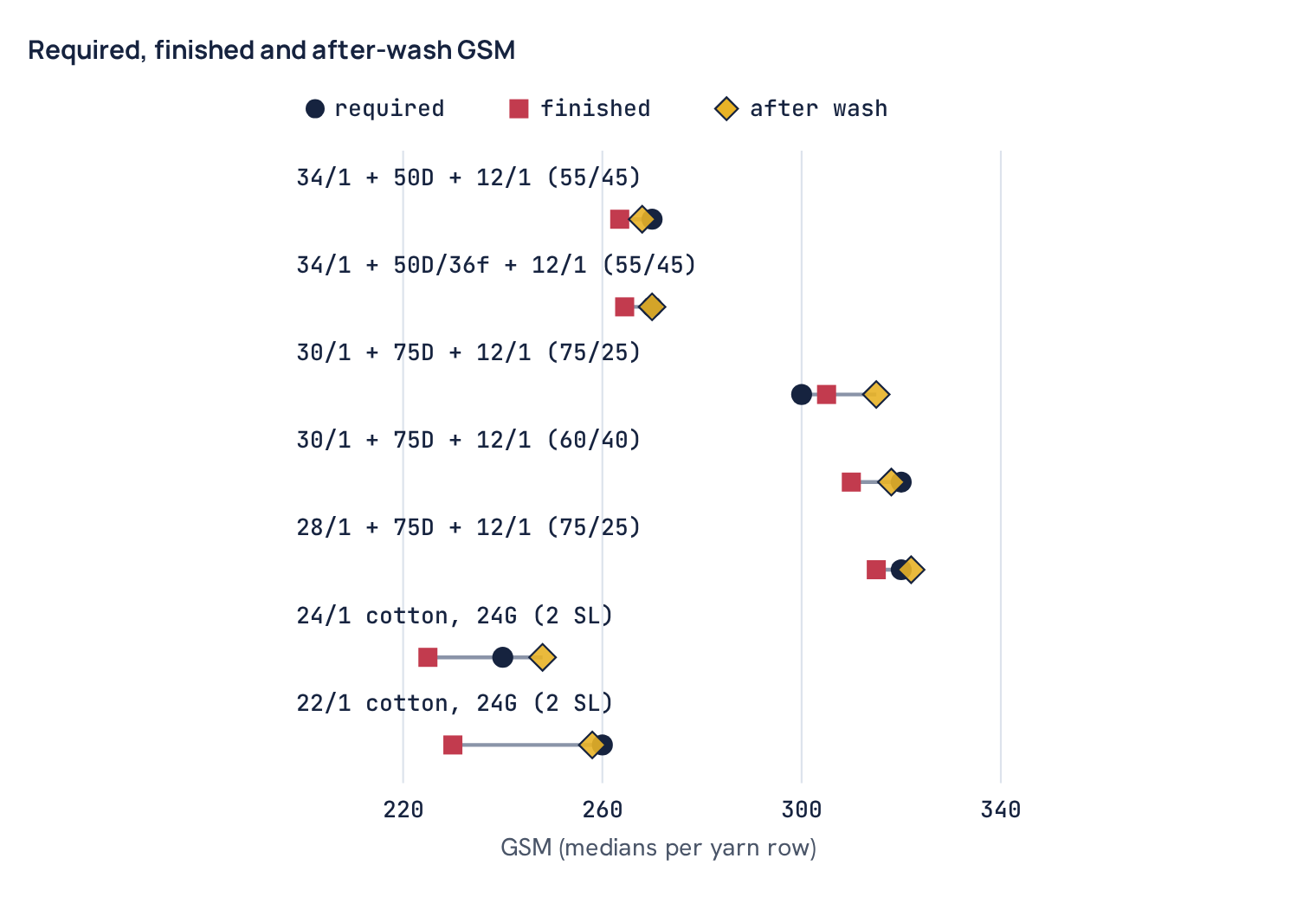
The table shows the seven most common yarn rows in our fleece register, with median values. Required GSM is the buyer’s target, finished GSM is after dyeing and finishing (interquartile range in brackets), and GSM after wash is from the dye-house wash test.
| Yarn (face + tie + loop) | Gauge | Entries | Stitch length per yarn as recorded, mm | Required GSM | Finished GSM | GSM after wash | Finished dia, cm |
|---|---|---|---|---|---|---|---|
| 34/1 cotton + 50D polyester + 12/1 CVC 55/45 | 20G | 108 | 4.60 + 3.00 + 1.55 | 270 | 263.5 (260–270) | 268 | 140 |
| 34/1 cotton + 50D/36f polyester + 12/1 CVC 55/45 | 20G | 42 | 4.60 + 3.00 + 1.55 | 270 | 264.5 (260–270) | 270 | 140 |
| 30/1 cotton + 75D polyester + 12/1 CVC 75/25 | 20G | 38 | 4.50 + 2.90 + 1.55 | 300 | 305 (290–315) | 315 | 142 |
| 30/1 cotton + 75D polyester + 12/1 CVC 60/40 | 20G | 37 | 4.50 + 2.95 + 1.85 | 320 | 310 (305–320) | 318 | 150 |
| 28/1 cotton + 75D polyester + 12/1 CVC 75/25 | 20G | 43 | 4.55 + 2.90 + 1.55 | 320 | 315 (310–330) | 322 | 146 |
| 24/1 cotton (two stitch lengths recorded) | 24G | 49 | 2.85 + 1.28 | 240 | 225 (218–230) | 248 | 170 |
| 22/1 cotton (two stitch lengths recorded) | 24G | 29 | 2.80 + 1.30 | 260 | 230 (222–240) | 258 | 168 |
Three things stand out. First, the 3-thread rows on 20 gauge are very consistent: the stitch lengths per yarn as recorded barely move between rows, from 4.50 to 4.60, 2.90 to 3.00 and mostly 1.55 mm. The GSM is steered mainly by the yarn counts. A 34/1 face with 50 denier tie gives the 270 GSM quality; a 28/1 or 30/1 face with 75 denier tie gives 300 to 320 GSM. Second, these rows finish close to the target, mostly within a few percent. Third, the two 24 gauge cotton rows, which record two stitch lengths and name only one cotton count, behave differently. They finish at about 168 to 170 cm, they finish well below the required GSM, and they recover it after the wash test.
Cam and feeder arrangement
On a fleece machine the feeders work in groups of three, one for each yarn, so a machine makes one third as many fabric courses per revolution as a jersey machine with the same feeder count. Points to set and check:
- Feeder order. Loop yarn, then tie yarn, then face yarn, repeated round the machine. A mixed-up yarn gives a wrong fabric that may look normal on the face.
- Tuck cams. Set the tuck repeat for the loop yarn exactly as the approved sample. Changing from one tuck in four to one in two changes the back, the weight and the brushing result.
- Sinker setting. Fleece sinkers control the height at which the loop yarn and tie yarn are held. This affects how easily the tie yarn shows through.
- Feed for each yarn. Record all three settings, not only the face yarn.
- Elastane. Feed it under controlled draft from a positive feeder; uneven draft shows as bars.
Machine settings to record
Record the machine number, diameter, gauge and feeders; the count, fibre and lot of each yarn; the stitch length per yarn measured on greige in face + tie + loop order; the cam chart, tuck repeat and sinker setting; input tensions and elastane draft; take-down and speed; and greige GSM, dia and roll weight.
Greige inspection
Inspect the greige face for holes, needle lines, oil marks and barre, and check the back for missed tucks, where the loop yarn has not been tied in and hangs loose. Look for tie yarn grinning through on the face, which shows as a glitter or a lighter dotted line once a polyester tie is dyed a different depth from the cotton. Measure greige GSM and dia after the roll has relaxed; the greige to finished difference becomes your planning ratio. Mixed yarn lots, especially in the loop yarn, are a common cause of barre in fleece; see barre in knit fabric: causes and remedies.
Dyeing and finishing route
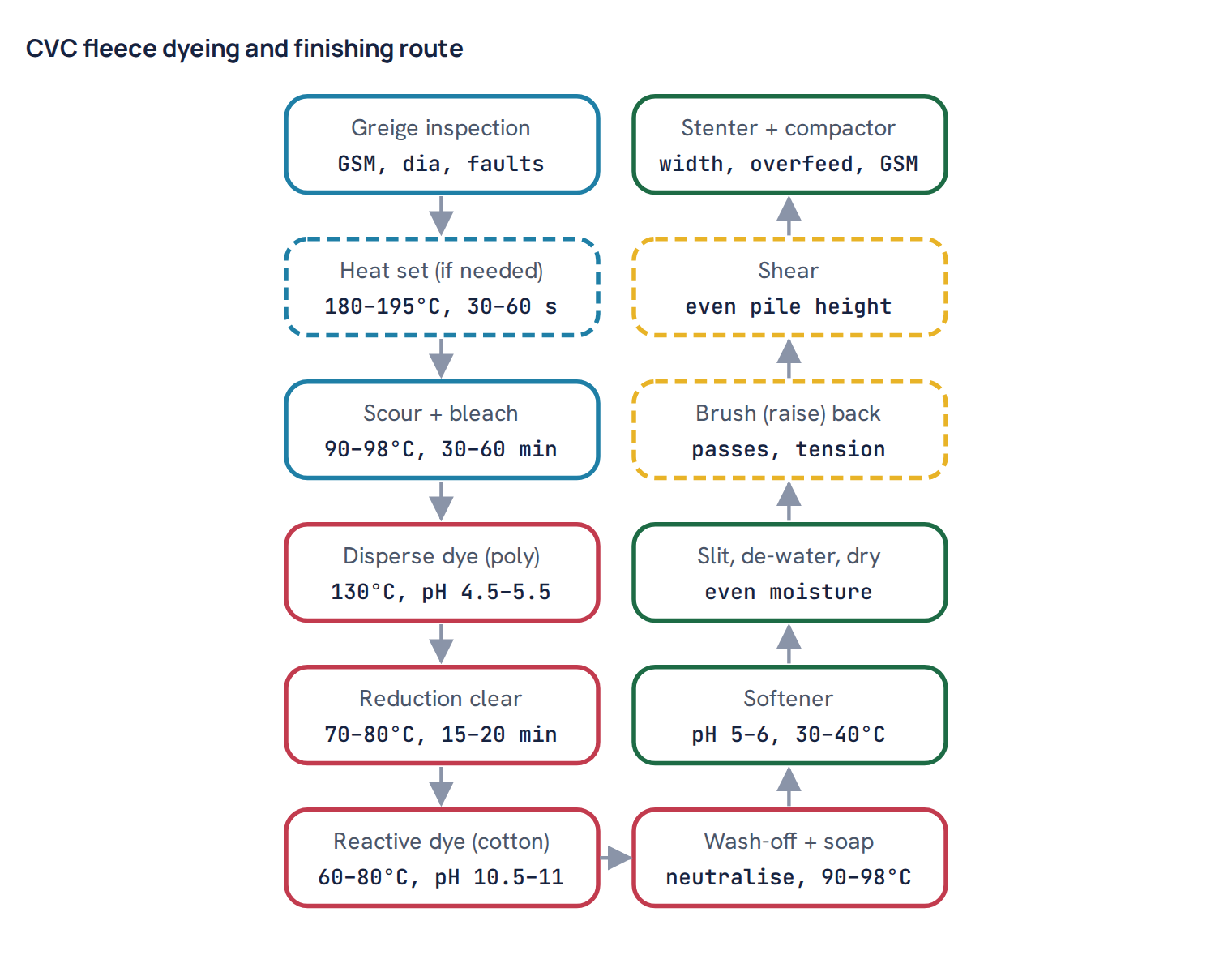
Every fleece entry in our register is finished by stenter and compactor. The full route for a CVC fleece is shown below with typical parameters. A shorter overview is in the fleece fabric dyeing and finishing flowchart, and the related loop-back fabric is covered in the French terry dyeing and finishing flowchart.
Heat setting
About 17% of the fleece entries in our register carry a heat-set flag. It is essential for elastane fleece, to fix the elastane at the planned width. For polyester-containing fleece it is optional but stabilises the fabric and reduces creasing. Typical settings are 180 to 195°C for 30 to 60 seconds, and they vary with the fibre and the machine. Fleece is heavy and bulky, so crease marks in jet dyeing are a real risk; see crease marks in knit dyeing.
Dyeing CVC fleece: the two-bath route
When polyester is present, in the tie yarn, in the CVC loop yarn or both, the shade needs two dye classes. Disperse dyes colour the polyester, and reactive dyes colour the cotton. The usual and safest method is two baths:
- Pretreatment. Scour and bleach, typically 90 to 98°C for 30 to 60 minutes, often with milder alkali than for 100% cotton to protect the polyester. Neutralise and remove leftover peroxide.
- Disperse dyeing. Dye the polyester at about 130°C for typically 30 to 60 minutes at pH 4.5 to 5.5 with a dispersing and levelling agent. The cotton picks up only loose surface dye.
- Reduction clearing. Treat with sodium hydrosulphite and caustic soda, typically 70 to 80°C for 15 to 20 minutes, to strip disperse dye from the surface. This is the main defence against poor wet rubbing and staining in medium and dark shades.
- Reactive dyeing. Dye the cotton with salt and alkali dosed in steps, fixation typically at 60°C for most vinyl sulphone and bifunctional types and up to 80°C for hotter types, at about pH 10.5 to 11. See how reactive dyes work.
- Wash-off and soaping. Rinse, neutralise and soap near the boil to remove unfixed reactive dye.
The polyester shade and the cotton shade must meet in one visual result. On the face the cotton dominates. On a brushed back the CVC loop yarn shows both fibres side by side, so a mismatch between disperse and reactive depth gives a two-tone, grainy back. Check face and back at every shade submission. Some dye houses use one-bath methods for light shades, but two baths control fastness better in medium and dark shades. The full process is described in CVC fabric dyeing process, and 100% cotton fleece follows the 100% cotton knit dyeing process. Elastane fleece follows the precautions in the cotton elastane (Lycra) knit dyeing process. For patchy results, read level dyeing and uneven shades.
Softener, drying, brushing and shearing
- Softener. Applied after dyeing, typically pH 5 to 6 at 30 to 40°C. It lubricates the fibres so the wires lift them instead of breaking them. Some softeners also help disperse dye migrate in heat, so choose with the fastness tests in mind.
- Slitting and drying. The tube is slit on a needle line, de-watered and dried. The fabric must be evenly dry before brushing; uneven moisture gives uneven pile.
- Brushing (raising). The back is passed over rollers covered with fine wire points that pull fibres out of the loop yarn floats. Passes, roller speeds and fabric tension decide how much pile is raised. More brushing gives a fuller back but costs weight and bursting strength, and loosens fibres that later pill.
- Shearing. A rotating blade cuts the raised pile to an even height and removes long loose fibres. Good shearing reduces pilling and shedding.
- Stenter and compactor. The stenter sets the width and dries the fabric, typically 130 to 160°C for cotton-rich fleece and kept below the heat-set temperature for fabrics with elastane or polyester. The compactor uses steam and overfeed to control length shrinkage and settle the final GSM.
Hitting finished GSM and width
What our records show
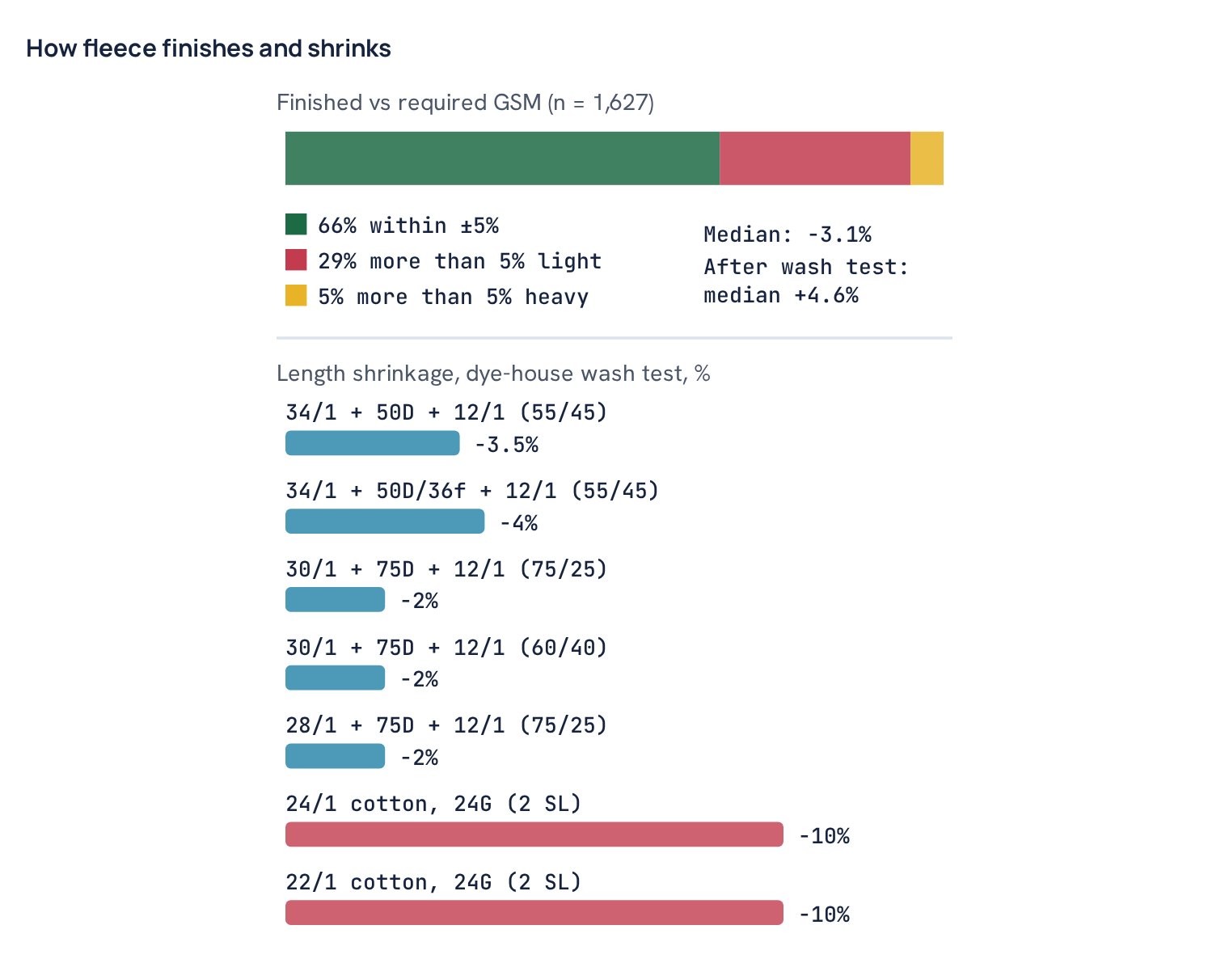
Across 1,627 fleece entries with both values, the median finished GSM is 3.1% below the required GSM. Two thirds (66%) finish within ±5%, 29% finish more than 5% light, and only 5% finish more than 5% heavy. When fleece misses, it nearly always misses light. After the dye-house wash test the GSM rises by a median of 4.6%, which shows that part of the shortfall is length still stretched in the fabric when it leaves the compactor.
Why the fabric finishes light
- Brushing. Some fibre is lost as fly, and brushing tension stretches the fabric in length.
- Stenter width. Running wide to reach 140 to 150 cm spreads the same yarn over a larger area.
- Incomplete relaxation. Heavy wet fleece is pulled hard through processing. With low compactor overfeed, length stays stretched in until the first wash.
- Greige planned at the edge. A construction that only just reaches the target under perfect finishing will finish light in half the lots.
Shrinkage and width
In the dye-house wash test the 3-thread rows with polyester tie and CVC loop yarn shrink only 2 to 4% in length. Width moves about 2% either way: the two 34/1 rows and the 60/40 loop yarn row grow about 2% in width (a positive value in the register means width growth), while the two 75/25 loop yarn rows shrink about 2%. The polyester tie and loop yarn content keep the fabric stable.
The two 24 gauge cotton rows are different. They shrink about 10% in length and grow 2 to 3% in width. They also finish about 6% and 12% below the required GSM and come back to around the target after the wash test. For all-cotton fleece, plan more compaction and do not cure low GSM by stretching wide. The fabric shrinkage calculator helps estimate the effect on cut size, and the knit GSM and shrinkage by fibre study compares fibres across fabric types.
Width: aim for 140 to 150 cm
The 3-thread rows in our records finish at 140 to 150 cm open width. The 34/1 rows sit at 140 cm, the 28/1 and 30/1 rows at 142 to 150 cm. For a width outside this band, change the machine diameter before pushing the stenter, because stenter width costs GSM.
How to plan greige GSM and dia
- Start from the closest record table row: yarns and stitch length per yarn as recorded.
- Check the finished GSM median, not only the required GSM. If the row finishes 2 to 3% light, either accept that within tolerance or plan a little heavier.
- Knit a trial, record greige GSM and dia, and run the full bulk route including brushing.
- Measure finished GSM, width and GSM after the wash test. If the finished GSM is light but the after-wash GSM is on target, improve compaction and reduce stretch. If both are light, adjust the loop yarn count or feed, which carries most of the weight.
- Write the greige to finished ratio for GSM and dia, brushed or unbrushed, on the record sheet.
Common mistake: approving GSM on an unbrushed lab sample and then brushing in bulk. Brushing changes the GSM, width and strength, so the approval sample must go through the same brushing as bulk.
Testing the developed fabric
The table gives typical buyer requirements and the results from the 26 fleece reports in our lab reports. These reached our desk, many because of a problem, so fail rates are higher than in normal production. It is a modest set; use it to see where fleece is at risk, not as an average.
| Test | Typical buyer requirement (varies by buyer) | Our lab reports (fleece) |
|---|---|---|
| Dimensional stability (shrinkage) | Often within ±5% L and W after the stated wash | 13 fails in 41 results; median after one wash L -1.8%, W +0.3% |
| Spirality | Often 5% maximum after washing | 3 fails in 41; median 0.0%, max 7.1% |
| Bursting strength | A minimum in kPa set by the buyer, often by GSM band | 4 fails in 26; median 234 kPa, range 135–500 kPa |
| Pilling | Often grade 3–4 minimum (box or Martindale, as the buyer states) | 5 fails in 25; typical results pilling 4–5 and fuzzing 4, including at 1,000 and 2,000 rubs |
| GSM | Often ±5% of required | 5 fails in 24 |
| Colour fastness to rubbing | Often dry 4, wet 2–3 or 3 | 8 fails in 20; wet grade 2–3 in 10 of 20 results, grade 2 in 2 |
| Fibre analysis | Within the label tolerance | 4 fails in 20 |
| Colour fastness to washing | Often 4 change, 3–4 staining | 3 fails in 19 |
| Colour fastness to perspiration | Often 4 change, 3–4 staining | 3 fails in 17 |
| Colour fastness to water | Often 4 change, 3–4 staining | 1 fail in 9 |
| Colour fastness to light | Often grade 4 | 0 fails in 7 |
| Colour fastness to hot pressing | Often 4 change, 3–4 staining | 3 fails in 3 |
| pH | Often 4.5–7.5 | 0 fails in 2 |
Wet rubbing: the main colour risk
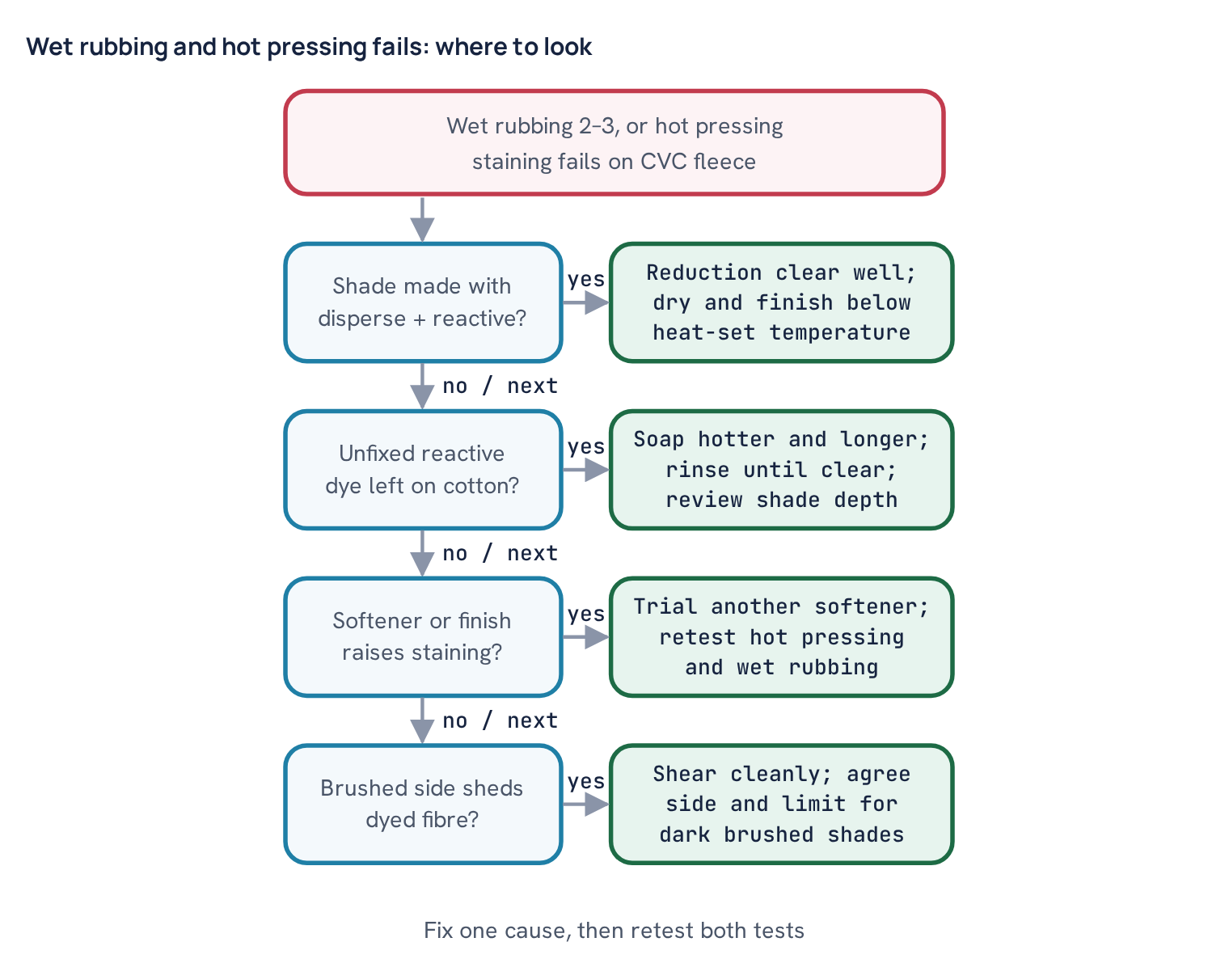
Wet rubbing is the colour test that fails most on fleece in our lab reports: 8 fails in 20 results, and half of all wet rubbing results are at grade 2–3. Fleece is often dyed in dark shades with two dye classes: loose disperse dye and unfixed reactive dye both transfer to the wet cloth, and a brushed surface sheds dyed fibre. The fix starts in the dye house: thorough reduction clearing after disperse dyeing, a hot and complete soaping after reactive dyeing, and a sensible shade depth. Read wet rubbing fastness fail: causes and remedies for the full list.
Hot pressing and the polyester part
All three hot pressing results in our fleece reports failed. The set is tiny, but the mechanism is well known. When disperse-dyed polyester is heated, in the stenter, a heat press or under an iron, dye can move to the fibre surface. This thermomigration is made worse by some softeners and gives staining, shade change and often poorer wet rubbing. Keep the post-dyeing stenter temperature moderate, reduction clear well, and test the chosen softener for hot pressing before bulk.
Pilling, strength and the brushed back
Five of 25 pilling results failed. When fleece passes, it passes well, typically pilling 4–5 and fuzzing 4 in both directions. The fails come from the usual causes on a brushed fabric: loose fibres raised by brushing, polyester fibres in the loop yarn that hold pills instead of letting them fall away, and low-twist backing yarn. Good shearing, adequate loop yarn twist and lighter brushing help. See fleece and terry pilling test fail: causes and remedies and how to test pilling (box and Martindale).
Bursting strength had a median of 234 kPa, with 4 fails in 26. Heavy brushing can take a borderline fabric below the limit, so test after brushing. See how to test bursting strength of knit fabric and bursting strength fail: causes and remedies.
Shrinkage, spirality, GSM and fibre content
Shrinkage failed 13 times in 41 results, even though the median after one wash is a small -1.8% in length and +0.3% in width. The median looks safe, but individual lots drift outside the limit. Spirality failed 3 times in 41 with a maximum of 7.1%, so it is not a routine problem but it can happen. GSM failed 5 times in 24, matching the light-finishing tendency in our register. Fibre analysis failed 4 times in 20; in a three-yarn fabric the final blend depends on the weight share of each yarn, so a change in the loop yarn blend or the tie yarn denier moves the result. Useful guides:
- How to test shrinkage of knit fabric and shrinkage test fail: causes and remedies
- How to test spirality of knit fabric and spirality test fail: causes and remedies
- How to test GSM of knit fabric and GSM test fail: causes and remedies
Worked example. A buyer asks for 270 GSM fleece in a dark navy, with 34/1 cotton face, 50 denier polyester tie and 12/1 CVC 55/45 loop yarn. Our register row for this yarn knits on 20 gauge at 4.60 + 3.00 + 1.55 mm (stitch length per yarn as recorded) and finishes at a median 263.5 GSM, 140 cm, and 268 GSM after the wash test. That is inside ±5%, so the construction can stay. The risk is colour: with polyester in two yarns and a dark shade, plan a full reduction clear, thorough soaping and a softener checked for hot pressing, and test wet rubbing on the first trial.
Development record sheet and troubleshooting
Record sheet template
Use one sheet per trial and keep the requested and actual values side by side. For fleece, every yarn-related line has three entries.
| Stage | Record |
|---|---|
| Request | Buyer, style, required GSM and tolerance, finished width, composition of each yarn, brushed or unbrushed, shade (face and back), wash care, test standard, hot pressing yes/no |
| Yarn | Face, tie and loop yarn: count or denier, fibre and blend, spinning type, supplier, lot |
| Knitting | Machine no., diameter, gauge, feeders, cam chart and tuck repeat, sinker setting, stitch length per yarn (face + tie + loop), input tensions, elastane draft, take-down, speed |
| Greige | Greige GSM, tubular dia, roll weight, faults (missed tucks, tie grin-through, barre) |
| Heat set | Temperature, time or speed, width, overfeed |
| Wet process | Pretreatment recipe, disperse recipe and temperature, reduction clearing, reactive recipe, fixation temperature and pH, soaping, softener type and amount |
| Brushing and shearing | Passes, roller speeds, fabric tension, pile height, shearing setting |
| Stenter and compactor | Temperature, speed, width, overfeed, compactor overfeed and steam, exit width |
| Finished | Finished GSM, width, GSM after wash test, shrinkage L/W, spirality, shade face and back |
| Lab tests | Each result against requirement, pass/fail, side tested (face or back) |
| Decision | Approved or adjust; what changes in the next trial and why |
Troubleshooting
| Problem | Likely cause | What to change |
|---|---|---|
| Finished GSM light, after-wash GSM on target | Length stretched in; stenter too wide; tension in brushing | More compactor and stenter overfeed; less width stretch; lower brushing tension |
| Finished and after-wash GSM both light | Loop yarn too fine or under-fed; heavy brushing | Coarser loop yarn or more loop feed; lighter brushing |
| Width too wide or narrow | Wrong machine diameter for the target; stenter used to correct width | Change diameter; set width at stenter only within a small range |
| High length shrinkage (all-cotton fleece) | Cotton relaxation; little compaction | More compactor overfeed; lower tension in wet processing and drying |
| Wet rubbing 2–3 or lower | Poor reduction clear; unfixed reactive dye; deep shade; shedding pile | Better reduction clearing and soaping; review depth; shear well |
| Hot pressing staining | Thermomigration of disperse dye; softener effect; hot stenter after dyeing | Lower post-dye heat; change softener; full reduction clear |
| Pilling on the back | Over-brushing; low-twist or high-polyester loop yarn; poor shearing | Lighter brushing; better loop yarn; clean shearing |
| Low bursting strength | Heavy brushing; weak face or tie yarn | Reduce brushing passes; stronger yarn; test after brushing |
| Tie yarn visible on face | Tie too thick or tension high; sinker setting; polyester shade off | Adjust tension and sinker; finer tie; match disperse depth |
| Grainy two-tone brushed back | Disperse and reactive depths do not match | Correct the polyester or cotton part of the recipe; check back at every shade |
| Barre on face | Mixed yarn lots; uneven feed between feeder groups | One lot per yarn; equalise feed and tension |
Treat fleece as three yarns, not one. Start from a proven face, tie and loop combination, expect finishing to take a few percent off the GSM, give the polyester as much attention in dyeing as the cotton, and test colour fastness early.
Questions
What are the three yarns in 3-thread fleece?
The face yarn knits the clean outer surface, the tie (binding) yarn locks the loop yarn into the fabric, and the loop (backing) yarn tucks on selected needles and floats on the back, where it can be brushed into pile.
What stitch length is used for 34/1 cotton fleece with 50D polyester tie and 12/1 CVC loop?
In our records this 20 gauge quality runs at 4.60 + 3.00 + 1.55 mm, stitch length per yarn as recorded in face + tie + loop order, for a required 270 GSM. Use it as a starting point and confirm with a trial.
Why does CVC fleece need two-bath dyeing?
The polyester in the tie and loop yarns takes disperse dye at about 130°C, and the cotton takes reactive dye. Dyeing the polyester first and reduction clearing before the reactive bath gives better control of shade and wet fastness.
Why does fleece fail wet rubbing so often?
Dark shades, loose disperse dye on polyester, unfixed reactive dye on cotton and fibre shed from a brushed surface all transfer to the wet cloth. In our lab reports 10 of 20 wet rubbing results were grade 2–3.
Does brushing change fleece GSM and strength?
Yes. Brushing loses some fibre, stretches the fabric in length and weakens the loop yarn, so GSM and bursting strength must be checked on brushed fabric, not on an unbrushed lab sample.

Textile engineer with 14+ years in dyeing and fabric development. He writes every guide on Dyeing Solution from real production work. Full profile