Pima cotton is an extra-long staple cotton with longer, finer fibres that give smoother, stronger, softer yarn. What it is, Pima vs regular and Egyptian cotton, how to judge a label, and how it shrinks and dyes.
At a glance
35 mm+fibre length
ELSextra-long staple
Lesspilling
6%cotton knit shrinkage
Pima cotton is a type of extra-long staple (ELS) cotton, with fibres noticeably longer, finer and stronger than ordinary cotton. Longer fibres can be spun into smoother, stronger, softer yarn with fewer fibre ends sticking out, so Pima cotton T-shirts, polo shirts and sheets feel silkier, keep their surface cleaner and pill less than regular cotton. It costs more because it is a smaller crop and gives a better yarn.
This guide explains what Pima cotton is, Pima vs regular and Egyptian cotton, why fibre length matters in the finished fabric, how to judge a “Pima” label, and how it behaves in dyeing and washing.
What is Pima cotton?
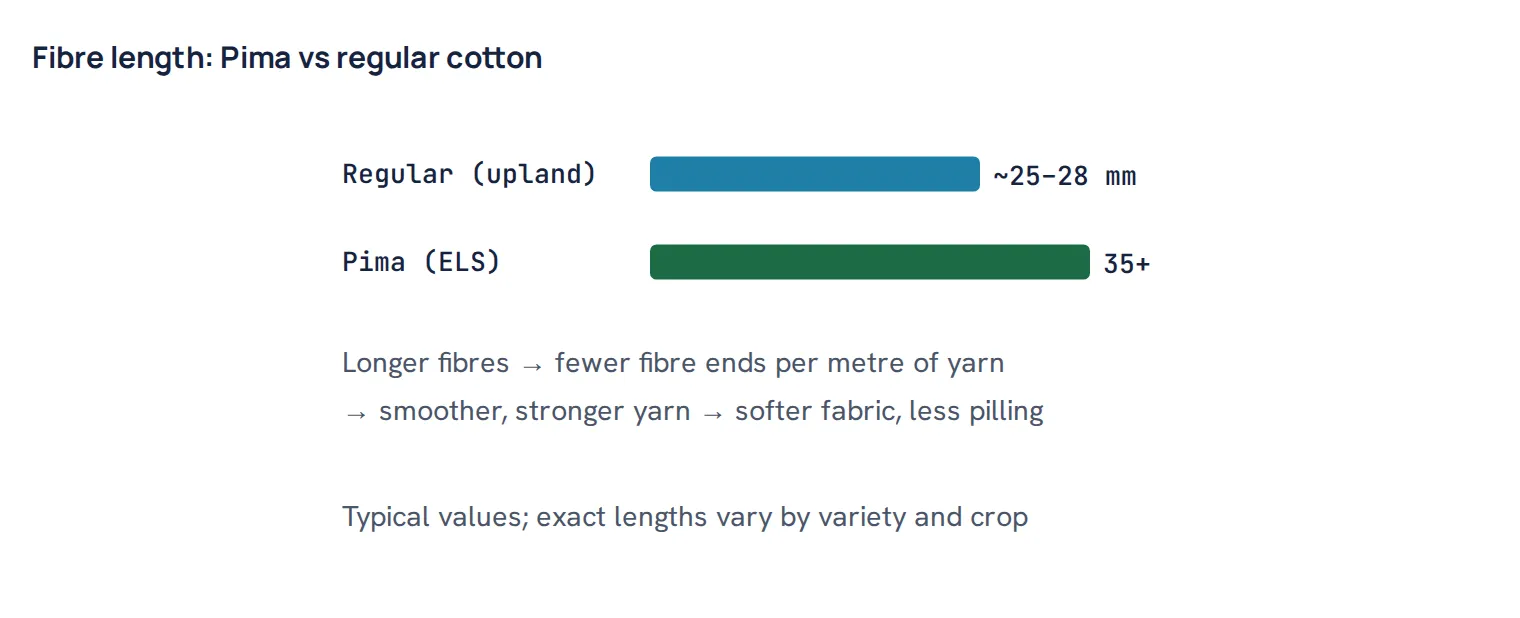
Almost all the world’s cotton is upland cotton, a species with fibres typically around 25–28 mm long. Pima cotton belongs to a different species, Gossypium barbadense, whose fibres are usually 35 mm or longer, which is why it is classed as extra-long staple. It is grown mainly in the south-western United States, Peru, Australia and a few other dry, sunny regions with irrigation. Egyptian cotton (Giza varieties) is the same species, grown in Egypt.
The name “Pima” comes from the Pima (Akimel O’odham) people of Arizona, who helped grow the early crops in the US in the early 1900s.
Why longer fibres make a better fabric
A yarn is a bundle of short fibres twisted together. Every fibre has two ends, and the ends that stick out of the yarn make the fabric look slightly fuzzy, feel rougher and, after rubbing and washing, roll into pills. With longer fibres there are fewer ends in each metre of yarn, and the fibres grip each other over a longer length. The result:
- Softer, smoother hand: fewer loose ends on the surface.
- Less pilling: fewer ends to tangle into pills.
- Stronger yarn: the same strength at a finer count, so lighter fabrics stay durable.
- Better lustre and colour: a smoother surface reflects light more evenly, so colours look a little brighter.
The same principle explains why combed and compact yarns are better than carded ones; see what is ring spun cotton. A premium shirt is often Pima cotton that is also combed and ring or compact spun.
Pima vs regular cotton vs Egyptian cotton
| Point | Regular (upland) | Pima | Egyptian (Giza) |
|---|---|---|---|
| Species | G. hirsutum | G. barbadense | G. barbadense |
| Fibre length | Short to medium | Extra-long | Long to extra-long |
| Feel | Soft | Very soft, smooth | Very soft, smooth |
| Pilling | More | Less | Less |
| Price | Lowest | Higher | Higher |
How to judge a “Pima cotton” label
- “100% Pima cotton” should mean all the cotton is Pima. Some labels say only “Pima cotton” on a blend, so check the composition line.
- Pima/modal or Pima/elastane blends are common in premium T-shirts and underwear; the Pima share is still listed in the composition.
- Some growers’ associations license their own name for certified American-grown Pima. That is a marketing and traceability claim on top of the fibre type, not a different fibre.
- Pima is a fibre claim; it does not by itself tell you about the knitting, dyeing or finishing, which decide shrinkage and colour.
Does Pima cotton shrink?
Yes, like any cotton. Fibre length does not stop the fabric relaxing after processing. Cotton knit shrank a median 6% in length in our finishing records, and Pima knit behaves the same way: what matters is how well it was relaxed and compacted at the mill. See what pre-shrunk means and does cotton shrink.
How Pima cotton dyes
Pima is cotton, so it is dyed with the same reactive dyes and process as any cotton knit; see the 100% cotton knit dyeing process. Its smoother yarn tends to give a slightly cleaner, brighter shade, and a bio-polish enzyme treatment keeps the surface clean; see what enzyme washed means.
Common mistake: paying for Pima and expecting it to fix pilling on its own. A Pima T-shirt knitted loosely from a carded yarn and brushed hard can still pill. Fibre, yarn type, construction and finishing all decide the result together.
How to care for Pima cotton
- Wash at 30–40°C, inside out, with similar colours.
- Line dry or tumble dry on low to limit shrinkage.
- Avoid washing with rough items like denim and zips to protect the smooth surface.
Worked example. Two white 160 GSM T-shirts are compared after ten washes. The Pima combed compact shirt keeps a clean, smooth face; the regular carded cotton shirt shows fuzz and small pills under the arms. Both shrank about the same, because both were finished the same way. The fibre made the difference in the surface, not in the size.
Summary
- Pima is extra-long staple cotton (G. barbadense), typically 35 mm or longer.
- Longer fibres give smoother, stronger, softer yarn that pills less.
- Egyptian cotton is the same species, grown in Egypt.
- Pima still shrinks like cotton; finishing decides the size.
- For the best result look for Pima that is also combed and ring or compact spun.
Questions
What is Pima cotton?
An extra-long staple cotton from the species Gossypium barbadense, with fibres typically 35 mm or longer, giving smoother, stronger and softer yarn than regular cotton.
Is Pima cotton better than regular cotton?
For softness, smoothness and pilling, yes. It costs more, and it still shrinks like any cotton if the fabric is not finished well.
What is the difference between Pima and Egyptian cotton?
Both are the same species of extra-long staple cotton. Pima is grown mainly in the US, Peru and Australia; Egyptian cotton is grown in Egypt.
Does Pima cotton shrink?
Yes, like any cotton. Shrinkage depends on how well the fabric was relaxed and compacted at the mill, not on the fibre length.
Does Pima cotton pill?
Less than regular cotton, because longer fibres leave fewer loose ends. Yarn type, knitting and finishing still matter.

Textile engineer with 14+ years in dyeing and fabric development. He writes every guide on Dyeing Solution from real production work. Full profile