Interlock is a double knit that is smooth on both sides, thicker and more stable than jersey and does not curl. How it is knitted, what interlock cotton is, what interlock is used for, and what our register of 887 interlock entries shows.
At a glance
2 facessmooth on both sides
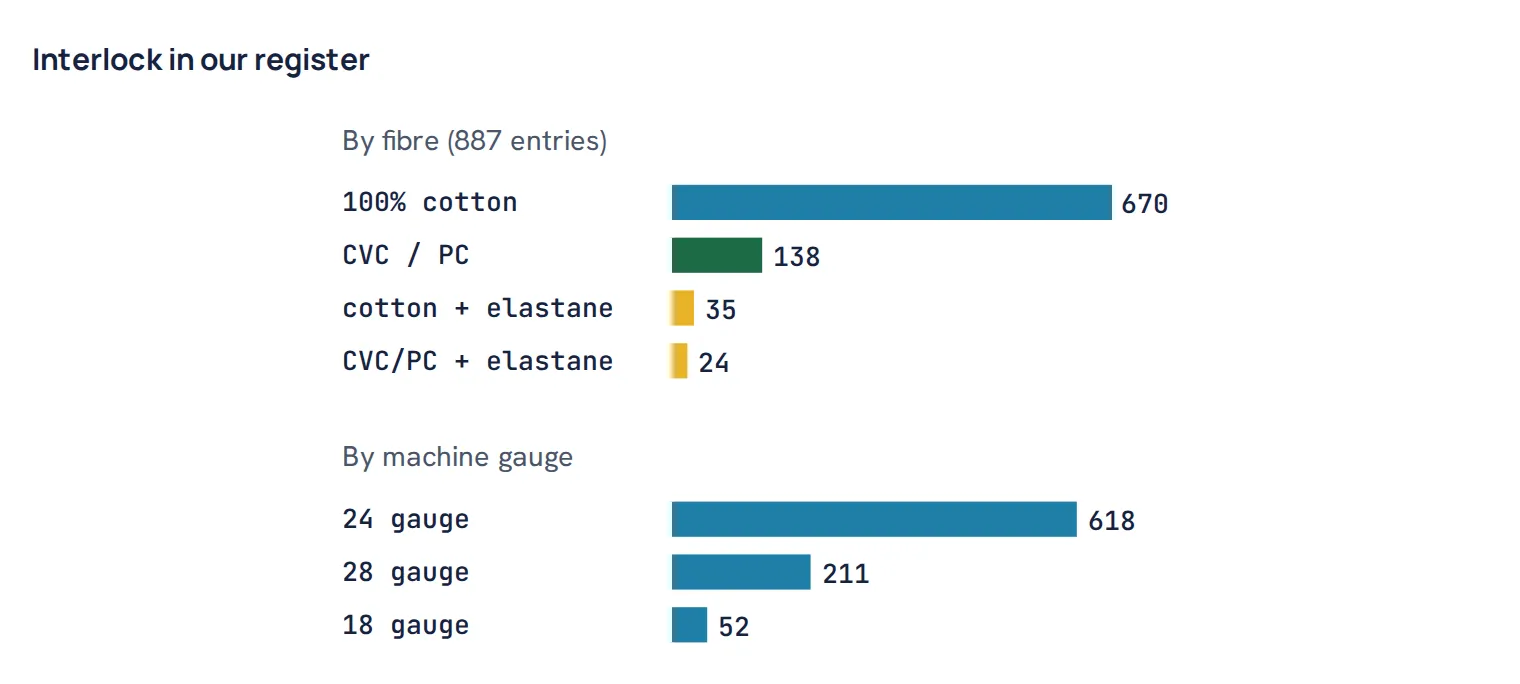
670 of 887entries are 100% cotton
24Gmost common gauge
180–260typical cotton GSM
Interlock is a double-knit fabric that looks smooth and identical on both sides. It is knitted on a circular machine with two sets of needles, so two layers of single jersey are effectively locked together into one fabric. The result is thicker, softer, more stable and more opaque than single jersey, it does not curl at the edges, and it has a smooth, slightly cushioned feel. Cotton interlock is a favourite for babywear, premium T-shirts, polo shirts, pyjamas and fitted dresses.
This guide explains how interlock is made, interlock cotton and other fibres, what interlock fabric is used for, how it compares with jersey and rib, and how it behaves in dyeing, using our own register of nearly 900 interlock entries.
How interlock is knitted
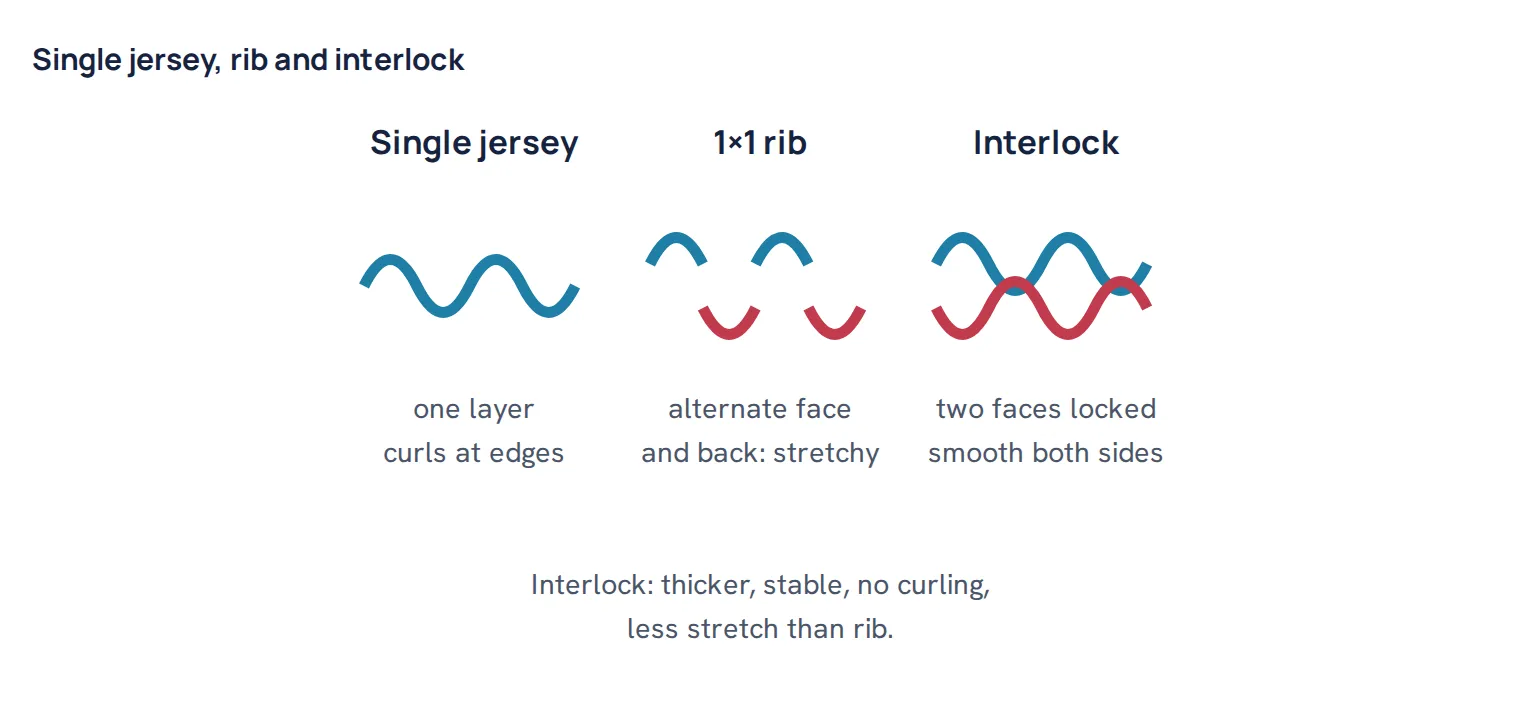
Interlock is made on a circular machine with a cylinder and a dial, each carrying needles. The needles are arranged so that a stitch on one face sits directly behind a stitch on the other, and two courses together form one complete row. Because each face hides the back of the other, both sides show only smooth face loops. Technically it is a variation of 1×1 rib in which two rib fabrics are interlocked.
In our register, 24 gauge is by far the most used for interlock (618 entries), then 28 gauge (211), with a smaller group on 18 gauge (52) for coarser yarns. The detailed parameters are in the interlock development guide.
What is interlock cotton?
“Interlock cotton” or “cotton interlock” simply means interlock knitted from cotton yarn. It is the most common type: in our register, 670 of 887 interlock entries were 100% cotton, 138 were CVC or PC (cotton-polyester), and smaller groups contained elastane or other fibres. Cotton interlock usually uses a finer yarn than single jersey of the same weight, because the double structure puts twice the yarn into each square centimetre. In our records the common combinations were 36/1 and 40/1 Ne cotton on 24 gauge for about 215–240 GSM, and 50/1 Ne on 28 gauge for about 180 GSM.
Common mistake: knitting interlock with the same yarn count as single jersey. A 24/1 or 26/1 yarn that makes a 170–180 GSM single jersey gives a very heavy, board-like interlock on a 24 gauge machine.
What is interlock fabric used for?
- Babywear and children’s wear: soft on both sides, no rough back, does not curl.
- Premium T-shirts and tops: smooth, opaque, holds its shape.
- Polo shirts: interlock polos are smoother and softer than pique polos.
- Pyjamas and loungewear: soft and comfortable.
- Fitted dresses, skirts and leggings, especially with elastane.
- Double-face and bonded fabrics: interlock-based structures with different yarns on each face; see bonded interlock.
Interlock vs single jersey vs rib
| Point | Single jersey | 1×1 rib | Interlock |
|---|---|---|---|
| Look | Smooth face, loopy back | Vertical ribs both sides | Smooth both sides |
| Edge curl | Yes | Little | No |
| Width stretch | Moderate | High | Moderate |
| Thickness | Thin | Medium | Thicker |
| Typical cotton GSM | 140–200 | 180–300 | 180–260 |
| Typical uses | T-shirts | Cuffs, collars, fitted tops | Babywear, polos, premium tees |
How interlock is dyed and finished
Interlock is dyed in rope form like other knits. It is denser than jersey, so it needs good liquor flow for level dyeing and careful control of crease marks in heavy qualities. Many interlock fabrics are back-sewn into tubes or singed to reduce surface hair, and elastane interlock is heat set. Width control at finishing decides the GSM: as a worked case from our records, a 40/1 cotton interlock on a 24 gauge machine finished at a median 165 cm open width and 210 GSM; pulling it in to about 160 cm would make it heavier, and stretching it to about 175 cm would make it lighter. The routes for each fibre are in the interlock dyeing and finishing flowchart.
Pros and cons
Pros: smooth on both sides, soft, opaque, stable, does not curl, good for printing, holds its shape well in wear.
Cons: heavier and warmer than jersey, uses more yarn so costs more, less stretch than rib, and a pulled stitch can run in one direction.
Worked example. A babywear brand wants a soft, opaque 200 GSM bodysuit fabric that will not curl at the cut edges during sewing. A 100% cotton interlock in a fine yarn, around 40/1 Ne on 24 gauge, meets all three needs; a 200 GSM single jersey would need a coarser yarn, feel rougher on the back and curl at the edges.
Summary
- Interlock is a double knit with smooth face loops on both sides.
- It is thicker, softer and more stable than single jersey and does not curl.
- Cotton interlock is the most common; it uses finer yarns than jersey of the same weight.
- It is used for babywear, polos, premium tees, pyjamas and fitted garments.
Questions
What is interlock fabric?
Interlock is a double-knit fabric made on a machine with two sets of needles, so two layers of face loops are locked together. It is smooth and identical on both sides.
What is interlock cotton?
It is interlock knitted from cotton yarn, the most common type. It is soft, opaque and stable, and uses finer yarn than single jersey of the same weight.
What is interlock fabric used for?
Babywear, premium T-shirts, polo shirts, pyjamas, loungewear and fitted dresses or leggings, especially where a smooth, non-curling fabric is wanted.
What is the difference between interlock and jersey?
Single jersey is one layer with a smooth face and loopy back and it curls at the edges. Interlock is a double knit, smooth on both sides, thicker and does not curl.
Does interlock fabric stretch?
It stretches moderately in width, less than rib. With elastane added it becomes a stretchy, stable fabric for fitted garments.

Textile engineer with 14+ years in dyeing and fabric development. He writes every guide on Dyeing Solution from real production work. Full profile