A step-by-step development guide for cotton/polyester bonded interlock and scuba-like double face: face, back and tie yarns, 18 gauge knitting, heat setting, two-bath dyeing of both faces, hitting GSM and width, and testing, built on our development records.
At a glance
265bonded interlock entries in our register
72%entries with a heat-set flag
68%finish within ±5% of required GSM
+8.3%median GSM rise after the wash test
Bonded interlock, also called double face, is the fabric behind many scuba-look dresses, skirts, structured tops and soft jackets. It has body, a smooth surface, flat cut edges and a firm, springy handle. It is really two fabrics, a face and a back, knitted at the same time on the two needle beds of a double jersey machine and tied together by a third yarn. Often one face is cotton and the other polyester filament, and a stretch yarn may be added. So you choose three or four yarns, balance two faces that shrink differently, and dye two fibres with two dye classes. This guide follows the route from the buyer’s request to a tested fabric, using our development records: 265 bonded interlock entries in our fabric register and 3 lab reports. Only two yarn constructions have enough entries for medians, so where the records are thin this guide says so and leans on general practice, marked as typical.
What bonded interlock is
Two faces knitted as one fabric
Bonded interlock is a weft knitted double jersey fabric made on a circular machine with a cylinder and a dial. In one common construction, the machine works in repeats of three feeders:
- Feeder 1, face yarn. Knits on the cylinder needles only. The dial needles miss. This builds one course of the face layer.
- Feeder 2, back yarn. Knits on the dial needles only. The cylinder needles miss. This builds one course of the back layer.
- Feeder 3, tie yarn. Tucks on needles of both beds, usually a fine filament. A tuck is a loop held in the hook without being knocked over, so it does not form a new stitch. It simply catches the two layers and holds them together.
Each layer is in effect a single jersey (see the single jersey development guide), but because the layers are tied at close intervals, the edge curling and spirality of single jersey cancel out. The result handles like one thick, smooth fabric with two different sides.
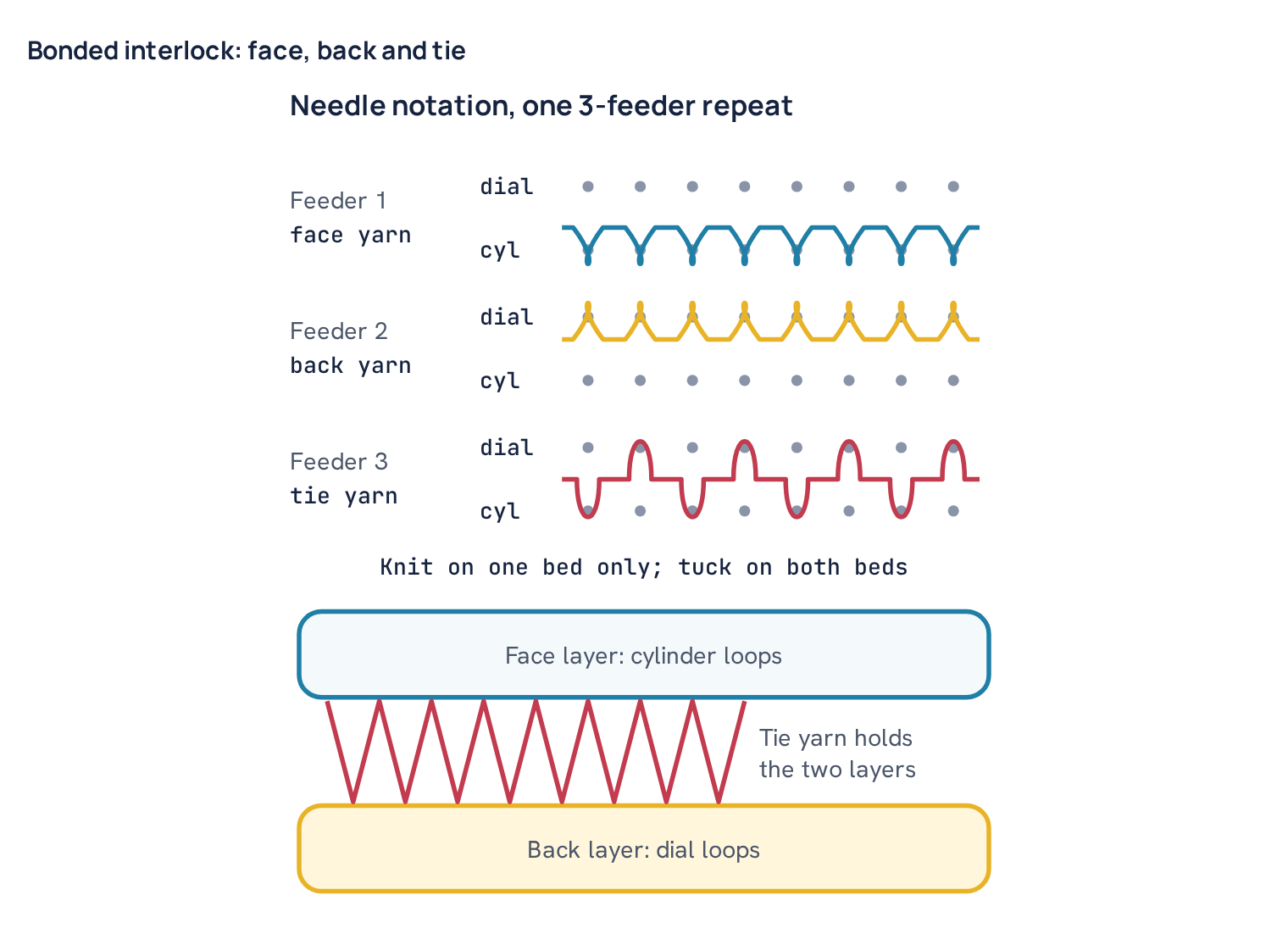
In our register “bonded” means knitted together in this way, not glued or laminated with adhesive or foam. So when this guide talks about the faces “separating”, it means a knitting or finishing fault, not a failed glue line. The register uses three type names: BONDED INTERLOCK, L/BONDED INTERLOCK (with a stretch yarn) and Y/D BONDED INTERLOCK (yarn-dyed). If you are new to double jersey, read the interlock fabric development guide first.
Properties you must design around
- No curling and low spirality. The tied structure is balanced, so cut edges lie flat and wales stay straight.
- Thickness and body. There is yarn on both faces and between them, so the fabric is thicker and firmer than interlock of similar GSM. It holds shapes such as flared skirts and structured shoulders.
- Two faces, two behaviours. Cotton swells, relaxes and shrinks in water. Polyester filament does not swell, but it shrinks with heat until it has been heat-set. If the two faces change size differently, the fabric puckers or bubbles.
- Snagging and pilling. A filament face rarely pills but can snag; a spun cotton face can pill.
- Stretch. Without a stretch yarn the fabric has modest give. With elastane or elastomultiester it has good stretch and recovery, which is what the scuba-like versions rely on.
Where it is used, and its common variants
It goes into dresses, skirts, structured tops, smooth-faced hoodies, athleisure and light jackets. The variants are:
- Cotton face, polyester back. Soft, natural face; firm, stable back.
- Polyester face, cotton back. A smooth, bright, scuba-like face with cotton next to the skin for comfort.
- With a stretch yarn. Elastane or elastomultiester added for stretch and recovery. These are the L/BONDED entries in our register.
- Contrast double face. A different colour on each side, either by dyeing the two fibres differently or by using yarn-dyed yarn.
- 100% polyester or polyester/elastane scuba. A related fabric, dyed with disperse dye only; see the scuba fabric dyeing and finishing flowchart.
What our records hold
Almost all bonded interlock in our register is a cotton and polyester combination, recorded as CVC or PC, many with a stretch yarn; only a handful are all cotton. All 265 entries were finished open width on stenter plus compactor. Most were knitted on 18 gauge (213 entries), with smaller groups on 24 gauge (41) and 28 gauge (10). The usual diameters are 34 inch (143 entries) and 36 inch (82), with some 38, 40 and 42 inch. The yarn strings are very varied, so only two constructions give reliable medians; they are shown in the knitting section.
Development inputs
Read the buyer’s request carefully
Collect every requirement before choosing yarn. For bonded interlock the request should state:
- Finished GSM with tolerance, often ±5%.
- Finished width, usually open width in cm.
- Composition, for example cotton/polyester with a stated percentage, with or without elastane. Because there are several yarns, the composition is set by the weight of each yarn in the fabric, so you must work it out, not guess it.
- Which side is the face, and what fibre the buyer expects on it.
- Shade plan: the same colour on both faces, a contrast, or one face left white.
- Stretch and handle: how much stretch, and whether a firm scuba handle or a softer one is wanted.
- Wash care and test requirements: dimensional stability, spirality, GSM, bursting strength, pilling or snagging, colour fastness, pH and fibre content.
If the shade plan or the face side is not written down, ask. These two points decide the yarn order on the machine and the whole dyeing route.
Choosing the yarns
Cotton yarn. The cotton carries most of the weight. In our two main constructions it is 34/1 and 40/1 Ne; fine counts suit an 18 gauge double face because two layers and a tie yarn share the space between needles. Combed or compact cotton gives a cleaner surface and better pilling.
Polyester filament yarn. Described by denier and filament count, for example 75D/72F. More filaments give a softer, more matt yarn; textured filament covers better than flat. Some buyers ask for a cooling-function polyester filament (a modified cross-section or treated filament), as in one of our main constructions.
Tie yarn. Fine and strong, typically a low-denier polyester filament, so it holds the layers without grinning through either face.
Stretch yarn: elastane or elastomultiester. These two are often confused, and the difference matters in dyeing.
- Elastane (Lycra is one brand) is a segmented polyurethane filament with very high stretch. It is fed bare under controlled tension. It is sensitive to high temperature, strong alkali and chlorine, so it limits polyester dyeing temperature and heat-setting time.
- Elastomultiester is a bicomponent polyester filament, two polyesters of different shrinkage (for example PET with PTT or PBT) joined side by side. When it is heated and relaxed it develops a spiral crimp that gives stretch. It is NOT elastane. It gives less stretch than elastane but takes disperse dye like polyester, survives normal polyester dyeing temperatures and is easier to process. Our second main construction uses 50 denier elastomultiester.
Twist and spirality. Twist torque makes single jersey spiral, but in bonded interlock the tie points lock the layers, so spirality is normally low. Still use knitting twist, not weaving twist.
Common mistake: treating elastomultiester as elastane on the dyeing card. If the dye house lowers the polyester dyeing temperature for “elastane” it may under-dye the polyester; if it treats real elastane as polyester and runs at 130°C, the elastane can lose power. Write the generic fibre name on the job card.
Knitting
Gauge and diameter
Bonded interlock in our records runs mostly on 18 gauge, coarser than the 24 gauge of most plain interlock, because each needle position must take a face, a back and a tie yarn. 24 and 28 gauge are used for finer, lighter double faces.
The number of needles on each bed is diameter × π × gauge. On interlock gauging the dial and cylinder needles stand opposite each other, so the face and back layers have the same number of wales.
Worked example. A 34 inch, 18 gauge machine has 34 × 3.1416 × 18 = about 1,923 needles on each bed. Our first main construction finishes at a median 175 cm open width, which means about 1,923 ÷ 175 = 11 wales per cm in the finished fabric. If the fabric is pulled in to 12 wales per cm, the width falls to about 160 cm. A 36 inch, 18 gauge machine has about 2,036 needles and would give about 185 cm at 11 wales per cm.
Stitch length, yarns and GSM
For a single-yarn fabric, GSM = (courses per cm × wales per cm × stitch length in mm × tex) ÷ 100. For bonded interlock you add up the same calculation for each yarn, because every yarn puts its own length into each square centimetre:
GSM = Σ (loops per cm² of that yarn × stitch length in mm × tex of that yarn) ÷ 100, with tex = 590.5 ÷ Ne for spun yarn and tex = denier ÷ 9 for filament.
34/1 cotton is about 17.4 tex, 40/1 about 14.8 tex, 75 denier polyester about 8.3 tex and 50 denier about 5.6 tex. A metre of the cotton weighs about twice a metre of the 75 denier filament, so the cotton decides most of the GSM and the composition. For quick single-yarn checks use the knit GSM from stitch length calculator, and add each yarn’s share by hand, or use the GSM calculator on a cut sample.
Constructions from our records
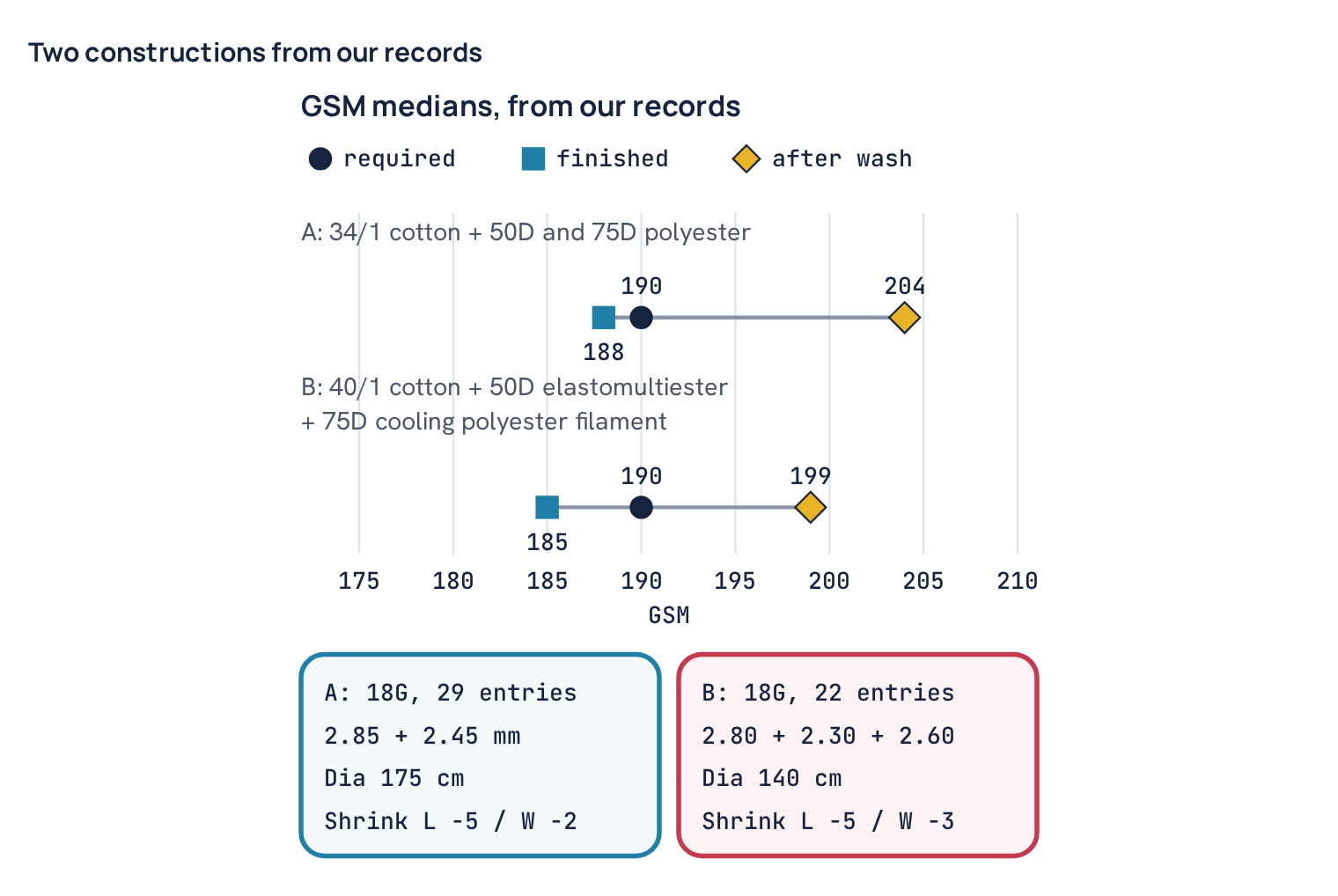
Only two yarn constructions have enough entries in our register to give medians. Stitch length is shown per yarn as recorded, in the order the register writes it. For the first construction three yarns are named but two stitch lengths are recorded; we show them exactly as written. Finished GSM has its interquartile range (the middle half of entries) in brackets.
| Yarns | Gauge | Entries | Stitch length per yarn as recorded | Required GSM | Finished GSM | GSM after wash | Finished dia, cm | Shrink L / W, % | Spirality, % |
|---|---|---|---|---|---|---|---|---|---|
| 34/1 cotton + 50 denier polyester + 75 denier polyester | 18G | 29 | 2.85 + 2.45 mm (n=19) | 190 | 188 (185–192) | 204 | 175 | -5 / -2 | 2 |
| 40/1 cotton + 50 denier elastomultiester + 75D/72F cooling-function polyester filament | 18G | 22 | 2.80 + 2.30 + 2.60 mm (n=22) | 190 | 185 (182–188) | 199 | 140 | -5 / -3 | 2 |
Both constructions target 190 GSM: the first with a coarser 34/1 cotton and two polyester filaments, the second with a finer 40/1 cotton plus a stretch yarn that pulls the fabric together. Both finish close to target, 188 and 185 GSM, with a narrow spread. The stretch version finishes far narrower, 140 cm against 175 cm. Machine diameter per construction is not in the table, so part of that gap may be the machine, but a stretch yarn always pulls the wales together and costs width. Plan for it when you choose the diameter.
Cam set-out and the tie yarn
The cam set-out decides which needles knit, tuck or miss at each feeder. A three-feeder repeat (face, back, tie) is common, and four-feeder repeats are also used, for example with a second tie feeder or with the tie on alternate needles in alternate repeats.
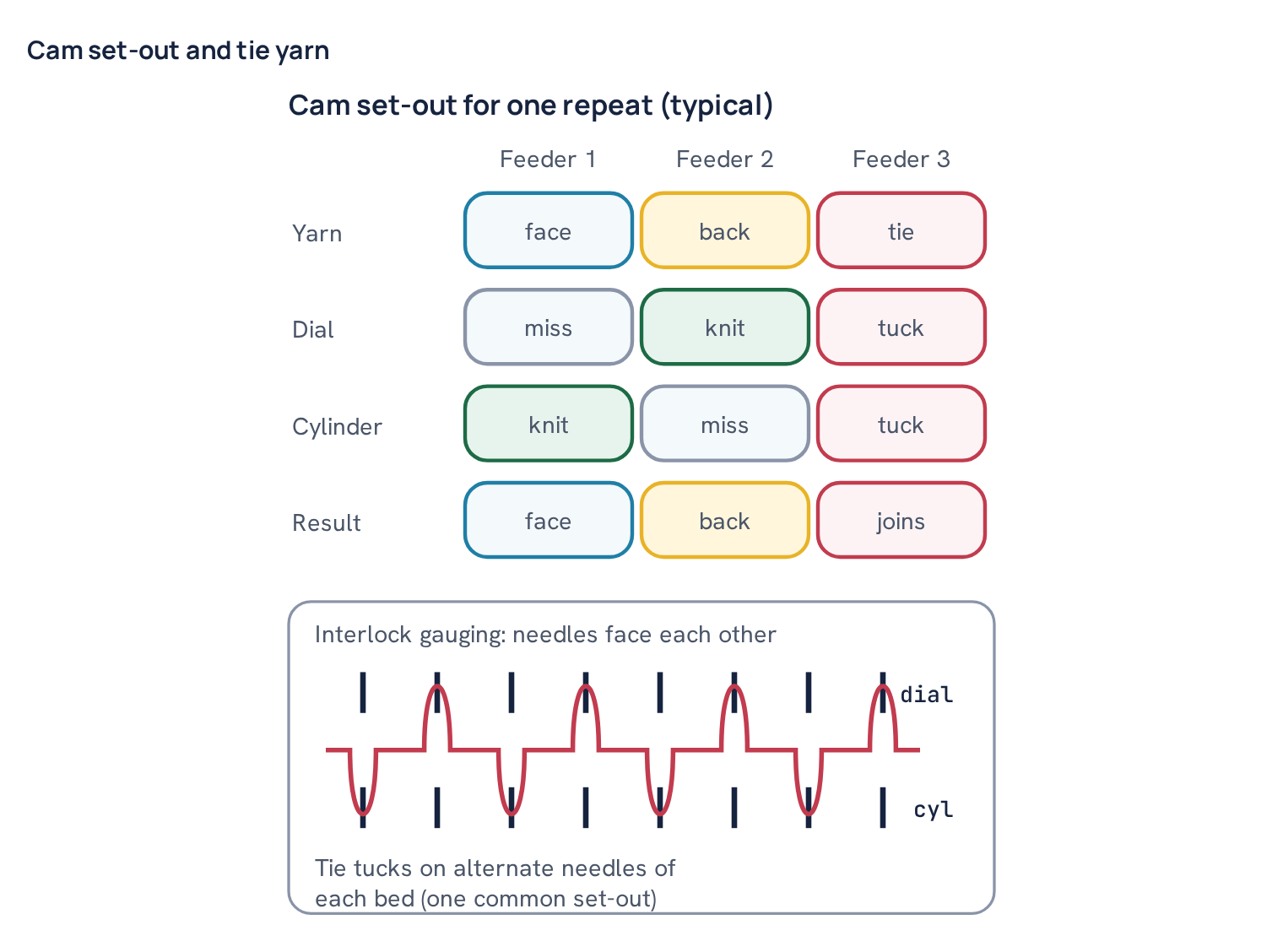
- Tie density. The more often the tie yarn catches the two layers, the firmer and flatter the fabric, and the less the two faces can move apart. Fewer tie points give a softer, more cushioned fabric, but the faces can separate into small bubbles after washing.
- Tie stitch length. The tie loop must be long enough to bridge the gap between the beds without pulling the faces into each other, and short enough to keep them tight. Too long and the faces float apart; too tight and the tie shows through as dots or grin, and the fabric becomes harsh.
- Dial height. The gap between dial and cylinder affects how thick the fabric is and how the tie yarn lies. Record it if your machine allows it to be changed.
- Which yarn on which bed. The cylinder side forms the outside of the tube. Put the yarn the buyer wants on the face on the cylinder feeders, and check the first metres to confirm the face is right before the full roll is knitted.
Feeding filament and stretch yarns
Feed filament and stretch yarns positively, at a controlled length per revolution; uneven feed shows as bars and GSM differences. Elastane is fed bare under a set draft, as in the Lycra single jersey development guide; elastomultiester is fed like a filament. A broken tie yarn leaves a line where the faces are loose, so check the stop motion on every tie feeder.
Machine settings to record
- Machine number, diameter, gauge, number of feeders and the feeder repeat (which feeder carries which yarn).
- Cam set-out for every feeder in the repeat: knit, tuck or miss on dial and cylinder.
- Each yarn: count or denier and filament number, type, lot and supplier.
- Stitch length of each yarn, measured on the greige fabric where possible.
- Yarn input tension or positive feed setting for each yarn; elastane draft.
- Dial height, take-down tension and machine speed.
- Greige tubular dia, greige GSM and roll weight.
Greige inspection
Inspect both faces for holes, drop stitches, needle lines, snagged filament, oil stains, barre, broken stretch yarn and lines where the tie yarn is missing. Pinch the fabric: the layers should not slide over each other. Measure greige GSM and tubular dia after the roll has rested; they will change a lot at heat setting, so record them.
Dyeing and finishing route
All 265 bonded interlock entries in our register are finished open width with stenter and compactor. The full route for a cotton/polyester double face is below, with typical parameter ranges. They depend on the dyes, chemicals, machine and shade, so use them as a starting point. A shorter summary is in the bonded double face interlock dyeing and finishing flowchart, and the general two-fibre process is in the CVC fabric dyeing process. For fabric with elastane, also read the cotton elastane (Lycra) knit dyeing process.
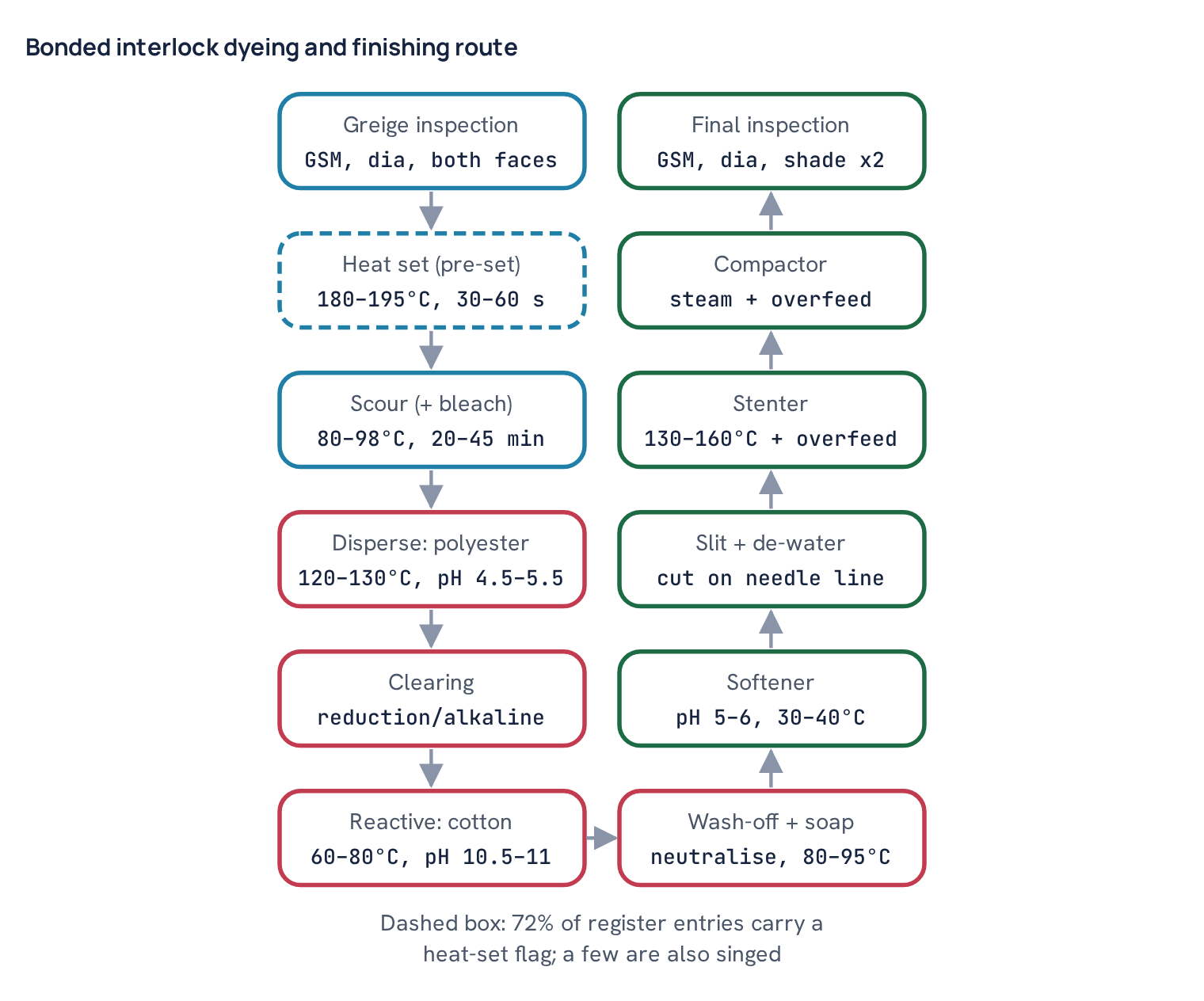
- Heat setting (pre-setting). In our register 72% of bonded interlock entries carry a heat-set flag. Pre-setting, typically 180 to 195°C for 30 to 60 seconds at the planned width, stabilises the polyester and stretch yarn, lets elastomultiester develop its crimp evenly and reduces crease marks. With elastane keep to the lower end. A few entries (17) also record singeing, on one or both faces; take care, because polyester melts rather than burns.
- Scouring. Removes oils and filament spin finish and cleans the cotton, typically 80 to 98°C for 20 to 45 minutes. Peroxide bleaching is added for light shades or white.
- Disperse dyeing of polyester. Typically at pH 4.5 to 5.5 with a dispersing and levelling agent, raised slowly through 80 to 120°C, then held at 125 to 130°C for 30 to 60 minutes. With elastane present the temperature is usually kept at about 120 to 125°C and the time shortened. Elastomultiester takes disperse dye like polyester.
- Clearing. Unfixed disperse dye sits on the polyester surface and on the cotton. It is removed by a reduction clear with sodium hydrosulphite and caustic soda, typically 70 to 80°C for 15 to 20 minutes, or by an alkaline clearing agent. For deep shades this step decides rubbing fastness and staining.
- Reactive dyeing of cotton. Salt and alkali in steps, fixation typically at 60°C for most vinyl sulphone and bifunctional dyes and up to 80°C for hotter types, at about pH 10.5 to 11. See how reactive dyes work.
- Wash-off and soaping. Rinse, neutralise and soap hot to remove hydrolysed reactive dye. Do not boil elastane fabric longer than needed.
- Softener. Typically pH 5 to 6 at 30 to 40°C; choose one that does not promote disperse dye migration.
- Slitting and de-watering. Slit along the marked needle line and remove water evenly.
- Stenter. Dry and set width, typically 130 to 160°C with overfeed, below the heat-set temperature.
- Compactor. Steam and overfeed compress the fabric in length and set final GSM and width.
- Final inspection. Measure GSM, width, shrinkage and spirality, and check shade on both faces.
Dyeing a cotton/polyester double face
The standard method is two-bath: polyester first with disperse dye at high temperature, then clearing, then cotton with reactive dye. Polyester goes first because reactive dyeing and soaping cannot survive 130°C conditions, and because the clearing step after disperse dyeing would damage reactive dye already on the cotton. One-bath and shortened processes exist, but they need careful dye selection and are not covered here.
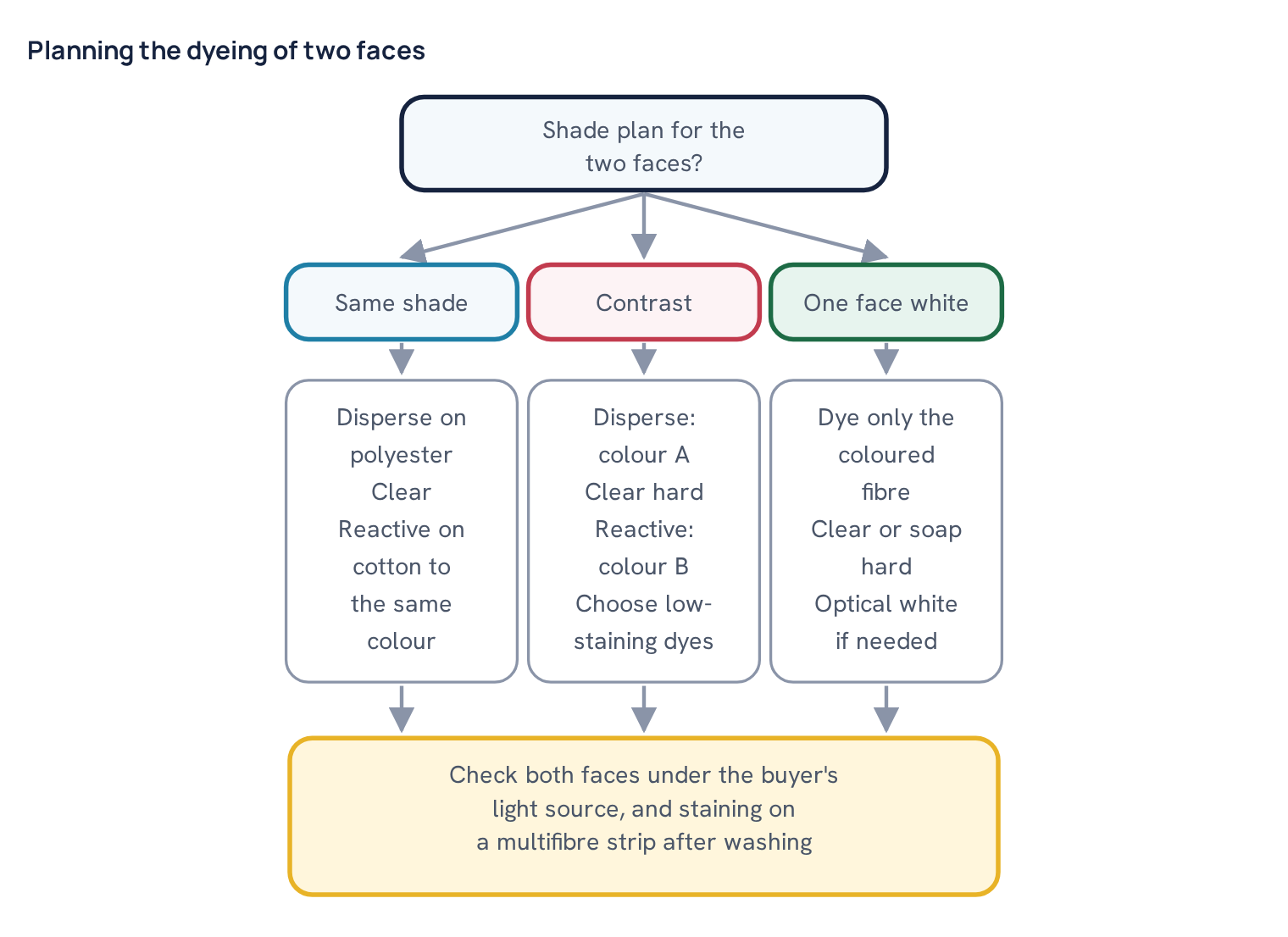
In a CVC jersey the fibres are mixed in each yarn, so the eye sees one averaged colour. In a double face each fibre sits on its own side, so for the same shade on both faces, each face must be matched on its own. A filament face reflects more light and can look brighter than cotton at the same depth. Match each face under the buyer’s light source and record both readings. For uneven or patchy results, see level dyeing and uneven shades and uneven and patchy dyeing.
Cross-staining and thermomigration
When the two faces are different colours, or one is white, cross-staining is the main risk.
- Disperse dye on cotton. It stains cotton without fixing, lowering wet rubbing and wash fastness. A thorough reduction clear and low-staining dyes help.
- Reactive dye on polyester. Reactive dye has little affinity for polyester, so staining of the polyester face is usually light and comes off in soaping. On a white polyester face even a light stain shows, so soap well.
- Thermomigration. High finishing temperature, helped by some softeners, draws disperse dye to the fibre surface, where it rubs off or stains the cotton. Keep stenter temperature moderate on dark polyester shades and check rubbing on finished fabric.
Two dye processes also add their errors lot to lot; keep recipes, liquor ratio and times fixed, and see shade variation lot to lot for the wider causes.
Common mistake: approving a double-face shade from the face only. The buyer’s garment may show the back at the neck, cuff or hem. Always submit and approve both faces, and state on the shade card which face is which.
Hitting finished GSM and width
What our records show
Bonded interlock hits its GSM target better than the single-yarn fabrics in our register. Across 257 entries, the median finished GSM is 2.6% below the required GSM. 68% of entries finish within ±5% of the requirement, 23% finish more than 5% light and 8% more than 5% heavy. So the fabric still tends to finish slightly light, but most lots are in tolerance.
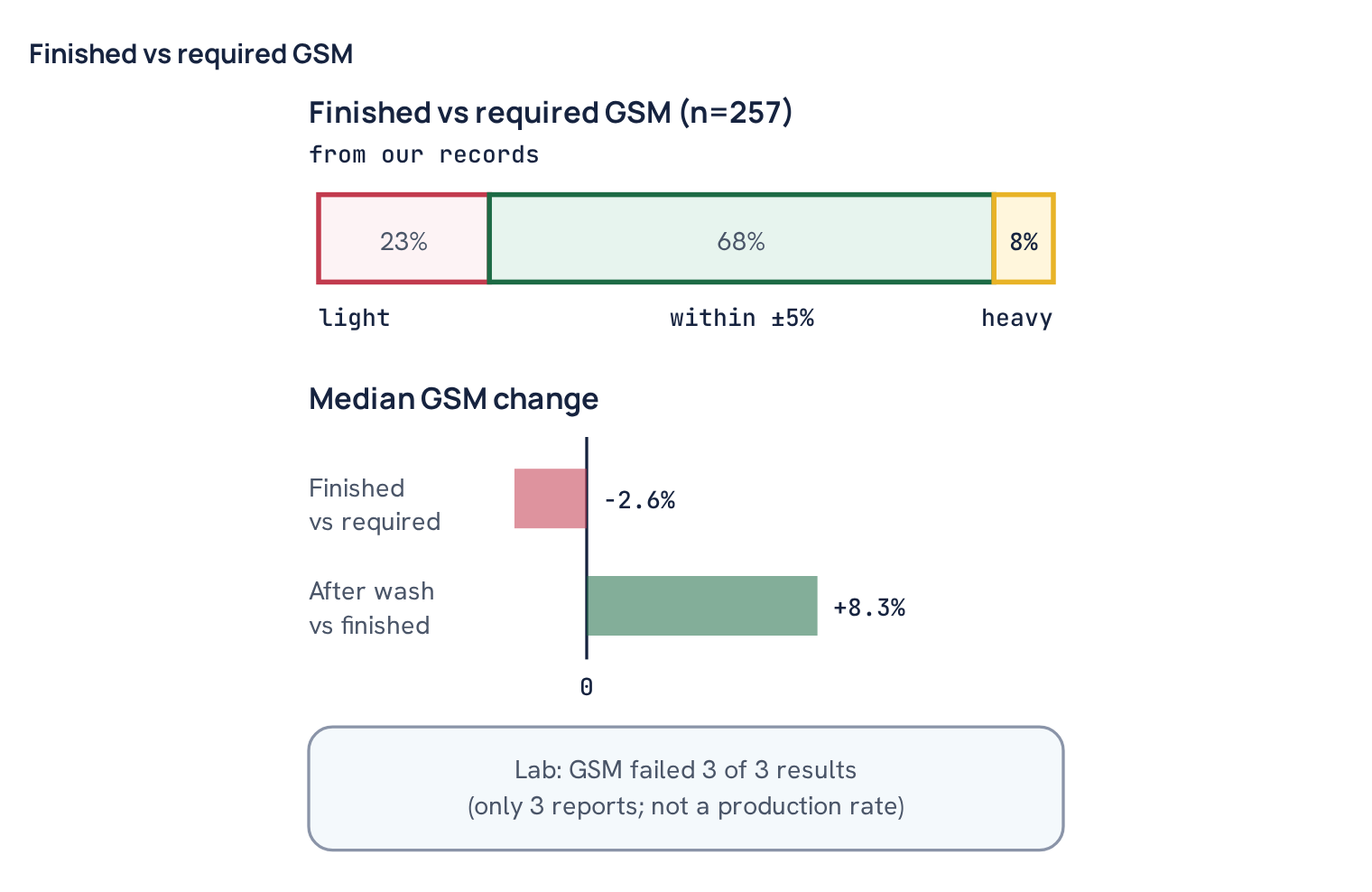
After the dye-house wash test, GSM rises a median 8.3% (256 entries); in the two main constructions 188 and 185 rose to 204 and 199. That comes from relaxation shrinkage, mainly in length: a median -5% in length for both constructions, and -2% and -3% in width. This is the dye-house wash test; the buyer’s lab shrinkage test is separate and covered in the testing section.
Why the two faces make GSM and width harder to control
- Two fibres relax differently. Cotton shrinks when wet; heat-set polyester barely moves. The tie points share the difference, so the fabric shrinks less than cotton alone.
- Heat setting width. The pre-set width largely fixes the polyester side. Too wide gives a light fabric; too narrow, a heavy, narrow one.
- Stretch yarn pulls in. Elastane and elastomultiester draw the fabric together once they are free to relax. This raises GSM and reduces width, as in our 140 cm stretch construction.
- Stenter stretch and compaction. As with any knit, running wide on the stenter to reach width makes the fabric lighter, and too little compactor overfeed leaves length in the fabric that comes out in the first wash.
How to plan greige GSM and dia
- Start from the record table: for a 190 GSM target on 18 gauge, the two constructions above are proven starting points.
- Choose the diameter from the width target, allowing for the narrower finish of stretch constructions.
- Decide the heat-set width and overfeed before knitting the bulk, and keep them the same for every lot.
- Knit a short trial, record greige GSM and dia for the whole tube, then run it through the full bulk route, including pre-setting and both dye baths.
- Measure finished GSM and width, and the GSM after the wash test. If finished GSM is low but after-wash GSM is on target, improve relaxation and compaction. If both are low, change the stitch length or the cotton count.
- Record the greige to finished ratio for GSM and width on the record sheet.
A fibre-by-fibre comparison of GSM gain and shrinkage is in our knit GSM and shrinkage by fibre study, and you can estimate the effect of shrinkage on cut size with the fabric shrinkage calculator.
Common mistake: correcting width only on the stenter. Pulling a double face wider after dyeing makes it lighter and stretches the cotton face more than the set polyester face, which can cause bubbling after washing. Correct width at the heat-set stage or with the machine diameter.
Testing the developed fabric
Only 3 lab reports for bonded interlock reached our desk, so our lab evidence for this fabric is thin. The table shows what those reports contained. Many reports reach us because there was a problem, so do not read them as a production pass rate. Use them as a guide to what to watch, and rely on the buyer’s own requirement for limits.
| Test | Typical buyer requirement (varies by buyer) | Our lab reports (3 reports) |
|---|---|---|
| Dimensional stability (shrinkage) | Often within ±5% L and W after the stated wash | 0 fails in 5 results; median after one wash L -1.4%, W -1.0% |
| Spirality | Often 5% maximum after washing | 0 fails in 5 results; all 0.0% |
| GSM | Often ±5% of the required GSM | 3 fails in 3 results |
| Bursting strength | A minimum in kPa set by the buyer | 1 fail in 2 results; 128 and 191 kPa (median 160) |
| Pilling (box method) | Often grade 3–4 minimum | 0 fails in 3; length pilling 4–5, fuzzing 4; width pilling 4–5 |
| Colour fastness to rubbing | Often dry 4, wet 2–3 or 3 | 1 result, passed; wet grade 3 |
| Colour fastness to washing and perspiration | Often 4 change, 3–4 staining | 1 result each, both passed |
| pH | Often 4.5–7.5 | 1 result, passed |
| Fibre content | Within the label tolerance | Not in our set |
With so few reports, only modest points can be made. Shrinkage and spirality behaved well in every result, which fits the stable, tied structure, and pilling was good. GSM failed in all three results, and one of two bursting results failed. Since the register shows most lots within ±5% of GSM, these fails probably reflect why the reports were sent, but GSM is still the property to watch. Test bursting strength early on any new construction.
The label composition depends on the weight share of each yarn, so have the fibre content of each new construction tested and keep the result.
The testing methods and fixes are covered in these guides:
- How to test shrinkage of knit fabric and shrinkage test fail: causes and remedies
- How to test spirality of knit fabric
- How to test GSM of knit fabric and GSM test fail: causes and remedies
- How to test bursting strength and bursting strength fail: causes and remedies
- How to test pilling (box and Martindale)
- Wet rubbing fastness fail: causes and remedies
Worked example. A buyer asks for a 190 GSM cotton/polyester double face with stretch, finished width about 140 cm. Our second construction, 40/1 cotton with 50 denier elastomultiester and 75D/72F cooling-function polyester on 18 gauge, has a median finished GSM of 185, which is 2.6% light and inside a ±5% tolerance, and a median finished dia of 140 cm. After the dye-house wash test it reaches 199 GSM, with -5% length shrinkage. Start from this construction, keep the heat-set width fixed, and if the finished GSM drifts low, add compactor overfeed before changing any stitch length.
Development record sheet and troubleshooting
Record sheet template
Use one sheet per trial and keep the request and the actual values side by side. A double face needs more lines than single jersey because every yarn and both faces must be recorded.
| Stage | Record |
|---|---|
| Request | Buyer, style, required GSM and tolerance, width, composition, face side and fibre, shade plan (same, contrast, one white), stretch, wash care, test standard |
| Yarns | For each yarn: count or denier/filaments, fibre (generic name), type, supplier, lot; which is face, back, tie and stretch yarn |
| Knitting | Machine no., diameter, gauge, feeders, feeder repeat, cam set-out per feeder, stitch length per yarn, feed or tension per yarn, elastane draft, dial height, take-down, speed |
| Greige | Greige GSM, tubular dia, roll weight, faults on both faces, tie yarn check |
| Heat set | Temperature, time or speed, set width, overfeed; singeing yes/no and which face |
| Wet process | Machine, scour/bleach recipe, disperse recipe, temperature and time, clearing method, reactive recipe, fixation temperature and pH, wash-off, softener |
| Stenter | Temperature, speed, set width, overfeed |
| Compactor | Overfeed, steam, temperature, exit width |
| Finished | Finished GSM, open width, GSM after wash test, shrinkage L/W, spirality, shade result on each face, staining check |
| Lab tests | Each result against requirement, pass/fail |
| Decision | Approved or adjust; what changes in the next trial, and why |
Troubleshooting
Start with the most likely cause and change one setting per trial.
| Problem | Likely cause | What to change |
|---|---|---|
| Bubbling or puckering between the faces after washing | Faces shrink differently; too few tie points; tie stitch too long; no or uneven heat set | Heat-set before wet processing; more tie points or shorter tie stitch; balance face and back stitch lengths |
| Faces separate in a line along the length | Tie yarn missing from a broken end at a tie feeder | Check tie feeder stop motion and yarn path; inspect greige for loose layers |
| Tie yarn shows through as dots | Tie yarn too thick or too tight | Finer tie yarn; slightly longer tie stitch |
| Finished GSM low, after-wash GSM on target | Fabric not relaxed; stretched in length or width | More compactor overfeed; less stenter width stretch |
| Finished and after-wash GSM both low | Stitch length too long or cotton count too fine | Shorten stitch length or use a coarser count |
| Width too narrow | Stretch yarn pulling in; heat set too narrow; too few needles | Wider heat-set width; bigger diameter; review stretch yarn tension |
| Shade differs between faces | Each fibre dyed to a different depth; filament lustre | Match each face separately; adjust disperse or reactive recipe alone |
| Cotton face stained or poor wet rubbing | Poor clearing; thermomigration in finishing | Stronger reduction clear; lower stenter temperature; review softener |
| Elastane fabric loses stretch | Polyester dyed too hot or too long; over-hot heat set | Lower dyeing and heat-set temperature; shorter time |
| Bars across the fabric | Uneven filament or stretch yarn feed; mixed yarn lots | Equalise positive feed; one lot per order; see barre causes and remedies |
| Crease marks | No pre-set; fabric folded in the dyeing machine | Pre-set; lower load; see crease marks in knit dyeing |
| Snags on the filament face | Rough guides or machine parts; harsh handling | Check yarn path and machine surfaces; handle rolls with care |
Decide the face side and shade plan before choosing yarns, start from the two proven 18 gauge constructions, fix the heat-set width, dye polyester first and clear it well, and match both faces. The fabric hits its GSM better than single jersey, but still gains weight in the first wash, so plan compaction and record every trial.
Questions
What is bonded interlock fabric?
It is a double face fabric: a face layer knitted on the cylinder and a back layer knitted on the dial, tied together by a third yarn that tucks on both beds. In our register ‘bonded’ means knitted together, not glued or laminated.
Which gauge and diameter are used for bonded interlock?
In our register most entries were knitted on 18 gauge (213 of 265), mainly on 34 inch and 36 inch machines. 24 and 28 gauge are used for finer, lighter double faces.
How do you dye a cotton/polyester double face?
Usually in two baths: disperse dye on the polyester at about 125 to 130°C, then reduction or alkaline clearing, then reactive dye on the cotton. Each face is matched separately, and cross-staining is checked when the faces differ in colour.
Is elastomultiester the same as elastane?
No. Elastomultiester is a bicomponent polyester filament that develops crimp and stretch with heat, and it dyes with disperse dye like polyester. Elastane is a polyurethane filament with higher stretch that is more sensitive to heat and chemicals.
Why does a double face bubble after washing?
Usually because the two faces shrink differently, for example a cotton face against heat-set polyester, and the tie yarn does not hold them firmly enough. Heat-set before wet processing, use enough tie points and a suitable tie stitch length, and balance the face and back stitch lengths.

Textile engineer with 14+ years in dyeing and fabric development. He writes every guide on Dyeing Solution from real production work. Full profile