Elastane, called spandex in North America, is the stretch fibre in jeans, leggings and T-shirts. What it is made of, whether it is plastic or toxic, how it is heat set in the dye house, and what it does to a fabric, from our records.
At a glance
= spandexsame fibre
3–8%typical content
180–190°Cheat setting
29%C-E within GSM
Elastane is a synthetic fibre that can stretch to several times its length and spring back. It is the same fibre as spandex: “spandex” is the usual name in North America, “elastane” in Europe and most of the world, and Lycra is a well-known brand name for it. A small amount, often 3–8%, is added to cotton, viscose, polyester or nylon to give clothes stretch and shape recovery, from T-shirts and jeans to leggings, swimwear and underwear.
This guide explains what elastane is made of, whether it is plastic or toxic, elastane versus spandex and polyester, how it is processed in the dye house, and what our records show about how it changes a fabric.
What is elastane made of?
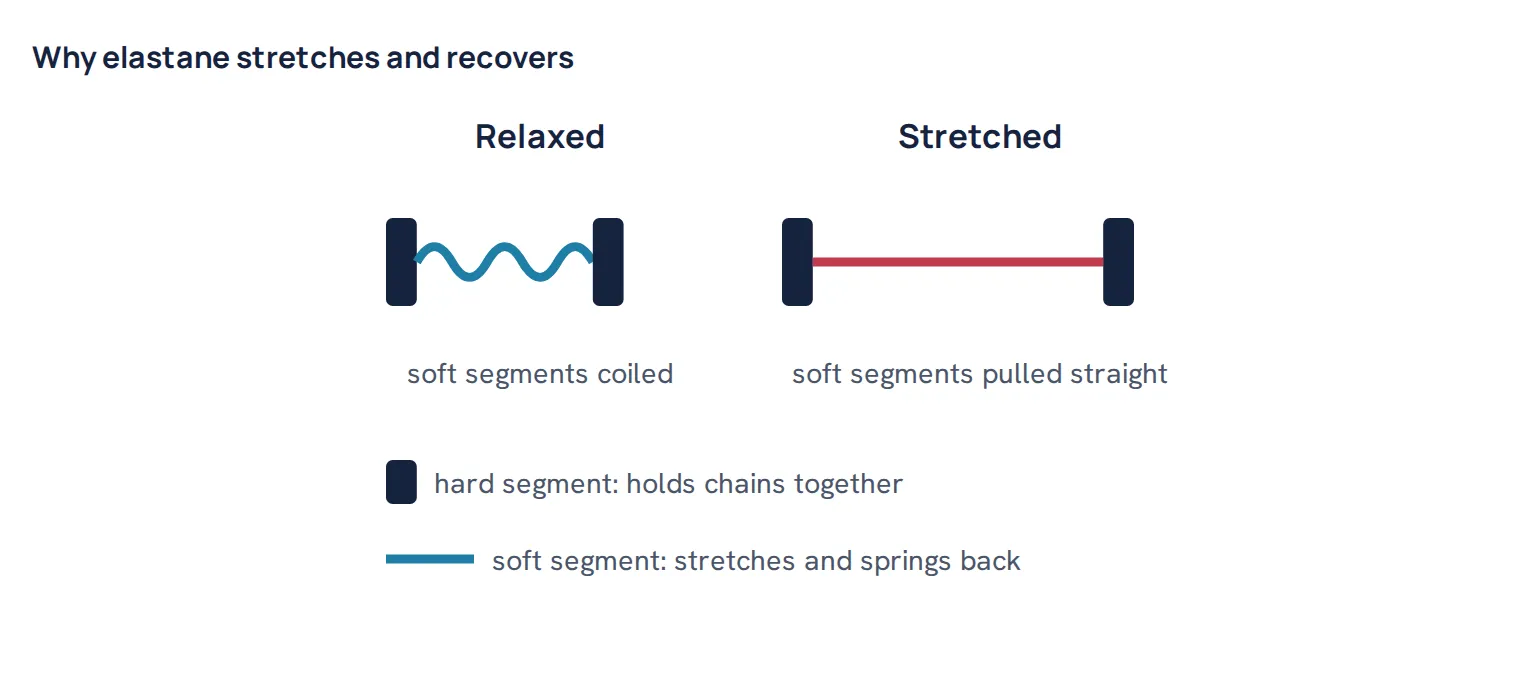
Elastane is a polyurethane-based fibre: by definition it contains at least 85% segmented polyurethane. Its long molecules alternate between soft, coiled sections that stretch easily and hard sections that hold the chains together. When you pull the fibre the soft sections uncoil; when you let go they coil back, and the fabric returns to shape. The raw materials come from oil, so elastane is a fully synthetic fibre.
Elastane vs spandex vs Lycra
They are the same type of fibre. Spandex is the generic name used in the United States and Canada (an anagram of “expands”), elastane is the generic name in Europe and elsewhere, and Lycra is a brand of elastane. In the dye house we often say “Lycra fabric” for any fabric with elastane, whatever the brand.
Is elastane plastic? Is it toxic?
Elastane is a synthetic polymer made from oil, so in that sense it is a plastic-based fibre, like polyester and nylon, and it is not biodegradable. The finished fibre is used next to the skin in underwear, socks and sportswear and is not considered toxic to wear. The concerns raised about it are mainly environmental: it is made from fossil raw materials, and a small amount in a blend makes recycling the fabric much harder.
What elastane does to a fabric
- Stretch and recovery: the fabric stretches with the body and returns to shape, so knees and elbows do not bag.
- Fit: garments can be cut closer to the body.
- Weight and feel: elastane fabrics are usually denser and heavier for the same yarn.
- Weak points: elastane is damaged by high heat, chlorine and some oils and creams, and loses its stretch over time. That is why old swimwear goes baggy.
In knit fabric, elastane is usually plated: a bare elastane filament, often 20 or 40 denier, is fed alongside the main yarn into every loop or every other loop. See the Lycra single jersey development guide for how it is knitted.
Elastane vs polyester
Both are synthetic, but they do different jobs. Polyester is a strong, stable fibre that hardly stretches; elastane is a weaker fibre that stretches enormously. Most stretch fabrics combine the two, or elastane with cotton or nylon: the main fibre gives strength and feel, the elastane gives stretch.
How elastane fabric is processed: heat setting
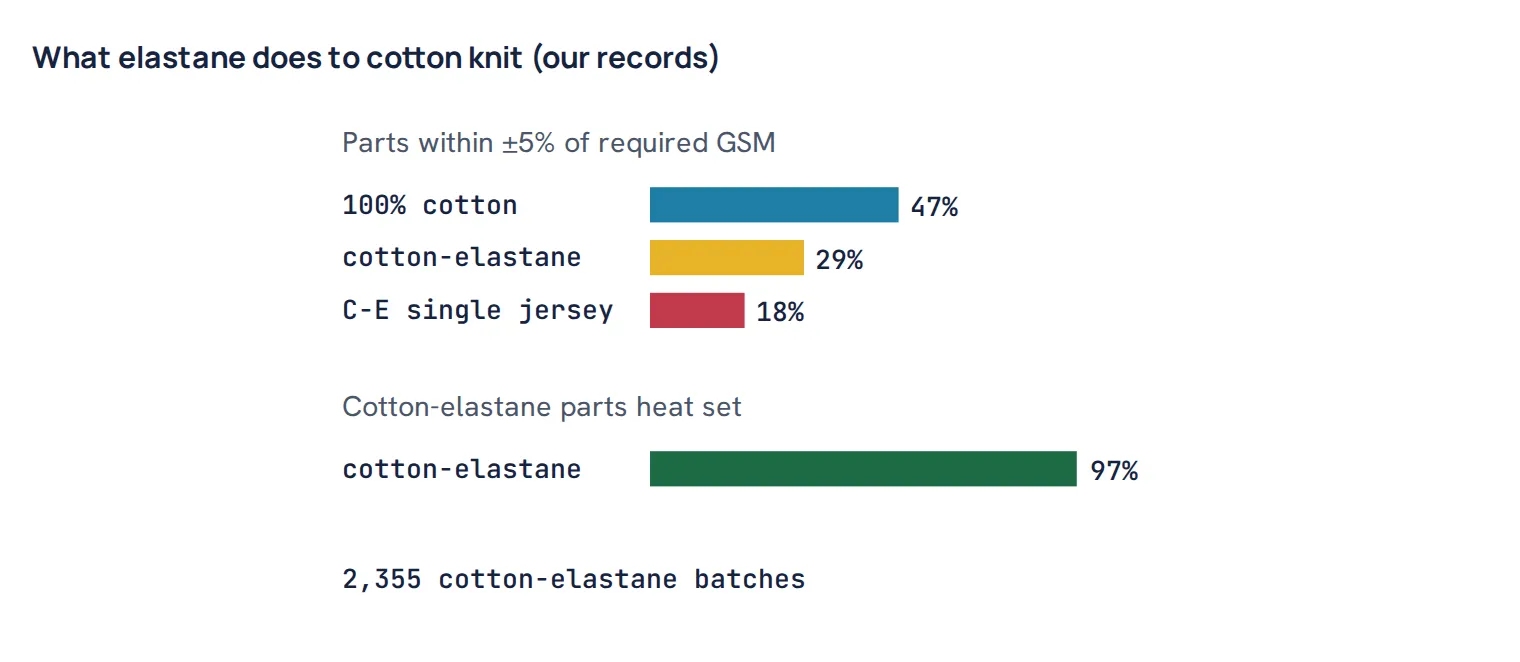
Fabric with elastane comes off the knitting machine with high, uneven stretch. If it is dyed like that, it shrinks, curls and creases unpredictably. So it is heat set first: run open-width through a stenter at high temperature, so the elastane takes a new, stable relaxed length. In our records 97% of cotton-elastane parts were heat set.
- For cotton-elastane fabric the normal heat-setting temperature is 180 to 190 °C. We heat set Lycra fabric to control its stretch, which is normally very high.
- Machine speed depends on the fabric. Speed sets the dwell time: higher speed means less time in the heat and a weaker heat-setting effect; lower speed means more time and a stronger effect.
Elastane also behaves differently in dyeing. Reactive dyes for cotton barely colour it, so on a stretched dark fabric the white elastane can show through, which is called grin-through. Disperse dyes used for polyester stain elastane but wash off it more easily. Mills choose dyes, temperatures and dyeable elastane types to manage this; see the cotton-elastane dyeing process and the polyester-elastane dyeing process.
What our records show
Elastane makes fabric harder to finish on target. Across our finishing records, adding elastane to cotton cut the share of parts finished within ±5% of the required GSM from 47% to 29% (2,355 cotton-elastane batches). Cotton-elastane single jersey was the hardest common fabric of all, with only 18% on target. Median length shrinkage after the wash test was 6%, the same as 100% cotton. For dyeing stretch clothes at home, see can you dye nylon and spandex.
Common mistake: tumble drying stretch jeans and leggings on high heat. Heat weakens elastane, so the fabric slowly loses its recovery and starts to bag. Wash cool and air dry anything that depends on its stretch.
What is cotton spandex?
Cotton spandex is a cotton fabric with a small amount of spandex (elastane) knitted or woven in, usually 3–8%, most often around 95% cotton and 5% spandex. The cotton gives the soft, breathable feel; the spandex lets the fabric stretch and spring back, so leggings, fitted T-shirts, underwear and stretch jeans keep their shape. In knits the spandex is usually fed alongside the cotton yarn on every course (full feed) or every other course (half feed).
- Cotton spandex vs 100% cotton: more stretch and better shape retention, but it should not be washed or dried hot, because heat weakens the spandex.
- In the factory: cotton spandex knits are heat set before dyeing to fix their width and stretch; in our records 97% of cotton-elastane parts were heat set. See the cotton elastane (Lycra) dyeing process.
How to care for elastane clothes
- Wash at 30–40°C; avoid very hot washes.
- Rinse swimwear in fresh water after chlorine or sea water.
- Air dry, or tumble dry on low.
- Do not iron directly on high heat; use a low setting.
Worked example. A 95/5 cotton-elastane single jersey is ordered at 180 GSM. Our records show this is the hardest common fabric to finish on weight, so it should be heat set at the right width and speed before dyeing, and the finished width checked against a relaxed, washed sample rather than straight off the stenter.
Summary
- Elastane and spandex are the same stretch fibre; Lycra is a brand of it.
- It is a polyurethane-based synthetic made from oil, not biodegradable, and safe to wear.
- A few percent gives fabric stretch and recovery; heat, chlorine and age weaken it.
- In the dye house almost all elastane fabric is heat set at 180–190°C first.
- In our records elastane cut GSM accuracy in cotton knit from 47% to 29%.
Questions
What is elastane?
A synthetic, polyurethane-based fibre that stretches to several times its length and springs back. A few percent is blended with other fibres to give fabric stretch and recovery.
Is elastane the same as spandex?
Yes. Spandex is the generic name in North America, elastane the name in Europe and elsewhere. Lycra is a brand of elastane.
Is elastane plastic?
It is a synthetic polymer made from oil, like polyester and nylon, and it is not biodegradable. The finished fibre is not considered toxic to wear.
What does elastane do in clothes?
It lets the fabric stretch with the body and return to shape, so garments fit closer and do not bag at knees and elbows.
Does elastane shrink?
Elastane fabrics are heat set to stabilise them. In our records cotton-elastane knit shrank a median 6% in length after washing, the same as 100% cotton, but was harder to finish on weight.
What is cotton spandex?
A cotton fabric with a small amount of spandex (elastane), usually 3–8% and often 95/5, which adds stretch and shape recovery while keeping the cotton feel.

Textile engineer with 14+ years in dyeing and fabric development. He writes every guide on Dyeing Solution from real production work. Full profile