A development guide for cotton/elastane single jersey: elastane denier and feeding, stitch length, heat setting before dyeing, elastane-safe processing, closing the finished-GSM gap and testing, built on our real development records.
At a glance
1,787Lycra jersey entries in our register
-7.2%median finished vs required GSM
+12%median GSM rise after the wash test
99%entries heat-set before dyeing
Lycra (elastane) single jersey looks like plain single jersey on the face, but it behaves like a different fabric. A thin elastane filament runs behind every cotton loop, or every second one, and pulls the structure together as soon as it is free. That gives the stretch and recovery buyers want, and it changes the stitch length, the feeding, the heat setting before dyeing, the safe wet-processing temperatures and, above all, how you hit finished GSM and width. This guide covers what differs from plain jersey. For loops, wales, courses, yarn choice and testing basics, read the single jersey fabric development guide first. The figures come from our development records: 1,787 Lycra single jersey entries in our fabric register, and just 3 lab reports. Values from general practice are marked as typical.
What Lycra single jersey is
Structure: a plated single jersey
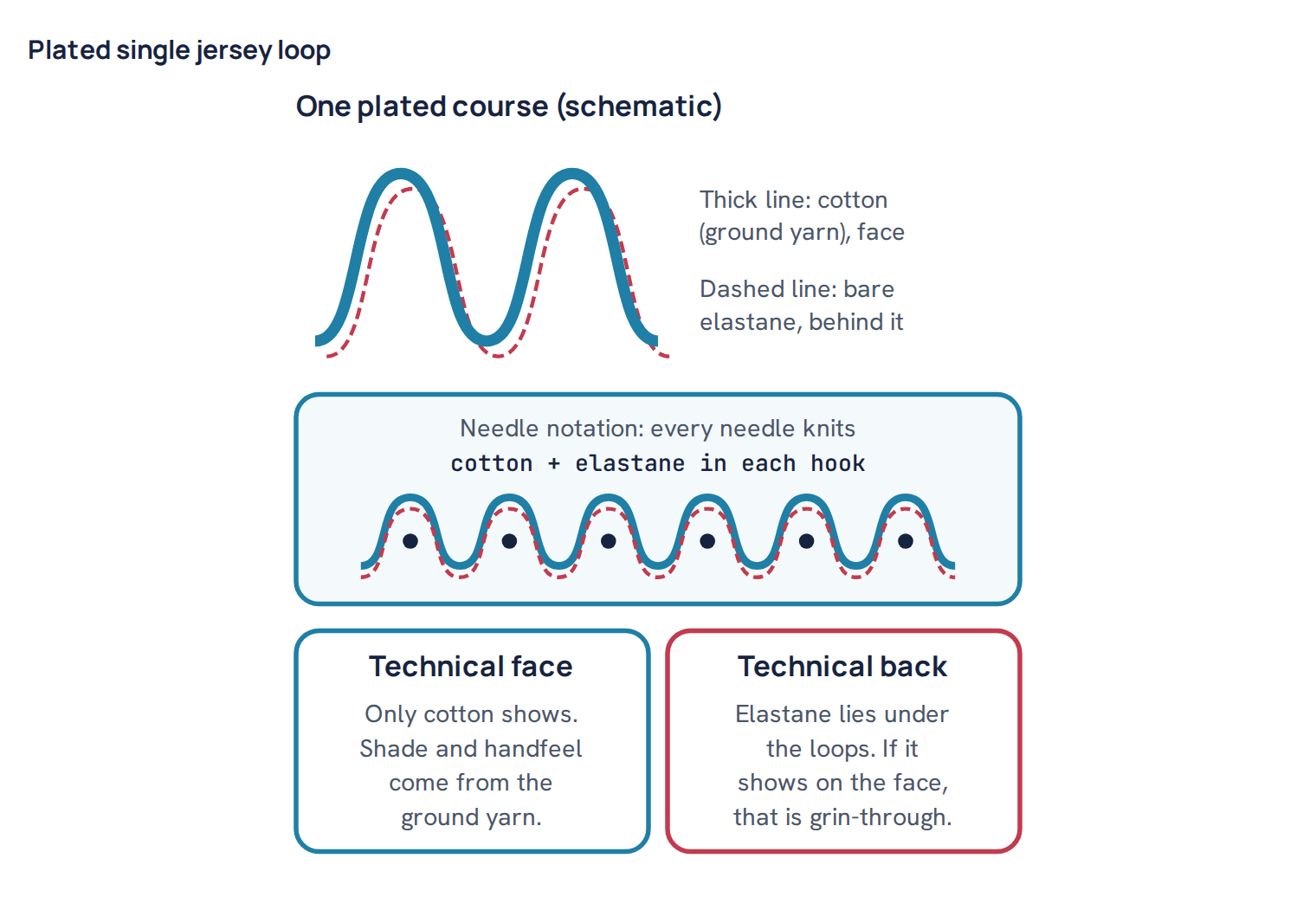
The knitting structure is plain single jersey: every needle knits in every course, the face shows V-shaped wales and the back shows loop heads and sinker loops as courses. The difference is that each loop is made from two yarns. The ground yarn, usually cotton, and a bare elastane filament are fed into the same needle hook, with the ground yarn on the outside of the loop and the elastane behind it. This is called plating. The face shows only cotton; on the back you can see the fine, shiny elastane under the loop heads.
The elastane is knitted under tension, so after knitting it shortens and draws the loops together. The greige is already narrower and more compact than plain jersey at the same stitch length, and it shrinks much more when wet and free to relax.
Properties that differ from plain jersey
- Stretch and recovery. Elastane gives a strong pull back (power) in width and length, so garments keep their shape.
- A more compact fabric. More wales and courses per cm than plain jersey at the same stitch length: heavier and narrower.
- Strong edge curling. The elastane on the back pulls harder than the cotton on the face, so untreated greige can roll tight within minutes of slitting. Heat setting controls this.
- Lower spirality. The fabric is tight and the elastane holds the wales in place, so spirality is usually lower than in plain jersey of the same count. In our register the median spirality is 2% for most rows, and 3% for the lyocell row.
- Heat and chemical sensitivity. Elastane is a segmented polyurethane, weakened by excess heat (especially wet), chlorine and long, hot, strongly alkaline treatments.
- High length shrinkage. In our register, length shrinkage after the dye-house wash test is -5% to -10%, depending on the yarn.
Where it is used, and the variants in our register
Lycra single jersey is used for fitted tees, women’s tops and dresses, leggings, base layers and underwear. In our register 1,372 of the 1,787 entries are cotton with elastane, 229 are other fibres with elastane (lyocell is the main one in our top rows) and 168 are CVC or polyester-cotton with elastane. A few are yarn-dyed stripe Lycra jersey, whose shrinkage and fastness depend on the yarn dyeing. One top row is a multi-yarn version: 40/1 cotton, 50 denier polyester and 20 denier elastane. Slub and melange yarns can also be plated with elastane and follow the same rules.
Development inputs
What the buyer’s request must say
Beyond the usual GSM, width, composition, shade, wash care and test list, a Lycra request must state:
- Elastane content and tolerance, for example 95/5 cotton/elastane. It decides denier and feeding, and fibre analysis will check it.
- Stretch and recovery limits, if any: extension under load and growth after a hold. They decide denier and feeding.
- Width basis. Cuttable, full or relaxed width? Elastane fabric changes a lot between stenter and cutting table.
- Wash care. Hot tumble drying is hard on elastane and raises test shrinkage.
Choosing the ground yarn
The ground yarn is chosen as for plain jersey: combed ring or compact yarn with a knitting twist. The difference is the count. Because elastane makes the fabric so compact, Lycra jersey uses finer counts for the same weight. Our main ground yarns are 30/1, 34/1 and 40/1 cotton and 34/1 lyocell, for 160 to 210 GSM. Plain cotton jersey of 180 GSM is usually 24/1; Lycra jersey of 180 GSM is 34/1 with 20 denier elastane. A finer, smoother ground yarn also hides the elastane better.
Choosing the elastane: denier and feeding
Denier. Bare elastane for plated jersey is commonly 20, 30 or 40 denier; higher denier gives more power and weight. In our register, 30/1 cotton on 28 gauge at about 3.0 mm is required at 190 GSM with 20 denier and 210 GSM with 30 denier (finished medians 178 and 196).
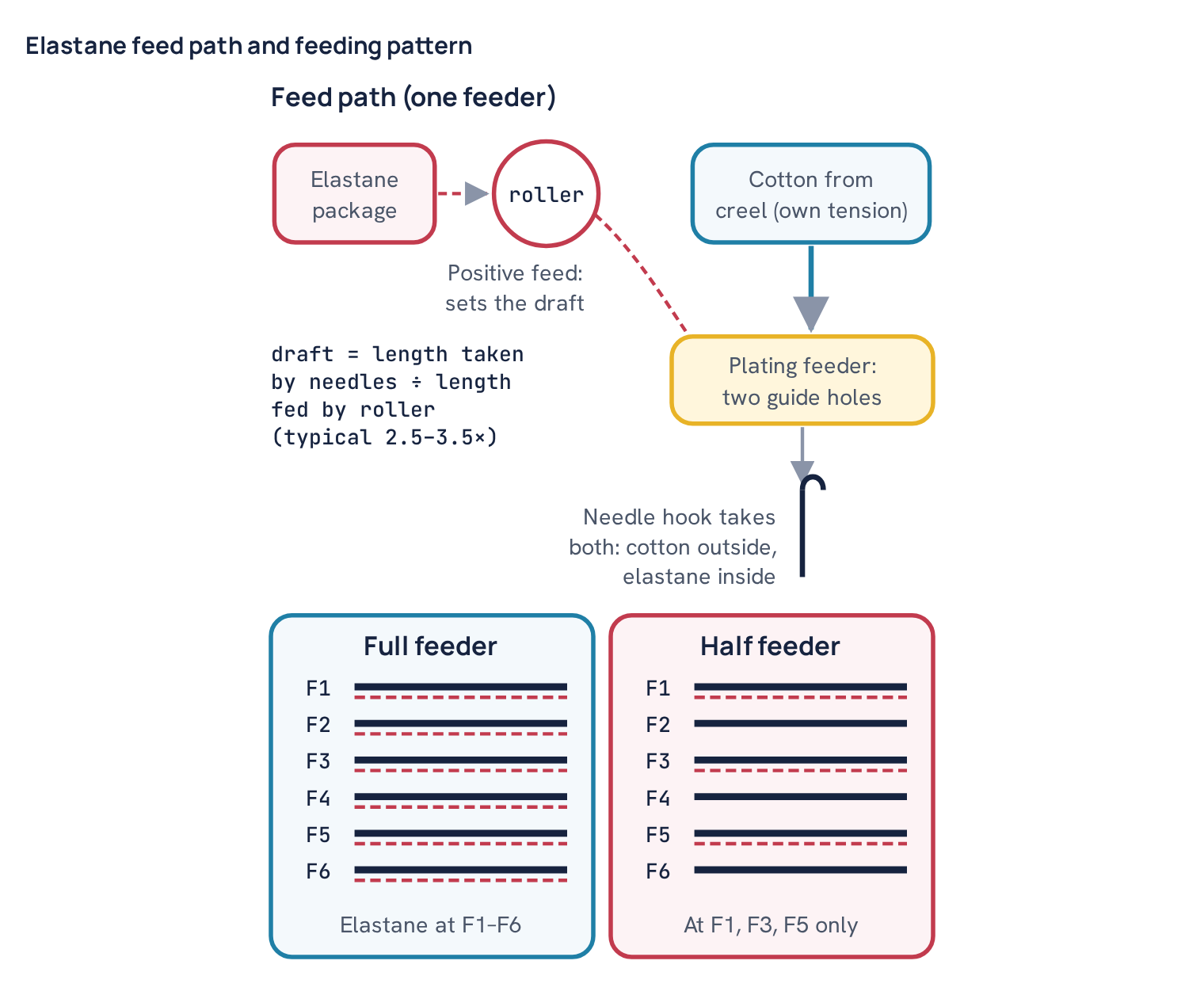
Full feeder or half feeder. In full feeder (FF) fabric, elastane is fed at every feeder, so every course is plated. In half feeder, also called alternate feeder (HF), elastane is fed at every second feeder, so every second course is plated. All the main rows in our register are full feeder. The general differences are summarised below; the values are typical and vary with yarn, denier and machine.
| Point | Full feeder (FF) | Half feeder (HF) |
|---|---|---|
| Elastane in courses | Every course | Every second course |
| Stretch and recovery | Highest; good in width and length | Lower; mainly width stretch |
| Elastane content (typical, 20 denier) | About 4–7% | About 2–4% |
| Fabric weight and width | Heavier, narrower | Lighter, wider |
| Length shrinkage risk | High if heat setting is poor | Lower, but uneven courses can show |
| Curling, uneven stretch | Strong curl, even stretch | Curl and some risk of uneven or wavy look |
| Cost | Higher | Lower |
Elastane content is not set by denier alone. It depends on the denier, the ground yarn count, the stitch length and the draft at which the elastane is fed. A finer ground yarn or a higher denier raises the elastane share. Make a trial, check the content by fibre analysis, and adjust the draft or denier before bulk.
Common mistake: promising a buyer “5% elastane” from a calculation, without a fibre analysis on the trial. Small changes in draft and ground count move the real content by one or two percentage points, which can fall outside the label tolerance.
Knitting
Gauge and diameter
In our register 1,226 entries are knitted on 28 gauge and 509 on 24 gauge; 20 and 32 gauge are rare. The most used diameter is 30 inch (1,267 entries), then 34, 36, 32 and 28 inch. Because elastane pulls the fabric narrower, it needs more needles for a given width than plain jersey; 30 inch, 28 gauge is the usual choice for a finished open width of about 176 to 190 cm.
Worked example. A 30 inch, 28 gauge machine has 30 × 3.1416 × 28 = about 2,639 needles. Our main row, 34/1 cotton with 20 denier elastane, finishes at a median of 180 cm open width. So the finished fabric has about 2,639 ÷ 180 = 14.7 wales per cm. A plain 24/1 jersey on a 24 gauge, 30 inch machine (2,262 needles) finishing at 176 cm has about 12.9 wales per cm. The elastane fabric is packed about 14% tighter in width.
Stitch length, count and GSM
The GSM formula is the same as for plain jersey, with one extra term for the elastane:
GSM = (courses per cm × wales per cm × stitch length in mm × (ground yarn tex + elastane tex × elastane length factor)) ÷ 100, where ground tex = 590.5 ÷ Ne and elastane tex = denier ÷ 9.
The length factor allows for the elastane being fed stretched, so it puts less relaxed length into each loop than the cotton. Its own mass is small: 20 denier is about 2.2 tex against 17.4 tex for 34/1 cotton. Its big effect is pulling the loops together and raising courses and wales per cm, so you cannot add elastane to a plain jersey construction and expect the same GSM. Explore combinations with the knit GSM from stitch length calculator or the GSM calculator, then confirm with a finished trial.
Lycra jersey uses a longer stitch length than plain jersey of the same weight: 2.9 to 3.0 mm in our main rows, against 2.70 to 2.80 mm for plain cotton jersey of 160 to 180 GSM. The longer loop lets the elastane close the fabric without making it board-like.
Yarn, gauge, stitch length and GSM from our records
The table shows the eight most common constructions in our register. Values are medians; the figures in brackets are the interquartile range (the middle half of the entries). All rows are full feeder. Finished dia is the finished open width in cm. Shrinkage is from the dye-house wash test.
| Yarn | Gauge | Entries | Stitch length, mm | Required GSM | Finished GSM | GSM after wash | Finished dia, cm | Shrink L / W, % | Spirality, % |
|---|---|---|---|---|---|---|---|---|---|
| 34/1 cotton + 20D elastane | 28G | 356 | 2.9 (2.9–2.9) | 180 | 165 (155–168) | 184 | 180 | -7 / -2 | 2 |
| 34/1 cotton + 20D elastane | 24G | 116 | 2.9 (2.9–2.9) | 180 | 162 (157–168) | 185 | 176 | -8 / -2 | 2 |
| 40/1 cotton + 20D elastane | 28G | 92 | 2.9 (2.9–2.9) | 160 | 148 (145–152) | 170 | 178 | -8 / -2 | 2 |
| 34/1 lyocell + 20D elastane | 28G | 56 | 2.9 (2.9–2.9) | 180 | 166 (155–168) | 187 | 179 | -10 / -3 | 3 |
| 30/1 cotton + 20D elastane | 28G | 32 | 3.0 (2.9–3.0) | 190 | 178 (175–182) | 195 | 180 | -5 / -2 | 2 |
| 30/1 cotton + 20D elastane | 24G | 30 | 3.0 (2.95–3.0) | 190 | 177 (170–180) | 196 | 180 | -5 / -2 | 2 |
| 30/1 cotton + 30D elastane | 28G | 29 | 3.0 (3.0–3.0) | 210 | 196 (186–200) | 222 | 180 | -5 / -2 | 2 |
| 40/1 cotton + 50D polyester + 20D elastane | 28G | 26 | 3.15 + 2.90 (stitch length per yarn as recorded, 23 entries) | 160 | 155 (152–156) | 166 | 190 | -4 / -3 | 2 |
Several things stand out:
- The stitch length is almost fixed. The middle half of entries is exactly 2.9 mm for 34/1 and 40/1, and 2.9 to 3.0 mm for 30/1. GSM is steered by ground count and denier, not stitch length.
- Gauge changes width more than weight. 34/1 with 20 denier on 24 gauge gives nearly the same GSM as on 28 gauge, but finishes a little narrower, 176 against 180 cm, with fewer needles in the same diameter.
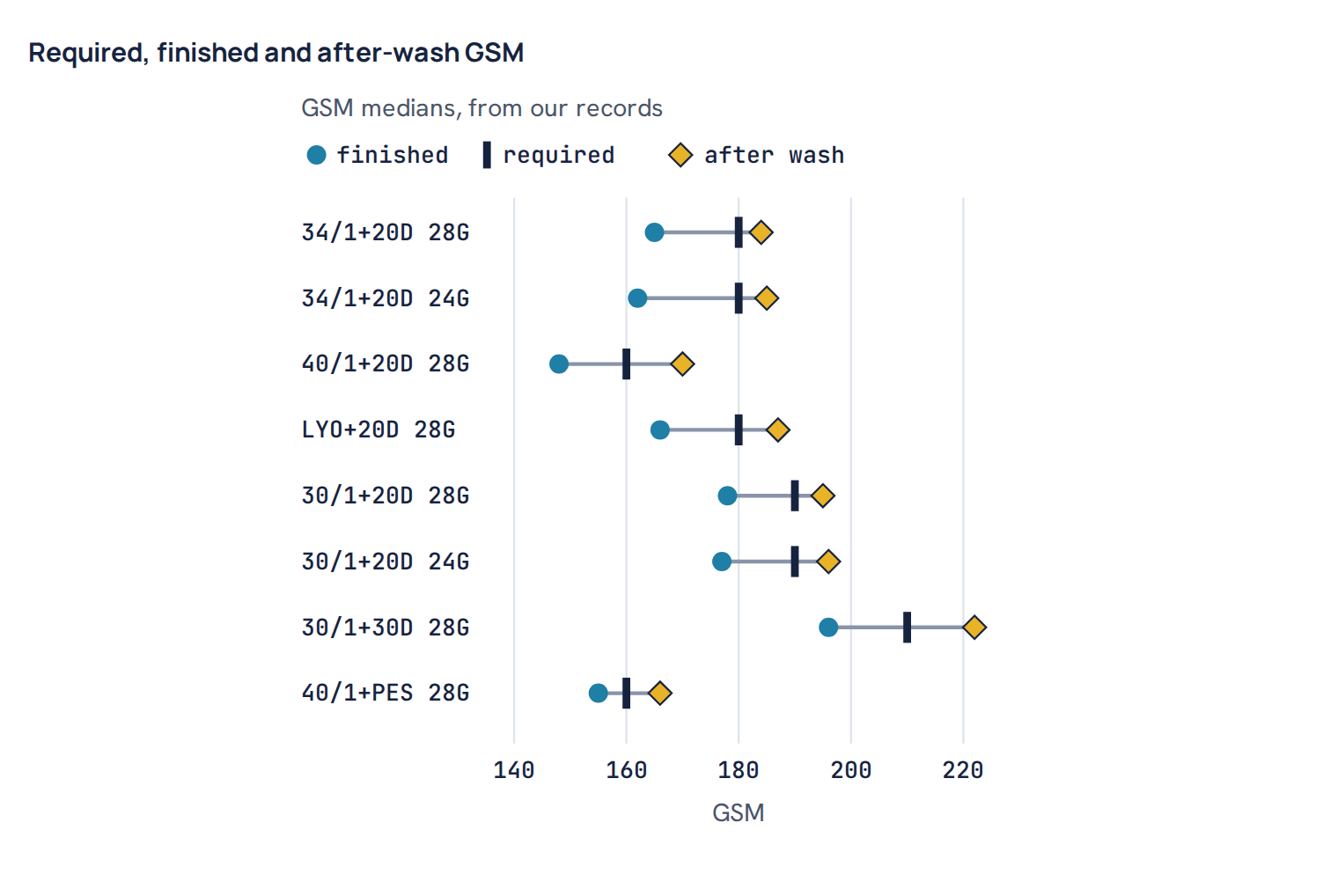
- Finished GSM is below required in every row, and GSM after the wash test is above required in every row. This is the central development problem for Lycra jersey, discussed below.
- Lyocell shrinks most: -10% length, -3% width, and 3% spirality. Lyocell swells strongly in water. See also 100% lyocell knit dyeing process for the handling of lyocell itself.
- Polyester in the mix stabilises the fabric. The multi-yarn row with 50 denier polyester has the lowest length shrinkage (-4%) and finishes closest to its target (155 against 160 GSM).
Elastane feeding and plating
The elastane runs from its package over a positive feed roller, which delivers a fixed length per machine turn, then through its own hole in the plating feeder into the needle hook. The needles take more length than the roller gives, so the elastane is stretched as it is knitted. That ratio is the draft, typically about 2.5 to 3.5 times for bare elastane, varying with denier and machine.
- Higher draft puts less relaxed elastane into the fabric. The fabric is lighter, has less elastane content and a little less power, and the elastane is closer to its breaking point.
- Lower draft puts more elastane in. The fabric is heavier, narrower and stronger in recovery, with a higher elastane share.
- Even draft on every feeder is critical. A feeder with a different draft makes a course with a different elastane tension, which shows as a horizontal bar or stripe, sometimes only after dyeing. See barre in knit fabric.
- Plating position. The feeder must keep the elastane behind the ground yarn. Worn or badly set feeders let the elastane twist to the face, and it then shows as shiny grin-through, especially in dark shades and under stretch.
Machine settings to record
Record everything you would record for plain jersey, plus the elastane settings. Without them, a Lycra trial cannot be repeated:
- Machine number, diameter, gauge and number of feeders.
- Ground yarn and elastane: count or denier, type, lot and supplier.
- Full or half feeder, and which feeders carry elastane.
- Elastane draft or positive feed setting, checked on each feeder; ground yarn input tension.
- Stitch length measured on the greige, per yarn where more than one yarn is fed.
- Cam or stitch setting, machine speed and take-down tension.
- Greige tubular dia, greige GSM and roll weight, measured after the greige has rested.
Greige inspection
Elastane greige needs a few checks that plain greige does not:
- Elastane breaks. A broken end makes a looser, lighter band that does not pull back when stretched.
- Grin-through. Stretch the greige and look at the face. Shiny elastane on the face means a plating fault.
- Tight or loose courses from uneven draft between feeders.
- Rest before measuring. Greige keeps shrinking for hours. Measure after a fixed rest, for example 24 hours flat, and record it.
- Knitting oil. Heat setting before scouring can fix oil stains, so they matter more than in plain jersey.
Heat setting, dyeing and finishing
Why the fabric is heat-set before dyeing
In our register 99% of Lycra single jersey entries carry a heat-set flag, about 409 of 1,787 (roughly 23%) also carry a singeing note, and all run on the open-width route with stenter and compactor.
Elastane is a polymer with hard and soft segments. Held at a chosen width and length and heated near its setting temperature, the hard segments rearrange and the elastane takes the held dimensions as its new relaxed state. This gives several benefits:
- The width is fixed before wet processing, so the fabric does not shrink into a narrow rope in the dyeing machine.
- Edge curling is reduced, which makes slitting, stenter feeding and cutting easier.
- Crease marks and running marks in the dyeing machine are reduced, because the fabric is flat and stable. See crease marks in knit dyeing.
- Length and width shrinkage in the final garment are lower and more predictable.
- The elastane no longer slips back from cut edges and seams as easily.
For cotton/elastane, heat setting is usually done on the greige, because the bleach that follows removes the slight yellowing of the cotton; setting after dyeing would change the shade.
Heat-setting parameters
The greige is slit, pinned on the stenter at the set width with a chosen overfeed, and passed through hot air. The values below are typical; they vary with elastane type, fabric weight and the stenter.
| Setting | Typical range | What it controls |
|---|---|---|
| Temperature | 185–195°C for cotton/elastane; often a little lower for lyocell or viscose blends | Too low: poor setting, curl and shrinkage. Too high: elastane loses power, cotton yellows, elastane can break |
| Dwell time at temperature | About 30–60 s | Set by fabric speed and stenter length; heavier fabric needs more time |
| Set width | Close to the planned finished width, often a few cm wider | The base width for the rest of the route; the finished width should not be pulled beyond it |
| Overfeed | Often about 5–15% | Pushes length into the fabric before setting; more overfeed gives a heavier set fabric with lower length shrinkage |
| Fabric state | Dry, clean, relaxed greige | Wet or oily spots set unevenly and can mark |
Worked example. Our main construction, 34/1 cotton with 20 denier on 28 gauge, finishes at a median of 180 cm. Heat-set at 185 cm, the stenter has width in hand after dyeing. Heat-set at 175 cm, the stenter must stretch it to 180 cm, which makes it lighter and returns as width shrinkage in the wash test.
Elastane-safe wet processing
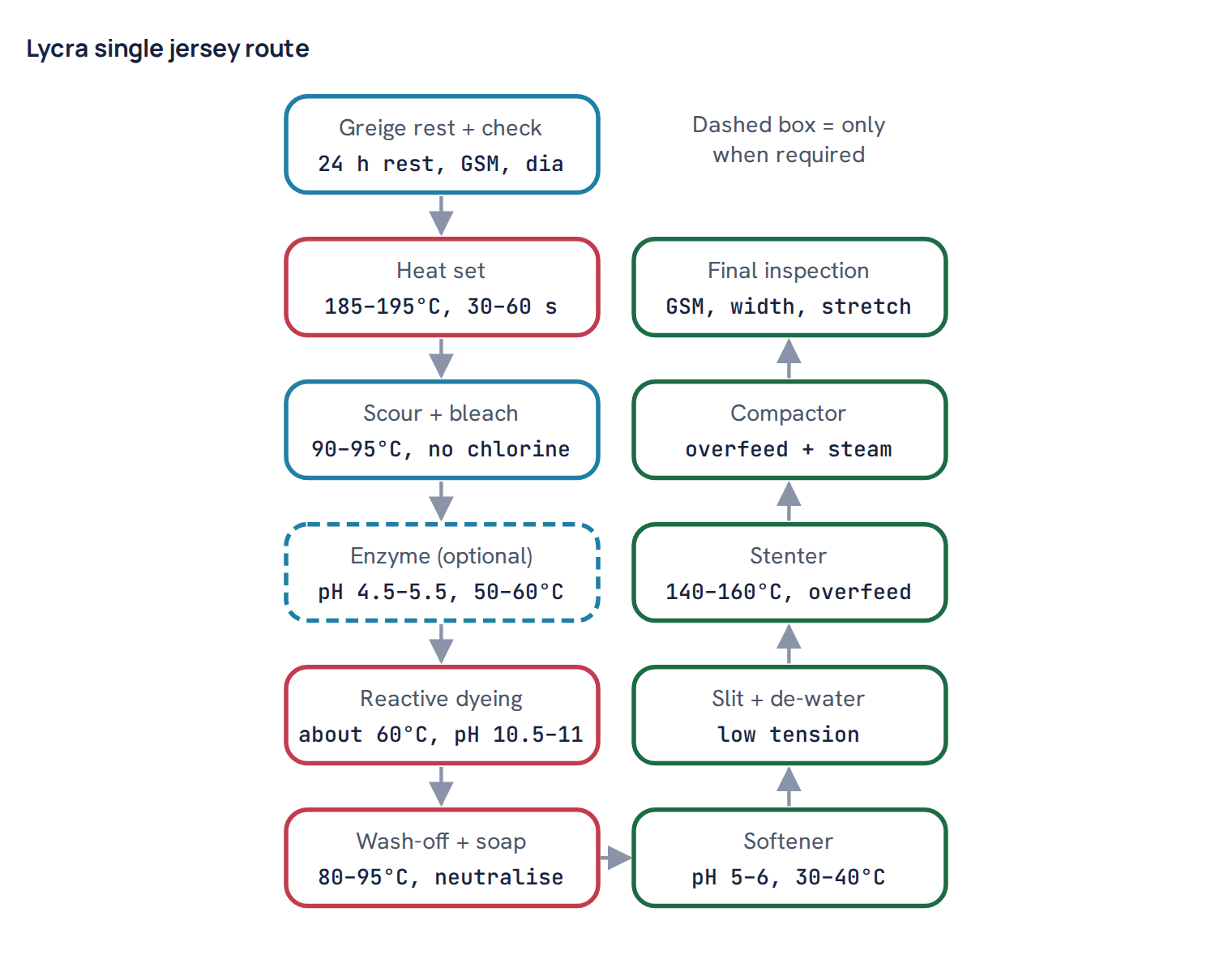
The wet process follows the cotton route, with limits set by the elastane. See cotton elastane (Lycra) knit dyeing process, and the single jersey dyeing and finishing flowchart. Ranges below are typical.
- Load the heat-set fabric with care. Use a lower fabric load and gentle reel speed. Elastane fabric is heavy for its area and creases easily if packed tight.
- Scouring and bleaching. Caustic soda, hydrogen peroxide, stabiliser and wetting agent, but at a moderate level. Many dye houses keep the temperature at about 90 to 95°C and the time as short as the whiteness target allows, rather than a long boil. Never use hypochlorite or any chlorine bleach on elastane.
- Enzyme, if required. Acid cellulase at about pH 4.5 to 5.5 and 50 to 60°C, as for cotton. It is safe for elastane, but it does reduce weight and bursting strength a little.
- Reactive dyeing. Fixation at about 60°C and pH 10.5 to 11 is safe for elastane; 80°C types are usually acceptable for short times. The elastane takes very little reactive dye and stays near white, so good plating must hide it. See how reactive dyes work and, for uneven shades, level dyeing and uneven shades.
- Polyester or nylon in the blend. Disperse dyeing of the polyester part is the hardest step for elastane. Keep it as low and short as the shade allows, commonly around 120 to 125°C, and avoid long runs at 130°C. Reduction clearing with sodium hydrosulphite and caustic is kept mild, typically 70 to 80°C. CVC handling is covered in CVC fabric dyeing process.
- Wash-off. Soap at about 80 to 95°C to remove unfixed dye. Wet rubbing on Lycra jersey depends on good wash-off as much as on plain jersey.
- Softener. Usually at 30 to 40°C and pH about 5 to 6. Choose a softener that does not reduce elastane recovery or cause yellowing at stenter temperature.
Slitting, stenter and compactor
Slitting and de-watering. Slit along the marked needle line with low tension. Over-squeezing or high draw-off tension stretches the fabric in length, and the elastane will give that length back as shrinkage later.
Stenter. Dry clearly below the heat-set temperature, typically about 140 to 160°C for cotton/elastane, with overfeed, at or below the heat-set width. Extra width here comes from GSM and returns as width shrinkage.
Compactor. Steam and overfeed compress the fabric in length. Lycra jersey springs back more than cotton jersey, so use enough overfeed and let it cool and relax before rolling.
Common mistake: drying a Lycra fabric on the stenter at the same temperature used for heat setting “to save a pass”. The width changes again, the elastane loses power, and the finished fabric can be both narrower and weaker in recovery.
Hitting finished GSM and width
What our records show: a high finished-GSM gap
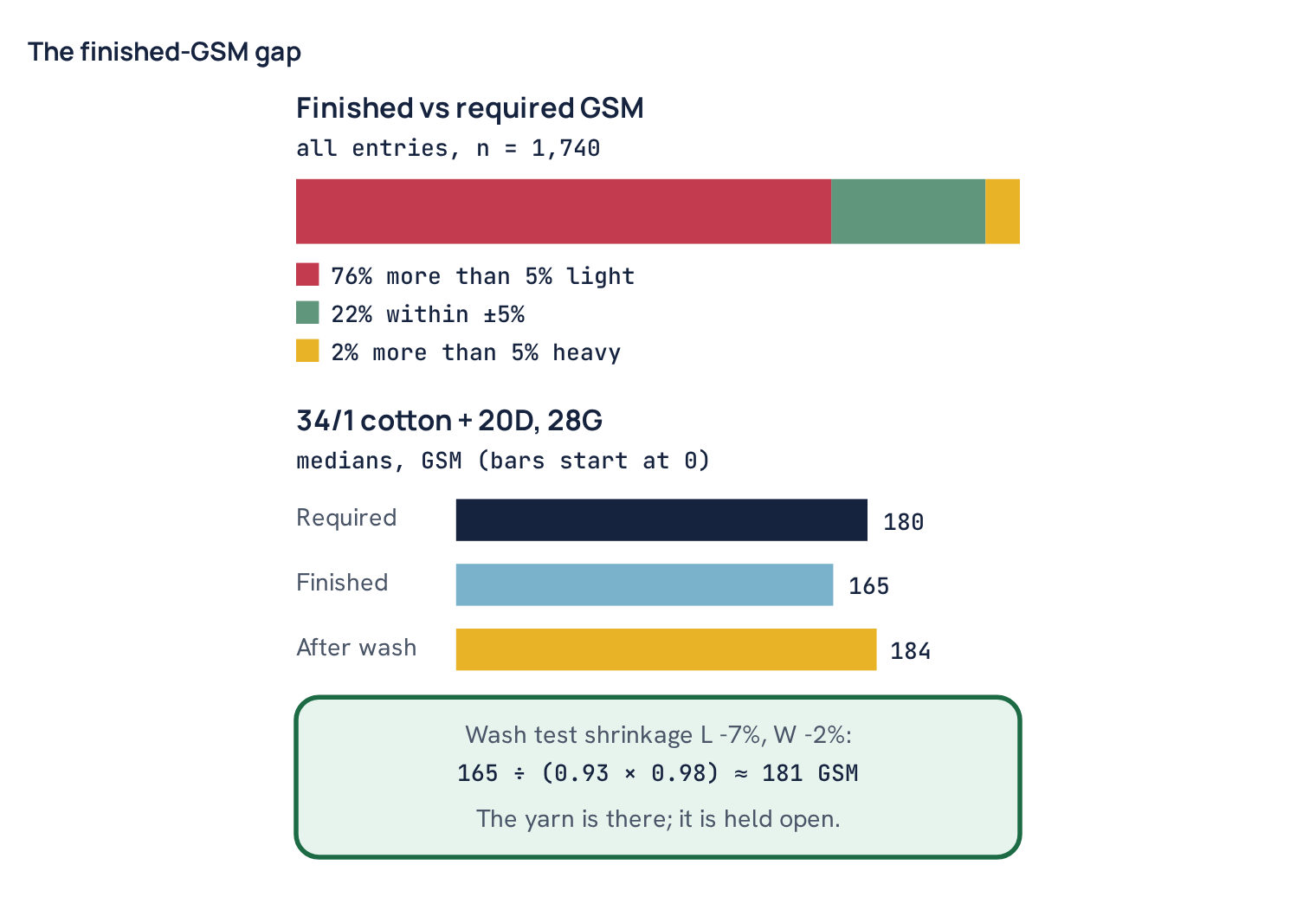
The biggest problem in our Lycra jersey records is that the fabric finishes light. Across 1,740 entries, the median finished GSM is 7.2% below required. Only 22% finish within ±5%; 76% finish more than 5% light and 2% more than 5% heavy. Plain cotton jersey in the same register finishes a median of about 5% light, so Lycra jersey has the wider gap.
The after-wash figures explain it. GSM after the dye-house wash test rises by a median of 12% over finished GSM, and in every main row it ends above the requirement: 184 against 180 for 34/1 with 20 denier on 28 gauge, 170 against 160 for 40/1, 222 against 210 for 30/1 with 30 denier. The fabric has enough yarn. It leaves finishing held open and reaches its real weight only when the elastane relaxes.
Why Lycra jersey finishes light
- The elastane is held stretched. Stenter pins, compactor and rolling keep it under strain, and the fabric is measured before it relaxes. In the wash test, length shrinks 5 to 10% and GSM jumps.
- Heat-set width too wide or overfeed too low. If the fabric is set wide and long, that open state becomes its new “relaxed” state, and it will finish light. This is the most powerful setting on the route.
- Stenter width beyond the set width. Pulling width to meet a buyer’s width target directly lowers GSM.
- Weak compaction. Cotton jersey settings are often not enough; elastane springs back.
- Measured too early. Warm fabric straight off the compactor reads light.
Width control
Width and GSM pull against each other. Our finished open widths are very consistent, about 176 to 190 cm, which suggests width is held to target and GSM falls. Relax the fabric more to gain GSM and it comes in narrower, so decide at the start:
- Plan the needle count for the width the fabric wants at its required GSM, not the width it can be stretched to. If the target width needs too much stretch, use a bigger diameter or a finer gauge.
- Set the heat-set width close to the finished width, and keep the stenter at or below it.
- Agree the width basis with the buyer (cuttable or full width, relaxed or not), so that you are not stretching to meet a number measured a different way.
Length shrinkage by yarn
In the dye-house wash test, length shrinkage in our main rows is -5% for 30/1 cotton (20 or 30 denier), -7% to -8% for 34/1, -8% for 40/1, -10% for 34/1 lyocell and -4% for the polyester mix. Width shrinkage is -2% for cotton rows and -3% for lyocell and the polyester mix. Finer ground yarns shrink more in length, because the finer cotton resists the elastane less. Use the fabric shrinkage calculator to see what a planned shrinkage means for cut size, and the knit GSM and shrinkage by fibre study for a wider comparison.
How to plan greige GSM and dia
- Start from the record table: ground count, denier, gauge, 2.9 to 3.0 mm stitch length and the usual finished width.
- Expect the median gap. If similar fabric finishes about 7% light, plan heat setting, stenter and compaction to close it, not the knitting.
- Knit a trial, rest the greige, and record greige GSM and tubular dia.
- Heat-set at a width close to the finished width with a recorded overfeed, then send the trial through the full bulk route.
- Measure finished GSM and width after a fixed conditioning time, then the GSM after the wash test.
- If finished GSM is low but after-wash GSM is on or above target, adjust heat-set width and overfeed, stenter width and compaction. If both are low, change the construction: lower the draft, use a coarser ground count or a higher denier, or shorten the stitch length slightly.
- Record greige-to-finished and finished-to-after-wash ratios for GSM and width on the record sheet.
Common mistake: tightening the knitting to fix a light finished GSM when the after-wash GSM is already above target. The fabric becomes even heavier and tighter after the first wash, the elastane share rises, and the length shrinkage problem remains.
Testing the developed fabric
Lycra jersey is tested with the same buyer tests as plain jersey, plus checks on the elastane. We have only 3 lab reports on Lycra single jersey in our set, and reports that reach our desk are often ones with a problem, so the results below show where risk can lie, not a production average. Treat them as examples.
| Test | Typical buyer requirement (varies by buyer) | Our lab reports (Lycra single jersey, 3 reports) |
|---|---|---|
| Dimensional stability (shrinkage) | Often within ±5% L and W after the stated wash | 1 fail in 5 results; median after one wash L -2.1%, W -1.0% (3 results) |
| GSM | Often ±5% of the required GSM | 2 fails in 3 results |
| Spirality | Often 5% maximum after washing | 0 fails in 5 results; all 0.0% |
| Bursting strength | A minimum in kPa set by the buyer | 1 fail in 3 results; one recorded value 113 kPa |
| Pilling | Often grade 3–4 minimum | 0 fails in 3; two at pilling 4–5, fuzzing 4; one at pilling 3, fuzzing 3–4 after 2,000 rubs |
| Colour fastness to rubbing | Often dry 4, wet 2–3 or 3 | 0 fails in 3; wet 4–5 twice, 3 once |
| Colour fastness to washing, water, perspiration | Often 4 change, 3–4 staining | 0 fails in 3 results each |
| Light fastness | Set by buyer, often grade 4 | 0 fails in 1 |
| Fibre content | Within the label tolerance | 0 fails in 1 |
| Stretch and recovery | Buyer-specific extension and growth limits | Not in our set |
Small as it is, the pattern matches the register. GSM failed in 2 of 3 results, which fits a fabric that finishes light. Spirality was 0.0% in all five results, as expected from a tight, heat-set fabric. Bursting strength failed once; light jersey on fine counts is not strong, and harsh bleaching or enzyme lowers it further. See how to test bursting strength and bursting strength fail: causes and remedies. One shrinkage result also failed.
Elastane damage and slippage checks
Elastane faults often do not show in a normal shade or GSM check. These checks are common practice in development and quality control; buyers may name their own standard methods.
- Stretch and recovery test. A strip is extended under a fixed load or to a fixed extension, held, released, and measured for recovery or growth after a rest. Standard strip methods such as ASTM D2594 and EN 14704-1 are widely used. A fabric with heat-damaged elastane shows high growth and low recovery.
- Elastane break check. Stretch the fabric widthways over a light: broken elastane shows as loose lines or bagging. Unravel a few courses and pull the elastane: healthy elastane stretches several times its length and returns; damaged elastane breaks easily or stays long.
- Elastane slippage (slip-back). Mark a cut edge or seam, wash or stretch it repeatedly, and look for elastane ends pulled back, leaving a loose band. Good heat setting reduces it.
- Grin-through. Stretch the fabric by a fixed amount on the face side, especially dark shades, and look for shiny elastane between the loops.
- Fibre content. Elastane content is checked by fibre analysis, usually by dissolving one component with a suitable solvent and weighing the rest. Do this on the development trial, not only in bulk.
For the standard tests, use the method guides: how to test shrinkage with shrinkage test fail: causes and remedies; how to test spirality; how to test GSM with GSM test fail: causes and remedies; pilling by box and Martindale; and wet rubbing fastness fail: causes and remedies.
Development record sheet and troubleshooting
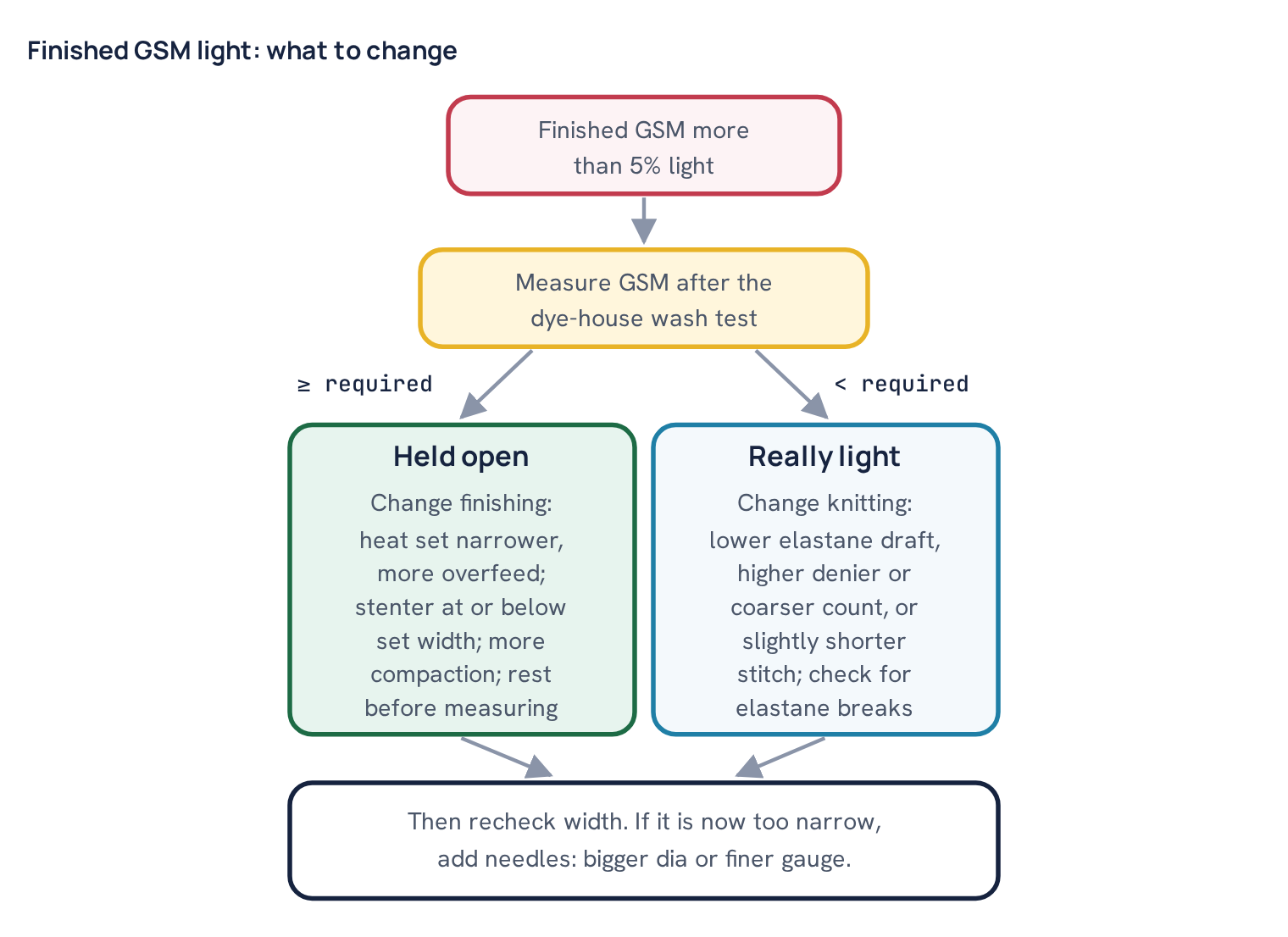
Most Lycra jersey problems start with the question “is the fabric held open, or is it really light?” The decision diagram below separates the two, using the finished GSM and the GSM after the wash test.
Record sheet template
Use one sheet per trial and keep the requested and actual values side by side. The rows in bold type are the ones that plain jersey sheets usually miss.
| Stage | Record |
|---|---|
| Request | Buyer, style, required GSM and tolerance, finished width and its basis, composition and elastane %, stretch and recovery limits, shade, wash care, test standard |
| Yarn | Ground count, type, spinning, supplier, lot; elastane denier, type, supplier, lot; third yarn if any |
| Knitting | Machine no., diameter, gauge, feeders; feeding (FF/HF) and which feeders; elastane draft or feed setting; stitch length per yarn as measured; input tension; take-down; speed |
| Greige | Rest time, greige GSM, tubular dia, roll weight, faults (elastane breaks, grin-through, bars) |
| Heat set | Temperature, speed or dwell time, set width, overfeed, singeing yes/no |
| Wet process | Machine, load, scour/bleach temperature and time, enzyme yes/no, dye recipe, fixation temperature and pH, disperse temperature if any, wash-off, softener |
| Stenter | Temperature (below heat set), speed, width, overfeed |
| Compactor | Overfeed, steam, temperature, exit width, relax time before rolling |
| Finished | Conditioning time, finished GSM, open width, GSM after wash test, shrinkage L/W, spirality, shade |
| Elastane checks | Stretch and recovery, elastane breaks, slippage, grin-through, fibre content |
| Lab tests | Each test result against requirement, pass/fail |
| Decision | Approved or adjust; what changes in the next trial, and why |
Troubleshooting
| Problem | Likely cause | What to change |
|---|---|---|
| Finished GSM light, after-wash GSM on or above target | Fabric held open: heat set too wide or too little overfeed; stenter too wide; weak compaction | Heat set closer to finished width with more overfeed; stenter at or below set width; more compactor overfeed; rest before measuring |
| Finished and after-wash GSM both light | Too little yarn or elastane: draft too high, count too fine, stitch too long | Lower draft, coarser ground count or higher denier, or slightly shorter stitch |
| GSM too heavy, fabric tight and narrow | Draft too low; heat set too narrow; over-compacted | Raise draft within limits; set wider; reduce compaction |
| Width too narrow | Not enough needles; heat set narrow; elastane relaxing after stenter | Bigger dia or finer gauge; heat set at target width; do not rely on stenter stretch |
| High length shrinkage | Poor heat setting; length stretched in wet processing or slitting; weak compaction | Check heat-set temperature, dwell and overfeed; lower tension in slitting and stenter; more compaction |
| Strong edge curl after dyeing | No heat set, or heat set too cool or too short | Heat set at the correct temperature and dwell time before wet processing |
| Bars or stripes across the fabric | Uneven elastane draft between feeders; mixed elastane or yarn lots | Check and equalise every positive feed; one lot per order |
| Shiny elastane on the face | Poor plating: feeder worn or set wrong; elastane twisting | Reset or replace plating feeders; check elastane path and tension |
| Loose bands, low recovery, bagging | Elastane broken in knitting, or damaged by heat, chlorine or long hot alkali | Check greige for breaks; lower heat-set or stenter temperature; no chlorine; shorten hot stages |
| Elastane pulls back at seams or cut edges | Elastane slippage from poor heat setting | Improve heat setting; check by slippage test before bulk |
| Bursting strength low | Fine ground count; light construction; harsh bleach or enzyme | Coarser count or more weight; milder pretreatment; review enzyme dose |
Lycra single jersey rewards planning more than correction. Choose denier and feeding from the buyer’s stretch and weight, start from 2.9 to 3.0 mm loops, heat-set at the width you want to finish at, keep later temperatures below the set, and judge light GSM by the after-wash value before touching the knitting.
Questions
What stitch length is used for Lycra single jersey?
In our records the main constructions sit at 2.9 to 3.0 mm, for example 34/1 cotton with 20 denier elastane at 2.9 mm on 28 gauge for 180 GSM. That is longer than plain cotton jersey of the same weight.
What is the difference between full feeder and half feeder Lycra?
Full feeder plates elastane in every course and gives the most stretch, recovery and weight. Half feeder plates every second course, so it is lighter, cheaper and has less elastane and power.
Why is Lycra single jersey heat-set before dyeing?
Heat setting, typically around 185 to 195°C for 30 to 60 seconds at the planned width, fixes the elastane so the fabric keeps its width, curls less and shrinks less. In our register 99% of entries are heat-set.
Why does Lycra single jersey finish below the required GSM?
The elastane is held stretched by the stenter and compactor and measured before it relaxes. In our records it finishes a median 7.2% light, but GSM rises about 12% after the wash test, above the requirement.
What temperatures are safe for elastane in dyeing and finishing?
Typical limits are scouring and bleaching around 90 to 95°C with no chlorine, reactive dyeing around 60°C, disperse dyeing kept around 120 to 125°C, and stenter drying clearly below the heat-set temperature. Limits vary by elastane type.

Textile engineer with 14+ years in dyeing and fabric development. He writes every guide on Dyeing Solution from real production work. Full profile