Modal is softer, silkier and drapier than cotton and stays soft after washing; cotton is stronger, cheaper and easier to care for. Is modal cotton, feel, breathability, shrinkage and pilling compared, with data from our finishing records.
At a glance
Woodvs seed fibre
6% / 6%median shrinkage
27% / 47%on target weight
Silkyvs sturdy
Modal is softer, smoother and drapier than cotton, absorbs more moisture and stays soft after many washes; cotton is stronger, cheaper, easier to care for and more breathable in open weaves. Modal is not cotton: it is a fibre made from wood cellulose, usually beech, which is dissolved and re-formed into fibre. Chemically the two are close relatives, both pure cellulose, which is why they feel similar and dye with the same dyes. In practice modal is the choice for silky underwear, loungewear and fitted tees; cotton for everyday durability.
This guide compares modal and cotton point by point: what each is made of, feel, breathability, moisture, shrinkage, pilling, durability, care, cost and sustainability, with figures from our finishing records of more than 370 modal-blend batches and over 7,400 cotton batches. It also explains why so many fabrics blend the two.
Is modal cotton?
No. Cotton is a natural seed fibre picked from the cotton plant and spun almost as it grows. Modal is a regenerated cellulose fibre: wood pulp is dissolved chemically, pushed through fine holes into a bath, and re-formed as filaments that are cut and spun. Both are made of cellulose, the same natural polymer, so modal is not plastic and not synthetic in the way polyester is. It is usually described as semi-synthetic. For the full story of the fibre see what is modal fabric.
Modal is a close cousin of viscose (rayon). It is made by a modified process that produces longer, better-aligned cellulose chains, so it keeps much more of its strength when wet. That is the main reason modal garments hold their shape better than rayon ones.
Modal vs cotton at a glance
| Point | Modal | Cotton |
|---|---|---|
| Source | Wood pulp, dissolved and re-formed | Natural seed fibre |
| Feel | Very soft, smooth, silky, cool | Soft, matt, slightly drier |
| Drape | Fluid, follows the body | Holds its shape |
| Moisture absorption | Higher (regain about 11–12%) | High (about 7–8%) |
| Softness after washing | Stays soft | Can stiffen, especially in hard water |
| Strength | Good dry, lower wet | Good, stronger wet |
| Pilling | Generally low | Low to moderate; pills wear off |
| Shrinkage (our knit records) | Median 6% in length (blends) | Median 6% in length |
| Colour | Bright, deep, lustrous | Good, slightly less brilliant |
| Price | Higher | Lower |
Feel and softness
Modal’s biggest selling point is its handle. Its fibres are fine, round and smooth, without the natural twist and surface of cotton, so a modal knit feels silky and slides over the skin. It also stays that way. Cotton can feel harsh after repeated washing in hard water, as minerals and detergent residue build up; modal keeps much more of its original softness. That is why modal and micro-fine modal are favourites for underwear, bras, pyjamas and T-shirts sold on comfort.
Cotton has its own appeal: a drier, more natural handle that many people prefer in warm weather, and a crispness in woven shirts that modal cannot give. Long-staple cottons such as Pima come closest to modal’s smoothness; see what is Pima cotton.
Breathability and moisture
Both are breathable cellulose fibres, far more comfortable in heat than polyester. Modal absorbs more moisture than cotton and feels cool to the touch, which many people notice in sleepwear and underwear. Cotton, especially in open weaves like voile, poplin or light single jersey, lets air through very well and dries a little faster.
In practice the construction matters as much as the fibre. A light modal jersey and a light cotton jersey feel similar in breathability; a heavy cotton fleece is warmer than either. If you sweat heavily during sport, neither is ideal: both hold moisture, and a technical polyester knit dries faster.
Does modal shrink more than cotton?
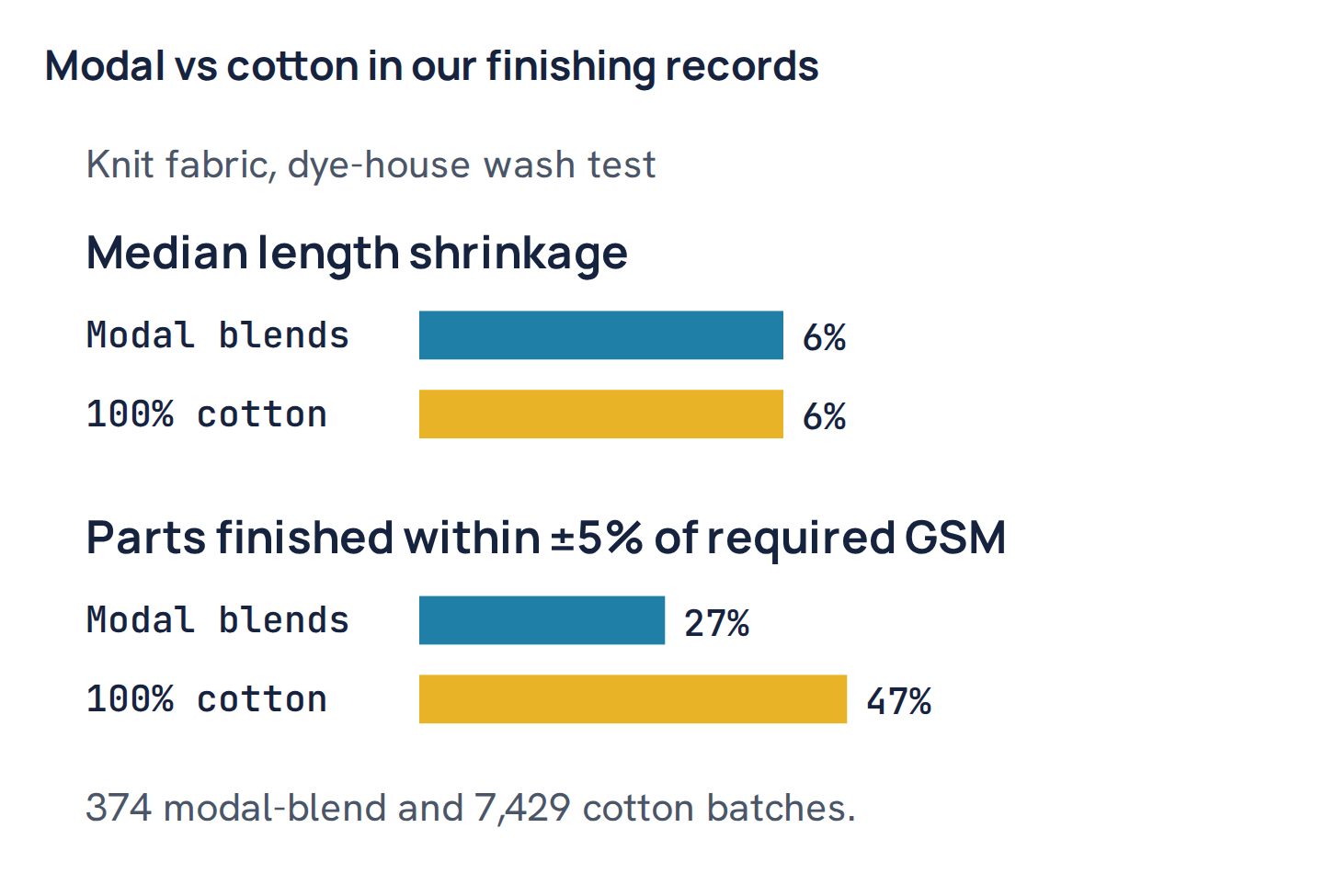
In length, about the same. In our finishing records the median length shrinkage after the wash test was 6% for 374 modal-blend batches and 6% for 7,429 batches of 100% cotton knit. The worst tenth reached about 10% in both. The difference shows up in weight: light modal parts gained a median 14.6% in weight after washing, and only 27% of modal-blend parts finished within ±5% of the required GSM, against 47% for cotton. Modal relaxes and closes up more in water, so a modal fabric that left the mill at the right weight can come back heavier and slightly smaller from the first wash.
For the home wash this means: treat modal at least as gently as cotton. Cool washing and line or low-heat drying keep both close to their bought size. See does cotton shrink and shrinkage by fibre.
Durability and pilling
Cotton is the tougher fibre, and it gets stronger when wet, which is why cotton jeans, towels and workwear survive years of hot washing. Modal is strong when dry but loses some strength when wet, so it does not like rough, hot machine cycles. On the other hand, modal’s smooth fibres tend to pill less than many cottons, and modal keeps its colour and lustre well.
For underwear and T-shirts washed gently, modal lasts well. For hard-wearing items washed hot and often, cotton is the safer fibre.
Colour and dyeing
Modal and cotton both dye with reactive dyes, which bond chemically to cellulose. Modal takes them brightly, giving deep, clean, slightly lustrous shades. In our dye house modal gets a viscose-type scour, the salt goes in at 80°C in three portions, the bath is cooled to 60°C for the soda, and most modal-elastane is heat set first. Modal is weaker wet, so it needs gentle handling. See the 100% modal knit dyeing process and the cotton-modal dyeing process.
Why cotton-modal blends are so common
Many T-shirts, underwear and loungewear fabrics are cotton-modal blends, often 50/50 or 60/40. The blend gives a fabric that is softer, smoother and drapier than cotton, but cheaper and a little sturdier than 100% modal. Cotton-modal with a few percent elastane is a classic fitted-tee and underwear fabric. These blends are also among the hardest to finish on weight: in our records cotton-modal rib with elastane was the worst of all, with only 18% of parts within GSM tolerance, because the fabric keeps relaxing after the stenter.
Common mistake: washing modal underwear or tees on a hot cotton cycle and tumble drying them on high. Cotton tolerates it; modal relaxes, gains weight and can lose shape, and the soft surface roughens. Wash modal at 30°C and dry low.
Sustainability
Both fibres have environmental costs. Conventional cotton uses a lot of water and, in many regions, pesticides; organic cotton reduces some of that. Modal comes from wood, often from managed forests, and needs far less irrigation, but its production uses chemicals that must be recovered and treated properly. Producers with closed-loop recovery and recognised certifications address this better than others. Both are biodegradable under suitable conditions, unlike polyester.
Which should you choose?
- Underwear, bras and sleepwear: modal or cotton-modal for softness, smoothness and moisture comfort.
- Fitted T-shirts and loungewear: cotton-modal blends give drape and softness at a fair price.
- Everyday tees, hoodies and kids’ clothes: cotton for durability and easy care.
- Towels, jeans and workwear: cotton, which is stronger when wet.
- Sensitive skin: both are generally well tolerated; modal’s smoothness can feel gentler.
Worked example. You are choosing between a 100% cotton tee and a 60/40 cotton-modal tee of the same weight. The cotton-modal tee will feel smoother, drape closer to the body and stay soft longer; the cotton tee will hold its shape better and survive hot washes. Wash the cotton-modal tee cool and dry it on low, and it will keep its size and softness.
How to care for modal and cotton
- Modal: wash at 30°C, gentle cycle, inside out; line dry or tumble low; iron medium.
- Cotton: wash at 30–40°C (60°C for whites if the label allows); tumble low or line dry; iron hot if needed.
- Both: avoid overloading the machine and wash with similar colours.
Summary
- Modal is not cotton: it is regenerated cellulose from wood, a stronger relative of rayon.
- Modal is softer, silkier and drapier, absorbs more moisture and stays soft after washing.
- Cotton is stronger, cheaper, sturdier when wet and easier to care for.
- Both shrank a median 6% in length in our records, but modal is harder to keep on weight.
- Cotton-modal blends combine softness with value; wash modal cool and gently.
Questions
Is modal cotton?
No. Modal is a regenerated cellulose fibre made from wood pulp; cotton is a natural seed fibre. Both are cellulose, so they feel similar and dye with the same dyes.
Is modal better than cotton?
It depends on use. Modal is softer, smoother and drapier and stays soft; cotton is stronger, cheaper and handles hot washing. Modal suits underwear and loungewear; cotton suits everyday and hard-wearing clothes.
Is modal more breathable than cotton?
Both are breathable. Modal absorbs more moisture and feels cooler; light, open cotton lets air through very well and dries a little faster.
Does modal shrink more than cotton?
In length about the same: a median 6% for both in our knit records. Modal blends gain more weight after washing, so they are harder to keep on size.
Why are cotton-modal blends so common?
They give a softer, drapier fabric than cotton at a lower cost than 100% modal, which suits T-shirts, underwear and loungewear.

Textile engineer with 14+ years in dyeing and fabric development. He writes every guide on Dyeing Solution from real production work. Full profile