Ring spun cotton is a smooth, strong yarn twisted on a ring frame. How it is made, ring spun vs regular (open-end) cotton, where combed and compact yarn fit, and what the yarn changes in a finished T-shirt.
At a glance
Ring framecontinuous twist
Softerthan open-end
Combedfewer short fibres
34/1–16/1jersey count range
Ring spun cotton is cotton yarn made on a ring spinning frame, which twists the fibres tightly and continuously to give a smooth, strong, soft yarn. T-shirts labelled “ring spun” are usually softer and smoother than cheap tees made from open-end (rotor) yarn, which is faster to produce but bulkier and harsher. Ring spinning is the standard for good-quality jersey; the label tells you about the yarn, not the cotton variety.
This guide explains how ring spun yarn is made, ring spun vs regular (open-end) cotton, where combed and compact yarn fit in, and what the yarn changes in a finished T-shirt, from a dyeing and fabric-development point of view.
How ring spun yarn is made
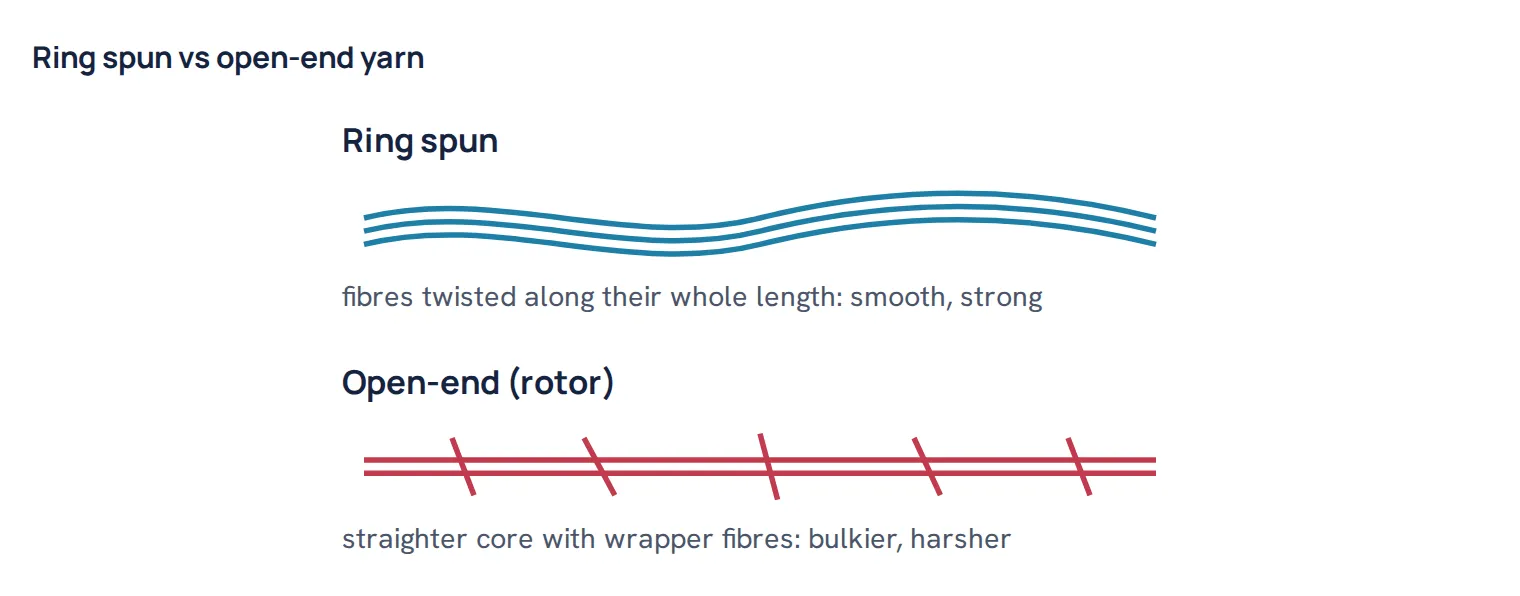
Raw cotton is cleaned and opened, carded into a rope-like sliver, drawn out to even it, and made into a slightly twisted roving. On the ring frame the roving is drafted (thinned) by rollers, and a traveller running around a ring on the spindle inserts twist as the yarn winds onto a bobbin. Fibres are twisted around each other along their whole length, which makes the yarn strong and smooth. It is slower and more expensive than open-end spinning.
Ring spun vs regular (open-end) cotton
“Regular” cotton tees are usually made from open-end or rotor yarn, where fibres are spun in a fast-turning rotor directly from sliver. The fibres are less parallel and the twist is mainly at the core, so the yarn is bulkier and more even but weaker and harsher.
| Point | Ring spun | Open-end (rotor) |
|---|---|---|
| Feel | Softer, smoother | Rougher, drier |
| Strength | Higher | Lower |
| Surface | Smoother, better for printing | More open, slightly fuzzy |
| Counts | Fine to medium (light fabrics) | Mostly coarser (heavier fabrics) |
| Cost | Higher | Lower |
| Typical use | Retail and fashion T-shirts | Budget tees, promotional wear, fleece |
Combed, carded and compact: how they fit together
These words describe different steps, and can be combined:
- Carded: the cotton is only carded. Cheaper, with more short fibres and neps, so the yarn is hairier.
- Combed: an extra combing step removes short fibres and neps. The yarn is cleaner and smoother, which gives a cleaner surface, better pilling and more even dyeing.
- Compact: a ring yarn spun with a compacting zone that tucks in surface fibres, so it is less hairy again. It helps pilling and spirality and gives a cleaner face.
So a premium T-shirt is often combed ring spun or combed compact cotton. “Organic” is a separate claim about how the cotton was grown, not how it was spun; it can be combed or carded.
What the yarn changes in a finished T-shirt
From the dye house and development side, yarn quality shows up in four places:
- Hand feel: ring and compact yarns feel softer and smoother on the skin.
- Pilling: hairier yarns (carded, open-end) shed loose fibre that rolls into pills; combed and compact yarns pill less. See why clothes pill.
- Dyeing and printing: a smoother, cleaner yarn gives a more even shade and a sharper print surface.
- Spirality: yarn twist is the main cause of twisted side seams in jersey; compact yarn and lower twist help.
Count matters as much as spinning type. In our development records jersey runs from 34/1 yarn for a light 135 GSM fabric to 16/1 for a heavy 240 GSM fabric, and a finer count gives a lighter, smoother T-shirt. See what is cotton jersey.
Common mistake: changing the yarn supplier between the approved sample and bulk without telling the knitting section. Two lots of the same nominal count can differ in twist and actual count, which changes GSM and spirality in the finished fabric, even if both are “ring spun”.
Is ring spun cotton worth it?
For T-shirts that are worn next to the skin and washed often, usually yes: they feel softer, print better and hold up better. For budget promotional shirts, heavy fleece or workwear, open-end yarn is a sensible, cheaper choice. Ring spun cotton does not shrink less by itself; shrinkage depends on how the fabric is knitted and finished.
Worked example. Two 160 GSM cotton jersey T-shirts look the same on the hanger. One is combed compact ring spun, the other carded open-end. After a few washes the open-end shirt feels harsher and shows more surface fuzz and small pills, while the compact shirt keeps a cleaner face. The difference is in the yarn, decided before the fabric ever reached the dye house.
Summary
- Ring spun cotton is yarn twisted on a ring frame: smooth, strong and soft.
- “Regular” cheap tees are usually open-end yarn: bulkier, harsher and weaker.
- Combed removes short fibres; compact reduces hairiness. Both can be ring spun.
- Better yarn means a softer feel, less pilling, more even dyeing and less spirality.
- Ring spun does not prevent shrinkage; that depends on knitting and finishing.
Better fibre, not just better spinning: for extra-long staple cotton and Pima vs Supima, see what is Pima cotton.
Questions
What is ring spun cotton?
Cotton yarn made on a ring spinning frame, where fibres are twisted tightly along their whole length. It is smoother, stronger and softer than open-end yarn.
What is the difference between ring spun and regular cotton?
Regular budget tees usually use open-end (rotor) yarn, which is cheaper and bulkier but harsher and weaker. Ring spun feels softer and prints better.
Is ring spun the same as combed cotton?
No. Combing removes short fibres before spinning; ring spinning is how the yarn is twisted. A yarn can be both, as in combed ring spun cotton.
Does ring spun cotton shrink?
It can. Shrinkage depends on how the fabric is knitted and finished, not on the spinning method. Look for pre-shrunk fabric and wash cool.
Is ring spun cotton better quality?
For T-shirts, usually yes: it is softer, smoother, stronger and pills less than open-end cotton, though it costs more.

Textile engineer with 14+ years in dyeing and fabric development. He writes every guide on Dyeing Solution from real production work. Full profile