Cotton jersey is the soft, stretchy knit of almost every T-shirt. What jersey fabric is made of, how it is knitted, its types and weights, jersey vs rib and interlock, and how it shrinks, from about 5,100 single jersey developments in our register.
At a glance
1 needle bedplain weft knit
135–240GSM range
5%median shrinkage
~5,100jersey entries
Cotton jersey is a soft, stretchy knit fabric made from cotton yarn in the plain jersey stitch: the fabric of almost every basic T-shirt. “Jersey” means the knit structure, not the fibre; “cotton jersey” says that the yarn is cotton. Jersey has a smooth face with fine V-shaped columns, a slightly rougher back, stretches easily across the width, and drapes and breathes well. Besides T-shirts it is used for dresses, pyjamas, underwear, babywear and bed sheets.
This guide explains what jersey fabric is made of, how it is knitted, the main types of cotton jersey, how it compares with other fabrics, and how it behaves in washing, with figures from our register of about 5,100 single jersey developments.
What is jersey fabric made of?
Jersey can be made from any fibre that can be spun into yarn:
- 100% cotton jersey: soft, breathable, the classic T-shirt fabric.
- Cotton-elastane jersey: cotton with a few percent elastane for stretch and recovery, used for fitted tops and dresses.
- CVC and poly-cotton jersey: cotton-polyester blends that shrink and wrinkle less; see what is CVC fabric.
- Viscose and modal jersey: silkier, drapier, cooler; see what is viscose.
- Polyester jersey: sportswear and sublimation-printed shirts.
The name comes from the island of Jersey in the Channel Islands, where knitted fishermen’s garments were made long before the fabric became a T-shirt staple.
How jersey is knitted
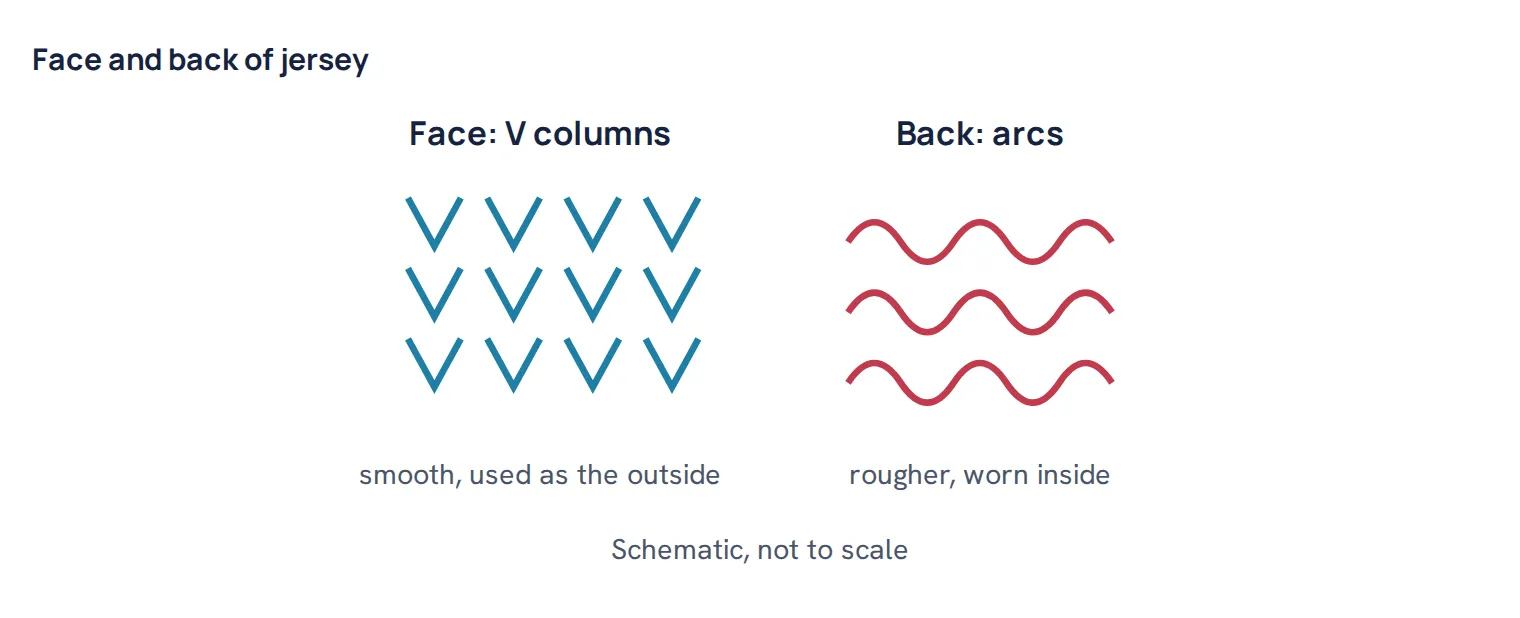
Jersey is a weft knit made on one set of needles, usually on a circular knitting machine that produces a tube. Every loop is pulled through the loop below it in the same direction, which gives the fabric two different sides: V-shaped columns (wales) on the face, and small arcs (courses) on the back. That one-direction structure is also why jersey curls at the cut edges and why the side seams of a cheap T-shirt can twist after washing (spirality). The technical details are in the single jersey development guide.
Types of cotton jersey
| Type | What it is | Typical use |
|---|---|---|
| Single jersey | Plain jersey on one needle bed | T-shirts, tops |
| Cotton-elastane jersey | With 3–8% elastane | Fitted tops, dresses |
| Slub jersey | Knitted from slub yarn | Casual, textured tees |
| Heather (melange) jersey | Yarn of mixed dyed and undyed fibre | Grey marl tees, basics |
| Interlock (double jersey) | Two needle beds, smooth both sides | Babywear, polos |
See slub fabric, heather fabric and interlock fabric.
How heavy is cotton jersey?
Jersey weight is given in GSM (grams per square metre). In our development records the usual range runs from about 135 GSM for a light jersey on 34/1 cotton yarn to about 240 GSM for a heavy jersey on 16/1. Most standard T-shirts sit around 150–180 GSM; “heavyweight” tees are 200 GSM and above. See what is GSM in fabric.
Cotton jersey vs other fabrics
- Jersey vs rib: rib is knitted on two needle beds, stretches much more across the width and recovers better; jersey is thinner and smoother.
- Jersey vs interlock: interlock is thicker, smooth on both sides and does not curl; jersey is lighter and cheaper.
- Jersey vs woven cotton: woven cotton (poplin, twill) hardly stretches and creases more; jersey stretches and is more comfortable for close-fitting clothes.
Does cotton jersey shrink?
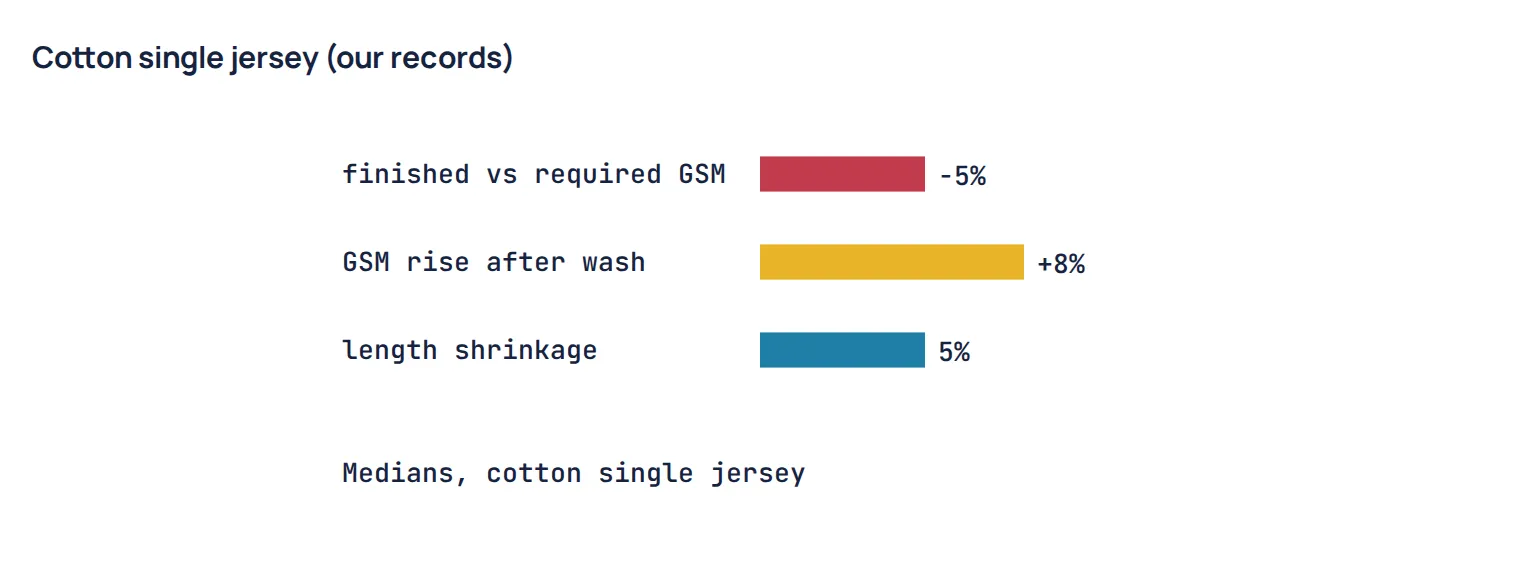
Yes, mainly in length. Processing stretches jersey, and it relaxes back when washed. In our finishing records cotton single jersey had a median length shrinkage of about 5% after the wash test. It also finished a median 5% below the required weight and then gained about 8% in GSM after washing, as the loops relaxed and closed up. That is why mills compact jersey before delivery; see what pre-shrunk means.
Common mistake: blaming the dye house when a T-shirt’s side seam twists after washing. Spirality in jersey comes mainly from the twist in the yarn and the number of feeders on the knitting machine. Finishing can hide it for a while, but the wash brings it back; the cure is in yarn and knitting, not dyeing.
How to care for cotton jersey
- Wash at 30–40°C with similar colours.
- Line dry or tumble dry on low to limit shrinkage.
- Do not hang heavy wet jersey by the shoulders; it stretches in length.
- Iron on the reverse, on a medium-hot setting.
Worked example. A brand wants a 180 GSM cotton jersey T-shirt. A mill using our records would knit it on a mid-range count, finish it slightly light because it gains about 8% in the wash, compact it to control length shrinkage, and check a washed sample for both GSM and spirality before bulk.
Summary
- Cotton jersey is a plain weft knit in cotton: the standard T-shirt fabric.
- “Jersey” is the knit structure; it can also be made in blends, viscose or polyester.
- It is soft, stretchy across the width, and curls at cut edges.
- Usual weights run from about 135 to 240 GSM in our records.
- Cotton jersey shrank a median 5% in length in our records; wash cool and dry low.
Questions
What is cotton jersey?
A soft, stretchy weft-knit fabric made from cotton yarn in the plain jersey stitch. It is the standard fabric for T-shirts.
What is jersey fabric made of?
Jersey is a knit structure, so it can be made of cotton, cotton-elastane, cotton-polyester, viscose, modal or polyester. Cotton jersey is the most common.
Is jersey fabric stretchy?
Yes, especially across the width. Cotton-elastane jersey also stretches in length and recovers better.
Is cotton jersey good for T-shirts?
Yes. It is soft, breathable and comfortable, which is why most T-shirts use it. Heavier jersey, 200 GSM and above, feels more substantial.
Does cotton jersey shrink?
Yes, mainly in length. In our records cotton single jersey shrank a median 5% after the wash test. Wash cool and tumble dry on low.

Textile engineer with 14+ years in dyeing and fabric development. He writes every guide on Dyeing Solution from real production work. Full profile