Terry cloth is a looped fabric, usually cotton, made to absorb water: the fabric of towels and robes. What it is made of, woven vs knitted and French terry, terry vs fleece, and how it shrinks and pills, from our records.
At a glance
Loopsabsorb water
Cottonmost common
6%terry shrinkage
1,096terry parts
Terry cloth is a cotton fabric covered with small uncut loops of yarn, made to absorb as much water as possible. The loops multiply the surface area of the yarn, so terry soaks up water quickly and feels soft and thick. It is the fabric of bath towels, bathrobes, beach towels, washcloths and baby bibs, and lighter terry is used for summer shirts, shorts and loungewear.
This guide explains what terry cloth is made of, how woven terry differs from knitted terry and French terry, the different types, and how terry behaves in dyeing, washing and wear, with figures from our knitted terry records.
What is terry cloth made of?
Most terry cloth is 100% cotton, because cotton absorbs water well and stays soft. Bamboo viscose terry is softer and more absorbent but weaker; cotton-polyester terry is cheaper and dries faster but absorbs less. For towels, cotton remains the standard; for beachwear and loungewear, blends are common.
How terry is made: woven and knitted
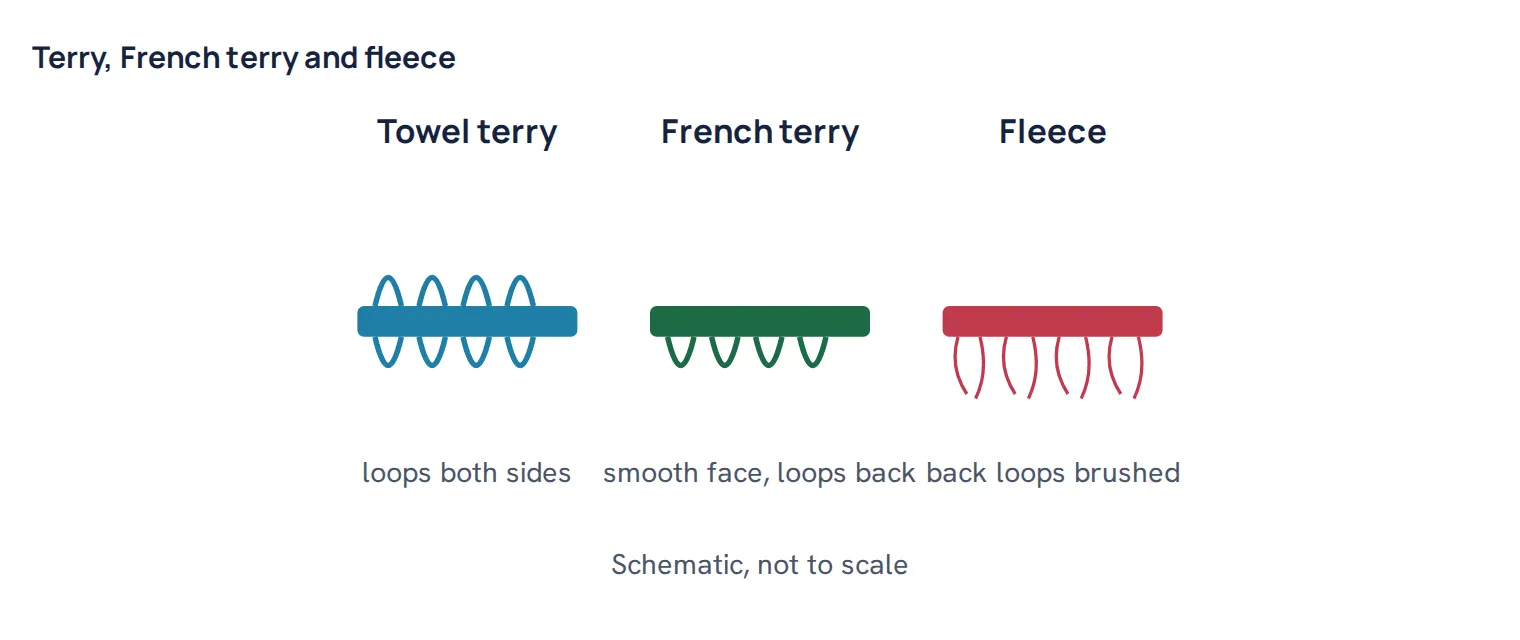
- Woven terry (towelling): woven on a loom with two warps. The ground warp is held tight; the pile warp is fed slack, and the loom beats the weft in a way that pushes the slack yarn up into loops, usually on both sides. This is the classic bath towel.
- Knitted terry: made on a circular knitting machine with a separate loop yarn that forms loops on the back of a jersey face. It is softer and stretchier than woven terry and is used for robes, baby clothes and sweatshirts.
- French terry: a knitted terry with a smooth face and loops only on the back, used for sweatshirts and joggers. See what is French terry.
Types of terry cloth
| Type | What it is | Typical use |
|---|---|---|
| Towelling terry | Woven, uncut loops both sides | Bath towels, robes |
| Velour terry | Loops on one side sheared into a velvety pile | Beach towels, luxury robes |
| Knitted terry | Loops knitted into a jersey base | Baby wear, robes, sweatshirts |
| French terry | Knitted, smooth face, loops on back | Sweatshirts, joggers |
Terry cloth vs fleece
Fleece starts as a knitted terry-type fabric whose back loops are then brushed into a soft, fluffy pile. Terry keeps its loops, so it absorbs water better and feels lighter and cooler; fleece traps more air and feels warmer but absorbs less. See brushed cotton for how brushing works.
How terry behaves in washing and wear
From our records of 1,096 knitted terry parts, cotton terry shrank a median 6% in length after the wash test, against 10% for cotton fleece. Terry and fleece are also where most pilling problems appear: in our lab reports, most pilling fails were heavy CVC fleece and terry fabrics around 330 GSM tested at 2,000 Martindale rubs. Loops snag easily, too: a pulled loop should be trimmed, not pulled further. See why fleece and terry fail pilling.
Common mistake: using fabric softener on every wash of terry towels. Softener coats the loops and makes them less absorbent over time. Use it rarely, or not at all, and dry towels on a line or in a tumble dryer to fluff the loops.
How to care for terry cloth
- Wash new towels before use to remove finishes and loose fibre.
- Wash at 40–60°C for towels; cooler for coloured terry garments.
- Avoid or limit fabric softener to keep absorbency.
- Tumble dry or line dry; shake towels before drying to lift the loops.
- Trim snagged loops with scissors instead of pulling them.
Worked example. A brand chooses a 300 GSM cotton knitted terry for a hoodie. Our records show terry shrinks less than fleece but still about 6%, and heavy CVC terry is where pilling fails cluster, so the mill should compact it for shrinkage and test pilling on a washed sample before bulk.
Summary
- Terry cloth is a looped fabric, usually cotton, made to absorb water.
- Woven terry has loops on both sides; knitted and French terry are softer knits.
- Fleece is terry with brushed loops: warmer, but less absorbent.
- In our records cotton terry shrank a median 6% in length, fleece 10%.
- Limit fabric softener and trim snagged loops to keep terry absorbent and neat.
Questions
What is terry cloth?
A fabric covered with small uncut loops of yarn, usually cotton, made to absorb as much water as possible. It is used for towels, robes and loungewear.
What is terry cloth made of?
Usually 100% cotton. Bamboo viscose and cotton-polyester terry are also made, for extra softness or faster drying.
What is the difference between terry cloth and French terry?
Towel terry is usually woven with loops on both sides. French terry is a knit with a smooth face and loops only on the back, used for sweatshirts.
Is terry cloth the same as fleece?
No. Fleece is a knitted terry-type fabric whose back loops are brushed into a soft pile, making it warmer but less absorbent.
Does terry cloth shrink?
Yes. In our records knitted cotton terry shrank a median 6% in length after the wash test, less than cotton fleece at 10%.

Textile engineer with 14+ years in dyeing and fabric development. He writes every guide on Dyeing Solution from real production work. Full profile