DTF transfers work well on polyester, but polyester needs lower press temperatures than cotton and care against dye migration from disperse-dyed fabric. How DTF works, typical polyester settings, preventing migration, DTF vs sublimation and HTV, sportswear and washing.
At a glance
120–150°Ctypical range
8–12 spress time
Migrationmain risk
Testwait 24 h
Yes, DTF (direct-to-film) transfers work well on polyester, but polyester needs lower press temperatures than cotton and care against dye migration. DTF prints are made by printing a design with water-based pigment inks onto a PET film, backing it with a white ink layer, coating it with hot-melt adhesive powder, curing it and then heat pressing it onto the garment. On polyester the adhesive bonds well, but heat can make the polyester’s own disperse dye move into the white ink and stain it, and too much heat can shine or scorch the fabric. Lower temperature, shorter time and a low-temperature or dye-blocking adhesive solve most problems.
This guide explains how DTF works, why polyester behaves differently from cotton, typical DTF press settings for polyester, what dye migration is and how to prevent it, DTF vs sublimation and HTV on polyester, sportswear and polyester blends, and how to wash DTF prints. It is written from the dyeing side, where we deal with how disperse dye behaves under heat on polyester and CVC fabrics.
How DTF printing works
- Print: the design is printed in reverse with CMYK pigment inks onto a special PET film, followed by a layer of white ink behind it.
- Powder: while the ink is wet, hot-melt adhesive powder (usually a polyurethane-type powder) is applied and the excess shaken off.
- Cure: the film is heated to melt the powder into an even adhesive layer.
- Press: the transfer is placed on the garment and heat pressed; the adhesive melts and bonds to the fabric.
- Peel: the film is peeled off hot, warm or cold, depending on the film type, leaving the print on the garment.
Because the colour sits in a pigment-and-adhesive layer on top of the fabric, DTF works on cotton, polyester, blends, nylon and many other materials, unlike sublimation, which only works on polyester.
Why polyester needs different settings
Polyester is a thermoplastic: it softens with heat. It is also usually dyed with disperse dyes, which can sublime, turning into vapour, at high temperatures. That creates two risks when pressing DTF:
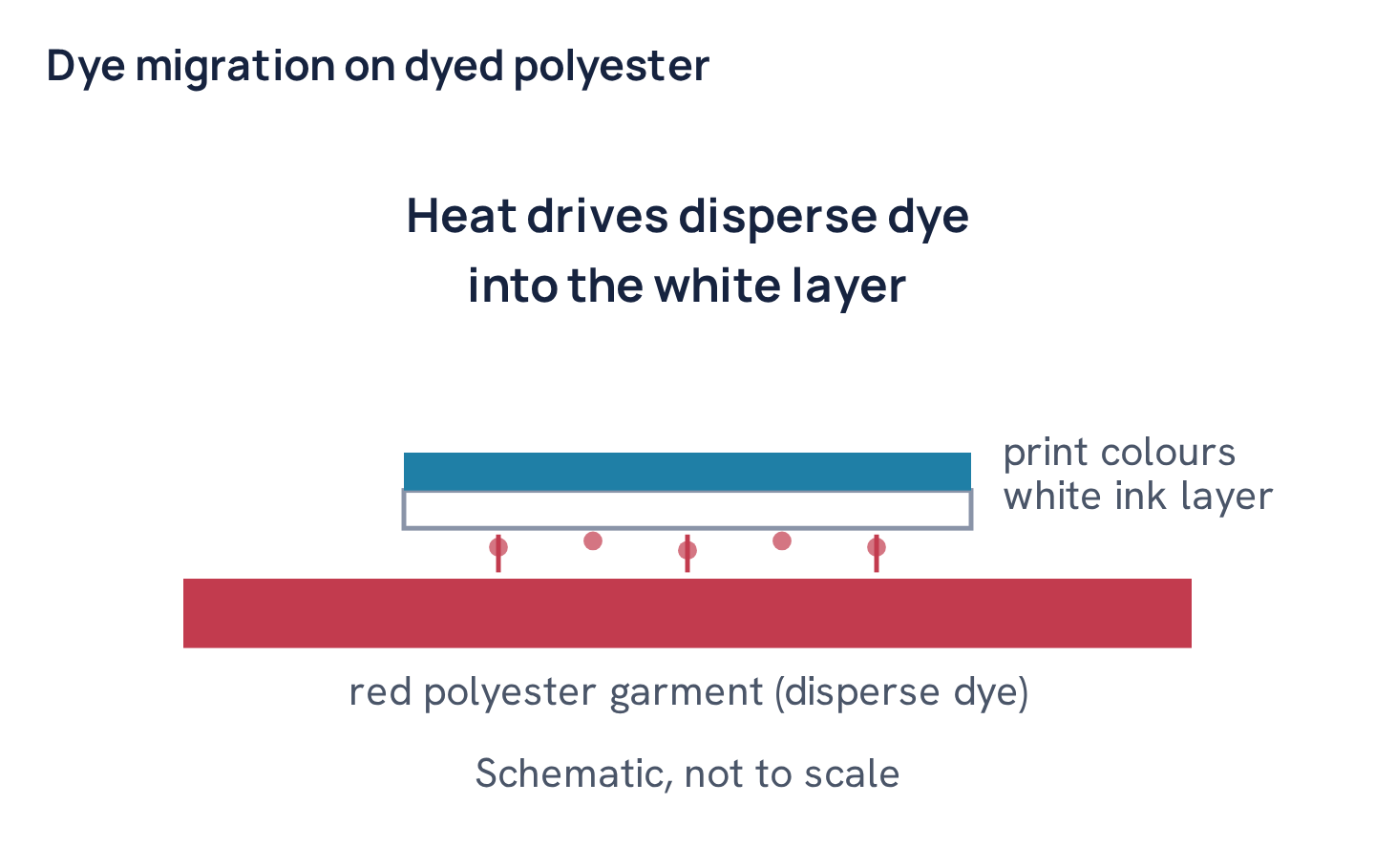
- Dye migration: at press heat, disperse dye in a coloured polyester garment can vaporise and move into the white ink layer of the print, giving pink, grey or tinted whites, sometimes days after pressing.
- Fabric damage: high heat can leave a shiny “press box” mark, scorch light polyester, or distort fine sportswear knits.
Cotton has neither problem, which is why cotton is usually pressed hotter.
Typical DTF press settings for polyester
| Fabric | Typical temperature | Typical time | Notes |
|---|---|---|---|
| 100% polyester (light colour) | About 130–150°C (265–300°F) | About 8–12 s | Lower end for thin sportswear |
| Dark or bright dyed polyester | About 120–140°C (250–285°F) | About 8–10 s | Use low-temp or blocker powder |
| Polyester-cotton blends | About 140–155°C (285–310°F) | About 10–12 s | Watch for migration on dark colours |
| 100% cotton (for comparison) | About 150–165°C (300–325°F) | About 10–15 s | No dye migration risk |
These are general starting ranges, not fixed rules. Always follow the film and powder supplier’s instructions, use medium pressure, and test on a spare garment or offcut. A short pre-press of a few seconds removes moisture and wrinkles. Many decorators finish with a second press of a few seconds through a parchment or teflon sheet to set the print.
How to prevent dye migration on polyester
- Use the lowest temperature that bonds the adhesive and keep press time short.
- Use low-temperature or “blocker” adhesive powder designed for polyester and sublimated or dark garments.
- Choose garments with good heat fastness: well-cleared, high-fastness dyed polyester migrates less.
- Test first, then wait 24 hours and check the whites, because migration can appear later.
- Avoid repeated pressing of the same area.
From the dyeing side, migration links directly to how the polyester was dyed and finished. Our floor practice is to finish fabric containing polyester at 100–110°C because hotter heat makes disperse dye bleed and fastness fail. In our lab reports, CVC fleece tested for hot pressing at 200°C for 15 seconds failed on wet staining in all three cases, graded 2–3 against a requirement of 4, through thermomigration of disperse dye. See colour fastness to hot pressing.
Common mistake: pressing a white-backed DTF logo onto a red polyester football shirt at cotton settings, 160°C for 15 seconds. The print looks fine at first, then the white turns pink overnight as the red disperse dye migrates into it. Lower heat and a blocker powder prevent it.
DTF vs sublimation vs HTV on polyester
| Method | Works on dark polyester? | Feel | Notes |
|---|---|---|---|
| DTF | Yes (white underbase) | Thin, flexible film | Full colour, any colour garment; watch migration |
| Sublimation | No (light colours only) | No feel; dye inside fibre | Best on white polyester; very durable |
| Heat transfer vinyl (HTV) | Yes | Thicker, smooth | Best for simple shapes and text |
| Screen print | Yes | Varies with ink | Economical for large runs; needs low-bleed inks on polyester |
For full-colour prints on white or light polyester, sublimation gives the best feel and durability. For dark polyester, DTF is usually the easiest full-colour option. See heat presses for sublimation.
DTF on sportswear and polyester-spandex
Performance polyester and polyester-spandex are thin, stretchy and heat-sensitive. Use the lower end of the temperature range, light to medium pressure, and a heat-resistant pillow or pad inside the garment to avoid press marks. Choose a soft, stretchy film and powder so the print can stretch with the fabric. Moisture-moving finishes on sportswear can reduce adhesion; a pre-press and a test wash confirm the bond.
Common DTF problems on polyester and their fixes
| Problem | Likely cause | Fix |
|---|---|---|
| White ink turns pink, blue or grey | Dye migration from the garment | Lower temperature, shorter time, blocker or low-temp powder |
| Shiny press box on the garment | Too much heat or pressure | Lower heat; use a pressing pillow and cover sheet |
| Print peels or lifts at edges | Too little heat or time; moisture; finish on fabric | Pre-press; increase time slightly; final press with cover sheet |
| Print cracks when stretched | Stiff film or powder on stretch fabric | Use soft, stretch-rated film and powder |
| Scorch marks on light polyester | Temperature too high | Reduce heat; test on scrap |
DTF on polyester blends
On cotton-polyester and tri-blend garments, DTF bonds well and is one of the easiest full-colour options. The cotton share makes the fabric a little more heat tolerant, but the polyester share can still migrate on dark or bright colours, so blends sit between polyester and cotton settings. Heather and dark CVC hoodies are where a quick test is most worthwhile.
How to wash DTF prints on polyester
- Wait at least 24 hours before the first wash.
- Turn the garment inside out and wash cool, around 30°C.
- Avoid bleach and strong solvents.
- Tumble dry low or line dry.
- Never iron directly on the print; iron inside out or with a cloth if needed.
Worked example. A club orders 50 navy polyester training tops with a white and gold DTF crest. The decorator runs a test at 135°C for 9 seconds with a blocker powder, waits a day, and sees clean whites. A second test at 160°C for 15 seconds shows a slight blue cast in the white. The full order is pressed at the lower setting.
Does DTF last on polyester?
A well-pressed DTF print on polyester usually lasts for dozens of washes without cracking or peeling, especially when washed inside out and dried low. The polyester itself barely shrinks, which is kind to the print. Durability falls if the print was under-pressed, if fabric softener is used heavily, or if the garment is ironed directly on the print.
Summary
- DTF works well on polyester and on dark polyester where sublimation cannot.
- Polyester needs lower press temperatures than cotton, often about 120–150°C.
- Heat can make disperse dye migrate into white ink; use low-temp or blocker powder.
- Test, wait 24 hours, and check whites before running an order.
- Wash DTF prints inside out, cool, and dry low.
Questions
Can you use DTF on polyester?
Yes. DTF bonds well to polyester, including dark polyester where sublimation cannot be used. Use lower heat than for cotton.
What temperature for DTF on polyester?
Typically about 130 to 150°C for 8 to 12 seconds, and lower for dark or bright dyed polyester. Follow your film and powder supplier and test first.
Why did my white DTF print turn pink on polyester?
Dye migration: press heat vaporised disperse dye from the coloured polyester into the white ink. Use lower heat and a low-temperature or blocker powder.
Is DTF or sublimation better on polyester?
Sublimation is best on white or light polyester for feel and durability. DTF is better on dark polyester and for printing on mixed fabrics.
How do you wash DTF prints?
Wait 24 hours, then wash inside out at about 30°C, avoid bleach, dry low and never iron directly on the print.

Textile engineer with 14+ years in dyeing and fabric development. He writes every guide on Dyeing Solution from real production work. Full profile