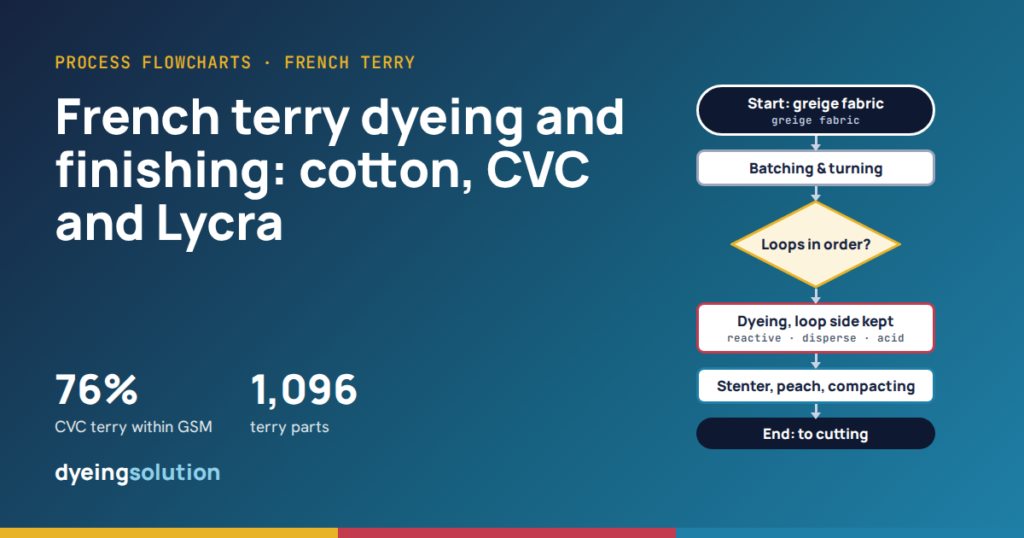
French terry is fleece before the brush: a loop-back knit whose loops are left whole on the back. Here is the dyeing and finishing route for each fibre, from greige terry to the cutting table, with what our records show about GSM and shrinkage.
At a glance
1,096Terry parts in our records
300Median required GSM
76%CVC terry within GSM tolerance
0.15%Enzyme; none on loose terry
French terry is a single jersey face with a loop yarn laid into the back. It is normally two-thread: a face yarn and a loop yarn. Three-thread terry adds a tie (binding) yarn, like fleece. In fleece the back loops are brushed into pile; in French terry they are left whole, which keeps the fabric lighter, cooler and smoother inside. Where our records list the yarns, 503 parts are two-yarn and 382 three-yarn constructions. In our records 639 of 1,096 terry parts are 100% cotton and 350 are CVC, mostly 60/40, 75/25 and 80/20.
| Terry type | Parts |
|---|---|
| Terry | 503 |
| French terry | 125 |
| 3-thread diagonal terry | 70 |
| Diagonal terry | 68 |
| Baby terry | 32 |
| Design terry | 17 |
| 2-thread terry | 12 |
Terry by fibre: what our records show
| Fibre or blend | Parts | Median required GSM | Within ±5% GSM | More than 5% light | Median length shrinkage | Median width shrinkage | Heat set |
|---|---|---|---|---|---|---|---|
| 100% cotton | 639 | 320 | 57% | 38% | 6% | 2% | 15% |
| CVC / PC | 350 | 300 | 76% | 17% | 2% | 2% | 16% |
| Cotton-elastane | 69 | 240 | 58% | 38% | 5% | 2% | 99% |
Terry is dyed like fleece, with one rule: watch the loops
The dyeing route for terry is almost the same as for fleece. The difference is the loops. Because they stay whole, every disordered loop shows on the finished fabric. So the fabric is loaded and run following the loop side, in the direction the loops lie, and that is kept at every stage of dyeing and finishing.
Terry also creases more easily than fleece. It is usually knitted tighter, more like single jersey, so the crease-mark rules apply in full: heat set heavy and tight terry, load straight at 80% capacity at most, and keep the temperature at 80°C or below where you can.
- In dyeing there is almost no difference between terry and fleece.
- The terry loops are very important. We load the fabric following the loop side and direction, so the loops do not get disordered. This has to be kept at every stage of dyeing and finishing.
- The crease-mark tendency is much higher in terry than in fleece, because terry is usually tightly knitted, just like single jersey.
Like fleece, terry holds GSM better than single jersey or rib, and CVC terry is the steadiest: 76% within GSM tolerance and only 2% median length shrinkage. 100% cotton terry shrinks 6% in length, much less than cotton fleece at 10%, because its loops are not opened up by brushing.
When terry is heat set
Heat setting is decided on the fibre content, elastane, GSM, construction, the width and stability requirement, and design. For terry that means: cotton-elastane terry is always heat set (99% in our records), tight or design terry is heat set, and other terry from 350 GSM. Most cotton and CVC terry is lighter than that, and only 15% and 16% of it was heat set.
Enzyme, singeing and strength
Three-thread terry has the same weak point as fleece: the binding yarn that holds the loops is usually cotton, and a heavy enzyme can weaken it until the loops pull out. Terry gets about 0.15% enzyme, adjusted to the supplier and the water, and a loose terry gets none. When the fabric cannot take an enzyme but the buyer needs a clean face, it is singed instead, in open width after slitting (and after heat setting when it is heat set). Check first that the flame cannot damage the fabric: polyester cannot be singed, and CVC only when the face side is cotton yarn.
The sequence before the dyeing machine
Every chart below follows the same sequence before dyeing. Steps a fabric does not need simply drop out; they are drawn dashed.
- Greige inspection, then batching. A fabric that stays a tube is turned inside out here.
- If it needs heat setting, singeing or mercerising: slitting first. None of these is ever done on a tube.
- If it needs heat setting: heat setting in open width.
- If it needs singeing: singeing in open width, after checking the flame cannot damage the fabric.
- If it is mercerised: mercerising, then drying.
- If the fabric was opened: back sewing, to make it a tube again with the face side inside (the loop side, for terry).
- Loading into the dyeing machine, then scouring, bleaching and dyeing, single part or double part as the fibre needs.
Flowcharts by fibre
100% cotton French terry
More than half of all terry. Heavy, soft on the loop side and absorbent. In our records: 639 parts, 57% within GSM tolerance, median length shrinkage 6%. Full process: 100% cotton dyeing process.
Dyeing and finishing: 100% cotton French terry
CVC French terry
A cotton face with a polyester or CVC loop yarn. The steadiest terry in our records. In our records: 350 parts, 76% within GSM tolerance, median length shrinkage 2%. Full process: CVC / PC dyeing process.
Dyeing and finishing: CVC French terry
Cotton-elastane French terry
Always heat set before dyeing, with a cooler 80°C scour to protect the elastane. In our records: 69 parts, 58% within GSM tolerance, median length shrinkage 5%. Full process: cotton-elastane dyeing process.
Dyeing and finishing: Cotton-elastane French terry
CVC terry: the polyester part is dyed
As with fleece, the polyester part of CVC terry is always dyed for a solid shade. Whether the loop yarn is CVC or PC depends on the buyer’s requirement, the price, and the yarn source.
- For a solid look, the polyester part of CVC terry must always be dyed, the same as fleece.
- Whether the loop is CVC or PC depends on the buyer requirement, the pricing and the yarn source and price.
- Terry is normally two-thread. Three-thread is also made.
Finishing terry: open width, never brushed
All terry is finished open width today: slitting, stenter and compacting. Terry is never brushed; brushing is what turns the loops into fleece. When a peach finish is required, it goes between two stenter passes: stenter, peach, stenter again, then compacting.
- Today all terry is done in open format.
- Terry is never brushed. It can be peached: stenter, then peach, then stenter again, then compacting.
Common faults and buyer complaints
- Disordered loops. The most common comment. Load and run the fabric following the loop direction at every stage.
- Loop size. Loops that come out too big or too small. In fleece the loops are cut by brushing, so this never shows; in terry they stay whole and every difference is visible.
- Hairiness. Terry must have a smooth surface. Buyers comment on a hairy face, so the enzyme or, where the fabric cannot take one, singeing matters.
- Harsh hand feel. Terry can feel hard. The softener has to bring the handle back.
- Crease marks, more than on fleece, because terry is knitted tighter.
- Most comments are about the loops getting disordered.
- Loop size, too big or too small, has to be controlled. In brushed fabric the loops are cut, so there is no problem, but in terry the loops stay whole, so a big, small or wrongly lying loop shows.
- We cannot give hairiness on terry. Buyers comment on it; terry needs a smooth surface.
- The hand feel has to be made soft. Terry sometimes feels hard, and buyers comment on that too.

Textile engineer with 14+ years in dyeing and fabric development. He writes every guide on Dyeing Solution from real production work. Full profile