Acrylic barely shrinks in a cool wash because it absorbs little water and cannot felt, but heat softens it: a hot wash or hot dryer can shrink, stretch or flatten acrylic permanently. Why, acrylic blends, the dryer, and how to wash and dry acrylic safely.
At a glance
1–2%moisture regain
Nofelting
Heatmain risk
Dryflat
Acrylic fabric usually does not shrink much in a normal cool or warm wash, because the fibre absorbs very little water. But acrylic is sensitive to heat. A hot wash or, more often, a hot tumble dryer can make acrylic shrink, pucker or, more commonly, go limp, stretched and shiny. Knitters call this “killing” acrylic: the heat softens the fibre so it loses its springiness and the garment grows and drapes instead of holding its shape. So the honest answer is: acrylic resists shrinking in water, but heat can change its size and feel permanently.
This guide explains how acrylic behaves in water and heat, why it can shrink or stretch, what happens in the dryer, how acrylic blends behave, how to wash and dry acrylic safely, whether you can shrink or unshrink acrylic on purpose, and how acrylic compares with wool and cotton. It is written from the dye-house side, where we dye cotton-acrylic knits and see how the acrylic part reacts to heat in processing.
Why acrylic does not shrink like cotton or wool
Cotton shrinks because its fibres swell in water and the yarns and knit relax. Wool shrinks mainly by felting: its scaly fibres lock together under warm water and agitation. Acrylic does neither. It absorbs only about 1–2% moisture, so it barely swells, and it has no scales, so it cannot felt. That is why acrylic was developed as an easy-care alternative to wool, and why acrylic sweaters can usually go in the washing machine. See does wool shrink and does cotton shrink.
Why heat changes acrylic
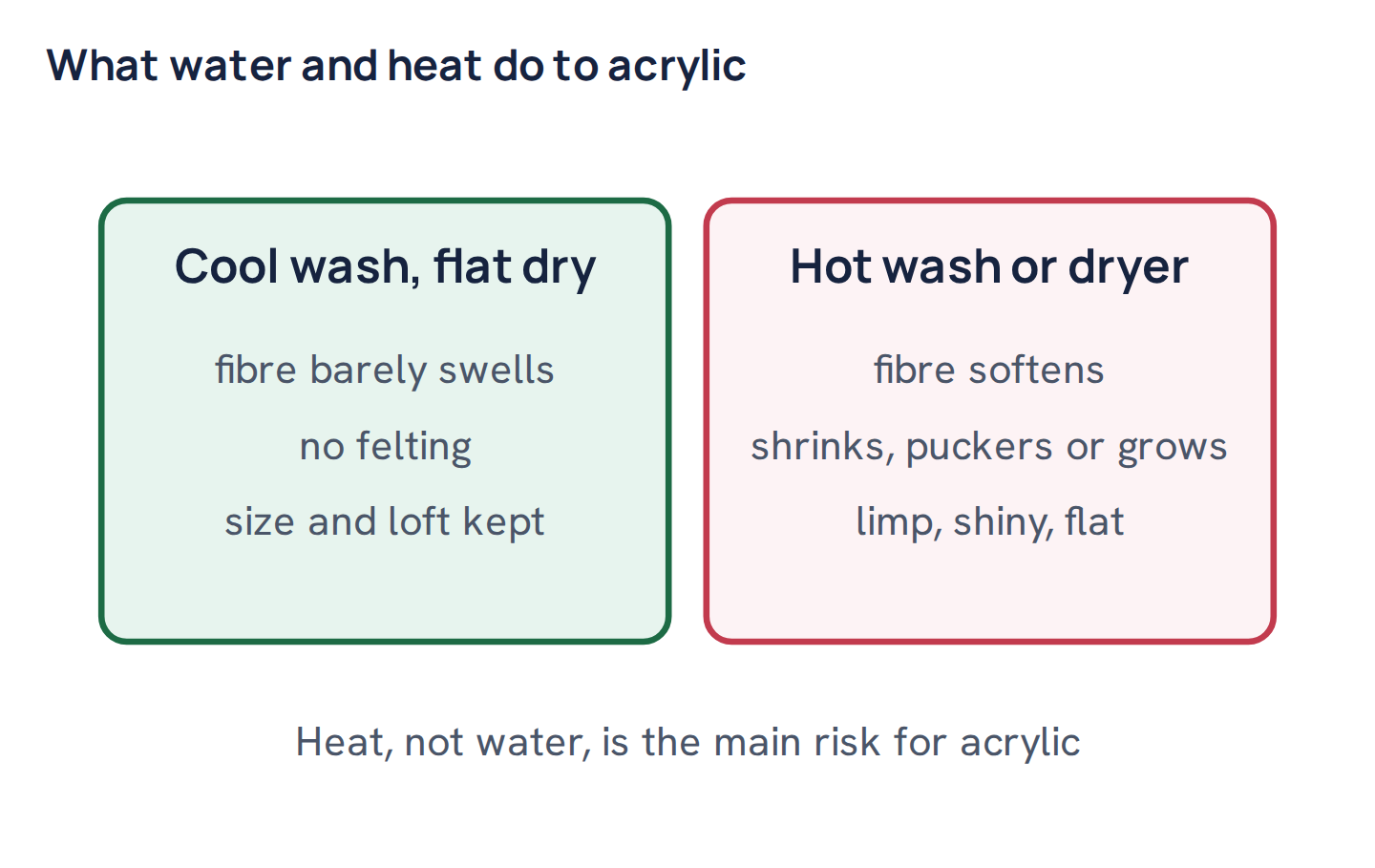
Acrylic is a thermoplastic: it softens as it gets hot. Its glass transition temperature, where the fibre changes from stiff to rubbery, is reached in hot water and in a hot dryer. When acrylic is hot and is pulled, tumbled or hung, the fibres relax and set in a new shape as they cool. Depending on how the garment is handled, that can mean:
- Shrinkage and puckering if the yarns had been stretched during spinning and knitting and the heat lets them retract.
- Growth and drape if the hot garment is stretched by tumbling or by its own weight.
- Loss of loft and a shiny surface as the fluffy, bulked fibres flatten.
Does acrylic shrink in the dryer?
The dryer is where most acrylic damage happens. A hot tumble cycle softens the fibre while the garment is being twisted and pulled. Many acrylic sweaters come out slightly smaller and puckered, or longer and droopy, with less bounce and a flatter, shinier surface. The change is permanent because the fibre has been reset by heat. A low or no-heat cycle is much safer, and drying flat is safest.
Acrylic vs other fibres for shrinkage
| Fibre | Shrinks in water? | Heat risk | Main cause of size change |
|---|---|---|---|
| Acrylic | Very little | High | Heat softening, stretching or shrinking |
| Wool | Yes, can felt | Medium | Felting from heat and agitation |
| Cotton | Yes | Medium | Fibre swelling and knit relaxation |
| Polyester | Very little | Low to medium | Heat-set, stable; high heat can shrink |
| Viscose | Yes, a lot | Medium | Fibre swelling, weak when wet |
In our finishing records, polyester knits had a median length shrinkage of 3%, 100% cotton 6% and viscose 9% after the wash test, which shows how strongly water-loving fibres shrink compared with low-absorbing synthetics.
Acrylic blends
- Acrylic-wool: the wool part can still felt and shrink in hot or rough washing; wash on a wool cycle.
- Cotton-acrylic: the cotton part shrinks in hot water; the acrylic part is sensitive to dryer heat. Wash cool and dry flat or low.
- Acrylic-polyester: very stable in water; still avoid high heat.
- Acrylic-nylon: common in socks; stable, but dryer heat can reduce elasticity.
See the cotton-acrylic dyeing process.
Acrylic in the dye house
Acrylic is dyed with cationic (basic) dyes. It takes dye rapidly once it passes its glass transition temperature, roughly in the range of 75–85°C in water, so the temperature must be raised slowly through that zone to avoid uneven dyeing. Acrylic is also cooled slowly after dyeing, because cooling too fast while the fibre is soft can set creases and harden the handle. This sensitivity to heat in processing is the same property that makes acrylic vulnerable in a hot dryer at home. See how cationic dyes work on acrylic.
Common mistake: trying to shrink a stretched acrylic sweater back by washing it hot and tumble drying on high, as you might with cotton. Acrylic does not tighten up in a controlled way; it is more likely to go limp, shiny and misshapen. Heat damage to acrylic cannot be reversed.
Can you shrink acrylic on purpose?
Not reliably. Some people steam or briefly heat acrylic to tighten loose stitches, but the result is unpredictable and it can easily flatten the knit or make it drape more instead. Knitters sometimes deliberately “kill” acrylic with a steam iron to make it softer and more drapey for shawls. If a garment is too big, altering it is more predictable than heat.
Can you unshrink acrylic?
If an acrylic garment has only tightened slightly, soaking it in lukewarm water with a little hair conditioner, gently easing it to size and drying it flat may help a little. If heat has changed the fibre, the change is permanent.
How to wash and dry acrylic safely
- Check the care label first.
- Wash at 30°C on a gentle or wool cycle, inside out.
- Use a mesh bag for sweaters and knitwear.
- Use a short, gentle spin.
- Dry flat on a towel or rack, reshaping while damp.
- Do not hang heavy knits to dry; they stretch.
- If you must tumble dry, use no heat or the lowest setting.
- Iron only on the lowest setting with a cloth, or avoid ironing.
Worked example. Two identical acrylic jumpers are washed at 30°C. One is dried flat on a rack and comes out the same size and fluffy. The other goes in the dryer on high for an hour; it comes out 4 cm longer in the body, narrower, flatter and shinier, and it never recovers. Same wash, different drying.
Acrylic blankets, throws and soft toys
Acrylic is common in blankets, throws and soft toys because it is warm, light and washable. These items are often large and heavy when wet, and a hot dryer can flatten their pile and leave them matted and shiny. Wash them on a cool, gentle cycle and dry them flat or over a rack, turning them so they dry evenly. Brushing an acrylic throw lightly when dry can lift the pile again if it has been flattened by use rather than by heat.
Acrylic socks, hats and scarves
Acrylic and acrylic-nylon socks hold their size well in normal washing. Beanies and scarves knitted from soft acrylic yarn are more likely to stretch than shrink, especially if they are hung while wet. Lay them flat to dry and reshape them gently. If a hat has become loose, a short warm rinse and drying it flat on a towel may tighten it a little, but avoid the dryer.
Acrylic vs wool: which is easier to care for?
Acrylic is generally easier: it goes in the washing machine, does not felt, does not attract moths and dries fairly quickly. Wool needs cool, gentle washing to avoid felting and must be dried flat. Wool, however, recovers its shape well, resists odour and is warmer when damp. Acrylic’s weak point is heat, so the rule for acrylic is simple: cool water is fine, heat is not.
How to read acrylic care labels
Most acrylic labels show a 30°C or 40°C wash, a gentle cycle, no bleach and either “dry flat” or “tumble dry low”. A dot inside the dryer symbol means low heat; a crossed-out dryer means no tumble drying. If the label shows “do not iron” or a single dot on the iron, heat sensitivity is the reason. Following the drying instructions matters more than the wash temperature for acrylic.
Summary
- Acrylic barely shrinks in water because it absorbs little moisture and cannot felt.
- Heat softens acrylic and can shrink, stretch or flatten it permanently.
- The tumble dryer is the main risk; dry flat instead.
- Acrylic blends also carry the risks of their other fibres.
- Heat damage to acrylic cannot be undone.
Questions
Does acrylic shrink?
Very little in a cool or warm wash. Heat is the main risk: a hot wash or dryer can shrink, stretch or flatten acrylic.
Does acrylic shrink in the dryer?
It can. Hot tumbling softens the fibre, so garments may shrink and pucker or grow and go limp. Dry flat or on no heat.
Can you unshrink acrylic?
Slight tightening may ease with a lukewarm soak and gentle reshaping, but heat damage to acrylic is permanent.
Does acrylic shrink more than cotton?
No. In water acrylic shrinks less than cotton; acrylic is more sensitive to heat.
How do you wash acrylic without ruining it?
Wash cool on a gentle cycle, inside out in a mesh bag, and dry flat without heat.

Textile engineer with 14+ years in dyeing and fabric development. He writes every guide on Dyeing Solution from real production work. Full profile