Nylon has more natural stretch than most fibres and recovers well, but it is not elastic like spandex. Woven nylon barely stretches, nylon knits stretch moderately and nylon-spandex stretches a lot. Nylon vs polyester, stretching out over time, heat setting, and care.
At a glance
Moderatefibre stretch
Very goodrecovery
Spandexfor high stretch
Lowheat only
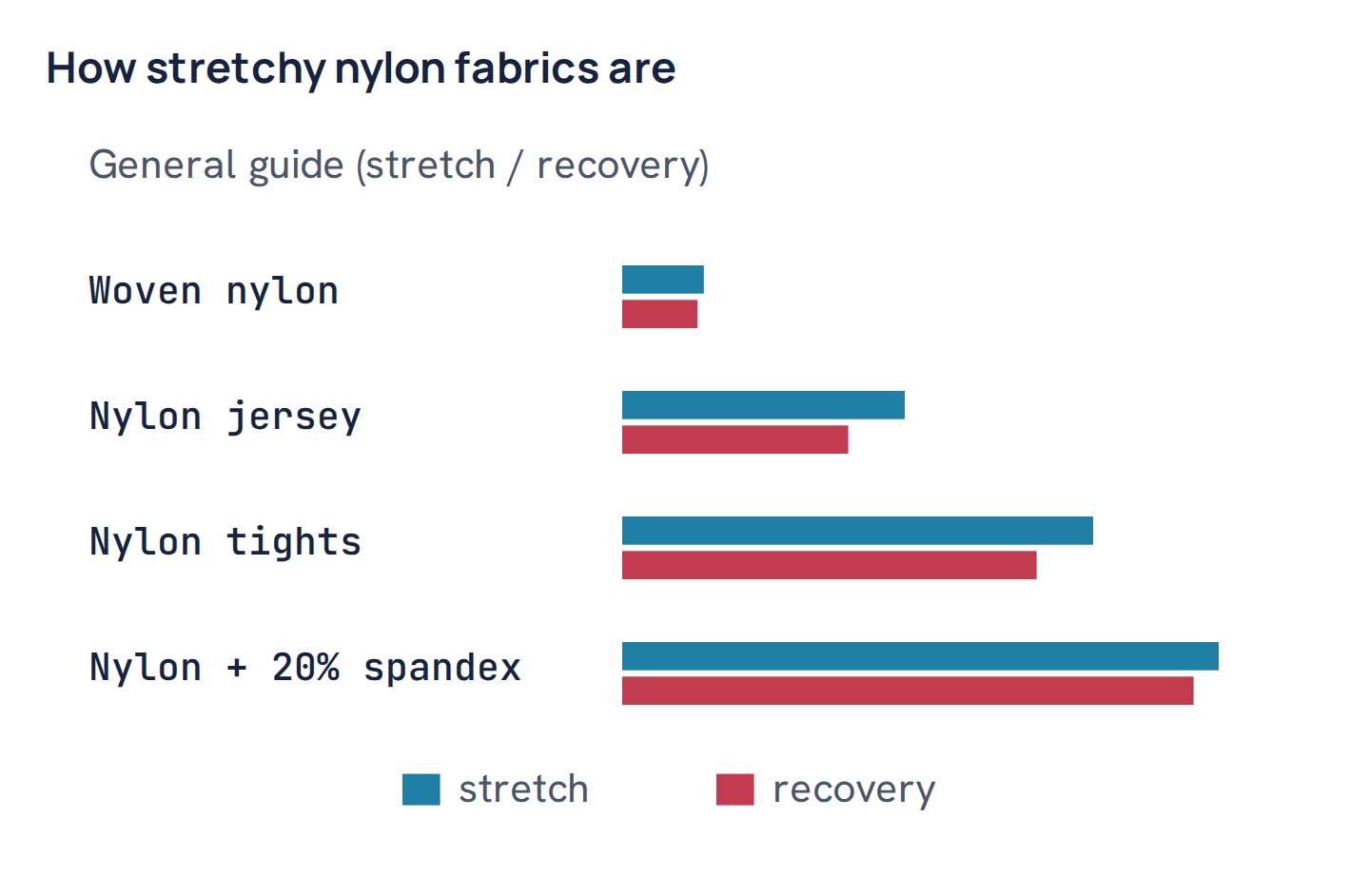
Yes, nylon has more natural stretch than most fibres, but it is not elastic like spandex. Nylon filament can stretch roughly 15–50% before breaking and recovers well from small stretches, which gives nylon fabrics a slight give and a springy feel. Woven nylon, such as a windbreaker or a backpack fabric, stretches very little because the weave locks the yarns. Nylon knits stretch more, and nylon blended with spandex, as in leggings, swimwear and tights, stretches a lot in every direction and snaps back. So nylon is “a bit stretchy” as a fibre and “very stretchy” in spandex blends.
This guide explains why nylon stretches, how much woven, knitted and spandex-blend nylon fabrics stretch, nylon vs polyester and spandex for stretch, whether nylon stretches out over time, how heat and washing affect it, and how to choose and care for stretchy nylon. It is written from the dye-house side, where we dye and heat set nylon and nylon-elastane fabrics.
Why nylon fibre stretches
Nylon is a polyamide. Its long polymer chains are held together by hydrogen bonds between neighbouring chains. When you pull a nylon filament, the chains can slide and straighten a little and the bonds flex, then they pull back when the force is released. That gives nylon good elongation and excellent elastic recovery for small strains, which is why nylon was the first fibre used for sheer stockings. It is also why nylon resists abrasion and does not snap easily. But beyond a modest stretch, the deformation becomes permanent; nylon is not designed to stretch to several times its length the way spandex is.
How much nylon fabrics stretch
| Fabric | Stretch | Recovery | Typical uses |
|---|---|---|---|
| Woven nylon (taffeta, ripstop) | Very little | Good | Jackets, bags, tents |
| Textured nylon woven | Slight give | Good | Outdoor trousers, travel wear |
| Nylon jersey (no spandex) | Moderate | Good | Linings, lingerie, sportswear |
| Nylon tricot | Moderate | Good | Lingerie, swim linings |
| Nylon-spandex (80/20) | High, four-way | Excellent | Leggings, swimwear, shapewear |
| Nylon hosiery | High | Very good | Tights, stockings |
Nylon vs polyester vs spandex for stretch
| Fibre | Fibre stretch | Recovery | Feel |
|---|---|---|---|
| Nylon | Moderate | Very good for small stretch | Soft, smooth, slightly springy |
| Polyester | Low | Good | Firmer, crisper |
| Spandex | Very high (several hundred %) | Excellent | Used in small amounts |
| Cotton | Low | Poor; bags out | Soft, absorbent |
Nylon’s softer, springier feel is one reason premium leggings and swimwear often use nylon-spandex rather than polyester-spandex. Polyester-spandex holds colour better in chlorine and sun. See what is elastane and is spandex polyester.
Does nylon stretch out over time?
Nylon itself holds its shape well and resists bagging. In nylon-spandex garments, the spandex is what wears out: heat, chlorine, sunscreen and body oils slowly break it down, so leggings and swimsuits lose their snap, go baggy at the seat and knees, and can show shiny lines where the spandex is exposed. Nylon fabric without spandex rarely stretches out in normal use, though straps and waistbands under constant tension can grow slightly.
Does nylon stretch when wet?
Nylon absorbs about 4% moisture, more than polyester, and becomes slightly more extensible and a little weaker when wet. In practice wet nylon swimwear can feel a touch looser, but it recovers as it dries. Unlike viscose, nylon keeps most of its strength when wet.
How heat setting fixes nylon stretch
In the factory, nylon and nylon-spandex fabrics are heat set on a stenter, typically before dyeing for nylon-elastane, to stabilise width and stretch. Heat setting locks in the fabric’s dimensions so it does not shrink or curl in dyeing and washing, and it sets how much stretch the finished fabric has. Over-heating weakens the spandex and yellows nylon; under-heating leaves the fabric unstable. See the nylon-elastane dyeing process and does nylon shrink.
Can you stretch nylon clothing?
A little. Nylon garments without spandex can be eased slightly by wetting them with lukewarm water and gently stretching them as they dry, because nylon is a bit more pliable when damp. The effect is limited and may reverse after washing. Do not use high heat to stretch nylon; it can glaze, shrink or melt. Nylon-spandex garments do not stretch permanently in a useful way.
Common mistake: ironing a nylon jacket or tumble drying nylon-spandex leggings on high heat. Nylon starts to soften at relatively low ironing temperatures and spandex is damaged by heat, so the result can be shiny patches, puckering and lost stretch. Use a low setting, a pressing cloth, or skip ironing.
How to choose stretchy nylon
- For leggings and swimwear, look for 15–25% spandex with nylon for a soft, compressive feel.
- For tights, a higher denier gives more durability and opacity.
- For outdoor trousers, look for “stretch nylon” or textured nylon with a little spandex.
- For bags and jackets, woven nylon with no stretch is stronger and more stable.
Caring for stretchy nylon
- Wash cool (30°C), inside out, on a gentle cycle.
- Avoid bleach, fabric softener and high heat.
- Rinse swimwear in fresh water after use.
- Dry flat or hang in the shade; do not tumble dry on high.
Worked example. A runner compares a woven nylon jacket, a nylon jersey top and nylon-spandex leggings. The jacket barely gives when pulled; the top stretches across the chest and springs back; the leggings stretch in every direction and hug the body. Same fibre, very different stretch, decided by the fabric construction and spandex content.
Nylon tights and stockings: stretch by design
Sheer tights show nylon’s stretch and recovery at their best. Fine nylon filaments are knitted into a very elastic structure, often with spandex covered by nylon, so the tights stretch over the leg and recover after each step. Denier describes how thick the yarn is: lower denier is sheerer but ladders more easily; higher denier is more opaque and durable. Ladders happen when a single loop breaks and the knit unravels down the wale, which is why tights should be handled with dry, smooth hands.
Nylon in activewear: comfort and compression
Activewear brands often choose nylon-spandex for leggings and sports bras because nylon feels softer and cooler to the touch than polyester and gives a smooth, sculpting compression. The amount of spandex and the knit structure decide how firm the compression feels. Thicker, double-knit leggings with more spandex feel supportive and opaque; lighter single knits feel softer and less compressive. Squat-test leggings in front of a light to check that the stretched fabric stays opaque.
Stretch nylon for travel and outdoor clothing
Many travel and hiking trousers use a woven nylon with a little spandex, or a textured nylon yarn, to give comfortable stretch for climbing and bending while staying light, quick drying and abrasion resistant. These fabrics usually stretch mainly across the width. They are often given a water-repellent finish, which can wear off and needs re-proofing over time.
Signs nylon-spandex has lost its stretch
- The fabric bags at the knees or seat and does not spring back.
- Shiny or white threads appear when the fabric is stretched.
- Waistbands roll or slip down.
- The garment feels thinner and less supportive than when new.
These changes are permanent; they come from damaged spandex, not from the nylon.
How to test stretch before buying
- Read the label: any spandex or elastane share means real elastic stretch.
- Pull the fabric gently across and along: four-way stretch moves both ways.
- Release it: good recovery means it snaps straight back with no ripple.
- Stretch it over your hand in front of a light: thin spots show where it will wear.
Nylon stretch and fit
Because nylon-spandex recovers so well, size choice matters. Too small, and the fabric is overstretched, which thins it, makes it see-through and wears out the spandex faster. Too large, and it wrinkles and slides. A good fit stretches the fabric evenly without visible strain at seams.
Nylon stretch in socks
Most socks contain some nylon, often with a little spandex, because nylon adds strength at the heel and toe and its springy recovery helps the sock stay up and keep its shape after many washes.
Summary
- Nylon fibre has moderate stretch and very good recovery, more than polyester.
- Woven nylon barely stretches; nylon knits stretch moderately.
- Nylon-spandex fabrics stretch a lot and recover strongly.
- Heat and chlorine wear out the spandex in nylon blends.
- Heat setting in the factory fixes nylon’s stretch and size.
Questions
Is nylon stretchy?
Nylon fibre has moderate stretch and very good recovery. Nylon knits stretch, and nylon-spandex blends stretch a lot.
Is nylon stretchier than polyester?
Yes, nylon fibre has more natural give and a springier feel than polyester.
Does nylon stretch out over time?
Nylon itself holds its shape well. In nylon-spandex garments the spandex wears out first, causing bagging.
Does nylon stretch when wet?
Slightly. Nylon absorbs about 4% moisture and is a little more extensible when wet, then recovers as it dries.
Can you stretch nylon clothes?
Only a little, by easing them while damp. Do not use high heat, which can damage nylon.

Textile engineer with 14+ years in dyeing and fabric development. He writes every guide on Dyeing Solution from real production work. Full profile