Yes, cotton wrinkles fairly easily, especially woven cotton, because its cellulose bonds reset in the bent position when damp or warm. Which cotton fabrics wrinkle most, cotton vs other fibres, easy-care finishes, polyester blends, and practical washing, drying and ironing tips.
At a glance
Highin poplin
Lowin jersey
Resineasy-care finish
Hangstraight away
Yes, cotton wrinkles fairly easily, especially woven cotton. Cotton fibres absorb water and have low elastic recovery, so when cotton is bent, crushed or creased while warm or damp, the cellulose chains shift and form new hydrogen bonds that hold the crease in place. That is why cotton shirts crease after sitting and come out of the dryer wrinkled. How much a cotton garment wrinkles depends a lot on its construction: crisp plain weaves such as poplin wrinkle most, knits such as jersey wrinkle very little, and easy-care finishes, blends with polyester and good drying habits reduce wrinkling a lot.
This guide explains why cotton wrinkles, which cotton fabrics wrinkle most and least, how cotton compares with linen, polyester, wool and modal, how easy-care and non-iron finishes work, how blends help, and practical ways to wash, dry and store cotton to avoid creases. It is written from the dyeing and finishing side, where wrinkle recovery is one of the properties we influence through finishing.
Why cotton wrinkles
Cotton is made of cellulose chains held together by hydrogen bonds. When cotton is bent, especially when water has loosened those bonds, the chains slide past each other. As the fabric dries or cools in the bent position, new hydrogen bonds form and lock the crease in. Cotton fibres also have relatively low elastic recovery: unlike wool or polyester, they do not spring back strongly once deformed. Water, heat and pressure all make wrinkling worse, which is why washing, tumble drying and sitting create the most creases.
Which cotton fabrics wrinkle most
| Fabric | Wrinkle tendency | Why |
|---|---|---|
| Cotton poplin, lawn, voile | High | Fine, flat plain weave shows every crease |
| Cotton linen-look, cotton gauze | High (often intentionally) | Light, open weaves crush easily |
| Oxford and chambray | Medium | Basket weave texture hides some creases |
| Twill and denim | Medium to low | Heavier diagonal weaves resist creasing |
| Cotton jersey and rib | Low | Knit loops spring back |
| Cotton fleece and terry | Very low | Thick, lofty knits hide creases |
| Seersucker | Very low (by design) | Puckered texture means no ironing needed |
Cotton vs other fibres
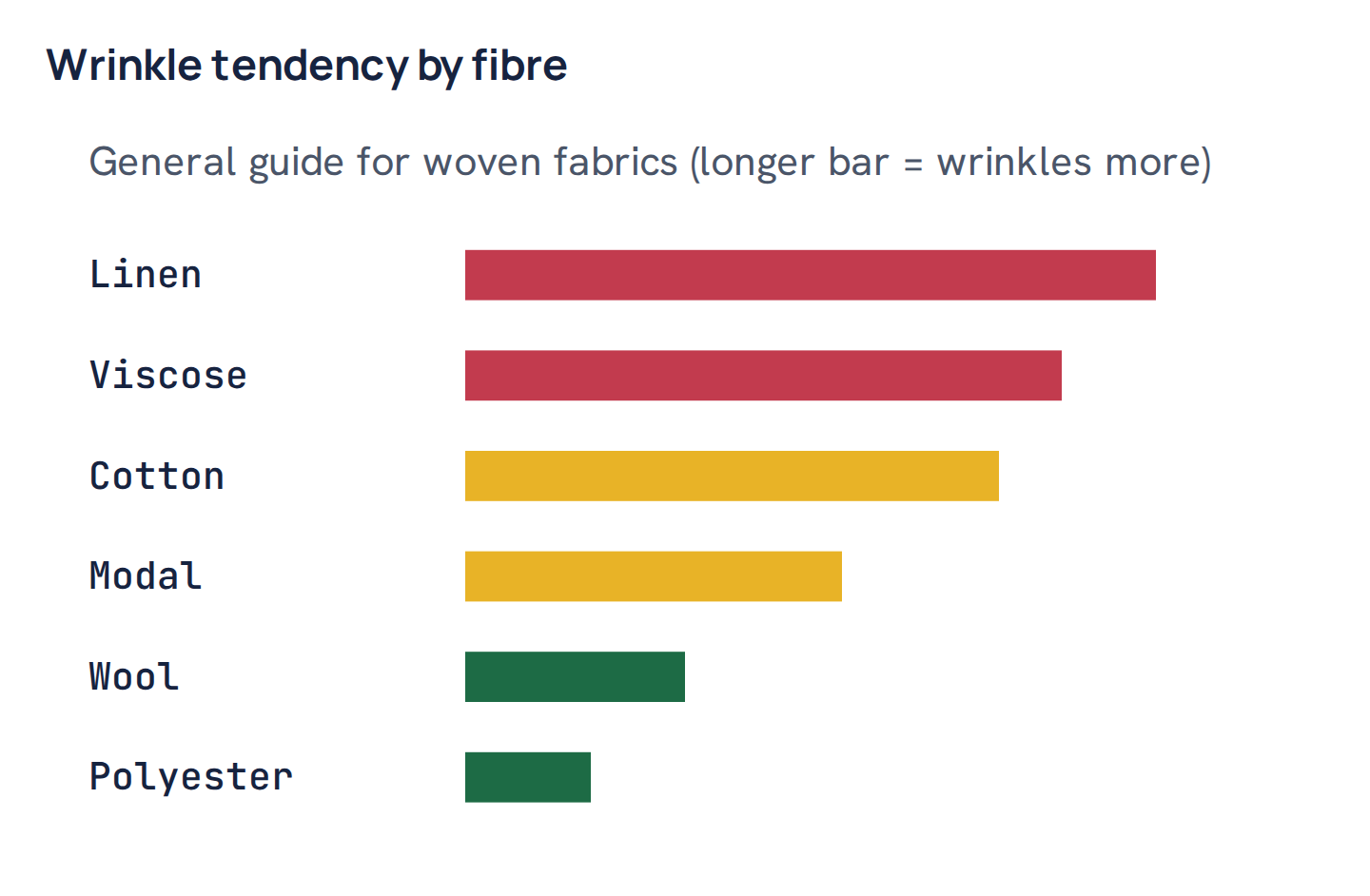
- Linen: wrinkles even more than cotton because its fibres are stiffer and less elastic.
- Viscose: wrinkles easily, especially when damp.
- Modal: wrinkles less than cotton and viscose in knits.
- Wool: naturally springy; creases often drop out when hung.
- Polyester: heat-set and elastic; very wrinkle resistant.
How easy-care and non-iron finishes work
Easy-care (wrinkle-resistant or non-iron) cotton is treated in finishing with cross-linking resins. These chemicals form bonds between neighbouring cellulose chains, so the chains cannot slide as freely and the fabric springs back to its flat shape after washing. The fabric is usually cured at high temperature to fix the resin. The trade-offs are some loss of strength and abrasion resistance, a slightly stiffer hand and, with older resins, concern about formaldehyde release; modern finishes are designed to keep formaldehyde low, and buyers test for it. See what is fabric finish.
How blends reduce wrinkling
Blending cotton with polyester reduces wrinkling a lot because polyester fibres are heat-set and spring back. A 60/40 or 65/35 polyester-cotton shirt needs far less ironing than 100% cotton. Cotton-elastane blends also recover better because the elastane pulls the fabric back. Our records show polyester also stabilises size: polyester-cotton knits shrank a median 4% in length against 6% for 100% cotton. See what is poly-cotton.
Polyester has no shrink property. In a CVC or PC fabric the polyester holds the structure, so the fabric cannot shrink, and washing changes the GSM very little.
Common mistake: leaving washed cotton shirts in the machine or the dryer after the cycle ends. Warm, damp cotton sitting in a heap sets deep creases as it cools. Remove cotton promptly, shake it out and hang it straight away.
How to stop cotton wrinkling
- Wash: use a lower spin speed for shirts and dresses; high spin presses creases in.
- Don’t overload the washer or dryer.
- Dry: tumble on low for a short time and remove while slightly damp, or line dry on a hanger.
- Shake and smooth: snap garments straight and smooth collars, cuffs and plackets by hand.
- Hang immediately: on shaped hangers, buttoned at the top.
- Steam: a handheld steamer or hanging in a steamy bathroom relaxes light creases.
- Store: leave space in the wardrobe; fold knits, hang wovens.
How to iron cotton well
- Iron while slightly damp, or use steam.
- Use a high (cotton) setting; check the label for blends.
- Iron collars and cuffs first, then yokes, sleeves and body.
- Iron dark cotton on the reverse to avoid shine.
- Hang straight away to cool without new creases.
Does cotton wrinkle less over time?
Not really. Washing removes finishing softeners and any easy-care treatment gradually loses effect, so cotton can wrinkle more as it ages. Fabric softener can reduce friction and make creases easier to remove. Knitted cotton keeps its low-wrinkle behaviour throughout its life.
Worked example. A traveller packs a 100% cotton poplin shirt and a 60/40 polyester-cotton shirt. After a day in a suitcase, the cotton shirt is creased and needs ironing; the blend looks presentable after a few minutes on a hanger in a steamy bathroom. A cotton jersey polo packed alongside looks fine straight out of the bag.
Cotton knits vs cotton wovens
The biggest single factor in cotton wrinkling is whether the fabric is knitted or woven. In a woven fabric, yarns cross at right angles and are held tightly, so a fold bends the yarns sharply and the crease stays. In a knit, yarns are formed into loops that can open, close and roll, so the fabric absorbs a fold and springs back. That is why a cotton T-shirt or polo can be packed in a bag and worn straight out, while a cotton poplin shirt needs ironing. If you want cotton with minimal ironing, choose knits such as jersey, pique and interlock. See what is pique fabric.
Does fabric weight matter?
Yes. Heavier cotton fabrics wrinkle less than light ones because thicker yarns and denser structures resist sharp folding. A heavy cotton twill or canvas holds a smoother surface than a fine lawn or voile. Very light cottons are chosen for coolness, and their wrinkles are part of the trade-off.
Mercerised and long-staple cotton
Mercerised cotton, treated with caustic soda under tension, has rounder, more lustrous fibres and slightly better wrinkle recovery and a smoother look than untreated cotton. Long-staple cottons such as pima make smoother yarns that show creases a little less. Neither makes cotton wrinkle-free, but both help. See what is mercerized cotton.
Travel tips for cotton
- Roll knits rather than folding them.
- Fold woven shirts with tissue paper between layers, or pack them in a garment folder.
- Hang garments on arrival and use bathroom steam to relax creases.
- Pack a small travel steamer or wrinkle-release spray for important outfits.
- Choose cotton-polyester or easy-care shirts for long trips.
Are wrinkles a sign of quality?
Not necessarily. Fine, natural cotton shirts often wrinkle more than cheaper easy-care ones because they have no resin finish. Many people accept a little creasing as part of the comfort and breathability of untreated cotton. Easy-care shirts look neater but can feel slightly stiffer and less breathable.
Does fabric softener reduce wrinkles?
A little. Softener lubricates fibres so they slide back more easily and creases are easier to iron out. Some laundry products are sold specifically as wrinkle-release sprays; they relax fibres so creases can be smoothed by hand. Neither changes cotton’s basic tendency to crease, and softener should be avoided on towels and sportswear.
Wrinkle resistance in testing
Labs measure wrinkle behaviour with tests such as wrinkle recovery angle, where a folded strip is pressed and released and the angle it springs back to is measured, and smoothness appearance after washing, where washed samples are compared with standard replicas. Easy-care shirts must reach set smoothness grades to carry non-iron claims.
Summary
- Cotton wrinkles easily because its cellulose bonds reset in the bent position.
- Woven poplin and lawn wrinkle most; jersey and fleece wrinkle least.
- Easy-care resins and polyester blends reduce wrinkling.
- Remove cotton from the machine promptly, dry low and hang straight away.
- Iron cotton slightly damp on a high setting.
Questions
Does cotton wrinkle easily?
Yes, especially woven cotton such as poplin. Cotton knits such as jersey wrinkle very little.
Why does cotton wrinkle?
Water and heat let cellulose chains slide when the fabric is bent, and new bonds lock the crease in as it dries.
Does cotton wrinkle more than polyester?
Yes. Polyester is heat-set and elastic, so it resists wrinkles much better than cotton.
What is non-iron cotton?
Cotton treated with cross-linking resins so it springs back flat after washing.
How do you stop cotton from wrinkling?
Use a lower spin, avoid overloading, dry on low, remove promptly and hang immediately.

Textile engineer with 14+ years in dyeing and fabric development. He writes every guide on Dyeing Solution from real production work. Full profile