Four quick home tests with a white cloth, water and an iron show whether clothes will bleed in the wash, rub off, run when wet or fade in the sun, and how each compares with the lab test a dye house works to.
At a glance
4 testsrub, press, soak, sun
1–5lab grade scale
Damp rubthe hardest test
Hidden areaalways test there
You can check whether clothes or fabric are colourfast at home in a few minutes, with a white cloth, some water and an iron. These simple tests copy, in a rough way, the three tests a textile lab uses most: rubbing, water and washing. They will not give you a lab grade, but they will tell you whether a garment is likely to bleed onto the rest of your laundry, rub off on a white sofa, or run when it gets wet.
This guide gives four home tests, how to judge the result, and how they compare with the lab methods a dye house works to.
What “colourfast” means
A fabric is colourfast when its colour does not change and does not stain other materials under a given treatment. Labs test each treatment separately: washing, rubbing dry and wet, water, perspiration, light and others. Each result is given as a grade from 1 (poor) to 5 (excellent), judged against a standard grey scale. A typical buyer minimum for knit garments is grade 3–4 or 4 for staining in washing, and 3 or more for wet rubbing in deep shades. You can see the lab methods in the washing fastness test and the rubbing fastness test.
Test 1: the white cloth rub (dry and wet)
This is the home version of the rubbing (crocking) test.
- Take a clean, plain white cotton cloth, such as an old handkerchief.
- Rub it firmly back and forth ten times over a hidden area of the garment, such as an inside seam allowance.
- Repeat with the cloth damp (wrung out, not dripping) on a fresh area.
- Look at the cloth. A faint tint is common for dark colours on the wet rub; a strong mark means the colour will rub onto pale furniture, bags and skin.

Test 2: the wet press test
This is a rough version of the lab’s water fastness test.
- Wet a small hidden area of the garment and a piece of white cotton cloth with plain water.
- Lay the white cloth on the wet area, cover with another cloth, and press with a warm iron for a few seconds, or press firmly by hand and leave for an hour.
- Check the white cloth. Any colour transfer means the garment will bleed when wet, for example in rain, sweat or a damp bag.
Test 3: the warm soak test
This is the closest home check for washing fastness and the best one before washing something new with other clothes.
- Put a little warm water (around 40°C) and a small drop of detergent in a white bowl or glass.
- Dip a hidden part of the garment, such as a hem, together with a strip of white cotton cloth, for 10–15 minutes, pressing them together a few times.
- Look at the water against the white bowl and at the white strip. Coloured water means loose dye will come out in the wash; a stained strip means it will stain other clothes.
| Home test | Lab equivalent | What it predicts |
|---|---|---|
| White cloth rub, dry and damp | Rubbing fastness (ISO 105-X12) | Colour on sofas, bags, skin |
| Wet press | Water fastness (ISO 105-E01) | Bleeding when wet: rain, sweat |
| Warm soak with detergent | Washing fastness (ISO 105-C06) | Bleeding and staining in the wash |
| Sun test (below) | Light fastness (ISO 105-B02) | Fading in sunlight |
Test 4: the sun test
For curtains, cushions and outdoor items, cut a small sample or use a hidden flap. Cover half of it with card and leave it in a sunny window for one to two weeks. Compare the two halves. A clear difference means the colour will fade where the sun reaches. The lab version uses a xenon lamp and blue wool references; see the light fastness test.
Common mistake: testing on the front of a garment. Always use a hidden seam, hem or inside facing; a strong rub or a soak can leave a mark.
What our lab reports show
In our outside lab reports on new knit developments, the hardest of these tests was wet rubbing. Dry rubbing and washing usually passed; deep shades often reached only grade 2–3 on wet rubbing, and the difference between a pass and a fail was the factory wash-off, not the dye itself; see why knit fabric fails wet rubbing. That matches what you will see at home: the damp cloth rub picks up colour from dark garments far more often than the soak test does.
If the garment fails
- Bleeds in the soak test: wash it alone, cool, for the first few washes; use a colour-catcher sheet afterwards.
- Rubs off when damp: avoid wearing it against pale bags or seats when wet; it often improves after several washes.
- Runs in the wet press: dry clean or wash very carefully; keep it away from rain if the item is valuable.
- Fades in the sun: use linings or blinds for curtains; store garments away from windows.
For why garments bleed in the first place, see why new clothes bleed dye.
Worked example. A new navy cotton hoodie passes the dry rub with a clean cloth, leaves a light blue tint on the damp rub, and turns the soak water slightly blue. Verdict: it will bleed a little in its first washes and may mark a white bag when damp. Wash it alone twice, then with darks, and it will settle down.
Summary
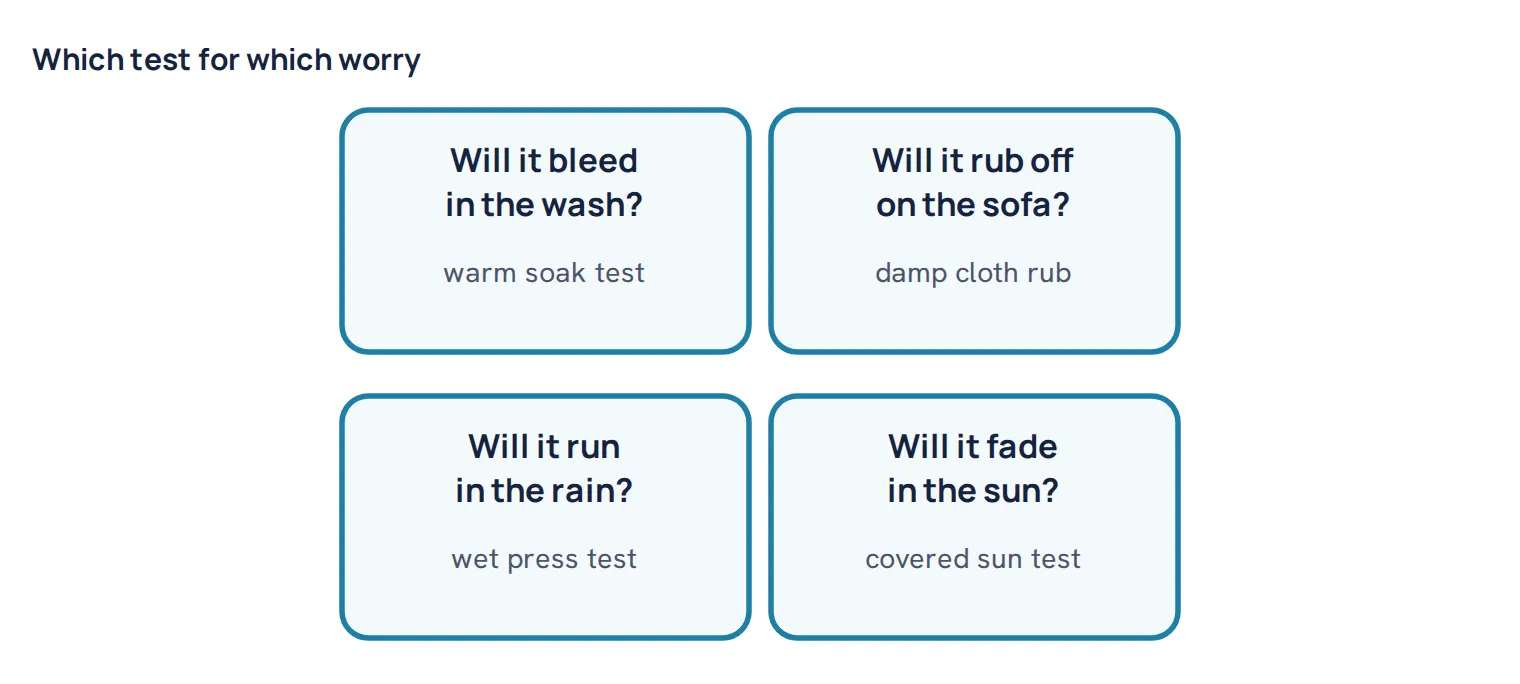
- Four quick home tests: dry and damp rub, wet press, warm soak and covered sun test.
- Each matches a lab test: rubbing, water, washing and light fastness.
- Always test on a hidden area with a plain white cotton cloth.
- The damp rub is the hardest test, just as wet rubbing is in the lab.
Questions
How do you test fabric for colourfastness?
Rub a damp white cotton cloth on a hidden area, and soak a hidden part with a white cloth strip in warm water with a little detergent. Colour on the cloth or in the water means the fabric is not fully colourfast.
How do I test clothes for colourfastness before washing?
Use the warm soak test: dip a hem and a white cotton strip in warm soapy water for 10–15 minutes. Coloured water or a stained strip means wash the item alone.
How do you check colour fastness of fabric for rubbing?
Rub a dry, then a damp, white cotton cloth ten times over a hidden area. A strong mark, especially when damp, means the colour may rub onto furniture and bags.
What is a good colourfastness grade?
Labs grade from 1 (poor) to 5 (excellent). Many buyers ask for 3–4 or 4 on wash staining and 3 or more on wet rubbing for deep shades.
Can colourfastness improve after washing?
Often yes. Loose dye comes out in the first washes, so bleeding and rub-off usually reduce after a few washes alone.

Textile engineer with 14+ years in dyeing and fabric development. He writes every guide on Dyeing Solution from real production work. Full profile