Why white and pastel knits turn lemon-yellow in poly bags, how the ISO 105-X18 test predicts it, why CVC blends failed in our lab reports, and how acidic pH, softener choice and BHT-free packing prevent it.
At a glance
50 °C, 16 hTest conditions under load, ISO 105-X18
Grade 4Most common requirement, varies by buyer
pH 5–6Target fabric extract pH for whites
2 of 5Our results that failed, both CVC
A white polo shirt leaves the factory bright and clean. Six weeks later the buyer opens the carton in a warehouse and finds a pale lemon-yellow tint along the folds and on the parts that touched the poly bag. Nobody spilled anything. The fabric was not dirty. The shirt has suffered phenolic yellowing, a slow chemical reaction between the fabric, its finish and the air and plastic around it during storage.
Because this kind of yellowing appears only after packing, long after the dye house has finished its work, buyers ask for a laboratory test that predicts it in advance. That test is ISO 105-X18. This article explains what the test is, how it is done, how to read the grade, why knit fabric fails it, and how to prevent and fix the problem. It is built on the phenolic yellowing results that appear in our own lab reports, so you can see what passing and failing look like in practice.
What phenolic yellowing is
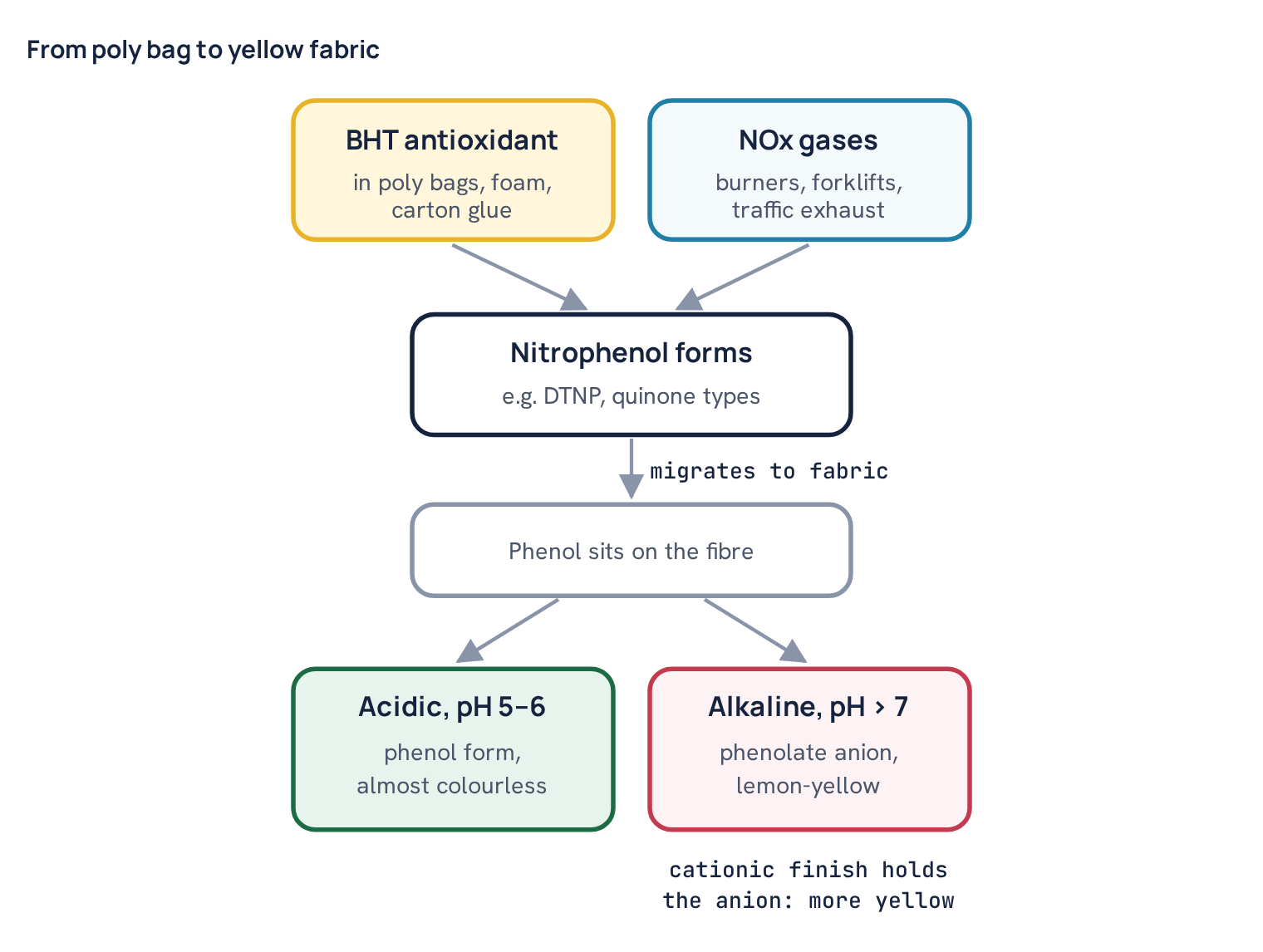
Phenolic yellowing is a yellow discolouration of textiles caused by certain phenol compounds. Phenols are a family of chemicals with an –OH group fixed on a benzene ring. Many phenols are used as antioxidants, which means they protect plastics and rubber from ageing. The most common one in packaging is BHT (butylated hydroxytoluene). It is added to polyethylene film, foam, cardboard adhesives and some rubber parts so that they do not become brittle.
BHT itself is almost colourless. The trouble begins when it meets nitrogen oxides, often written NOx. These gases are produced whenever fuel burns at high temperature: gas burners in stenters and dryers, gas or diesel forklifts in a warehouse, truck exhaust at loading docks, and city traffic. NOx reacts with BHT and turns it into nitrated phenols and quinone-type compounds. The best-known of these is 2,6-di-tert-butyl-4-nitrophenol, usually shortened to DTNP.
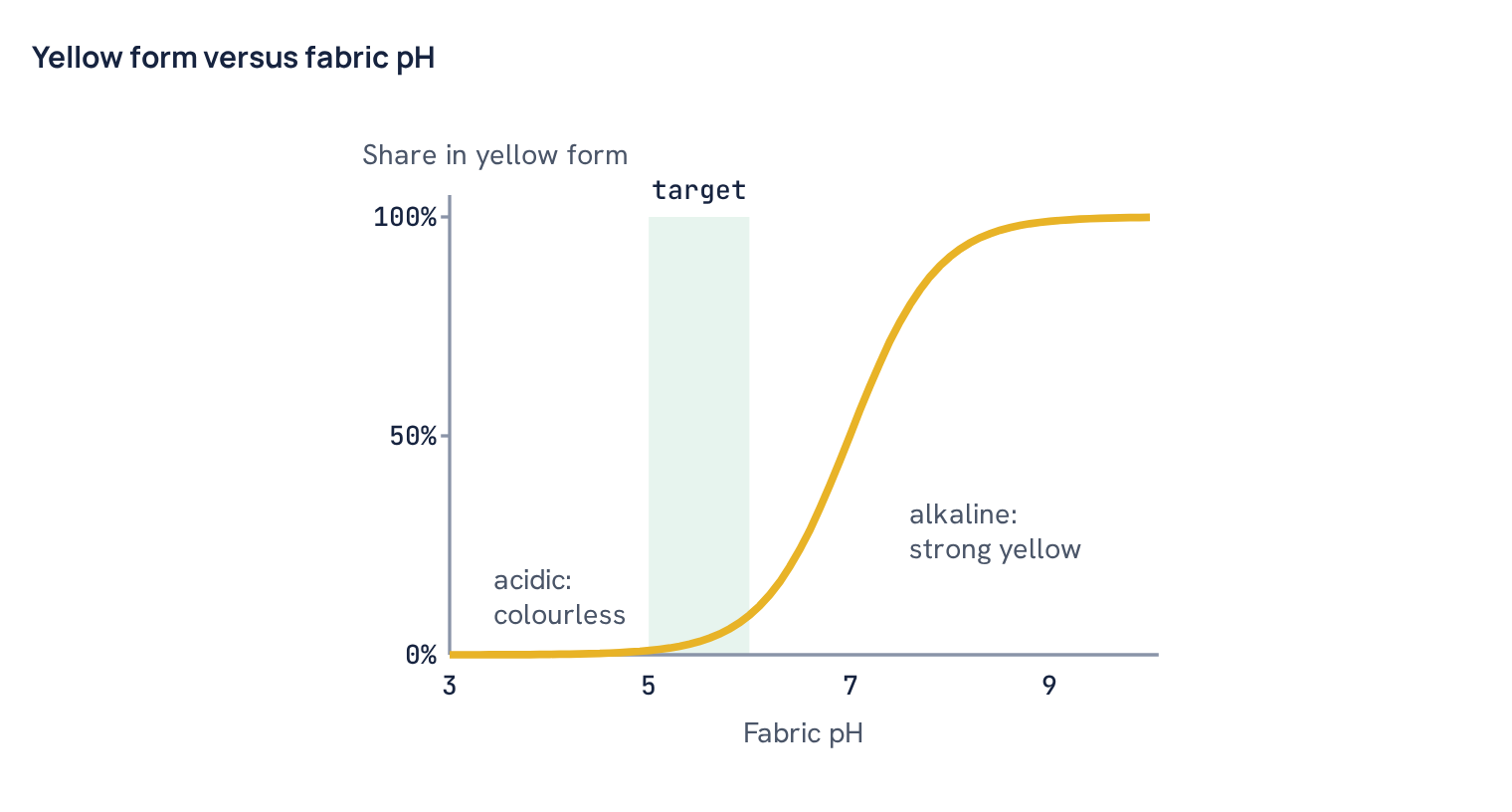
DTNP is a weak acid. In an acid or neutral environment it stays almost colourless. In an alkaline environment it loses a hydrogen ion and becomes a negatively charged ion, the phenolate, which is a strong lemon-yellow. This compound slowly moves out of the bag or carton, as vapour or by direct contact, and settles on the fabric. If the fabric is alkaline, or carries a finish that holds this anion, the yellow colour appears.
Other quinone-type products, such as stilbene quinones formed when two BHT units join, can also add yellow. For practical work you do not need to remember every structure. You only need the chain: antioxidant + NOx → yellow-capable phenol → yellow colour on alkaline or cationic fabric.
Why whites, pastels and polyester blends are sensitive
The amount of yellow compound involved is tiny, often only traces. On a navy or black shade you would never see it. On an optical white, a natural white or a pale pastel the same trace is clearly visible, because the eye is very sensitive to a yellow cast on a near-white surface. That is why buyers usually ask for this test on whites, ecru, light greys and pastel shades, and rarely on deep shades.
Optical brightening agents make the problem easier to see. An optical white looks blue-white because the brightener absorbs ultraviolet light and emits blue light. When a yellow layer forms, it cancels part of that blue, and the white suddenly looks flat and creamy. Some brighteners are themselves anionic and are applied with cationic aids, which can also hold the yellow phenolate. If you work on nylon whites, the article on nylon white optical brightening gives more background on how brighteners behave.
Fibre type matters too. BHT and its nitrated products are oily, water-hating molecules. They dissolve much more easily in synthetic fibres such as polyester, nylon and elastane than in cotton. Polyester behaves a little like a sponge for small non-polar molecules, which is the same property that lets disperse dyes enter it (see how disperse dyes work on polyester). Nylon is even more sensitive because it has amine end groups that can bind acidic phenols. So a CVC or PC blend, which has a polyester part, usually picks up more yellow-capable material than a 100% cotton fabric with the same finish.
Finally, the finish decides how much colour develops. Cationic softeners, amino-functional silicones and cationic fixing agents carry a positive charge. The yellow phenolate is negative. The two pair up, so the finish traps the yellow anion on the fibre surface. Fabric with residual alkali from scouring, bleaching or reactive dyeing gives the phenol the high pH it needs to turn yellow. A white CVC fabric with an alkaline final pH and a cationic softener is therefore close to the worst case.
The test: ISO 105-X18 in plain words
ISO 105-X18 is the international method for assessing the potential of a textile to show phenolic yellowing. The word “potential” is important. The test does not check whether yellowing has already happened. It deliberately exposes the fabric to a yellowing compound under warm, closed conditions and measures how strongly the fabric reacts. National versions, such as the EN and NF EN editions, follow the same principle, which is why reports often quote “NF EN ISO 105-X18”.
Principle
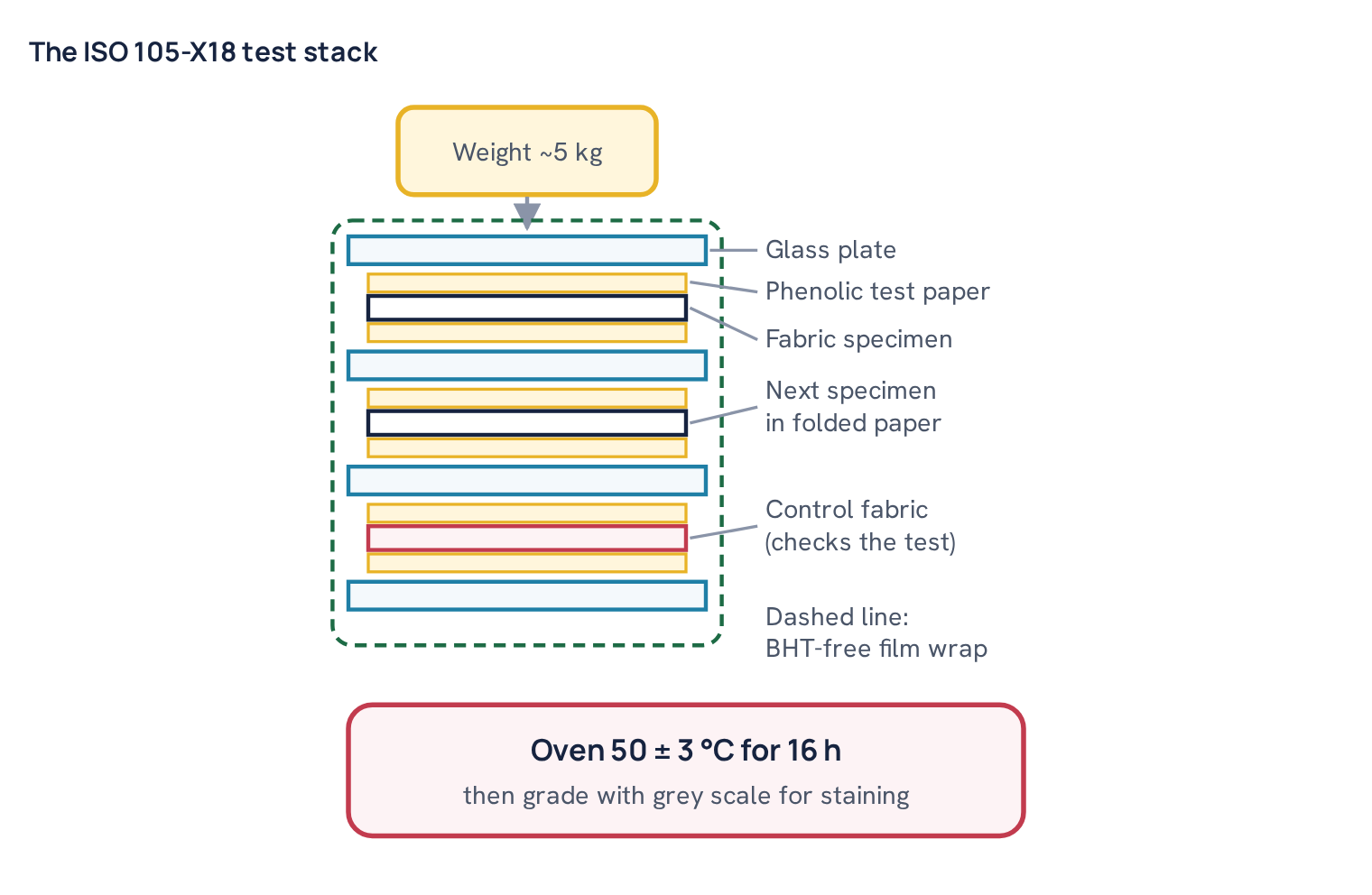
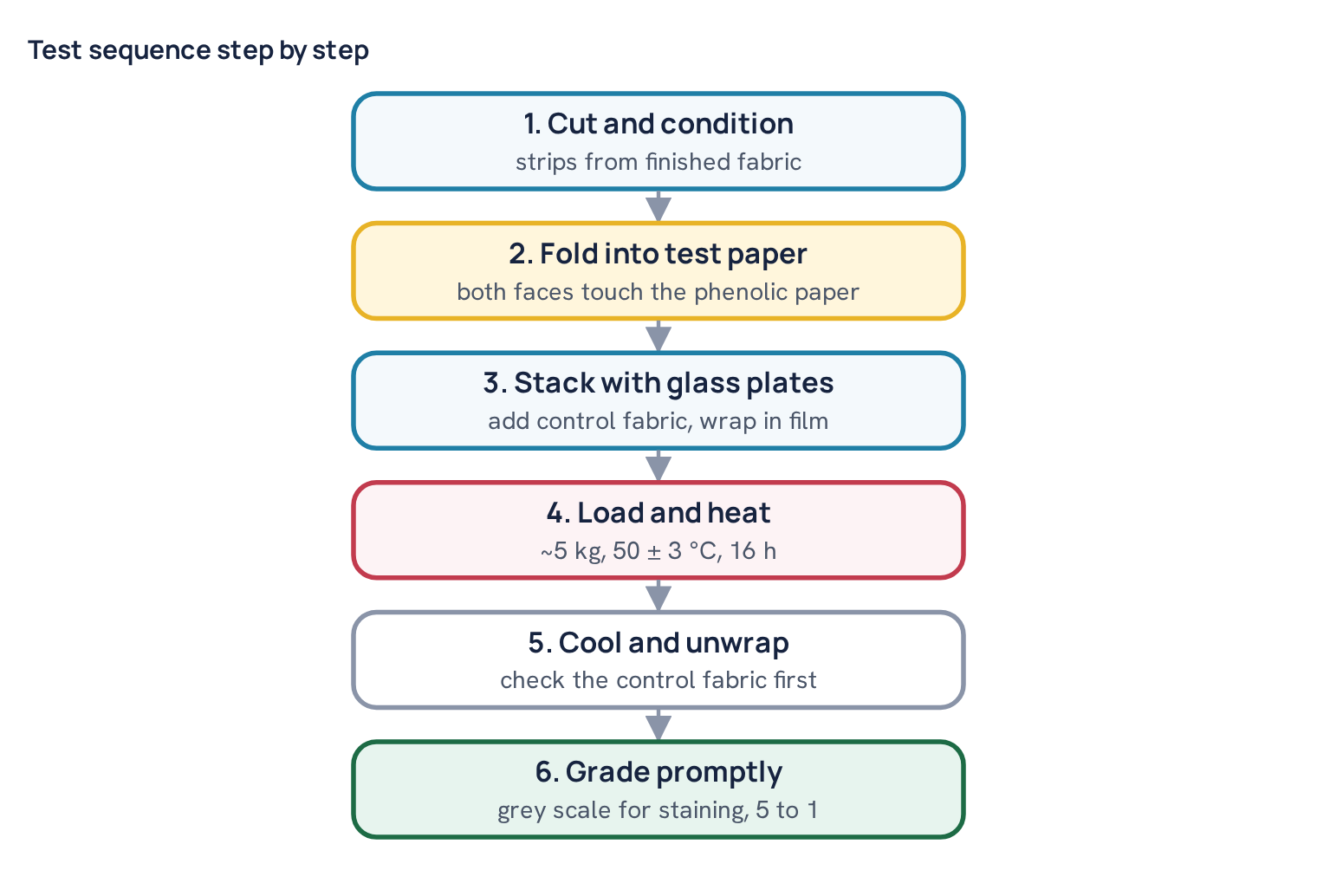
A strip of the fabric is placed in contact with a special test paper that has been treated with a phenolic compound of the DTNP type. The paper acts as a controlled source of the yellowing chemical. The fabric and paper are sandwiched between glass plates, wrapped in a film that is itself free of BHT, put under pressure and held in an oven at about 50 °C for 16 hours. The phenolic compound migrates into the fabric. If the fabric chemistry favours the yellow form, the specimen turns yellow.
Specimen and assembly
The specimens are small strips cut from the fabric, typically a few centimetres wide and about 10 cm long; the standard gives the exact size. Each specimen is placed inside a folded piece of test paper so that both faces touch the treated paper. The paper packet goes between glass plates. Several specimens can be built into one stack, together with a control fabric supplied with the test materials. The whole stack is wrapped in BHT-free polyethylene film so that no outside phenol or gas can interfere.
The stack is then placed in a frame similar to a perspiration tester and loaded with a weight, usually around 5 kg, so that the contact between fabric and paper is even. The loaded frame goes into an oven at 50 ± 3 °C for 16 hours. Our reports quote exactly these conditions, some with a time tolerance of plus or minus 15 minutes.
Assessment
After 16 hours the stack is removed, allowed to cool and opened. The specimens are compared with an untested piece of the same fabric under standard viewing light, using the grey scale for assessing staining. The grading should be done promptly, within a short time after opening, because the yellow colour can change once the fabric is exposed to air. Grade 5 means no visible change. Grade 1 means very strong yellowing. Half grades such as 3-4 are used between the main steps.
The control fabric is the safety check. It is designed to yellow to a known degree. If it does not reach the level stated in the standard, the test papers, the oven or the wrapping were not right and the result must not be used. Ask your lab to report the control result, or at least confirm that it was within limits.
Typical requirements
Requirements differ from buyer to buyer and sometimes from product to product within one buyer. The most common requirement we see is grade 4. Some programmes accept 3-4, especially for blends or for fabrics that are not white. Others ask for 4-5 on optical whites and baby wear. Always read the actual requirement on the test request or the report, and do not assume it from a previous order.
| Grade | What you see | Typical meaning (varies by buyer) |
|---|---|---|
| 5 / 4-5 | No change or a trace only | Pass for nearly all programmes |
| 4 | Slight yellow cast next to the original | Most common pass limit |
| 3-4 | Clearly visible but light yellowing | Pass for some blends; fail where 4 is required |
| 3 | Obvious yellow | Usually a fail |
| 2-3 and below | Strong lemon-yellow | Fail; also a real risk in storage |
What our lab reports show
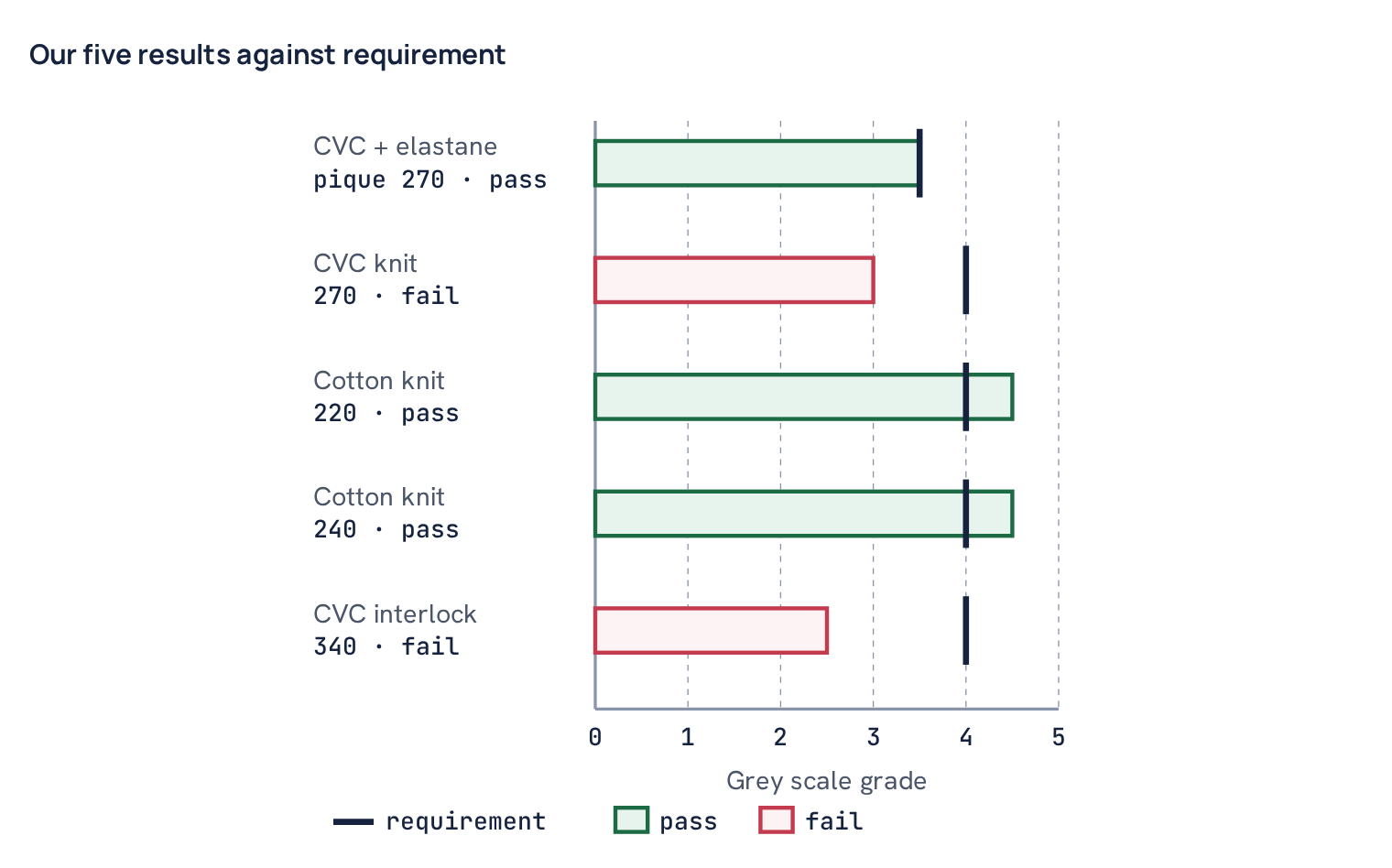
Among the knit lab reports that reached our desk, five contain a phenolic yellowing result. That is a small set, and it is skewed: reports usually reach our desk because there is a question or a problem, so the fail rate here is higher than in normal production. Read these numbers as examples, not as statistics.
Two of the five results failed, and both were cotton-polyester (CVC) fabrics. A 270 g/m² CVC knit scored grade 3 against a requirement of 4. A heavy 340 g/m² CVC interlock scored 2-3 against a requirement of 4, the worst result in the set. A 270 g/m² CVC pique with elastane scored 3-4 and passed only because its requirement was 3-4; against the more common limit of 4 it would also have failed. The two 100% cotton fabrics, at 220 and 240 g/m², both scored 4-5 and passed easily.
So in our reports every blend sat at 3-4 or lower, while both cotton fabrics sat at 4-5. This fits the chemistry described above: the polyester part of a blend takes up more phenolic compound. With five results we cannot say whether the heavier interlock failed because of its weight, its finish or its pH. The safe conclusion is simpler: treat light-coloured CVC and PC knits as high-risk for this test, and check them before shipment.
Worked example. A report for a white-ground CVC interlock reads: “ISO 105-X18, 50 ± 3 °C, 16 h. Result 2-3. Requirement 4. Fail.” First, check that the conditions match the standard, which they do. Second, ask whether the control fabric was within limits; if the lab confirms it, the test is valid. Third, measure the gap: 2-3 against 4 is one and a half grades, which is a large failure and not a borderline one. Fourth, check the fabric itself. Suppose the extract pH of the finished fabric is 8.2 and the finish recipe contains a cationic softener. Both point to the chemistry described above. The plan is an acid re-rinse to bring the fabric to pH 5–6, refinishing with a softener that has low phenolic yellowing risk, and a repeat test before shipment. If the result had been 3-4 against 4, a pH correction alone might have been enough.
Why knit fabric fails: the pH effect
Of all the factors, fabric pH is the strongest and the easiest to control. Because DTNP is a weak acid with a dissociation point around neutral, a small change in pH makes a large change in colour. At pH 5 almost all the compound is in the colourless phenol form. At pH 8 most of it is in the yellow phenolate form. The exact switching point varies with the compound and the fibre surface, but the direction never changes.
In knit processing, alkali enters the fabric at many stages: caustic scouring, peroxide bleaching with soda or caustic, reactive dyeing with soda ash, and soaping. If the final neutralisation is weak or the last rinse uses alkaline water, the fabric leaves the machine at pH 7.5–9. Open-width compaction and drying do not remove that alkali. A heavy interlock or fleece holds more liquor and is harder to rinse through, so it can keep more residual alkali than a light single jersey.
Common mistake: Checking the pH of the last bath and assuming the fabric has the same pH. The bath can read 6 while the fabric extract reads 8, because alkali is still trapped inside the yarn. Measure the fabric extract pH, by the standard aqueous extract method, on finished fabric.
Causes at a glance
| Cause | Why it raises yellowing | Typical sign |
|---|---|---|
| Alkaline final fabric pH (above about 7) | Turns the nitrophenol into its yellow phenolate form | Fail on all lots from one process route |
| Cationic softener or amino silicone | Holds the yellow anion on the fibre surface | Fail starts after a softener change |
| Cationic fixing or anti-static agent | Same ion-pairing effect as cationic softener | Fail on fixed whites or pastels |
| Optical brightener and its aids | Yellow cancels the blue fluorescence; some aids are cationic | Optical whites fail more than natural whites |
| Polyester, nylon or elastane content | Synthetic fibres absorb the oily phenols | Blends fail where cotton passes |
| BHT-containing poly bags and foam | Supply the phenol in storage | Yellow at folds and bag contact areas |
| NOx exposure | Converts BHT into the yellow-capable form | Worse near forklifts, docks, gas dryers |
| Long, warm storage | More time and heat for migration | Problem appears after shipping in hot season |
Prevention: control it from rinse to carton
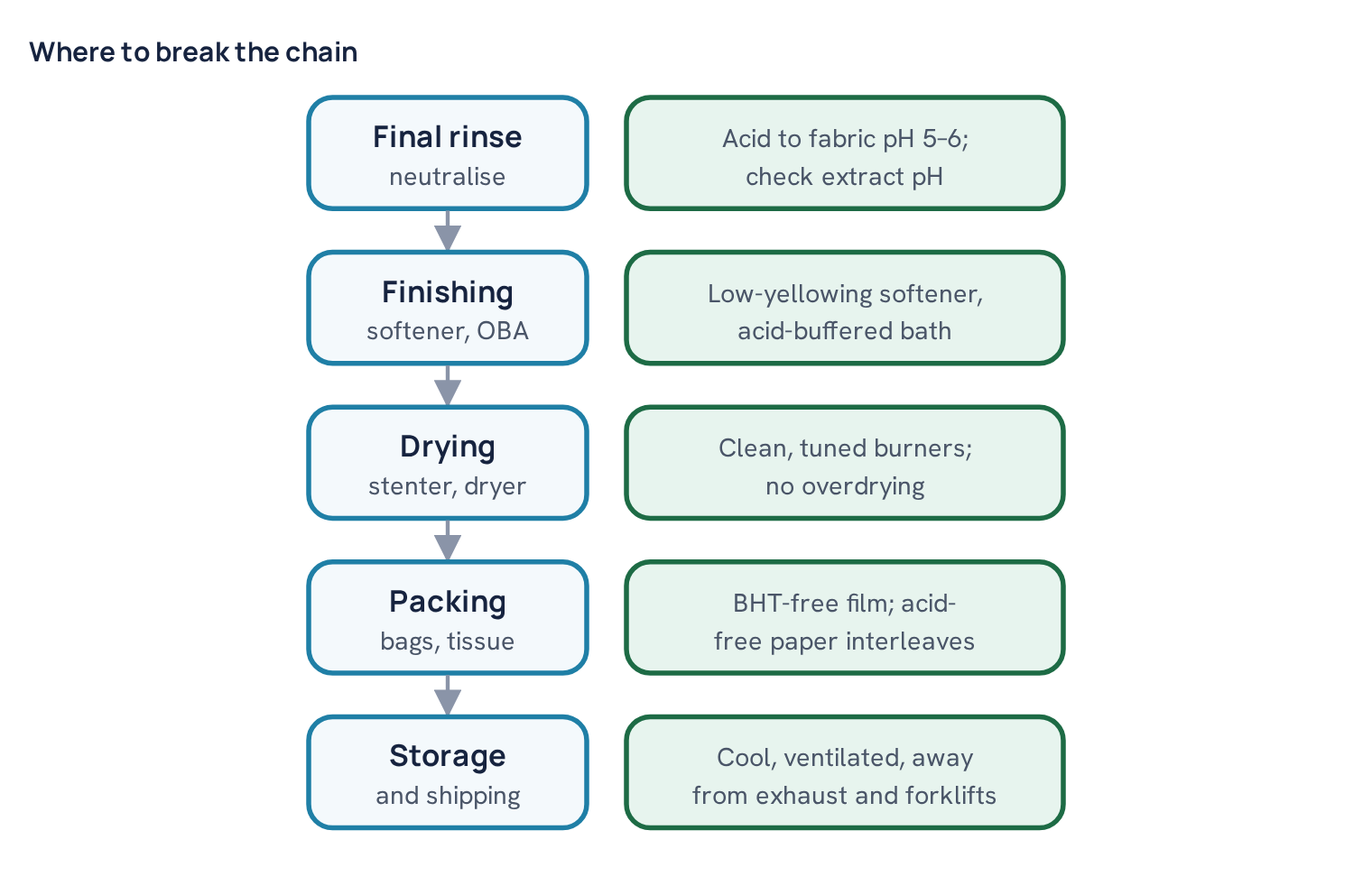
Phenolic yellowing is a chain. Breaking any link helps, but the dye house controls the strongest links: pH and finish. Packing and storage are the next line of defence, and they also matter for garments that will never be lab-tested.
1. Finish at an acidic pH
The single most effective step is to bring the finished fabric to a pH of about 5 to 6, measured on the fabric extract. Use an acid rinse with acetic or citric acid after the last soaping, and add an acid or acid donor to the softener bath so the fabric leaves finishing slightly acidic. Many buyers already ask for a fabric pH between about 4.5 and 7.5 for skin contact, so aiming at 5–6 keeps you inside that window as well. Do not overshoot below about 4.5, because very low pH can harm handle and some dyes, and can itself be a compliance fail.
Common mistake: Neutralising only to “about 7”. That is exactly where the yellow form starts to grow. For whites and pastels, neutral is not enough; slightly acidic is the target.
2. Choose the softener and auxiliaries with care
Ask your chemical supplier for softeners that are tested and declared low in phenolic yellowing risk. In general, nonionic softeners, weakly cationic softeners designed for whites, and some hydrophilic silicones give lower risk than strongly cationic fatty softeners or high-amine silicones. Check fixing agents, anti-static agents and anti-slip agents in the same way, because any strongly cationic product can hold the yellow anion. Some suppliers offer an anti-phenolic-yellowing agent; these are usually acidic or buffering products added in the finishing bath. They help, but they do not replace correct pH control. The article on dyeing auxiliaries explains the main chemical families.
Common mistake: Changing to a cheaper or softer-handle softener during bulk without retesting phenolic yellowing. A softener change is one of the most common reasons a fabric that passed at development fails at production.
3. Choose the optical brightener and its aids
For optical whites, select brighteners that suit the fibre and the pH of finishing, and avoid strongly cationic aids where you can. Keep the brightener dose sensible: overloading does not make a whiter white, it only increases the risk of a dull or yellowish cast. For CVC whites the polyester part is often brightened with a disperse-type brightener and the cotton part with an anionic one; follow the route in your CVC dyeing process and keep the final pH acidic.
4. Control the stenter and dryer
Direct gas-fired stenters produce NOx in the drying chamber. Poorly tuned or dirty burners produce more. NOx can also cause a separate yellowing of whites called gas fume yellowing. Keep burners clean and correctly adjusted, maintain good exhaust, and avoid overdrying or excessive temperatures on whites and blends. On 100% polyester knits, high heat-setting temperatures also bring spinning oils to the surface, so a clean scour before heat setting helps.
5. Packing and storage
Ask the garment unit and the packing supplier for BHT-free polybags, foam and tissue. Many packaging suppliers now offer antioxidant-free or non-phenolic film, and some buyers require it. Where a bag is unavoidable, paper interleaves between garment and film reduce direct contact. Store finished fabric and garments in cool, dry, ventilated areas, away from loading docks, generator exhaust and gas or diesel forklifts. Electric forklifts are the better choice for white goods. Shorter storage time is always safer.
Prevention checklist
- Measure finished fabric extract pH on every white, pastel and light blend lot; target 5–6.
- Use an acid rinse after soaping and an acid or acid donor in the softener bath.
- Approve softeners, silicones, fixing agents and brightener aids for low phenolic yellowing before bulk use.
- Retest ISO 105-X18 whenever the softener, brightener, finishing route or packing film changes.
- Treat CVC, PC, nylon and elastane blends as high-risk; test them before shipment, not after.
- Keep stenter burners clean and tuned, and do not overdry whites.
- Specify BHT-free polybags and foam; use paper interleaves where film touches white fabric.
- Store away from exhaust gases, keep areas ventilated, and limit storage time in hot seasons.
- Ask the lab to confirm the control fabric result with each report.
What to do with a failed batch
A phenolic yellowing fail is usually recoverable at fabric stage, because the cause is in the surface chemistry, not in the dye. Follow these steps in order.
- Confirm the test. Check the conditions on the report and ask whether the control fabric was within limits. If there is any doubt, request a retest before reprocessing.
- Measure the fabric. Take the extract pH of the failed lot and a retained sample. Check the finishing recipe for cationic softener, amino silicone, fixing agent or a recent product change.
- Run a lab trial first. Take a fabric sample, give it an acid rinse to pH 5–6, and refinish with a low-yellowing softener in an acid-buffered bath. Send the trial for ISO 105-X18 before treating the bulk.
- Reprocess the bulk. If the trial passes, rinse the lot with dilute acetic or citric acid, refinish with the approved softener at the corrected pH, dry with clean burners and recheck extract pH.
- Check side effects. Recheck shade, whiteness, handle, and other properties the buyer requires, especially wash fastness if a fixing agent was removed, and shrinkage after the extra wet pass.
- Retest and record. Send the reprocessed lot for a new ISO 105-X18 test. Record the cause and the fix so the same route is not used again for this quality.
If yellowing has already appeared on garments in storage, the colour is often in the alkaline phenolate form and can fade when the goods are washed or rinsed in a mildly acidic bath, because the phenol returns to its colourless form. This rescue does not remove the source. Repack the goods in BHT-free film and move them away from exhaust gases, or the yellow will come back. If the yellow does not respond to acid at all, suspect a different cause, such as oxidised softener, overheating or gas fume yellowing of a brightener, and investigate separately.
Common mistake: Bleaching or adding more optical brightener to cover a phenolic yellowing fail. It may make the fabric look whiter for a day, but the alkaline pH and cationic finish that caused the fail are still there, and the retest will fail again.
Practical notes for blends and heavy knits
Our results point to CVC and PC as the fabrics to watch. In these blends, the polyester part takes up the phenol while the cotton part often carries most of the softener and residual alkali. So both halves contribute. Heavier constructions such as interlock, fleece and pique hold more water and chemical, which makes thorough rinsing and correct pH more difficult. Give them extra rinse time or an extra acid rinse, and measure extract pH on the thickest part of the fabric. If you develop these qualities, the pique fabric development guide covers other points that matter at the development stage.
Elastane adds its own risk. It is a synthetic polymer that also absorbs phenols, and it is often finished with silicone-based lubricants. When a blend with elastane is borderline, as one of ours was at 3-4, a small improvement in pH or a change of softener is usually enough to move it to grade 4.
Remember that the test measures potential. A fabric that passes can still yellow if it is packed in BHT-rich film and stored for months next to a diesel forklift. A fabric that fails will not always yellow in real life, but it carries a much higher risk. The goal of the dye house is to send out fabric that resists the chemistry, and the goal of the supply chain is to keep the chemistry away from the fabric. When both do their part, phenolic yellowing becomes rare.
Questions
What causes phenolic yellowing on fabric?
BHT antioxidant from polybags, foam or carton glue reacts with nitrogen oxides from burners and exhaust to form nitrophenols. On alkaline fabric, or fabric with cationic finishes, these turn into a yellow anion.
How is ISO 105-X18 done?
Fabric strips are folded into a test paper treated with a phenolic compound, stacked between glass plates, wrapped in BHT-free film, loaded and held at about 50 °C for 16 hours. The yellowing is then graded with the grey scale for staining, and a control fabric confirms the test worked.
What grade is a pass for phenolic yellowing?
Grade 4 is the most common requirement. Some buyers accept 3-4 for blends and some ask 4-5 for optical whites, so always check the actual requirement.
Why do CVC and polyester blends fail more than cotton?
BHT and its nitrated products are oily molecules that dissolve more easily in polyester, nylon and elastane than in cotton. Blends therefore pick up more yellow-capable compound.
Can a failed batch be corrected?
Usually yes. An acid rinse to fabric pH 5–6 and refinishing with a low-yellowing softener in an acid-buffered bath often brings the result up to grade 4, but confirm with a lab trial and a retest.

Textile engineer with 14+ years in dyeing and fabric development. He writes every guide on Dyeing Solution from real production work. Full profile