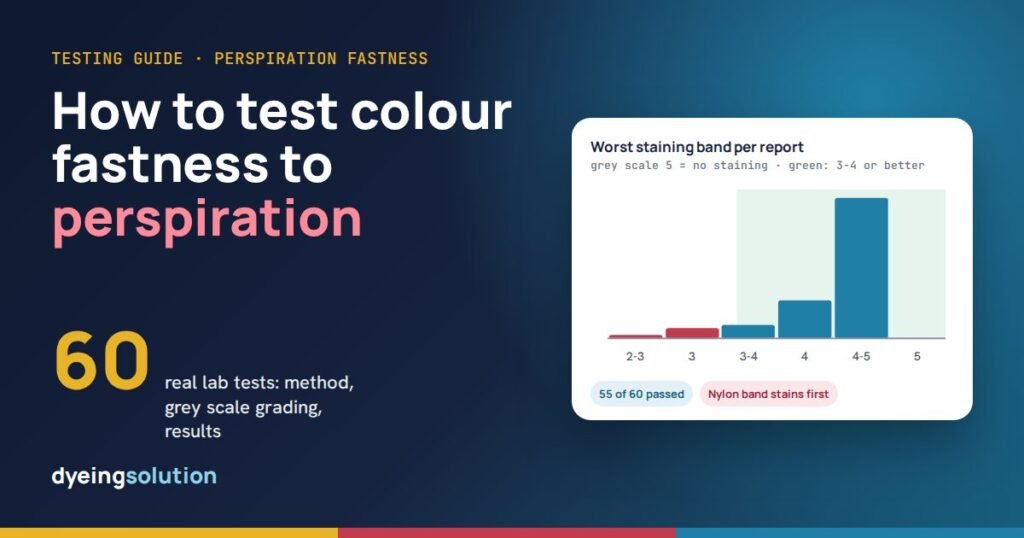
How the lab tests colour fastness to perspiration (ISO 105-E04) in acid and alkaline solution, step by step, how it is graded, and what 60 real lab tests showed.
About this guide. The method below is written from the public ISO and AATCC standards in plain words. The data comes from our own lab reports on 95 new knit developments, each tested by an accredited lab to the buyer’s standard, so you can see what real results look like.
At a glance
60Perspiration tests in our data
91%Passed
37°C × 4 hTest condition
Acid + alkalineBoth tested
What the test measures
Colour fastness to perspiration shows whether sweat makes a fabric lose colour or stain the fabric next to it: a dark T-shirt marking a white collar, or a coloured lining staining the skin side of a shirt. Sweat can be acid or alkaline, so the test is done with both.
Equipment
- A perspirometer: a frame that holds specimens between glass or acrylic plates under a set pressure (12.5 kPa).
- An oven at 37 ± 2°C.
- Artificial perspiration solutions, acid (pH 5.5) and alkaline (pH 8.0), made with histidine, salt and phosphate as the standard describes.
- Multifibre adjacent fabric, the grey scales and a viewing cabinet.
How the test is done, step by step (ISO 105-E04)
- Prepare two composite specimens, each 100 × 40 mm of fabric sewn to the same size of multifibre strip: one for acid, one for alkaline.
- Soak each composite in its solution for 30 minutes at room temperature, at a liquor ratio of 50:1, so it is fully wetted.
- Remove the excess solution by drawing the specimen between two glass rods.
- Press each composite between plates in the perspirometer under 12.5 kPa.
- Keep the loaded perspirometer in the oven at 37 ± 2°C for 4 hours.
- Separate and dry the fabric and strip, touching only at the stitching, at no more than 60°C.
- Assess colour change and staining for the acid and the alkaline specimen separately.
Grading: the two grey scales
Two results are reported. Colour change compares the tested specimen with an untested piece of the same fabric, using the grey scale for colour change. Staining compares each band of the multifibre strip with an unused strip, using the grey scale for staining. Both run from 5 (no change, no staining) to 1 (severe), in half grades, and are assessed in a viewing cabinet under daylight (D65).
The multifibre strip has six bands: acetate, cotton, nylon, polyester, acrylic and wool. Each band shows whether the dye that came off would mark that kind of fibre in a mixed wash or in a garment made of different fabrics.
Some of our reports used the AATCC version (AATCC 15), with an acid solution only, at 38°C for 6 hours.
Example result. “Change 4 (acid), 4 (alk); staining acid: nylon 3, polyester 3; alk: nylon 3, polyester 3-4.” Against a minimum of staining 3-4, it fails on nylon and polyester.
What real results look like
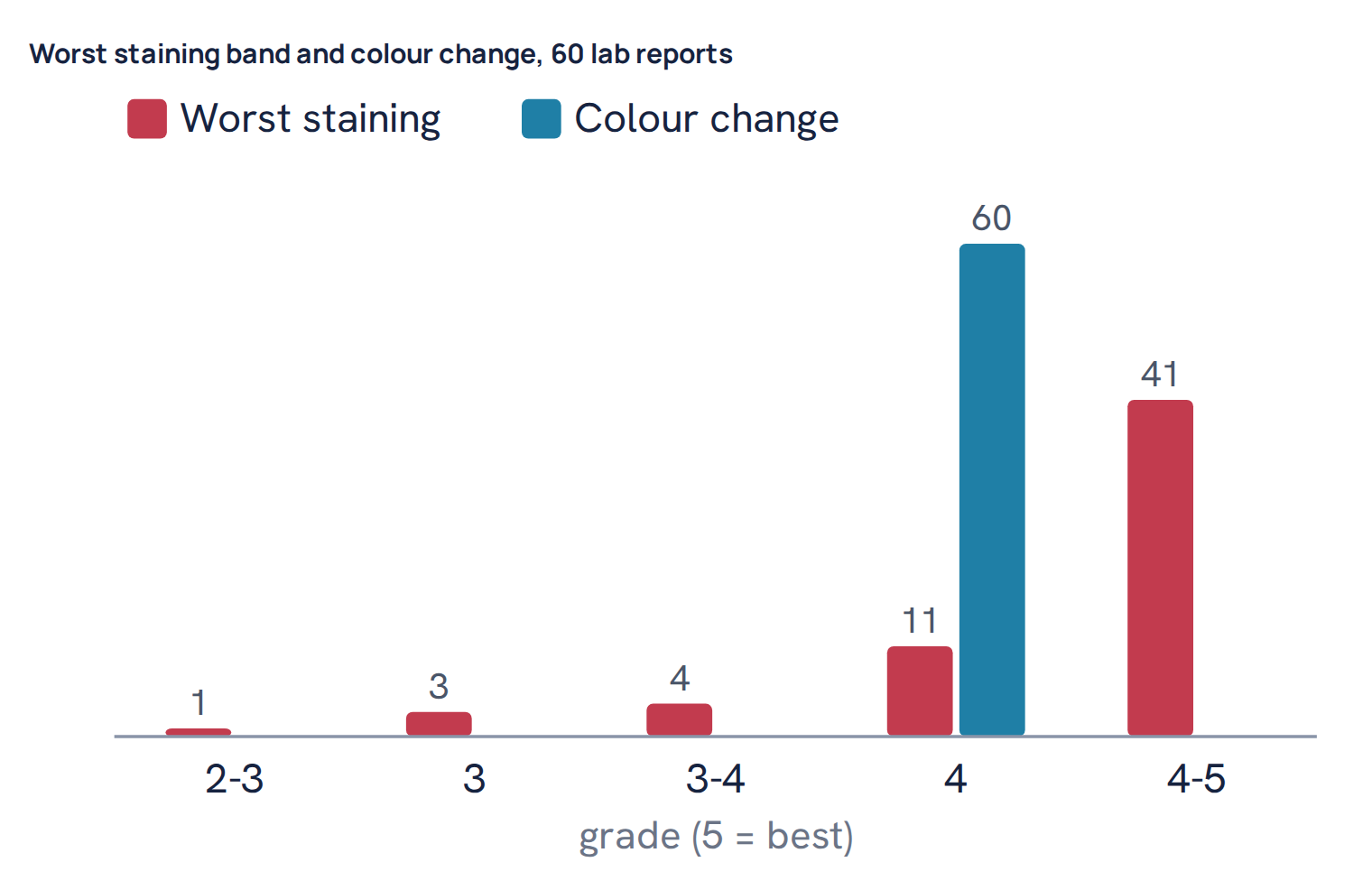
55 of 60 batches passed. Colour change rarely decides the result; it is the staining, usually on the nylon band, that fails.
| Fabric | Failed |
|---|---|
| With polyester | 4 of 25 |
| Without polyester | 1 of 35 |
Fabrics with polyester fail more often: the disperse dye on the polyester part stains nylon, polyester and acetate if it is not fully reduction cleared, or if the fabric is finished too hot and the dye moves back to the surface.
If a batch fails, see why knit fabric fails staining: 9 real cases.
Common mistakes that change the result
- Using old perspiration solution: its pH drifts, so make it fresh.
- Leaving too much solution on the specimen before pressing.
- Wrong pressure in the perspirometer, or plates not evenly loaded.
- Reporting only the acid result when the buyer asks for both.
From the floor
- In perspiration fastness, colour change was never the problem; staining was.
- If the fabric gets a proper hot wash and hot soaping before it is unloaded, it passes. We use high-quality dyes from leading makers, so with a proper wash-off the chance of a perspiration fail is very low.
Questions
Why is perspiration fastness tested with acid and alkaline solutions?
Human sweat can be either, and some dyes bleed more in one than the other, so both are tested.
How long is the perspiration fastness test?
4 hours at 37°C under 12.5 kPa in ISO 105-E04; the AATCC version runs 6 hours at 38°C.
What is a pass for perspiration fastness?
Most buyers ask for colour change 3-4 or 4 and staining 3-4.

Textile engineer with 14+ years in dyeing and fabric development. He writes every guide on Dyeing Solution from real production work. Full profile