GSM and shrinkage are the knit fabric tests that fail most: 42% and 39% of results in our 744 lab reports. Fail rates for every test, broken down by fibre and fabric structure, with what each result means for development and how to avoid the common failures.
At a glance
744lab reports
42%GSM fails
39%shrinkage fails
4%pilling fails
Fabric weight (GSM) and shrinkage are the tests knit fabrics fail most: 42% and 39% of results in our 744 lab reports. Fibre content came next at 19%, then bursting strength and rubbing fastness at 15% each. Pilling, spirality and pH almost never failed. The fibre and the fabric structure explain most of the differences: viscose blends failed fibre content and bursting far more often than cotton, and fleece and terry failed rubbing about twice as often as average.
This study pulls together every lab test report we have on new knit fabric developments: 744 reports, 5,719 individual test results. It shows which tests fail, for which fabrics, and what that means for anyone developing, buying or approving knit fabric. Each section links to our detailed guide on how that test is done and how to fix a failure.
What is in the data
Every report is a lab test report on a new knit fabric or garment sample, tested against the buyer’s requirements before bulk production. We read the conclusion table of each report, recorded each test as pass or fail, and grouped the reports by fibre and fabric construction. Duplicate reports were counted once, keeping the amended version where a report was reissued.
| Fibre group | Reports |
|---|---|
| 100% cotton | 318 |
| Cotton-polyester (CVC, PC) | 190 |
| Cotton-elastane | 88 |
| Viscose, modal or lyocell blends | 65 |
| CVC or PC with elastane | 41 |
| Other (polyester, nylon, 100% viscose and unknown) | 42 |
By construction, the largest groups were single jersey (143), rib (108), interlock (57), fleece (57), terry (36), pique (33) and waffle (29); 204 reports did not state the structure clearly. Not every report includes every test, so each fail rate below is out of the reports that ran that test.
Which fabric tests fail most
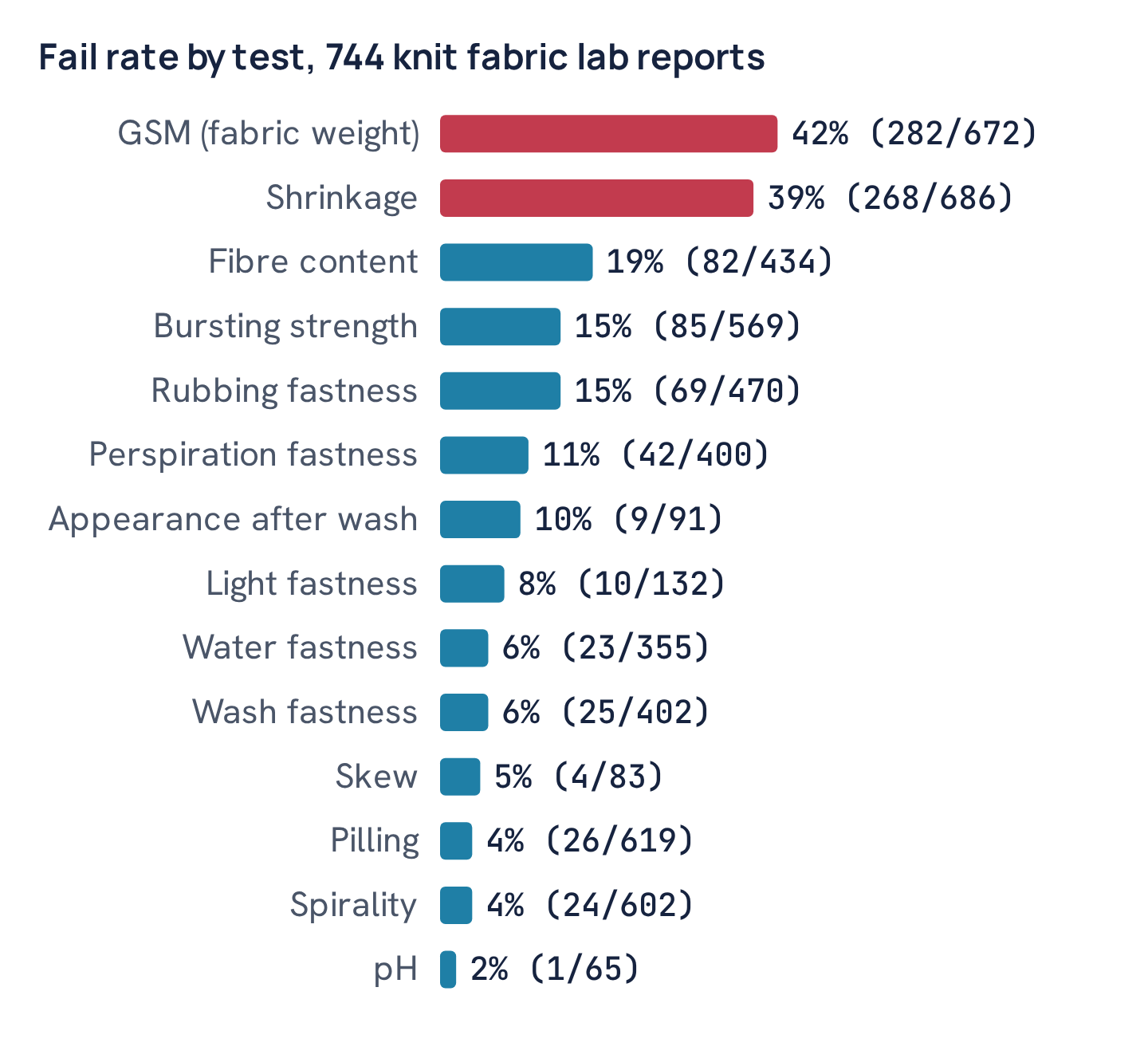
The top two are both about dimensions and weight, not colour. That matches what we see in development: a fabric can look perfect and still be rejected because it is 9% too light or shrinks 7% in the wash. Colour fastness tests, by contrast, failed in only 6–11% of reports, because modern reactive and disperse dyeing is well controlled when the recipe and wash-off are right.
A few rare tests were run on fewer than ten reports each: snagging, phenolic yellowing, chlorine fastness and hot pressing. Their fail rates were high, but the numbers are too small to draw conclusions from.
GSM: 42% of results failed
GSM was tested in 672 reports and failed in 282. The misses went both ways. Of the results we could compare with the declared weight, 139 were more than 5% light (median 9.3% under) and 149 were more than 5% heavy (median 10% over). The overall median was almost exactly on target, at 0.5% under. In other words, the process is centred, but the spread is too wide for a ±5% tolerance.
By fibre, CVC with elastane failed GSM most often (54%), then cotton-elastane (45%), viscose blends (43%), CVC (40%) and cotton (37%). Elastane fabrics are hardest to hit because their final weight depends on how much they relax and how they are heat set. Bonded interlock and ottoman rib, both heavy, complex structures, failed in 7 of 10 and 6 of 9 reports.
See how GSM is tested and why knit fabric fails the GSM test.
Shrinkage: 39% of results failed
Shrinkage failed in 268 of 686 reports. The median length shrinkage after one wash was 2.4%, but the tail is what fails a test.
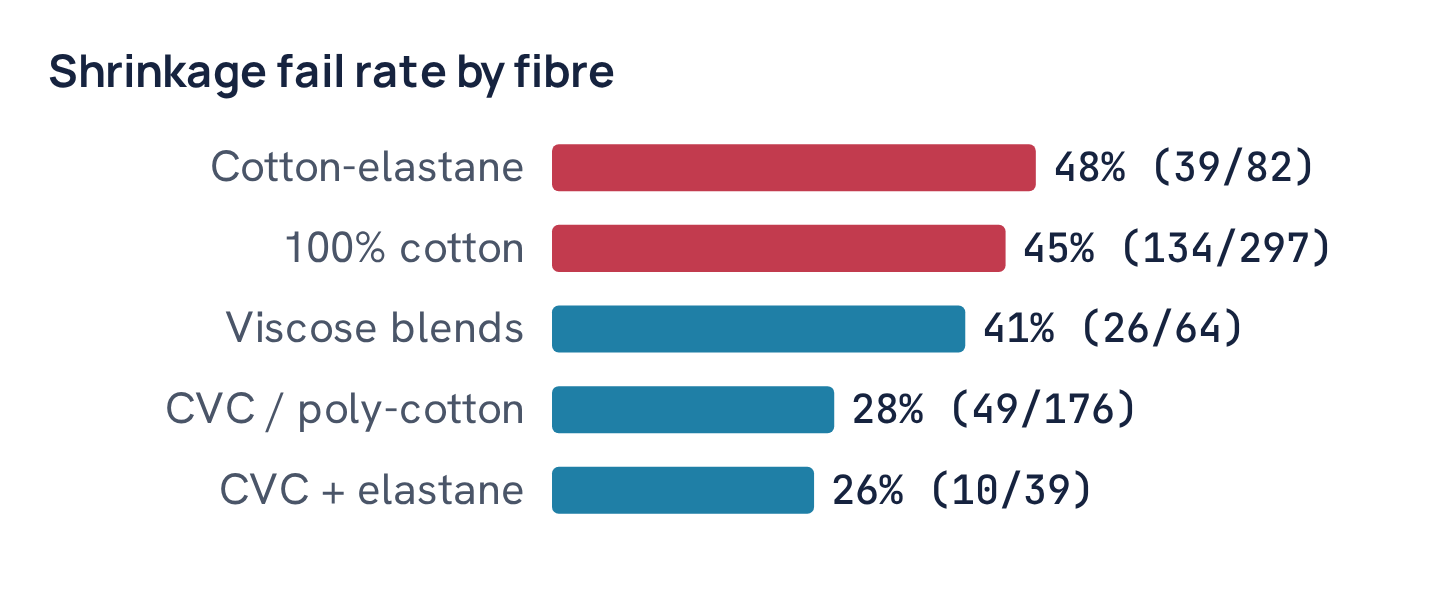
Drying method made a clear difference: 50% of tumble-dried shrinkage tests failed, against 37% of line-dried ones. By structure, pique failed most (47%) and bonded interlock and ottoman rib least. See how shrinkage is tested, why knit fabric fails the shrinkage test and our larger study of finishing records, GSM and shrinkage by fibre in 14,000 knit batches.
Fibre content: 19% failed, mostly blends
A fibre content test checks that the fabric contains what the label says, within a tolerance. It failed in 82 of 434 reports, but the failures were concentrated in blends:
| Fibre group | Failed | Fail rate |
|---|---|---|
| CVC or PC with elastane | 7 of 16 | 44% |
| Viscose, modal or lyocell blends | 15 of 37 | 41% |
| Cotton-polyester (CVC, PC) | 29 of 109 | 27% |
| 100% cotton | 17 of 207 | 8% |
| Cotton-elastane | 2 of 44 | 5% |
Blend ratios drift at the spinning stage, elastane content changes with feed tension and fabric relaxation, and some fibres are lost or gained in processing. A label declared from the yarn order rather than from a test of the finished fabric is the usual cause. See how fibre content is tested and why fibre content tests fail.
Bursting strength: 15% failed
Bursting strength failed in 85 of 569 reports; the median result was 194 kPa. The weak fabrics were the softest ones: viscose blends failed in 35% of reports and cotton-elastane in 27%, against 13% for cotton and 6% for CVC, where polyester adds strength. Waffle structures failed in 27%. See how bursting strength is tested and why knit fabric fails bursting strength.
Rubbing fastness: 15% failed, and fleece and terry most
Rubbing (crocking) failed in 69 of 470 reports. Across 402 graded results, the median was grade 4.5 dry and 3.5 wet, so wet rubbing is almost always the one that fails. Raised and looped surfaces were the weak point: 35% of fleece and 32% of terry reports failed, against 12% for single jersey and 7% for rib. Loose fibre ends and loops carry more surface dye that rubs off. See how rubbing fastness is tested and why knit fabric fails wet rubbing.
Colour fastness: perspiration, water, wash and light
| Test | Failed | Fail rate |
|---|---|---|
| Perspiration | 42 of 400 | 11% |
| Appearance after washing | 9 of 91 | 10% |
| Light | 10 of 132 | 8% |
| Water | 23 of 355 | 6% |
| Washing | 25 of 402 | 6% |
Perspiration fastness failed mainly on cotton-polyester blends: 18% of CVC reports and 19% of CVC with elastane, against 5% for 100% cotton. In a blend, staining usually comes from disperse dye left on the polyester or migrated during hot finishing, so reduction clearing and finishing temperature matter. Fleece also stood out at 21%. See perspiration fastness, wash fastness, water fastness, light fastness and why knit fabric fails staining tests.
Pilling, spirality, skew and pH: rarely a problem
- Pilling failed in only 26 of 619 reports (4%). CVC was the weak group at 10%, because polyester fibres hold pills on the surface; fleece failed in 12%. See how pilling is tested and why fleece and terry fail pilling.
- Spirality failed in 24 of 602 reports (4%), but terry failed in 18%, and 100% cotton single knits more often than blends. See how spirality is tested and spirality fails.
- Skew failed in 4 of 83 reports. See the skew test.
- pH failed in 1 of 65 reports. See how fabric pH is tested.
What fails by fibre
| Fibre | Most likely fails | Usually safe |
|---|---|---|
| 100% cotton | Shrinkage 45%, GSM 37% | Fibre content 8%, pilling 3% |
| Cotton-elastane | Shrinkage 48%, GSM 45%, bursting 27% | Fibre content 5%, pilling 0% |
| CVC or PC | GSM 40%, shrinkage 28%, fibre content 27% | Bursting 6%, spirality 2% |
| CVC or PC with elastane | GSM 54%, fibre content 44% | Pilling 3%, spirality 3% |
| Viscose, modal or lyocell blends | GSM 43%, shrinkage 41%, fibre content 41%, bursting 35% | Rubbing 3%, perspiration 3% |
What fails by fabric structure
| Structure | Watch for |
|---|---|
| Single jersey | Shrinkage 42%, GSM 41% |
| Rib | GSM 45%, shrinkage 41% |
| Interlock | GSM 47%, shrinkage 43%, fibre content 28% |
| Pique | GSM 50%, shrinkage 47% |
| Fleece | Rubbing 35%, perspiration 21%, pilling 12% |
| Terry | Rubbing 32%, spirality 18% |
| Waffle | GSM 54%, bursting 27% |
What this means if you develop or buy knit fabric
- Fix the weight and the shrinkage first. Most rejections are dimensional. Agree the finished GSM and the wash and drying method before knitting, then set stitch length, finishing width and compaction for that target.
- Test the blend, not the yarn order. For CVC, viscose blends and anything with elastane, declare the fibre content from a test of the finished fabric.
- Expect weaker bursting on soft fibres. Viscose blends and cotton-elastane need enough GSM and a suitable structure to pass.
- Plan wet rubbing for fleece and terry. Dark shades on raised and looped fabrics need a thorough wash-off and the right finishing.
- Control finishing temperature on polyester blends. Hot finishing can make disperse dye migrate and fail perspiration and staining tests.
Worked example. A developer plans a 95/5 viscose-elastane single jersey at 200 GSM. The data says the risks are, in order: GSM, shrinkage, fibre content and bursting. So the sample plan should include a heat-setting trial, a fibre test on the finished fabric, and a bursting check before the fabric goes to the buyer’s lab.
Limits of this data
These are development samples, which are riskier than repeat bulk orders, so the fail rates are higher than a mature product line would show. Requirements differ from buyer to buyer, so a “fail” means the fabric missed that buyer’s limit, not a universal standard. Groups with fewer than about 30 reports, such as 100% polyester and nylon blends, are mentioned only where the pattern is strong. We publish no buyer names, report numbers or lab names.
Summary
- In 744 knit fabric lab reports, GSM (42%) and shrinkage (39%) failed most, followed by fibre content (19%), bursting and rubbing (15% each).
- Colour fastness failed in only 6–11% of reports; pilling, spirality and pH almost never failed.
- Viscose blends and elastane fabrics are the riskiest; CVC blends shrink less but fail fibre content and perspiration more often.
- Fleece and terry fail rubbing about twice as often as average; tumble-dried shrinkage tests fail more than line-dried ones.
Questions
What is the most common fabric test failure?
In our 744 knit fabric lab reports, fabric weight (GSM) failed most often, in 42% of results, followed closely by shrinkage at 39%.
What tests are done on knit fabric?
The usual package covers GSM, shrinkage, spirality, fibre content, bursting strength, pilling, rubbing fastness and colour fastness to washing, water, perspiration and light, plus pH where required.
Which fabrics fail lab tests most often?
Viscose blends and elastane fabrics. They fail GSM and shrinkage often, viscose blends also fail fibre content and bursting, and fleece and terry fail rubbing more than other structures.
Why do blended fabrics fail fibre content tests?
Blend ratios drift in spinning and processing, and elastane content changes with knitting tension and relaxation. Declaring the label from a test of the finished fabric avoids most failures.
Does colour fastness often fail?
Not often. Wash, water, perspiration and light fastness failed in only 6 to 11% of our reports. Wet rubbing on dark fleece and terry is the main colour risk.

Textile engineer with 14+ years in dyeing and fabric development. He writes every guide on Dyeing Solution from real production work. Full profile