
Polyester fibre is not stretchy, but polyester fabric can be: knits stretch across the width and polyester-spandex blends stretch in every direction. How much each polyester fabric stretches, whether it stretches out over time, heat setting, and care.
At a glance
Lowfibre stretch
Knitadds give
Spandexadds recovery
Holdsits shape
Polyester fibre itself is not stretchy: it is a strong, stiff fibre that stretches only a few percent before it resists. Polyester fabric, however, can stretch a lot or hardly at all, depending on how it is made. A woven polyester shirt barely gives. A polyester knit such as jersey or interlock stretches comfortably across the width. Polyester blended with spandex (elastane), such as 95/5 or 85/15, stretches in all directions and snaps back. Textured polyester yarns add a little extra give even without spandex. So the honest answer to “is polyester stretchy?” is: the fibre no, the fabric often yes.
This guide explains why polyester fibre does not stretch much, how knitting, yarn texturing and spandex change that, how much each type of polyester fabric stretches, whether polyester stretches out over time, how heat and washing affect it, and how to choose a polyester fabric for the stretch you need. It is written from the dye-house side, where we finish thousands of polyester and polyester-spandex knits and see exactly how they behave.
Why polyester fibre is not elastic
Polyester (PET) is made of long, tightly packed polymer chains that are drawn and crystallised during fibre spinning. That structure gives the fibre high strength and good resistance to stretching. A polyester filament typically stretches around 15–40% before it breaks, but most of that is permanent extension, not elastic stretch. Within the small range of normal wear, it recovers well, but it does not have the rubber-like stretch of spandex, which can extend several hundred percent and spring back. That is why polyester on its own is used where shape stability matters: shirts, trousers, outerwear shells and sewing thread.
What makes polyester fabric stretch
- Knit structure: knitted loops can open and straighten, so polyester jersey, interlock and rib stretch, especially across the width, even with no spandex.
- Textured (crimped) yarn: textured polyester filament is given a permanent crimp. The crimp straightens when pulled and comes back when released, adding mild stretch and a softer feel.
- Spandex blends: adding 3–20% spandex gives true elastic stretch and recovery in one or both directions.
- Mechanical stretch weaves: some woven polyesters use high-twist or textured yarns to give a little stretch without spandex.
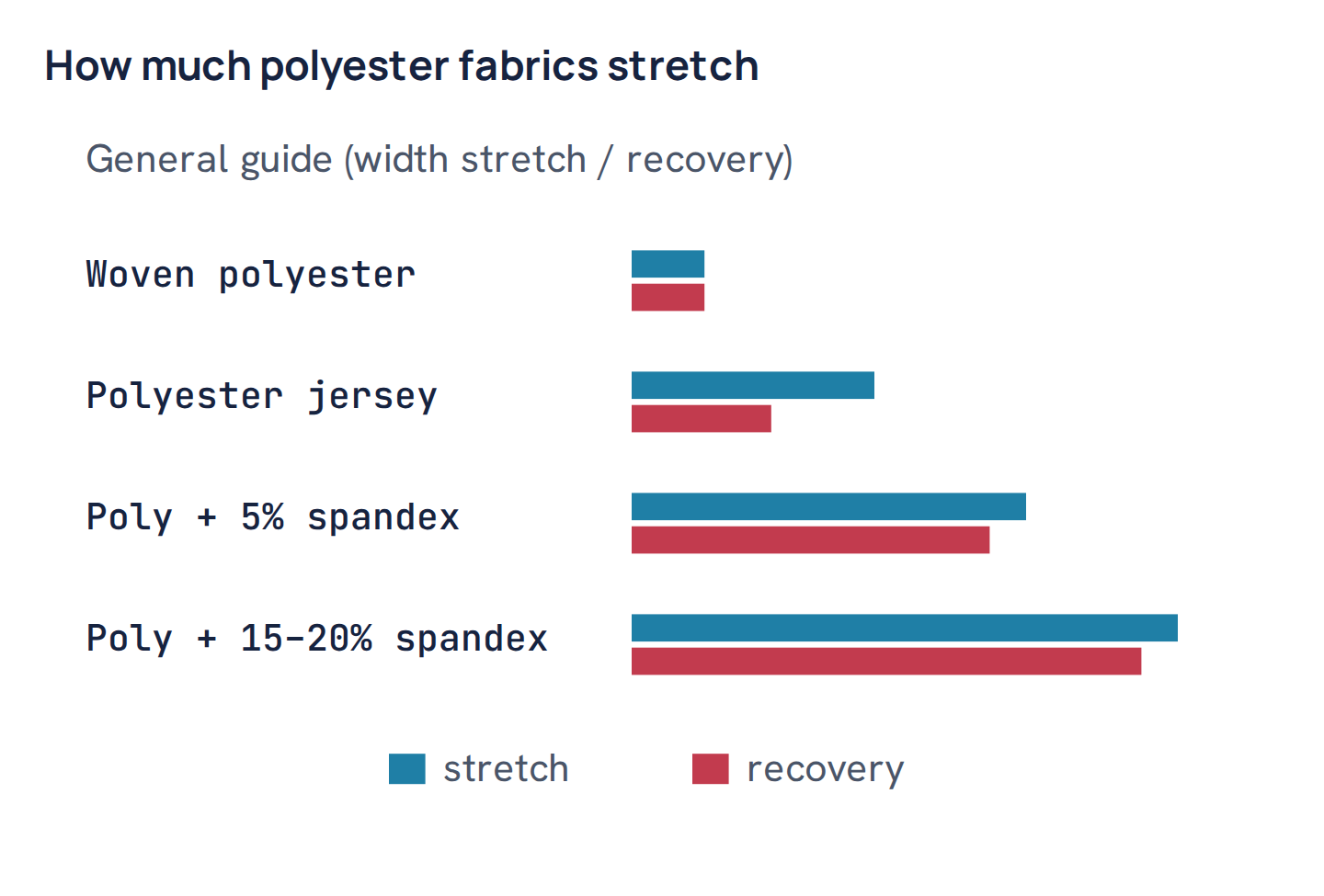
Polyester fabrics and their stretch
| Fabric | Stretch | Recovery | Typical uses |
|---|---|---|---|
| Woven polyester (poplin, twill, chiffon) | Very little | Good | Shirts, linings, dresses, outerwear |
| Polyester single jersey | Moderate across width | Fair | Sports tees, printed tops |
| Polyester interlock | Moderate | Good | Sportswear, uniforms |
| Polyester fleece | Some width stretch | Fair | Jackets, blankets |
| Polyester-spandex jersey (95/5) | Good four-way | Very good | Fitted tops, dresses |
| Polyester-spandex (80–85/15–20) | High four-way | Excellent | Leggings, activewear, swimwear |
| Scuba / double knit with spandex | Moderate | Very good | Structured dresses, skirts |
Two-way vs four-way stretch
Two-way stretch fabric stretches mainly in one direction, usually across the width. Most plain polyester knits are two-way stretch. Four-way stretch fabric stretches both across and along the fabric. That needs spandex in a knit, or spandex in both directions of a woven. For leggings, swimwear and fitted activewear, four-way stretch is what you want; for tees and casual tops, two-way stretch from the knit is usually enough.
Does polyester stretch out over time?
Polyester holds its shape better than most fibres. Unlike cotton, it does not relax and bag much at the knees or elbows, and unlike rayon it does not lose strength when wet. A plain polyester knit can still grow slightly at the neckline or hem if it is pulled repeatedly, but it rarely sags the way cotton jersey does. Polyester-spandex fabrics keep their recovery for a long time, but the spandex is the weak link: heat, chlorine and body oils slowly break it down, and a worn-out legging loses its snap even though the polyester is fine. See what is elastane.
How heat setting controls stretch
In the factory, polyester and polyester-spandex knits are heat set on a stenter: the fabric is held at a set width and length and heated so that the polyester (and spandex) “remember” those dimensions. Heat setting is what makes polyester fabric so stable in washing and what fixes the stretch level of a spandex fabric. Too little heat and the fabric shrinks and curls; too much and the spandex loses power. See heat setting of polyester fabric and the polyester-elastane dyeing process.
Polyester has no shrink property. In a CVC or PC fabric the polyester holds the structure, so the fabric cannot shrink, and washing changes the GSM very little.
Can you stretch polyester fabric yourself?
Because polyester is heat set, it is hard to stretch permanently at home. Gentle stretching while slightly warm and damp may relax a tight knit a little, but the fabric usually returns to its set size after the next wash. Polyester-spandex can be eased over a frame or by wearing, but any gain is temporary. If a polyester garment is too small, it is better to choose a different size than to try to stretch it, because high heat can glaze or damage the fabric.
Common mistake: assuming a polyester shirt will “give” like a cotton one after a few wears. Cotton relaxes and grows slightly; polyester stays the size it was heat set to. Buy polyester garments in the size that fits from day one.
Polyester vs other fibres for stretch
| Fibre | Fibre elasticity | Shape retention | Notes |
|---|---|---|---|
| Polyester | Low | Excellent | Stable, needs knit or spandex for stretch |
| Nylon | Moderate | Very good | More natural give than polyester |
| Cotton | Low | Fair | Relaxes and bags over wear |
| Rayon | Low | Poor when wet | Stretches out when wet |
| Spandex | Very high | Excellent recovery | Used in small amounts in blends |
How to tell how stretchy a polyester fabric is
- Read the content label: any spandex or elastane means real stretch.
- Pull a small width of fabric gently between your hands and release it: watch whether it snaps back or stays slightly grown.
- Check both directions: stretch along the length means four-way stretch.
- Look at the structure: a knit with visible loops stretches; a smooth, crisp woven usually does not.
Worked example. A brand compares three black polyester tops. The woven polyester blouse barely moves when pulled. The 100% polyester jersey tee stretches easily across the chest but only a little along the length. The 92/8 polyester-spandex top stretches in every direction and springs back instantly. For a fitted top that must keep its shape, the spandex blend is the right choice.
Caring for stretchy polyester
- Wash cool or warm (30–40°C); polyester does not need hot water.
- Avoid high dryer heat, which weakens spandex and can set creases.
- Skip fabric softener on activewear; it can coat the fibres and reduce wicking.
- Rinse swimwear in fresh water after chlorine or salt water.
- Store knits folded, not on hangers, to avoid shoulder stretch.
Stretch and fit: choosing the right spandex level
The amount of spandex in a polyester fabric decides how close-fitting a garment can be. Around 3–5% spandex gives comfort stretch for tops, dresses and work trousers: they move with you but are not skin-tight. About 8–12% suits fitted tops, shapewear-style dresses and many sports bras. Leggings, cycling shorts and swimwear usually use 15–25% for strong compression and full recovery. Higher spandex costs more and needs more careful heat setting and care, so it is used only where the stretch is really needed. See is spandex polyester.
Why polyester knits curl at the edges
Single jersey made from polyester or polyester-spandex tends to curl at cut edges because the loops pull in opposite directions on the face and back. Heat setting at the right temperature and width reduces curling, which makes the fabric easier to cut and sew. If a polyester knit curls badly or keeps changing width after washing, it was usually under-heat-set in finishing.
Summary
- Polyester fibre is not stretchy, but polyester fabric can be.
- Knits stretch across the width; spandex blends stretch in all directions and recover.
- Textured polyester yarn adds mild stretch without spandex.
- Polyester keeps its shape well and does not stretch out like cotton or rayon.
- Heat setting in the factory fixes polyester’s size and stretch.
Questions
Is polyester stretchy?
Polyester fibre is not elastic, but polyester knits stretch across the width and polyester-spandex blends stretch in all directions.
Does polyester stretch out over time?
Very little. Polyester holds its shape better than cotton or rayon; in spandex blends the spandex eventually loses recovery first.
Is 100% polyester stretchy?
A 100% polyester knit has some width stretch from the loops; a 100% polyester woven barely stretches.
Can you stretch polyester clothes?
Only slightly and temporarily, because polyester is heat set in the factory. High heat can damage it.
Which is stretchier, polyester or nylon?
Nylon fibre has more natural give than polyester, but in practice stretch depends mostly on the knit and the spandex content.

Textile engineer with 14+ years in dyeing and fabric development. He writes every guide on Dyeing Solution from real production work. Full profile