No, spandex is not polyester: spandex (elastane) is a polyurethane-based stretch fibre, polyester is PET. How they differ, why they are blended, what 95/5 and 80/20 mean, how polyester-spandex is dyed and finished, and how to care for it.
At a glance
Polyurethanevs PET
500%+spandex stretch
95/5everyday stretch
Cool washprotects spandex
No, spandex is not polyester. Both are synthetic fibres made from petroleum-based chemicals, and they are often blended together, which is why the two names are confused. Polyester is a polyester polymer (mostly polyethylene terephthalate) that is strong and stable but stretches very little. Spandex, also called elastane, is a polyurethane-based fibre that can stretch to several times its length and snap back. In a polyester-spandex fabric, the polyester gives strength, colour and shape, and a small amount of spandex gives stretch and recovery.
This guide explains what spandex and polyester are, the key differences, why they are blended, what common ratios such as 95/5 and 80/20 mean, how polyester-spandex is processed and dyed, and how to care for it. It draws on how we heat set, dye and finish polyester-elastane knits in the dye house.
What spandex is
Spandex is the North American name for the fibre called elastane in most other countries. By definition, it is a fibre made of at least 85% segmented polyurethane. Its molecules have long, soft, coiled segments that stretch and short, hard segments that hold the structure together. Pull it and the soft segments uncoil; let go and they coil back. That gives spandex its remarkable stretch, often 500% or more before breaking, and excellent recovery. Lycra is a well-known brand name for this fibre. For more, see what is elastane.
What polyester is
Polyester in clothing is almost always polyethylene terephthalate (PET), the same polymer family used in drink bottles. It is melted and spun into fibres that are strong, smooth, stable and very low in moisture absorption. Polyester stretches only a little, recovers moderately, resists wrinkles and barely shrinks in normal washing. In our finishing records, polyester knit shrank a median 3% in length after the wash test. See does polyester shrink.
Spandex vs polyester: the differences
| Point | Spandex (elastane) | Polyester |
|---|---|---|
| Polymer | Segmented polyurethane | Polyethylene terephthalate (PET) |
| Stretch | Very high, several times its length | Low |
| Recovery | Excellent | Moderate |
| Used alone? | Almost never; always blended | Often 100% |
| Typical share in a fabric | 2–25% | Up to 100% |
| Heat sensitivity | High; weakened by heat | Moderate; shrinks above setting temperature |
| Chlorine and sweat | Degrades over time | Resistant |
| Dyeing | Takes disperse dye poorly, stays lighter | Disperse dyes at about 130°C |
| Moisture absorption | Low | Very low (about 0.4%) |
Why polyester and spandex are blended
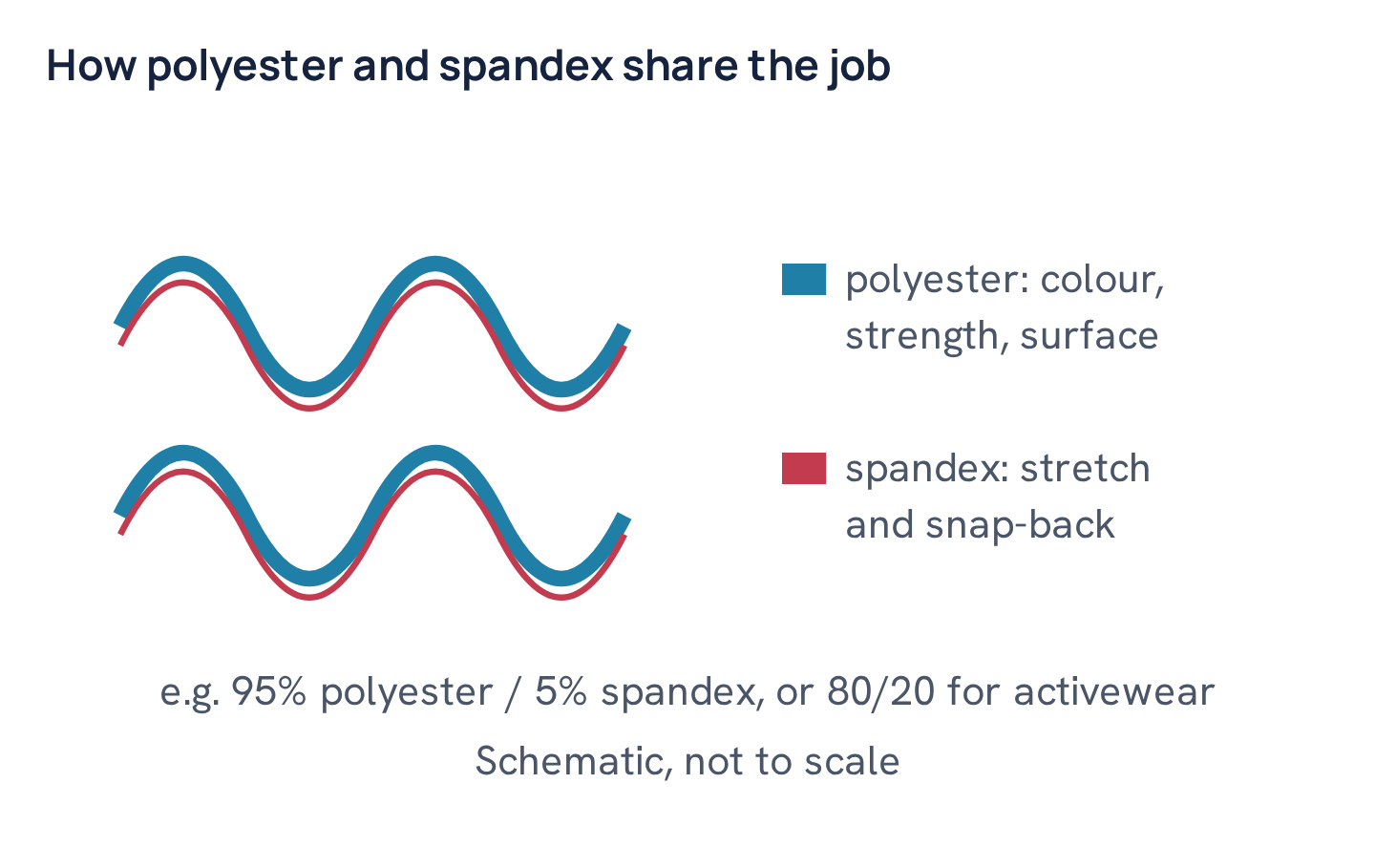
Spandex is almost never used on its own, because a fabric of pure spandex would be rubbery, weak against abrasion and uncomfortable. Instead, a thin spandex yarn is fed alongside a polyester yarn during knitting, or wrapped inside it. The polyester forms the surface you see and touch; the spandex gives stretch and shape. The combination is used for:
- Leggings and yoga pants: often 75–90% polyester with 10–25% spandex for compression.
- Sportswear and running tops: 85–95% polyester with 5–15% spandex.
- Swimwear: polyester-spandex lasts longer in chlorine than nylon-spandex.
- Fashion stretch fabrics: scuba, crepe and stretch dresses; see what is scuba fabric.
- Stretch linings and shapewear.
What 95/5 and 80/20 mean
- 95% polyester, 5% spandex: comfortable stretch and good recovery for T-shirts, dresses and casual tops. The fabric looks and feels mostly like polyester.
- 90/10 to 85/15: more stretch and hold for sportswear and fitted garments.
- 80/20 or 75/25: strong compression for leggings, shapewear and swimwear.
More spandex means more stretch and hold, but also more sensitivity to heat and chlorine and a higher cost.
Is spandex a type of polyester or nylon?
Neither. Polyester, nylon (polyamide) and spandex (polyurethane) are three separate synthetic fibre families. You will see all three combined: nylon-spandex for swimwear and hosiery, polyester-spandex for sportswear, and cotton-spandex for jeans and T-shirts. The spandex plays the same role in each: stretch and recovery.
How polyester-spandex is processed in the dye house
Polyester-spandex needs care because the two fibres react to heat differently. Polyester is dyed at about 130°C; spandex is weakened by high heat. A typical route:
- Heat setting on a stenter before dyeing, to fix width, length and stretch.
- Disperse dyeing of the polyester at high temperature, kept as low and short as the shade allows to protect the spandex.
- Reduction clearing to strip loose dye from the fibre surfaces; spandex tends to hold disperse dye loosely, which hurts fastness if it is not cleared.
- Finishing at moderate temperatures, so the dye does not migrate and the spandex is not damaged.
Reduction clearing is a must on dark and medium shades; on polyester-elastane we do it on every shade. Fabric with polyester must be finished at 100–110°C, not at the 140–150°C used for cotton. Hotter than that and the dye bleeds and the fastness fails.
The full route is in the polyester-elastane dyeing process.
Common mistake: assuming a “polyester” sports top can be dried hot because polyester is tough. If it contains spandex, high heat weakens the spandex, and the garment loses its snap and starts to bag. Read the full fibre content.
How to tell how much spandex a fabric has
The label is the only reliable guide, but the fabric gives clues:
- Stretch and snap: pull the fabric gently and let go. Fabric with spandex snaps straight back; plain polyester knit recovers slowly and may stay slightly stretched.
- Four-way vs two-way stretch: high-spandex knits stretch well both across and along the fabric; low-spandex fabrics mainly stretch across the width.
- Grin-through: stretch a dark fabric hard. Small white or pale lines showing between the stitches are the spandex, which takes disperse dye poorly and stays lighter.
- Weight and hand: high-spandex fabrics feel heavier, denser and more rubbery than plain polyester of the same thickness.
Textile labs measure the exact share of spandex by dissolving one fibre away with a selective solvent and weighing what is left; see how fibre content is tested.
Polyester-spandex vs nylon-spandex vs cotton-spandex
| Blend | Feel | Strengths | Weak points |
|---|---|---|---|
| Polyester-spandex | Smooth, cool to slightly slick | Holds colour, resists chlorine and sun better, dries fast | Holds odour, less soft than nylon |
| Nylon-spandex | Very soft, silky | Excellent stretch and abrasion resistance | Fades and weakens faster in chlorine and sun |
| Cotton-spandex | Natural, breathable | Comfortable for everyday wear and jeans | Shrinks like cotton, dries slowly |
Does polyester-spandex shrink?
Very little when washed cool, because both fibres absorb little water and the fabric is heat set in the factory. Hot drying is the risk: it can shrink the polyester slightly and damage the spandex, so the garment first feels tighter and later loses its recovery. Cotton-spandex, by contrast, shrinks like cotton.
Is spandex safe? Is it breathable?
Spandex is widely used next to the skin and is not considered harmful to wear. Some people with latex allergy worry about spandex; spandex is a polyurethane, not natural rubber latex. Breathability depends on the blend and the knit: polyester-spandex activewear can move sweat well, but tight, high-spandex garments hold heat close to the body.
Worked example. Two pairs of leggings look the same: one is 88% polyester and 12% spandex, the other 75% polyester and 25% spandex. The second gives firmer compression and snaps back harder, but it is more sensitive to hot washing and chlorine. Washed cool and air dried, both keep their size; tumble dried hot, the high-spandex pair loses its hold sooner.
Why stretch clothes lose their stretch
Spandex is the part of a stretch garment that wears out first. Heat from hot washes, dryers and irons breaks down its soft segments. Chlorine in pools and bleach attacks it chemically. Body oils, sunscreen and sweat slowly degrade it, and repeated over-stretching tires it. When the spandex weakens, the garment stretches but no longer pulls back, so leggings sag at the knees and swimwear goes baggy. Cool washing, air drying and rinsing after swimming keep it working much longer.
How to care for polyester-spandex
- Wash cold or at 30°C, inside out, on a gentle cycle.
- Avoid fabric softener, which can coat sports fabrics and trap odour.
- Air dry, or tumble on low only.
- Rinse swimwear in fresh water after chlorine or sea water.
- Never iron hot; use a low setting if needed.
Summary
- Spandex is not polyester: spandex is polyurethane-based, polyester is PET.
- Spandex stretches several times its length; polyester barely stretches.
- They are blended so polyester gives strength and colour, spandex gives stretch.
- Polyester-spandex is heat set, disperse dyed and reduction cleared on every shade.
- Wash cool and avoid high heat to protect the spandex.
Questions
Is spandex polyester?
No. Spandex is a segmented polyurethane fibre; polyester is polyethylene terephthalate. Both are synthetic and often blended.
What is the difference between spandex and polyester?
Spandex stretches several times its length and snaps back; polyester is strong and stable but stretches little. Polyester gives strength and colour, spandex gives stretch.
Is spandex the same as elastane?
Yes. Spandex is the North American name and elastane the name used in most other countries for the same fibre.
What does 95% polyester 5% spandex mean?
A mostly polyester fabric with a small amount of spandex for comfortable stretch and recovery, common in T-shirts, dresses and tops.
Does polyester spandex shrink?
Very little when washed cool. High heat can shrink the polyester slightly and weaken the spandex, so dry it low or air dry.

Textile engineer with 14+ years in dyeing and fabric development. He writes every guide on Dyeing Solution from real production work. Full profile