DTF transfers bond very well to cotton, the easiest fabric to press. Typical settings start around 150 to 165°C for 10 to 15 seconds. Pre-pressing, hot vs cold peel, finishing presses, cotton fabric types, DTF vs DTG and screen printing, common problems and washing.
At a glance
150–165°Ctypical range
10–15 smain press
Pre-pressremove moisture
Nodye migration
DTF (direct-to-film) transfers work very well on cotton, and cotton is the easiest fabric to press them on. Because cotton does not melt and does not contain disperse dye that can migrate, it tolerates higher press temperatures than polyester. A typical starting point is about 150–165°C (300–325°F) for about 10–15 seconds at medium pressure, followed by the peel the film requires and often a short finishing press. Prewashed, dry, smooth cotton gives the best adhesion and the longest-lasting print.
This guide explains how DTF works on cotton, typical time and temperature settings, hot vs cold peel, pre-pressing and finishing presses, how cotton fabric type affects the result, DTF vs DTG and screen printing on cotton, common problems and fixes, and how to wash DTF prints on cotton. It is written from the textile-processing side, where we know how cotton fabrics behave under heat, moisture and washing.
How DTF works on cotton
- The design is printed in reverse with pigment inks onto PET film, with a white ink layer behind it.
- Hot-melt adhesive powder is applied to the wet ink and cured.
- The transfer is pressed onto the cotton garment: the adhesive melts and grips the cotton fibres.
- The film is peeled away, leaving the print bonded to the surface.
The adhesive works into the cotton’s surface fibres and yarn texture. Because cotton is absorbent and textured, it gives the adhesive plenty to grip, which is why DTF bonds so reliably to cotton.
Typical DTF settings for cotton
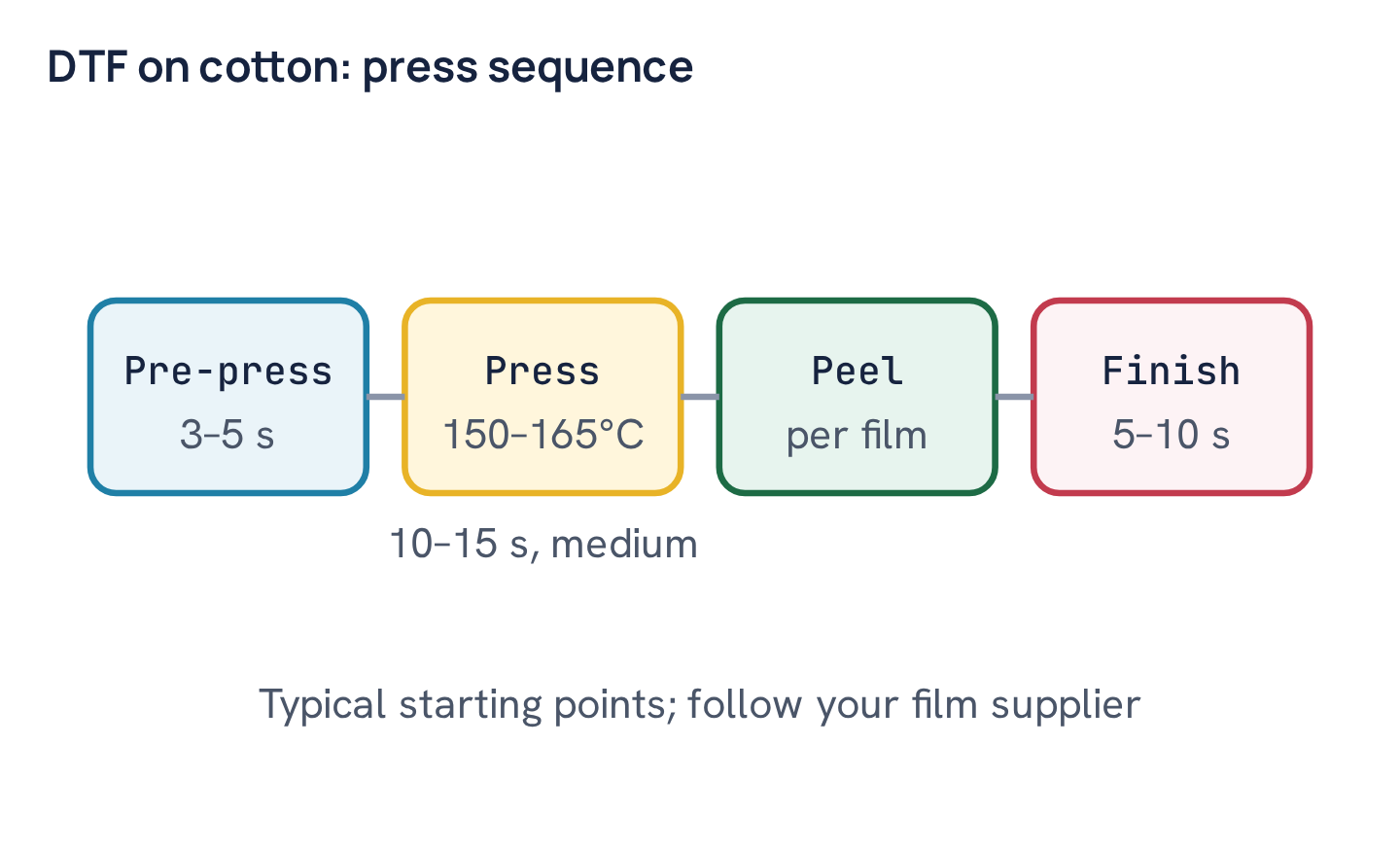
| Step | Typical setting | Why |
|---|---|---|
| Pre-press | 3–5 seconds | Removes moisture and wrinkles |
| Main press | About 150–165°C (300–325°F), 10–15 s, medium pressure | Melts adhesive into the cotton |
| Peel | Hot, warm or cold, as the film requires | Wrong peel can lift the print |
| Finishing press | 5–10 s with a parchment or teflon sheet | Sets the print, improves feel and durability |
These are general starting points. Films and powders differ, so always follow your supplier’s instructions and test on a spare garment or offcut. Heat press accuracy varies, so an infrared thermometer or heat strips help confirm the real platen temperature. See choosing a heat press.
Hot peel vs cold peel
DTF films are made for hot, warm or cold peel. Hot-peel films are peeled immediately after pressing and give a matt, soft finish; cold-peel films must cool completely and often give a slightly glossier finish and very sharp edges. Peeling a cold-peel film hot can pull the print off or leave it uneven; peeling a hot-peel film cold can leave the film stuck. Check the film type before pressing.
Why cotton is easier than polyester
Polyester garments are dyed with disperse dyes that can turn to vapour at press temperatures and migrate into the white ink, tinting it. Polyester also softens and can shine under heat. Cotton is dyed with reactive dyes that are chemically bonded to the fibre and do not migrate, and cotton does not melt. That is why cotton can be pressed hotter and with less risk. See reactive vs disperse dye and colour fastness to hot pressing.
How cotton fabric type affects DTF
- Smooth single jersey (T-shirts): ideal; even surface for full contact.
- Ring-spun and combed cotton: smoother surface and less fuzz, so prints look sharper; see what is ring spun cotton.
- Fleece and French terry (hoodies): thicker and more textured; may need a few extra seconds and a firm, even pressing pad, especially over seams and pockets.
- Pique (polos): textured surface; good pressure and a finishing press help the print settle into the texture; see what is pique.
- Heavyweight and garment-dyed cotton: dry thoroughly with a pre-press; these often hold moisture.
- Enzyme-washed or softened cotton: heavy silicone softeners can reduce adhesion; a pre-press and test help.
DTF vs DTG vs screen printing on cotton
| Method | Best for | Feel | Notes |
|---|---|---|---|
| DTF | Small runs, full colour, any cotton colour | Thin film on surface | Easy to store transfers and press on demand |
| DTG | Soft prints on light or dark 100% cotton | Softest, ink in the fibres | Needs pretreatment on dark garments |
| Screen printing | Large runs, simple colours | Varies with ink | Lowest cost per piece at volume |
| Sublimation | Not for cotton | None on polyester | Only works on polyester |
Common DTF problems on cotton
| Problem | Likely cause | Fix |
|---|---|---|
| Print peels after washing | Under-pressing, moisture, softener on garment | Pre-press; check temperature; add finishing press |
| Cracking | Too thick ink or adhesive; over-curing; stretching | Adjust curing; use stretch-friendly film |
| Rough, uneven surface | Uneven pressure over seams or pockets | Use a pressing pillow or pad |
| Scorch or yellowing on white cotton | Too hot or too long | Lower temperature or time; cover sheet |
| Edges lift | Wrong peel or low pressure | Follow film peel type; increase pressure slightly |
Common mistake: pressing a DTF transfer onto a damp, freshly washed cotton hoodie without pre-pressing. Steam from the fabric weakens the adhesive bond, and the print starts lifting after a few washes. Always pre-press cotton for a few seconds to drive out moisture.
How cotton shrinkage affects DTF prints
Cotton knits can shrink in the first washes as the knit relaxes. In our finishing records, 100% cotton single jersey shrank a median 5% in length after the wash test, and fleece and terry about 8%. A DTF print is flexible and usually moves with the fabric, but heavy shrinkage can make a large print look slightly puckered. Pre-washed or well-compacted cotton garments give the best long-term result. See does cotton shrink.
Worked example. A shop presses a full-colour DTF design on black 100% cotton tees at 160°C for 12 seconds, peels hot as the film requires, then presses again for 6 seconds under parchment. After 30 home washes inside out at 30°C, the print is intact and flexible. A batch pressed without pre-pressing on humid days showed edge lifting after 10 washes.
How to wash DTF prints on cotton
- Wait 24 hours before the first wash.
- Turn the garment inside out; wash cold or at 30°C.
- Use mild detergent; avoid bleach and heavy fabric softener.
- Line dry or tumble on low.
- Do not iron directly on the print; iron inside out if needed.
Placing DTF on cotton garments
Good placement matters as much as the press setting. Lay the garment flat with the print area centred on the platen, and smooth out wrinkles before the pre-press. On hoodies and sweatshirts, a thick seam, zip or kangaroo pocket can hold the platen off part of the transfer, so the print bonds unevenly. A pressing pillow or folded heat-resistant pad inside the garment lifts the print area so it gets full, even pressure. On ribbed collars and cuffs, use a smaller platen or a lower pressure, because ribs stretch and can distort the design. On children’s garments and small sizes, check that the transfer fits the flat area without running over side seams.
Dark cotton vs white cotton
DTF works on both because the white ink layer under the colours blocks the garment colour. On black and navy cotton, the white underbase keeps colours bright. On white or light cotton, some printers reduce or remove the white layer in light areas for a softer feel. White cotton can show scorch marks or yellowing if the press is too hot or the time too long, so a cover sheet and the lower end of the temperature range are a good idea. Reactive-dyed dark cotton rarely bleeds into the print, which is another advantage over dark polyester.
Cotton blends: what changes
On cotton-rich blends such as 60/40 or CVC, DTF still bonds well, but the polyester part brings some risk of dye migration on dark shades and of shine from the platen. Many printers lower the temperature slightly for blends and keep times short. On 50/50 and tri-blend garments, test first. See what is CVC fabric.
Summary
- DTF bonds very well to cotton, the easiest fabric for DTF.
- Typical settings: about 150–165°C for 10–15 seconds at medium pressure.
- Pre-press to remove moisture, follow the film’s peel type, and add a finishing press.
- Cotton has no dye-migration risk, unlike polyester.
- Wash inside out, cool, and dry low to keep prints lasting.
Questions
What temperature for DTF on cotton?
Typically about 150 to 165°C (300 to 325°F) for 10 to 15 seconds at medium pressure. Follow your film and powder supplier and test first.
Do you need to pre-press cotton for DTF?
Yes. A 3 to 5 second pre-press removes moisture and wrinkles, which helps the adhesive bond and prevents lifting.
Hot peel or cold peel for DTF?
It depends on the film. Hot-peel films are peeled straight away; cold-peel films must cool completely. Using the wrong peel can lift the print.
Why is my DTF print peeling off cotton?
Usually under-pressing, moisture in the garment, or softener on the fabric. Pre-press, check the real temperature and add a finishing press.
Is DTF or DTG better on cotton?
DTG gives the softest feel on 100% cotton; DTF is easier for small runs, works on any cotton colour and stores well as ready transfers.

Textile engineer with 14+ years in dyeing and fabric development. He writes every guide on Dyeing Solution from real production work. Full profile