Polyester is naturally water resistant because the fibre absorbs almost no water, but it is not waterproof on its own. How DWR finishes, coatings and membranes work, how water resistance is tested, polyester vs nylon and cotton in rain, and how to restore repellency.
At a glance
0.4%moisture regain
Resistantnot waterproof
DWRmakes water bead
Sealedseams needed
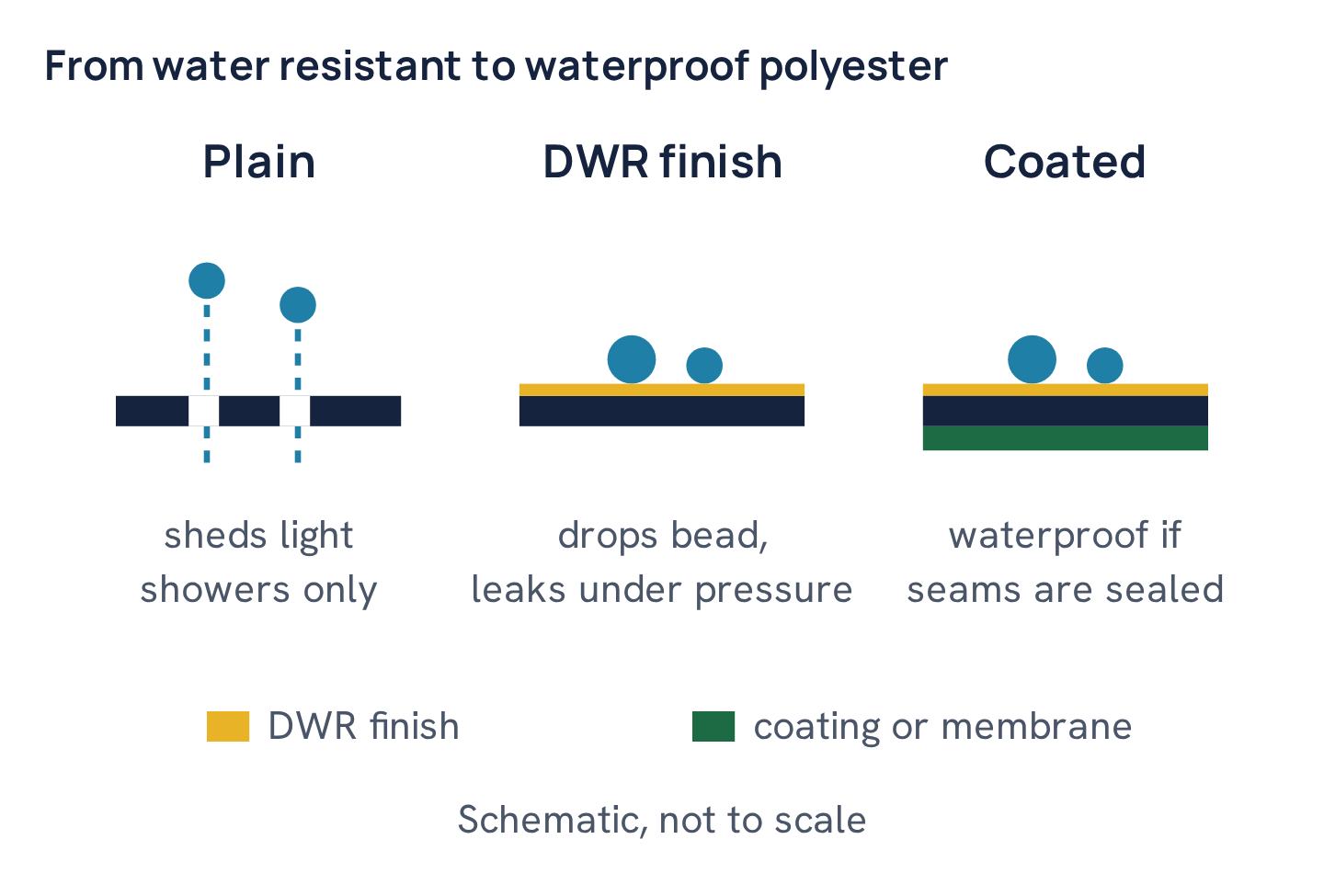
Polyester is naturally water resistant, but it is not waterproof on its own. The fibre absorbs almost no water, so polyester fabric sheds light rain, dries very quickly and does not get heavy when wet. But water can still pass through the gaps between the yarns, so in steady rain an untreated polyester jacket will eventually soak through. To become properly water repellent, polyester is given a durable water-repellent (DWR) finish; to become waterproof, it needs a coating or a laminated membrane, plus sealed seams.
This guide explains why polyester resists water, the difference between water resistant, water repellent and waterproof, how coatings, membranes and finishes work, how polyester compares with nylon and cotton in rain, how water resistance is tested, why it wears off, and how to restore it. It is written from the dyeing and finishing side, where water-repellent finishing is one of the treatments applied to polyester fabrics before they leave the factory.
Why polyester resists water
Polyester (PET) is hydrophobic. At standard conditions it holds only about 0.4% moisture, compared with about 8% for cotton and around 4% for nylon. Water does not soak into the fibre; it sits on the surface or runs between yarns. That gives polyester three useful properties in wet weather:
- It does not gain much weight when wet.
- It dries very fast, because water only has to evaporate from the surface.
- It keeps its strength and shape when wet, unlike rayon or wool.
What polyester does not do on its own is stop water being pushed through the fabric. Rain falling hard, or pressure from a backpack strap or from sitting down, forces water through the spaces between yarns.
Water resistant vs water repellent vs waterproof
| Term | What it means | How polyester gets there |
|---|---|---|
| Water resistant | Resists light water for a short time | Plain, tightly woven polyester |
| Water repellent | Water beads and rolls off the surface | DWR finish on the face |
| Waterproof | Water cannot pass under defined pressure | PU or other coating, or a laminated membrane, plus sealed seams |
| Waterproof breathable | Blocks liquid water, lets vapour out | Microporous or hydrophilic membrane with DWR outer |
How a DWR finish works
A durable water-repellent finish is a very thin chemical layer applied to the fabric surface, usually by padding the fabric through a bath and then curing it with heat on the stenter. The finish lowers the surface energy of the fibres, so water droplets cannot spread out and soak in; they stay round and roll off. DWR does not fill the gaps between yarns, so the fabric still breathes. Older DWR finishes were often based on long-chain fluorochemicals; many brands now use shorter-chain or fluorine-free repellents because of environmental concerns. Fluorine-free finishes repel water well but are generally weaker against oily stains.
Coatings and membranes
- Polyurethane (PU) coating: a thin layer on the back of the fabric. Cheap and effective for rain jackets, tents and bags, but less breathable.
- Microporous membranes: films with tiny pores too small for liquid water but large enough for water vapour.
- Hydrophilic (solid) membranes: non-porous films that pass vapour by diffusion.
- 2, 2.5 and 3-layer constructions: describe how the face fabric, membrane and inner lining are bonded together.
Even a perfect waterproof fabric leaks if the seams are not sealed: every stitch is a hole. Waterproof garments have taped or welded seams.
How water resistance is tested
Laboratories use a few standard approaches. A spray test showers water on a fabric sample held at an angle and grades how much the surface wets. A hydrostatic head test raises a column of water (or water pressure) under the fabric until drops appear on the other side; the result is quoted in millimetres. A rain test sprays water from a set height and measures how much passes through. Outdoor brands often quote hydrostatic head: roughly, a few thousand millimetres resists ordinary rain, and higher figures resist heavier rain and pressure. These numbers are only meaningful when the test method is stated.
Polyester vs nylon vs cotton in rain
| Fibre | Water absorption | Drying | In rain |
|---|---|---|---|
| Polyester | Very low (~0.4%) | Very fast | Sheds water, needs DWR or coating for heavy rain |
| Nylon | Low (~4%) | Fast | Similar; stronger and more abrasion resistant, slightly more water uptake |
| Cotton | High (~8%, holds much more liquid) | Slow | Soaks up water, gets heavy and cold |
| Wool | High | Slow | Stays warm when damp, but gets heavy |
Polyester also resists UV better than nylon, so it holds its colour and strength longer in sun, which is why it is popular for outdoor furniture fabrics, flags and awnings. See is nylon water resistant.
Why water resistance wears off
A DWR finish slowly loses performance through abrasion, dirt, body oils and washing. Detergent residue and fabric softener attract water and make the surface “wet out” so that the face fabric looks dark and soaked even though the membrane underneath still keeps you dry. When that happens the jacket feels clammy because sweat vapour can no longer escape through the wet outer layer.
Common mistake: washing a waterproof polyester jacket with ordinary detergent and fabric softener. The residue destroys the water repellency. Use a technical wash or a small amount of mild detergent, rinse well, and never use softener on outerwear.
How to restore water repellency
- Clean the garment with a technical cleaner or mild detergent and rinse well.
- Many DWR finishes are reactivated by gentle heat: tumble dry on low or iron on a low setting with a cloth, if the care label allows.
- If water still soaks in, apply a wash-in or spray-on repellent and cure it as directed.
- Test by sprinkling water on the shoulders: it should bead and roll off.
Is polyester good for swimwear and outdoor use?
Yes. Polyester holds up well to chlorine and sun, dries quickly and keeps its colour, which is why polyester-spandex is widely used for swimwear and sports kits. For outdoor furniture, umbrellas and boat covers, solution-dyed or high-UV-resistance polyester lasts well. For heavy rain gear, polyester or nylon with a membrane and sealed seams is the standard construction.
Worked example. A hiker compares two polyester jackets in a 30-minute shower. The plain woven polyester windbreaker sheds the first drops but is damp at the shoulders after 15 minutes. The DWR-finished, membrane jacket with taped seams keeps water out completely; drops bead and roll off the face. Both are “polyester”, but only one is waterproof.
How to tell if a polyester garment is waterproof
- Look for “waterproof” on the label, not just “water resistant” or “showerproof”.
- Check for taped seams on the inside.
- Look for a stated hydrostatic head figure and test method.
- A shiny or rubbery inner surface usually means a coating or membrane.
Polyester umbrellas, tents and bags
Most umbrellas use tightly woven polyester, often called pongee, with a water-repellent finish. The tight weave and the repellent together keep rain out because the umbrella fabric is stretched and water runs off quickly. Tents usually combine polyester or nylon fabric with a PU or silicone coating and taped seams. Polyester backpacks often have a PU coating on the inside; the coating, not the polyester itself, is what keeps the contents dry. Over years, PU coatings can break down and become sticky or flaky, at which point the fabric loses its waterproofing.
Water-resistant vs quick-drying
These are different benefits. A quick-drying polyester sports top is designed to let sweat pass through and evaporate, so it is not water resistant at all in the rain sense. A water-repellent polyester shell is designed to keep rain out. Both use the same low-absorbing fibre, but the fabric and finish are designed for opposite jobs.
Summary
- Polyester is water resistant: it absorbs almost no water and dries fast.
- It is not waterproof alone; water passes through the gaps between yarns.
- A DWR finish makes water bead; a coating or membrane with sealed seams makes it waterproof.
- Water repellency wears off; clean and heat-reactivate or re-proof it.
- Avoid fabric softener on any water-repellent polyester.
Questions
Is polyester water resistant?
Yes. Polyester absorbs almost no water and dries fast, so it sheds light rain, but water can pass between the yarns in heavy rain.
Is polyester waterproof?
Not on its own. It becomes waterproof with a coating or laminated membrane and sealed seams.
Is polyester or nylon more water resistant?
Both are similar. Polyester absorbs slightly less water and resists UV better; nylon is stronger and more abrasion resistant.
Why does my polyester jacket feel wet inside?
The water-repellent finish may have worn off, so the outer fabric wets out and sweat vapour cannot escape. Clean and re-proof it.
Does polyester get heavy when wet?
No. Because the fibre does not absorb water, polyester stays light and dries quickly.

Textile engineer with 14+ years in dyeing and fabric development. He writes every guide on Dyeing Solution from real production work. Full profile