
Acrylic is one of the fibres most prone to pilling, because it is spun from short fibres into loose, lofty yarns and its strong fibres keep pills attached. Where acrylic pills, how it compares with other fibres, how pilling is tested, washing tips, pill removal and buying advice.
At a glance
Highpilling tendency
Shortstaple fibres
Pillsstay attached
Dryflat, no heat
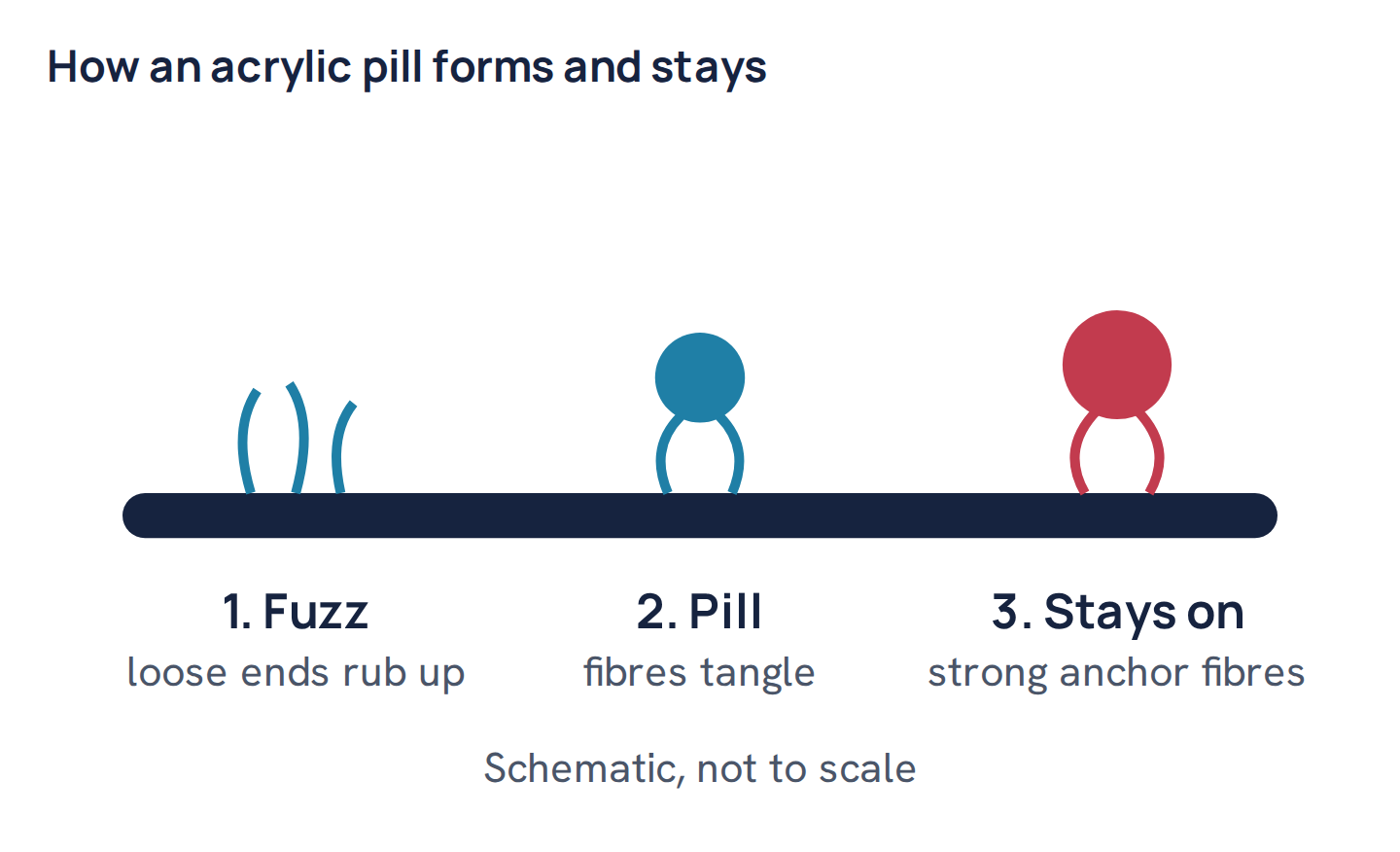
Acrylic is one of the fibres most prone to pilling. Acrylic sweaters, scarves and blankets often develop little bobbles within a few wears, especially under the arms, on the sides and on the cuffs. Acrylic pills because it is usually spun from short staple fibres into soft, lofty, loosely twisted yarns, and because acrylic fibre is strong enough that once a pill forms, it stays attached instead of breaking off. Not all acrylic pills equally: better yarns, tighter knits and anti-pill finishes make a big difference.
This guide explains why acrylic pills, which acrylic garments pill most, how acrylic compares with wool, cotton and polyester, what manufacturers do to reduce pilling, how pilling is tested, how to wash acrylic to slow pilling, how to remove pills safely, and how to choose acrylic knitwear that lasts. It is written from the dye-house and testing side, where pilling is one of the most common quality complaints on knitwear and fleece.
What is acrylic fabric?
Acrylic is a synthetic fibre made mainly from acrylonitrile. It was developed as a cheaper, easy-care alternative to wool: it is light, warm, soft, holds bright colours and does not felt or get eaten by moths. Most acrylic in clothing is spun as staple fibre into soft, bulky yarns for sweaters, beanies, scarves, socks and blankets. It is often blended with wool, cotton or polyester. In the dye house, acrylic is dyed with cationic (basic) dyes, which give very bright, clear shades. See how cationic dyes work on acrylic.
Why acrylic pills so easily
- Short staple fibres: acrylic is cut into short lengths for spinning; short fibres have many loose ends that work out of the yarn.
- Low-twist, high-bulk yarns: acrylic is often spun loose and “high-bulk” to feel soft and lofty like wool, but loose yarns release fibres easily.
- Loose knits: chunky, open sweater knits let fibres move and rub.
- Strong fibres anchor the pills: acrylic fibre is strong enough that a pill stays anchored to the fabric rather than wearing away, as cotton pills often do.
- Static: acrylic builds static electricity, which can attract loose fibres and lint into pills.
Where acrylic pills most
| Area | Why |
|---|---|
| Under the arms and sides | Arms rub the body with every movement |
| Cuffs and sleeves | Rub on desks, bags and keyboards |
| Front where a bag strap sits | Constant friction from straps |
| Seat and thighs of acrylic trousers | Sitting and walking friction |
| Blankets and throws | Rubbing against other fabrics and furniture |
Acrylic vs other fibres for pilling
| Fibre | Pilling tendency | Do pills fall off? |
|---|---|---|
| Acrylic | High | Mostly stay on |
| Polyester (spun) | High | Mostly stay on |
| Nylon | Medium to high | Stay on |
| Wool (short, soft) | Medium | Often wear off over time |
| Cotton | Low to medium | Often break off |
| Long-staple cotton, worsted wool | Low | Few pills |
See why is my sweater pilling and does polyester pill.
What manufacturers do to reduce acrylic pilling
- Longer fibres and better spinning: longer staple and more twist hold fibres in the yarn.
- Two-ply yarns: plying two yarns together locks fibre ends better than a single yarn.
- Tighter knits: a denser gauge restricts fibre movement.
- Low-pill acrylic types: special fibre types are engineered so pills break off more easily.
- Finishing: anti-pill and softening finishes, shearing and singeing of surface fibres.
- Blends: blending with wool or cotton can change the pilling behaviour.
How pilling is tested
Factories and labs test pilling by rubbing fabric samples in a controlled way and then grading them against standard photographs, from grade 5 (no pills) to grade 1 (severe pilling). Common methods include the pilling box, where samples tumble on cork-lined tubes, and the Martindale method, where samples are rubbed in a figure-eight pattern for a set number of rubs. Results can change a lot with the number of rubs: in our fleece testing, fabrics that scored grade 4–5 at 1,000 rubs dropped to grade 2–3 at 2,000 rubs. See how pilling is tested.
How to wash acrylic to reduce pilling
- Turn garments inside out before washing.
- Wash cool (30°C) on a gentle or wool cycle.
- Wash with similar soft items; keep away from jeans, zips and towels.
- Use a mesh laundry bag for sweaters.
- Avoid tumble drying; heat can also distort acrylic. Dry flat.
- Use liquid detergent rather than powder, which can be abrasive.
Common mistake: drying an acrylic sweater on a hot tumble cycle. The tumbling adds friction that builds pills, and heat can permanently stretch or “kill” acrylic, leaving it limp and shiny. Dry acrylic flat at room temperature.
How to remove pills from acrylic
- Lay the garment flat on a firm surface.
- Use a battery fabric shaver or sweater comb, moving lightly in one direction.
- Do not press hard; you can cut through the loose yarn.
- For a few pills, snip them off with small scissors rather than pulling them.
- Avoid razors on thin or loose knits.
Removing pills improves the look, but each time a little fibre is removed, so the garment slowly thins. Prevention through gentle washing is better.
Acrylic blends and pilling
Acrylic-wool blends combine acrylic’s low cost and easy care with wool’s warmth and natural feel; they usually pill less than pure low-quality acrylic but more than good wool. Cotton-acrylic knits are common for lightweight sweaters and fleece; the cotton part pills less but the acrylic still pills. In the dye house, cotton-acrylic needs two dye classes, reactive for cotton and cationic for acrylic. See the cotton-acrylic dyeing process.
How to choose acrylic that pills less
- Feel the yarn: a firm, smooth, tightly twisted yarn pills less than a fluffy, loose one.
- Look at the knit: a fine, dense knit pills less than a chunky, open one.
- Rub a hidden area between your fingers; if fuzz appears straight away, it will pill quickly.
- Look for “anti-pill” or “low-pill” claims.
- For heavy-wear items, consider a wool-rich blend or a fine-gauge knit.
Worked example. Two navy acrylic sweaters at different prices are worn for a month. The cheaper chunky knit, made from a loose single yarn, is heavily pilled under the arms after five wears. The fine-gauge sweater made from two-ply anti-pill acrylic shows only light fuzz after the same wear. The fibre is the same; the yarn and knit make the difference.
Acrylic blankets and throws
Acrylic fleece and knitted blankets are popular because they are warm, light, cheap and machine washable, but they pill where they rub against sofas, bedding and clothing. A blanket washed alone or with other soft items on a gentle cycle pills much more slowly than one washed with towels. Shaking a blanket out after washing and drying it over a line or rack, rather than tumbling, also helps. Polyester fleece blankets labelled anti-pill usually hold up better than plain acrylic knits. See anti-pilling fleece.
Is pilling a sign of poor quality?
Pilling is partly about fibre and partly about construction. Even good acrylic can pill under heavy rubbing, but early, heavy pilling within a few wears usually points to a loose single yarn, a low-twist spin or a very open knit chosen to cut cost and give a fluffy feel in the shop. A garment that keeps a smooth face after weeks of wear has usually been made from better yarn and a denser knit. Pilling does not affect warmth much, but it does make the garment look old quickly.
Static, lint and acrylic
Acrylic builds static in dry weather, which pulls lint, hair and loose fibres from other fabrics onto the surface. These can tangle into pills of a different colour, which is why a dark acrylic sweater can show pale pills after being washed with towels. Washing separately, using a little fabric conditioner on non-technical knits, or a dryer sheet when air-drying is not possible, reduces static cling.
Summary
- Acrylic pills easily because of short fibres, loose yarns and strong fibres that anchor pills.
- Underarms, sides and cuffs pill first.
- Better yarns, tighter knits and anti-pill types reduce pilling.
- Wash inside out, cool, gently, and dry flat.
- Remove pills with a fabric shaver or comb, lightly.
Questions
Does acrylic fabric pill?
Yes, acrylic pills easily because of its short fibres, loose yarns and strong fibres that keep pills attached.
Why does my acrylic sweater pill so fast?
Loose, low-twist yarns and chunky knits release fibres quickly, and rubbing under the arms and at the cuffs tangles them into pills.
How do you stop acrylic from pilling?
Wash inside out on a cool, gentle cycle in a mesh bag, avoid rough items in the load, and dry flat without tumble drying.
Does acrylic pill more than wool?
Usually yes. Acrylic pills stay attached, while many wool pills wear off over time.
How do you remove pills from acrylic?
Use a fabric shaver or sweater comb lightly on a flat surface, or snip individual pills with small scissors.

Textile engineer with 14+ years in dyeing and fabric development. He writes every guide on Dyeing Solution from real production work. Full profile