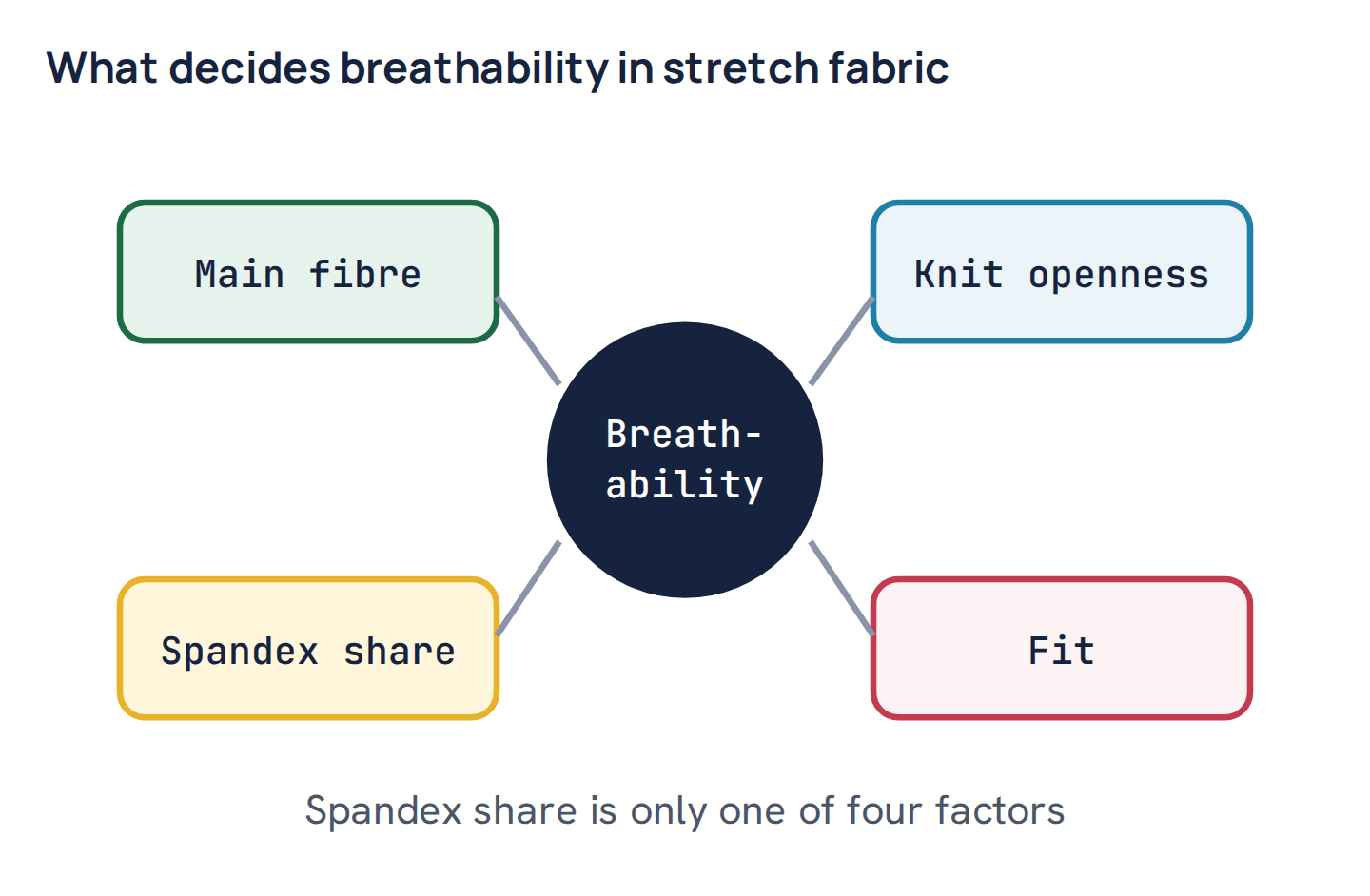
Spandex itself is not very breathable, but most stretch fabrics contain only a few percent, so breathability depends on the main fibre, the knit and the fit. Spandex blends compared, why tight fit traps heat, spandex for sport and hot weather, and care.
At a glance
2–25%typical share
Main fibredecides most
Tight fittraps heat
Nosoftener
Spandex itself is not very breathable, but most spandex fabrics are only a few percent spandex, so their breathability depends mainly on the other fibre and the knit. Spandex (elastane) absorbs little moisture and is usually used as a small share, 2–25%, blended with cotton, polyester, nylon, rayon or modal. A cotton tee with 5% spandex breathes almost like cotton; a dense nylon-spandex shapewear garment with 25% spandex breathes poorly. Tight fit matters too: spandex fabrics hug the body, which can trap heat even when the fibre mix is breathable.
This guide explains what makes a fabric breathable, why spandex itself is not, how different spandex blends compare, why tight fit traps heat, which spandex fabrics are good for sport and hot weather, and how to choose and care for breathable stretch clothing. It draws on how we process cotton-, polyester- and nylon-elastane knits in the dye house.
Is spandex breathable?
Breathability has two parts: how much air can pass through the fabric, and how well the fabric handles sweat (absorbing it, or moving it away to evaporate). Spandex fibre is a segmented polyurethane that absorbs very little moisture and is often used as a bare filament inside a knit. On its own it would make a dense, rubbery, poorly breathable fabric. But spandex is almost never used on its own; it is always blended, and in most clothing it is a minor component. See what is elastane.
Breathability by spandex blend
| Blend | Typical spandex share | Breathability | Sweat handling |
|---|---|---|---|
| Cotton-spandex | 3–8% | Good | Absorbs sweat, dries slowly |
| Rayon or modal-spandex | 4–8% | Good, cool feel | Absorbs sweat, dries slowly |
| Polyester-spandex (technical) | 8–20% | Moderate to good | Moves sweat, dries fast |
| Nylon-spandex (leggings, swimwear) | 15–25% | Moderate | Absorbs little, dries fast |
| High-spandex shapewear | 20–30%+ | Low | Traps heat and sweat |
Why tight fit traps heat
Spandex exists to make fabrics fit closely. A close fit leaves no air gap between skin and fabric, so warm, moist air cannot circulate and escape. That is why a loose cotton tee feels cooler than a fitted cotton-spandex tee of the same fibre and weight. For sport, a close fit can actually help, because a technical fabric in contact with the skin can pick up sweat directly and move it outward. For casual wear in heat, looser fits feel cooler.
Is spandex good for hot weather?
It depends on the base fibre and fit. For casual summer wear, a loose cotton-spandex, linen-spandex or modal-spandex garment is comfortable. For exercise in heat, technical polyester-spandex or nylon-spandex with mesh panels or open knits dries fast and stays light. High-spandex shapewear and dense compression garments are the least comfortable in heat. Light colours and ventilation zones help in sun.
Spandex for sportswear
Spandex is essential in activewear because it lets fabric move with the body and recover its shape. Breathability in sportswear comes from:
- Technical base yarns: fine polyester or nylon filaments that move sweat along their surfaces.
- Moisture-moving finishes: applied on the stenter so the fabric spreads sweat instead of holding it.
- Mesh and open knits: placed at the back, underarms and other hot zones.
- Lighter weights for summer and warmer climates.
How spandex fabrics are processed
Spandex is sensitive to heat, so stretch fabrics are handled carefully in the dye house. They are heat set before dyeing to fix their width and stretch, for example at about 180–190°C for cotton-elastane. Polyester-spandex is dyed with disperse dyes and reduction cleared; the spandex takes disperse dye poorly and stays lighter, which can show as “grin-through” when stretched. Moisture-moving finishes for sportswear are applied at the end. See the polyester-elastane dyeing process and the cotton-elastane dyeing process.
Common mistake: blaming spandex for a hot, sweaty pair of leggings when the real cause is a dense, heavy, brushed polyester knit with no ventilation. A light, smooth nylon-spandex legging with the same spandex share can feel far cooler. Look at the weight and knit, not only the spandex percentage.
Is spandex bad for your skin?
Spandex is widely worn next to the skin and is not considered harmful. Problems usually come from heat and moisture trapped by tight garments, which can cause chafing, heat rash or, in intimate areas, irritation. People with latex allergy sometimes worry about spandex; it is a polyurethane, not natural rubber latex. Changing out of damp, tight sportswear promptly and choosing breathable base fibres helps.
How to choose breathable stretch clothing
- Everyday wear: cotton, modal or rayon with 3–8% spandex, in a relaxed fit.
- Running and gym: technical polyester or nylon with spandex, mesh zones and a wicking finish.
- Yoga: nylon-spandex or cotton-spandex, depending on how much you sweat.
- Hot weather: lighter weights, looser fits, light colours.
- Underwear: modal or cotton with a little spandex and a breathable gusset.
Spandex and odour
Synthetic stretch fabrics, especially polyester-spandex, can hold body odour after workouts, because sweat compounds cling to synthetic fibres and the tight fit keeps the fabric in contact with the skin. Many sportswear fabrics carry an odour-control finish. Washing promptly after use, inside out, without fabric softener, keeps stretch sportswear fresher. Cotton-spandex and modal-spandex hold less odour but dry more slowly.
Worked example. Two fitted T-shirts both contain 5% spandex. The one in 95% cotton feels breathable on a warm day but stays damp if you sweat. The one in 95% polyester with a wicking finish feels slightly warmer when you sit still but dries quickly during a run. The spandex share is the same; the main fibre makes the difference.
Spandex in jeans and trousers
Stretch jeans and trousers usually contain 1–3% spandex in a woven cotton or cotton-polyester fabric. That small share gives comfort and shape recovery without changing breathability much: stretch denim breathes almost like rigid denim of the same weight. The bigger difference is fit, since stretch styles are often cut closer to the body. Lighter-weight stretch chinos and linen-spandex trousers are comfortable in warm weather.
Compression wear
Compression garments, such as running tights, recovery socks and shapewear, use higher spandex shares and tighter knits to apply pressure. They are deliberately less breathable, and they rely on technical base yarns and ventilation zones to stay comfortable. If you find compression wear hot, look for lighter weights, mesh panels and moisture-moving finishes, and avoid wearing it for long periods in heat when it is not needed.
How to care for spandex fabrics
- Wash cool, around 30°C, inside out.
- Avoid fabric softener on sportswear; it blocks wicking finishes.
- Air dry or tumble low; heat weakens spandex.
- Rinse swimwear in fresh water after chlorine or sea water.
- Do not iron spandex-rich fabrics hot.
Swimwear and spandex
Swimwear is mostly nylon-spandex or polyester-spandex with a high spandex share, made to fit tightly and dry quickly. Breathability matters less in water than quick drying, chlorine resistance and shape retention. Polyester-spandex lasts longer in chlorinated pools; nylon-spandex feels softer. Rinsing in fresh water after swimming and drying out of direct sun keeps the spandex working.
Breathable stretch fabrics for work
Stretch office trousers, scrubs and work shirts use spandex for comfort when moving and bending. For warm workplaces, look for cotton-rich or rayon-rich stretch fabrics, lighter weights and relaxed cuts. For active jobs, technical polyester-spandex with a moisture-moving finish dries faster after physical effort.
Quick checks in the shop
Hold the fabric up to the light: a knit you can see light through will breathe better than an opaque, dense one. Breathe through it gently; if air passes easily, it will vent heat. Check the label for the base fibre and the spandex share, and look for mesh panels or ventilation zones on sportswear.
Summary
- Spandex fibre is not very breathable, but it is usually a small part of a blend.
- Breathability depends mainly on the base fibre, knit openness, spandex share and fit.
- Cotton and modal spandex blends breathe well; technical polyester-spandex dries fast.
- High-spandex, dense, tight garments trap heat.
- Wash cool, skip softener and dry low to keep stretch fabrics working.
Questions
Is spandex breathable?
Spandex fibre absorbs little moisture and is not very breathable, but it is usually a small share of a blend, so the main fibre and knit decide breathability.
Is spandex good for hot weather?
Loose cotton, linen or modal blends with a little spandex are comfortable. For exercise, technical polyester or nylon spandex with mesh dries fast.
Is cotton spandex breathable?
Yes. With 3 to 8% spandex, cotton spandex breathes almost like cotton, though a tight fit is warmer than a loose one.
Does spandex make you sweat?
Not directly, but tight, dense spandex garments trap heat and moisture, which can make you feel sweatier.
Is spandex bad for skin?
Not for most people. Irritation usually comes from heat and moisture trapped by tight fit; change out of damp sportswear promptly.

Textile engineer with 14+ years in dyeing and fabric development. He writes every guide on Dyeing Solution from real production work. Full profile