GSM is grams per square metre: the weight of one square metre of fabric. Typical GSM for T-shirts, polos and fleece, how it is measured, converting to ounces, and why knit fabric gets heavier after finishing.
At a glance
g/m²what GSM measures
150–180standard T-shirt
× 33.906oz/yd² to GSM
+5.5%lab vs factory GSM, median
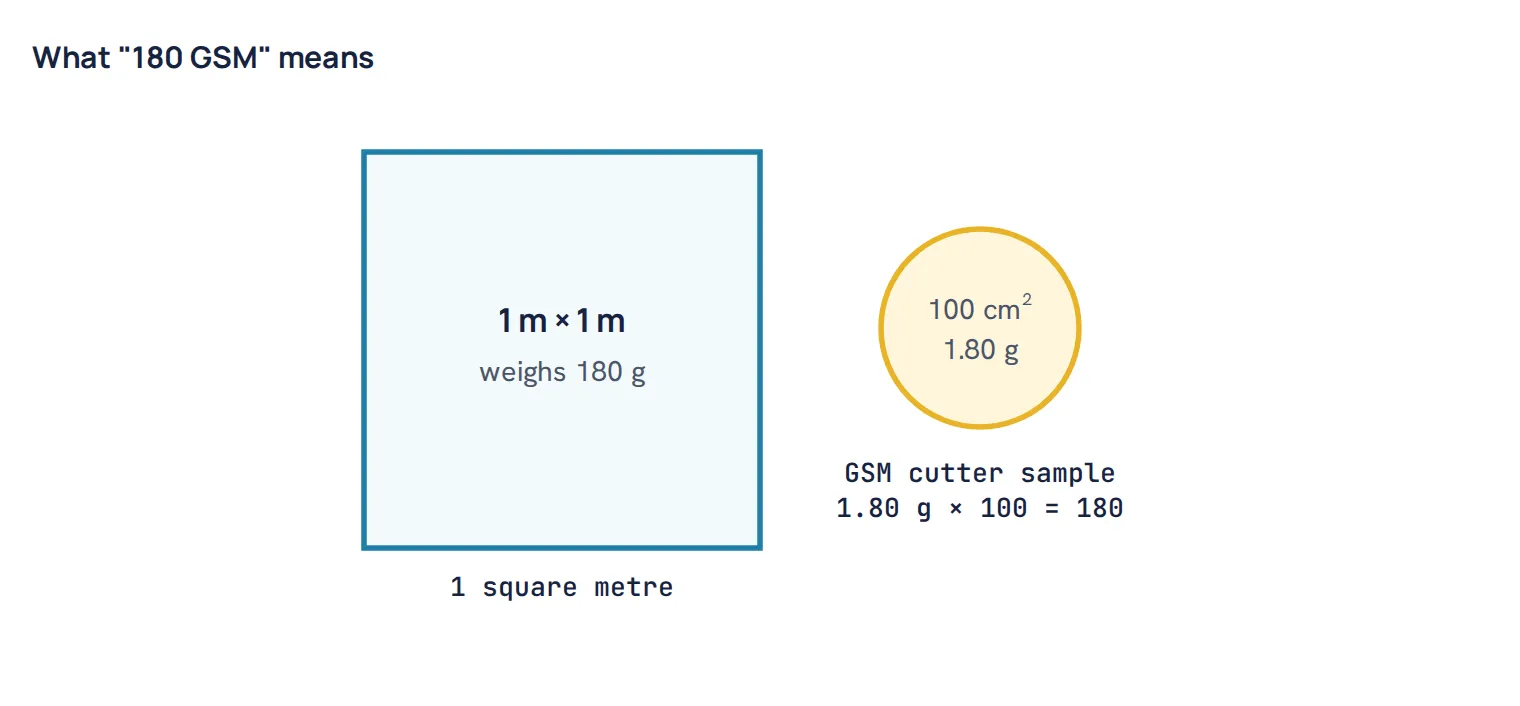
GSM means grams per square metre. It is the weight of one square metre of fabric, and it is the number the textile trade uses to say how light or heavy a fabric is. A 140 GSM T-shirt is light and airy; a 320 GSM sweatshirt is heavy and warm. When a label, a fabric offer or a buyer’s specification says “180 GSM”, it means one square metre of that fabric weighs 180 grams.
This guide explains what GSM tells you and what it does not, typical GSM for common garments, how GSM is measured, how to convert it to ounces, what changes the GSM of a knit, and what our own lab and finishing records show about hitting the target.
What GSM in fabric tells you
GSM is a measure of weight per area. For the same fibre and construction, a higher GSM fabric is heavier, usually thicker, more opaque and warmer, and a lower GSM fabric is lighter, thinner and cooler. That is why GSM is the first number in almost every knit fabric order, next to the composition and the width.
What GSM does not tell you on its own is quality. A loosely knitted heavy yarn and a tightly knitted fine yarn can have the same GSM and feel completely different. A 180 GSM single jersey and a 180 GSM pique are different fabrics. GSM compares weight; handle, strength and durability depend on the fibre, the yarn and the knit structure as well.
Typical GSM for common knit garments
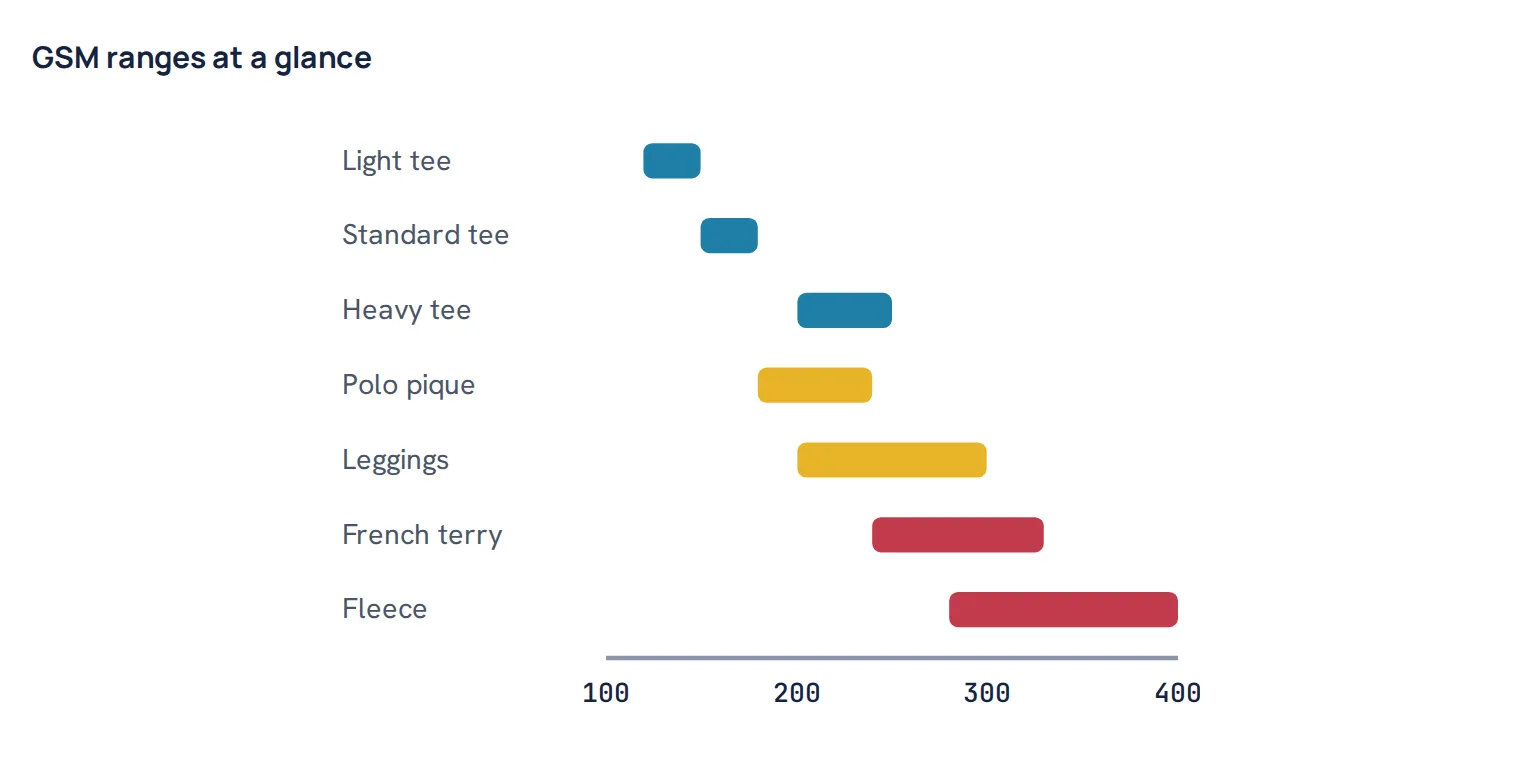
These are typical ranges for finished knit fabric. Brands set their own targets, so treat them as a guide, not a rule.
| Garment / fabric | Typical GSM | Feel |
|---|---|---|
| Lightweight T-shirt, single jersey | 120–150 | Light, airy, can be see-through in pale shades |
| Standard T-shirt, single jersey | 150–180 | Everyday weight |
| Heavyweight T-shirt | 200–250 | Firm, structured, opaque |
| Polo, pique | 180–240 | Textured, holds shape |
| Rib for tops and trims | 180–300 | Stretchy, depends on rib type |
| Interlock | 180–260 | Smooth both sides, soft |
| Leggings, cotton or poly with elastane | 200–300 | Opaque, stretchy |
| French terry | 240–330 | Loops inside, mid-season |
| Fleece / sweatshirt | 280–400 | Brushed inside, warm |
GSM in clothing, towels and other products
The same unit is used everywhere. In clothing, GSM tells you how heavy the fabric is. In towels, a higher GSM, typically from about 300 for light towels to 600 or more for thick bath towels, means more loops and more absorbency. In microfibre cloths, a higher GSM usually means a denser, more absorbent cloth. In paper it means sheet weight. The idea is always the same: grams in one square metre.
How GSM is measured
The standard method is simple. The fabric is first conditioned, laid flat without tension at about 20°C and 65% relative humidity, because fabric that has just come off the stenter or out of a damp store does not weigh the same as relaxed fabric. Then a circular cutter cuts specimens of exactly 100 cm² from different places across the width, avoiding the edges. Each is weighed on a balance reading to at least 0.01 g. The GSM is the average mass in grams multiplied by 100.
For example, if four specimens weigh 2.12, 2.13, 2.11 and 2.14 g, the average is 2.125 g and the GSM is 212.5. The full lab method, with tolerances, is in how to test the GSM of knit fabric, and you can do the arithmetic with the fabric GSM calculator.
Common mistake: cutting the GSM sample straight from a roll that has just left the stenter. Knit fabric relaxes over the next hours and usually gets heavier as it shrinks back, so a “hot” sample reads light and the buyer’s lab reads heavy.
Converting GSM to ounces and back
American specifications often give fabric weight in ounces per square yard (oz/yd²). The conversion is fixed:
- GSM = oz/yd² × 33.906
- oz/yd² = GSM ÷ 33.906
| oz/yd² | GSM |
|---|---|
| 4.0 | 136 |
| 5.0 | 170 |
| 6.0 | 203 |
| 8.0 | 271 |
| 10.0 | 339 |
Be careful with “oz per linear yard”, which some fabric shops use. That is the weight of one yard of the full fabric width, so it depends on the width and is not the same as oz/yd².
What changes the GSM of a knit fabric
In knitting and finishing, the GSM is controlled by a handful of variables. Understanding them is what lets a dye house hit the target instead of hoping for it.
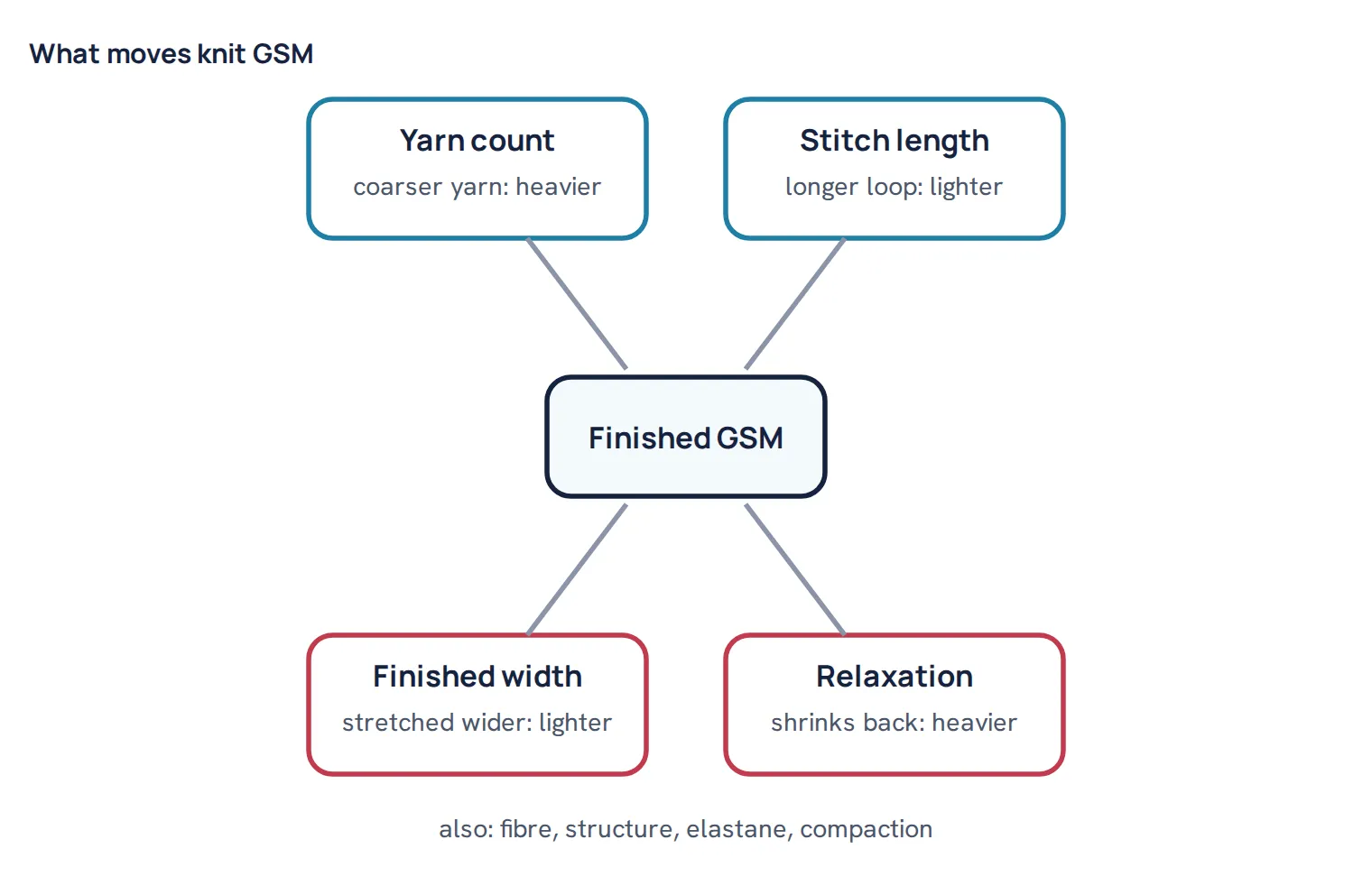
- Yarn count. A coarser yarn (for example 24s instead of 30s Ne) puts more fibre in each loop and raises GSM.
- Stitch length. A shorter loop packs more loops into each square metre and raises GSM; a longer loop lowers it. You can estimate it with the knit GSM from stitch length calculator.
- Structure. Pique, rib, interlock and fleece put more yarn into each square metre than single jersey at the same count.
- Elastane. Elastane pulls the fabric together after heat setting and raises GSM; how far it is set decides how much.
- Finishing width and overfeed. Stretching the fabric wider on the stenter lowers GSM; overfeed and compaction raise it.
- Relaxation. After finishing, knit fabric keeps relaxing and shrinking, and the GSM usually rises.
What our records show
Hitting GSM is harder than the arithmetic suggests. In our outside lab reports on new knit developments, 292 of 316 reports included a GSM result and 111 of them failed (38%). Most buyers allowed ±5% on the required GSM (62 of the first 93 reports); some allowed −5%/+8%.
The biggest single reason is relaxation. In 77 of 89 batches, the lab measured a higher GSM than our finished GSM, by a median of 5.5%. Even among batches that passed, the lab read about 4% higher. So a fabric that leaves the factory 5% light can fail, while textured fabrics such as waffle can gain 25–40% as they relax. The cases and fixes are in why knit fabric fails the GSM test.
Worked example. The order says 200 GSM ±5%, so the lab will pass 190 to 210. If your fabric of this type usually reads about 5% higher in the lab than off the stenter, finishing it at 200 risks a lab result near 210, right on the upper edge. Aiming for about 192–195 at finishing, and letting the fabric relax before you check it, puts the lab result near the middle of the tolerance.
Is higher GSM better?
Not automatically. Higher GSM means heavier and usually more durable and opaque, which suits heavyweight tees, sweatshirts and workwear. Lower GSM means lighter and cooler, which suits summer tees, sportswear and layering. The right GSM is the one that fits the garment, the season and the buyer’s sample, and the right fabric hits that number consistently after washing, not just on the day it is finished.
Summary
- GSM is grams per square metre: the weight of one square metre of fabric.
- Typical knit T-shirts are 150–180 GSM; fleece sweatshirts 280–400.
- Measure on relaxed, conditioned fabric with a 100 cm² cutter: grams × 100 = GSM.
- GSM = oz/yd² × 33.906.
- Yarn count, stitch length, structure, width and relaxation all move the GSM; plan for the fabric getting heavier after finishing.
Questions
What does GSM mean in fabric?
GSM means grams per square metre. It is the weight of one square metre of the fabric and shows how light or heavy the fabric is.
What is a good GSM for a T-shirt?
Most standard T-shirts are 150–180 GSM. Lightweight summer tees are about 120–150 GSM and heavyweight tees about 200–250 GSM.
Is higher GSM better quality?
Not on its own. Higher GSM means heavier and usually more opaque and durable, but quality also depends on the fibre, the yarn and the knit structure.
How do you calculate GSM?
Cut a 100 cm² specimen with a GSM cutter from relaxed, conditioned fabric, weigh it in grams and multiply by 100. Average several specimens across the width.
How do I convert GSM to oz per square yard?
Divide GSM by 33.906 to get oz/yd², or multiply oz/yd² by 33.906 to get GSM. For example, 170 GSM is about 5.0 oz/yd².

Textile engineer with 14+ years in dyeing and fabric development. He writes every guide on Dyeing Solution from real production work. Full profile