A step-by-step development guide for rib bodies and trims: dial and cylinder set-outs, yarn and elastane, stitch length, heat setting, width recovery, hitting finished GSM and width, shade matching to the body, and testing, built on our real development records.
At a glance
1,461rib entries in our register
-5.8%median finished vs required GSM
+12.2%median GSM rise after the wash test
26 of 63shrinkage lab results that failed
Rib is the second fabric every knit development engineer has to master. It is the neckband and cuff on a T-shirt, the waistband on a jogger, the bottom band on a sweatshirt, and, more and more, the body of fitted tops, tank tops, kidswear and inner wear. It is knitted on a double-jersey machine with two sets of needles, and that one fact gives it its two famous properties: it stretches a long way in width and it pulls back again. The same properties make it harder to develop than single jersey. The finished width is narrow and moves with every stretch on the stenter, the GSM follows the width, elastane is in most of it, and a rib trim must match a body fabric that was knitted, dyed and finished differently. This guide follows the route from yarn to a tested fabric for 1×1, 2×1, 2×2 and Lycra rib, built on real figures from our fabric register: 1,461 rib entries, plus 39 rib lab reports. Where a value comes from general practice rather than our records, it is marked as typical.
What rib is
Two needle beds: dial and cylinder
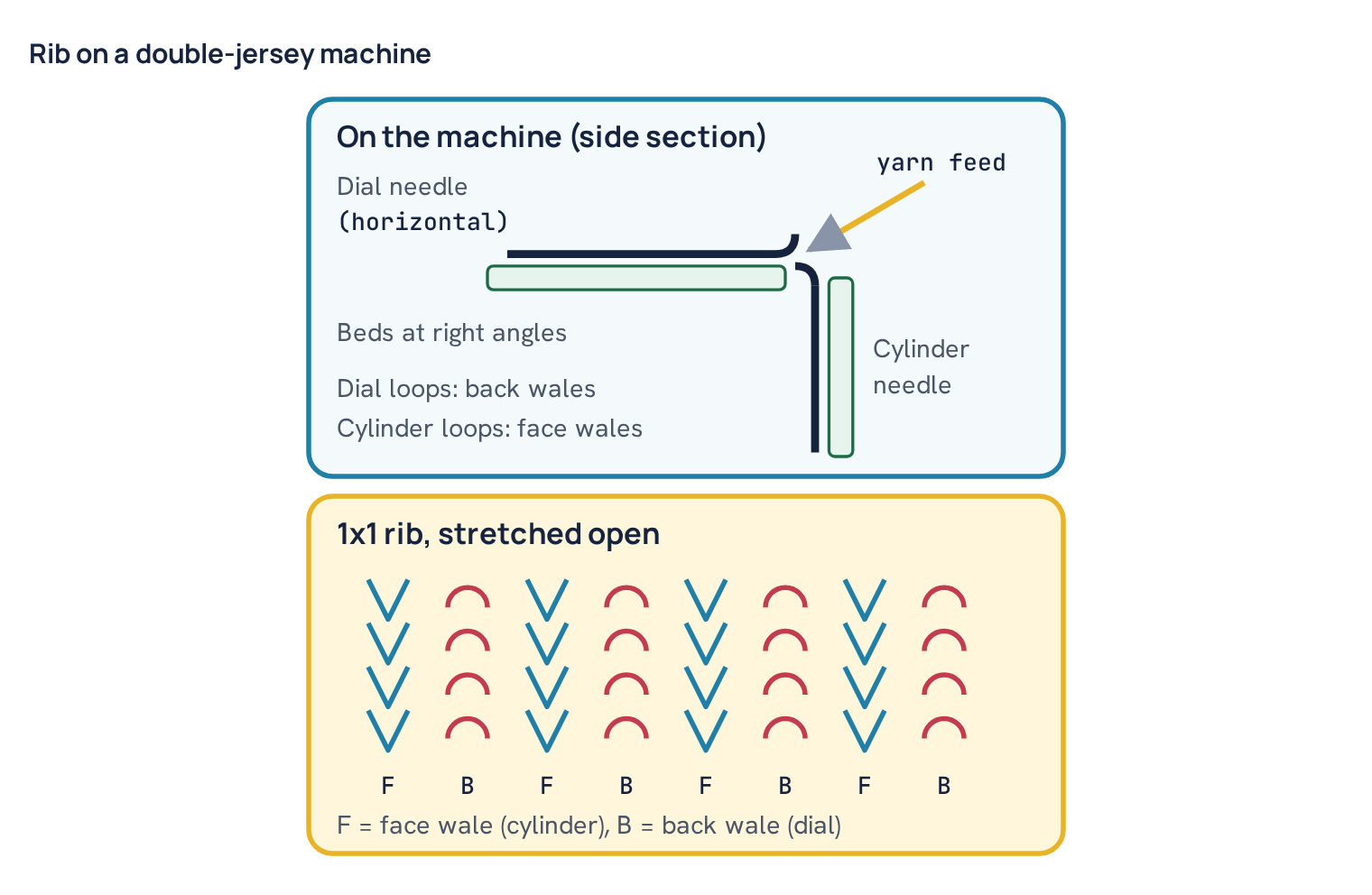
Single jersey is knitted on one bed of needles. Rib needs two. On a circular rib machine the cylinder holds needles standing vertically, and the dial, a flat plate on top of the cylinder, holds needles lying horizontally. The two sets meet at right angles at the knitting point, and the same yarn is fed to both.
- Cylinder needles pull their loops towards the outside of the tube. These loops show on the technical face as normal knit loops, the V columns you know from single jersey.
- Dial needles pull their loops the other way. Seen from the face, these are reverse (purl) loops; from the back they look like knit loops.
So a rib fabric has knit wales and purl wales side by side across the width. A vertical column of face loops is a face wale, a column of dial loops is a back wale. The name tells you the order: 1×1 rib has one face wale, then one back wale, repeated; 2×2 rib has two and two; 2×1 rib has two face wales and one back wale. In 1×1 and 2×2 rib both sides look the same, which is why rib is often called a balanced fabric.
Properties you must design around
- High width stretch and recovery. When rib relaxes, the back wales slide behind the face wales and the fabric closes up like a concertina. Pull it and the hidden wales come out again; let go and they go back. A relaxed rib can often be stretched to roughly twice its width (typical; it depends on yarn, stitch length and elastane).
- No edge curling. In balanced rib the pull of the face loops and back loops cancels out, so the cut edges lie flat. That makes cutting and sewing trims much easier than single jersey.
- Low spirality. The opposite loop directions also balance much of the yarn torque. Rib is far less prone to wale twist than single jersey, a point our lab results confirm below.
- Thicker and heavier for the count. Two beds put more loops in each square centimetre, so rib is heavier and warmer than single jersey from the same yarn.
Where rib is used
Rib has two jobs, and they need different thinking.
- As a trim. Neckbands, cuffs, waistbands and bottom bands. The rib is cut in strips so that its width direction, the stretchy direction, runs along the band. Here recovery and shade match to the body matter most. Knitted polo collars are a separate product made on flat machines and are not covered here.
- As a body fabric. Fitted tees, tank tops, ladies’ tops, dresses, kidswear and underwear. Here GSM, width, shrinkage and handfeel matter as much as for any body fabric.
Our register shows the range of rib in daily development: 1×1, 2×1 and 2×2 rib, wider ribs such as 4×2 and 5×2, flat back rib, and yarn-dyed 1×1 and 2×2 rib, with and without elastane. This guide concentrates on piece-dyed 1×1, 2×1 and 2×2 rib and their Lycra versions.
Needle set-outs: 1×1, 2×1 and 2×2
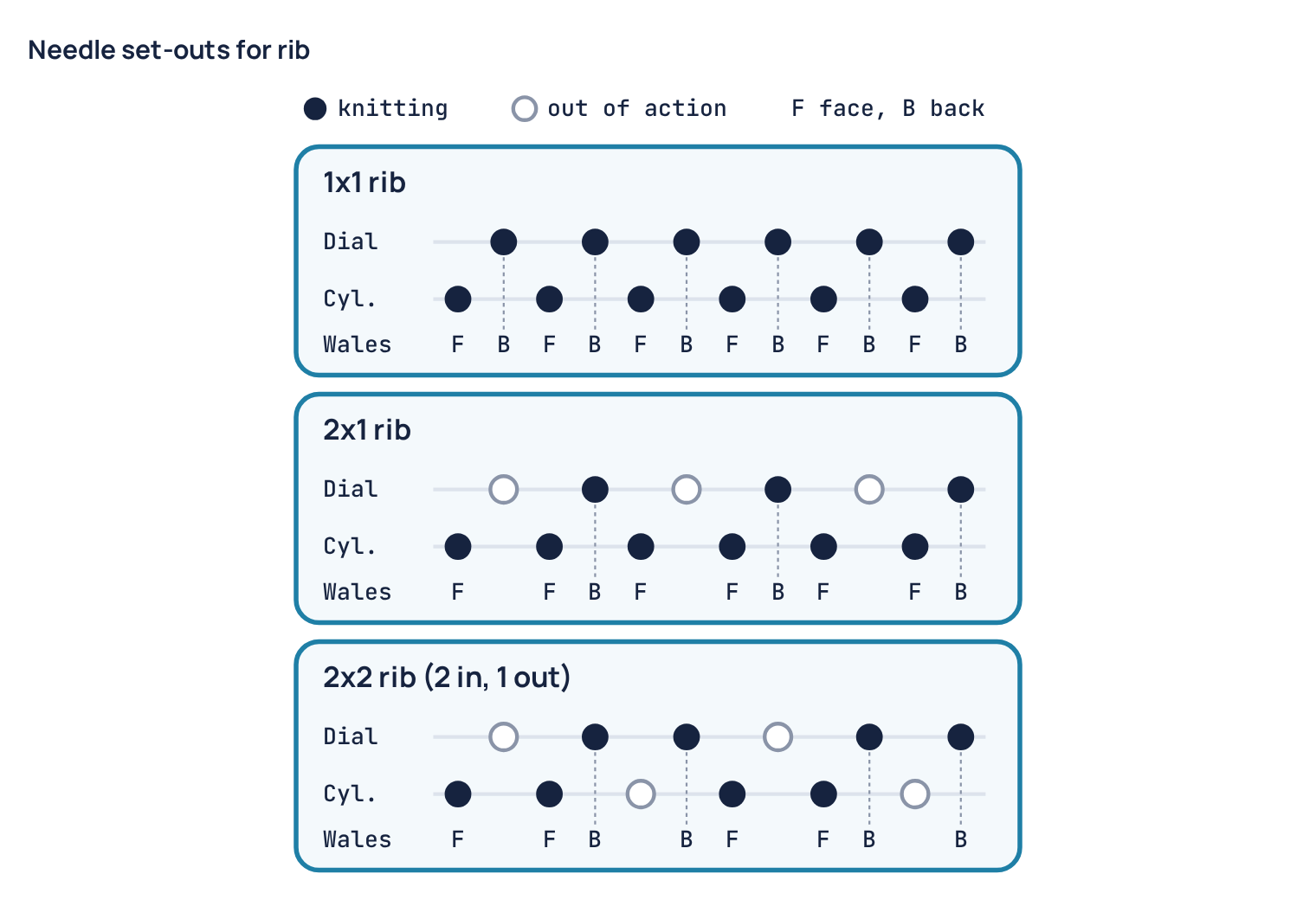
On a rib machine the dial needles sit in the gaps between the cylinder needles. This arrangement is called rib gating. Every rib structure is made by deciding which needles in each bed knit and which are taken out of action. This is the needle set-out, and it must be written on the record sheet, because two fabrics knitted on the same machine with different set-outs are different fabrics.
- 1×1 rib. Every needle in both beds knits. Cylinder, dial, cylinder, dial across the whole machine. This gives the finest, most even rib and the most loops per square centimetre.
- 2×1 rib. One common set-out uses every cylinder needle and every second dial needle. Two face wales sit together, then one back wale. The face shows wider cords, and the fabric is a little less elastic in width than 1×1.
- 2×2 rib. On rib gating, a common set-out takes every third needle out of action in both beds, with the two beds offset so that two face wales are followed by two back wales. Another way, used on machines with interlock gating, is two needles in and two out on each bed. Either way, 2×2 rib has deeper cords and is popular for cuffs and waistbands where a strong, visible rib is wanted.
Common mistake: copying a rib quality from an old record without checking the set-out. A 2×2 rib knitted where a 1×1 was meant can look acceptable on the machine, but it has fewer loops per square centimetre, so it finishes lighter and with a different width.
Development inputs
Read the buyer’s request, and ask what the rib is for
Write every requirement in one place before you choose yarn: finished GSM with tolerance, finished width or tubular dia, composition including elastane percentage, rib type (1×1, 2×1, 2×2), shade and light source, wash care, and the list of tests. For rib there is one more question that decides everything else: is it a body fabric or a trim, and if a trim, for which body?
- For a body, the buyer’s GSM, width and shrinkage limits apply directly.
- For a trim, the body fabric’s yarn, shade, dye route and test standard come with it. The rib must pass the same colour fastness tests, look the same colour next to the body, and recover well enough that a neckband does not stay open after washing.
Choosing the yarn
Count. Because rib carries two beds of loops, a rib of the same weight as a jersey is usually knitted from a finer count. In our register the most used rib yarns are 30/1, 32/1 and 34/1 cotton or cotton blends with elastane, plus 24/1 and 40/1 cotton for rib without elastane.
Fibre. In our register 82% of rib entries contain elastane: 744 cotton with elastane, 349 other fibres with elastane (mostly cotton blended with modal or lyocell), and 100 CVC or PC with elastane. Plain cotton rib accounts for 223 entries and CVC or PC rib without elastane for 27. Modal and lyocell blends give a softer, cooler handfeel and are common in inner wear and ladies’ tops; they need their own dyeing route (see cotton modal knit dyeing process and lyocell knit dyeing process).
Yarn quality. Combed, ring or compact yarn gives a cleaner rib face and better pilling. For trims, use the same yarn quality as the body if possible. A carded rib next to a combed body can show a different lustre and a slightly different shade even from the same dye bath.
Elastane denier. In our register the elastane in rib is 20 or 30 denier, almost always fed at every feeder (recorded as full feeder). The data below show that 30 denier gives a heavier, narrower rib than 20 denier on the same count.
Knitting
Gauge and machine diameter
Rib gauge is counted as needles per inch on one bed. In our register rib is overwhelmingly an 18 gauge fabric: 1,410 of 1,461 entries are 18G, with a few on 14G, 16G and 28G. The machine diameters are much larger than for single jersey: 42 inch is the most used (452 entries), then 40, 32, 34 and 44 inch. Large diameters are needed because rib finishes narrow, as the next section shows.
Why rib finishes narrow
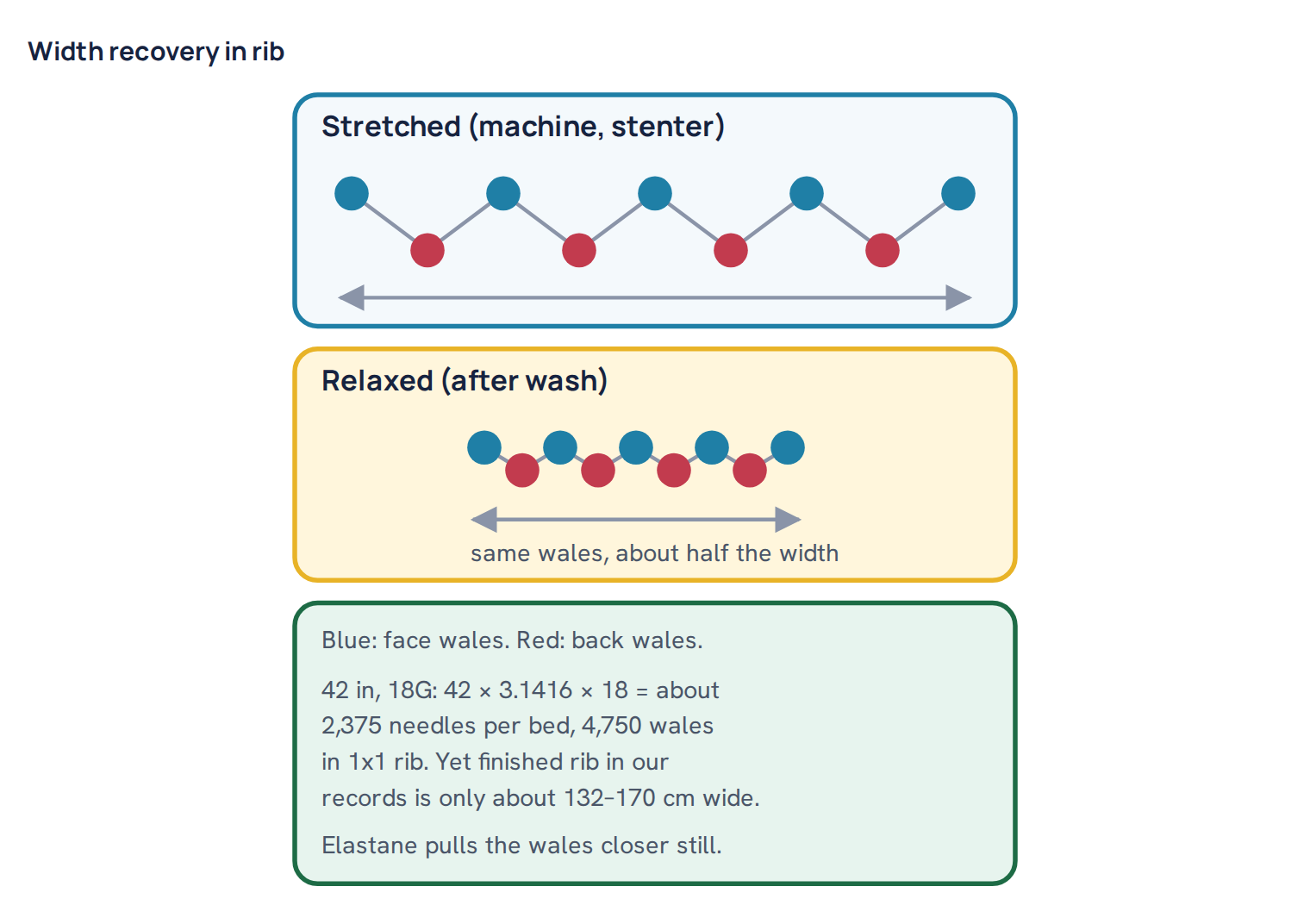
Count the needles. A 42 inch, 18 gauge machine has 42 × 3.1416 × 18, about 2,375 needles in the cylinder and the same number in the dial. A 1×1 rib from it has about 4,750 wales in total. A 30 inch, 24 gauge single jersey machine has about 2,262 needles and gives a fabric around 170 cm wide. Yet the rib from the bigger machine, with twice the wales, finishes at only about 132 to 170 cm in our records.
The reason is width recovery. On the machine, and while it is stretched on a stenter, the rib is held open with the face and back wales side by side. As soon as it is free, the back wales slide behind the face wales and the width closes up. Elastane makes this much stronger, because the elastane is stretched during knitting and pulls back when released. So rib width is not a fixed number like the needle count. It is a balance between how far the fabric is held open and how hard it pulls back.
Stitch length, count and GSM
The weight formula is the same as for any weft knit: GSM = (courses per cm × wales per cm × stitch length in mm × yarn tex) ÷ 100, with tex = 590.5 ÷ Ne count. For rib, count all the wales, face and back. In relaxed 1×1 rib you see only the face wales, but the same number of back wales is hidden behind them, so the true wales per cm are about twice what you count on the face. You can try combinations with the knit GSM from stitch length calculator or the GSM calculator.
The formula also shows why rib GSM is so sensitive to width. Stretch the rib wider on the stenter and the wales per cm fall at once, so the GSM falls with them. A rib that is 5% too wide will usually be close to 5% too light, and the opposite holds for a rib that is too narrow.
Yarn, stitch length and GSM from our records
The table shows the most used rib yarns in our register, all on 18 gauge. Stitch length is in mm per loop, with the interquartile range (the middle half of entries) in brackets. Finished GSM is after dyeing and finishing; GSM after wash is after the dye-house wash test. Finished dia is in cm, open width unless the rib was finished tubular. Shrinkage is the dye-house wash test.
| Yarn | Entries | Stitch length, mm | Required GSM | Finished GSM | GSM after wash | Finished dia, cm | Shrink L / W, % |
|---|---|---|---|---|---|---|---|
| 30/1 cotton + 30 den elastane, full feeder | 144 | 2.88 (2.80–2.90) | 280 | 260 (242–270) | 286 | 135 | -5 / -4.5 |
| 34/1 cotton + 20 den elastane, full feeder | 110 | 2.80 (2.70–2.80) | 200 | 190 (185–205) | 220 | 140 | -5 / -7 |
| 34/1 cotton/modal 60/40 + 20 den elastane | 84 | 2.80 (2.80–2.80) | 200 | 185 (182–194) | 214.5 | 160 | -6 / -5 |
| 34/1 cotton + 30 den elastane, full feeder | 74 | 2.70 (2.70–2.75) | 220 | 210 (205–212) | 234 | 132 | -5 / -6 |
| 32/1 cotton + 30 den elastane, full feeder | 46 | 2.70 (2.65–2.80) | 240 | 230 (220–240) | 260 | 135 | -4 / -5 |
| 34/1 cotton/lyocell 60/40 + 20 den elastane | 35 | 2.80 (2.80–2.80) | 230 | 205 (190–210) | 230 | 142 | -7 / -3 |
| 30/1 cotton + 20 den elastane, full feeder | 35 | 2.80 (2.80–2.80) | 240 | 227 (216–230) | 248 | 152 | -5 / -3 |
| 34/1 cotton/modal 60/40 + 20 den elastane (second yarn record) | 33 | 2.80 (2.70–2.80) | 220 | 188 (182–197) | 212 | 155 | -6 / -3 |
| 40/1 cotton | 28 | 2.48 (2.45–2.50) | 180 | 148 (136–155) | 175 | 150 | -8.5 / -6 |
| 34/1 cotton/modal/lyocell blend + 20 den elastane | 26 | 2.80 (2.80–2.80) | 200 | 190 (180–198) | 214 | 162.5 | -7.5 / -3.5 |
| 24/1 cotton | 25 | 2.75 (2.75–2.75) | 250 | 245 (242–250) | 272 | 170 | -4 / -4 |
A few things stand out. First, the stitch length band is very tight: almost all Lycra rib sits at 2.70 to 2.88 mm on 18 gauge. The floor has a standard, and the GSM is steered mainly by count, elastane denier and finishing, not by large stitch length changes. Second, elastane denier drives weight and width. On 30/1 cotton, 30 denier gives 280 GSM at 135 cm, while 20 denier gives 240 GSM at 152 cm. On 34/1, 30 denier gives 220 GSM at 132 cm against 200 GSM at 140 cm with 20 denier. The heavier elastane pulls the rib narrower and denser. Third, the modal and lyocell blends finish wider, 142 to 162.5 cm, than the 34/1 cotton with the same 20 denier elastane at 140 cm. Fourth, the 40/1 cotton rib without elastane is the outlier: required 180, finished 148 and still only 175 after the wash test.
Elastane in rib
In Lycra rib a bare elastane filament is fed with the cotton yarn and knitted into the loops. All the main Lycra rib qualities in our register are recorded as full feeder, meaning elastane at every feeder. Points to control:
- Denier. 20 denier for lighter, softer rib bodies and trims; 30 denier for heavier rib and for trims that need more power. As the table shows, the denier changes both GSM and width.
- Feed tension (draft). Elastane is fed from a positive feeder at a set draft. A feeder running at a different tension makes a course with different stretch, which shows as a bar across the fabric and as local GSM and width variation. Record the draft for every feeder and check it on every trial. Barre causes and cures are in barre in knit fabric.
- Elastane breaks. A broken elastane end leaves a line of loose, wider loops. Inspect greige for it before heat setting, because heat setting will fix the fault in place.
- Grin-through. Elastane takes little or no reactive dye. When a rib is stretched, as it is in a neckband, the white elastane can show through a dark shade. Check dark rib in the stretched state, not only relaxed.
Machine settings to record
- Machine number, diameter, gauge, number of feeders, gating and needle set-out.
- Yarn count, type, supplier and lot; elastane denier, feed (full or alternate) and draft.
- Stitch length measured on the greige fabric, with the cam setting for both dial and cylinder.
- Yarn input tension, take-down tension and machine speed.
- Greige tubular dia, greige GSM and roll weight, measured after the roll has relaxed.
Greige inspection
Check the greige for holes, needle lines, drop stitches, elastane breaks, tension bars and oil stains. Measure GSM and dia after the roll has rested. Greige Lycra rib often measures much narrower and heavier than the finished target, because the elastane has already pulled it in. That is normal; the heat setting width is what brings it back.
Dyeing and finishing route
All 1,461 rib entries in our register are finished open width on stenter and compactor. In the register 82% of rib entries carry a heat-set flag, the same share as the rib with elastane. The route is shown below with typical parameter ranges, which vary with the dye supplier, machine and shade. A shorter overview is in the rib fabric dyeing and finishing flowchart, and the wet processes are in cotton elastane (Lycra) knit dyeing process, 100% cotton knit dyeing process and CVC fabric dyeing process.
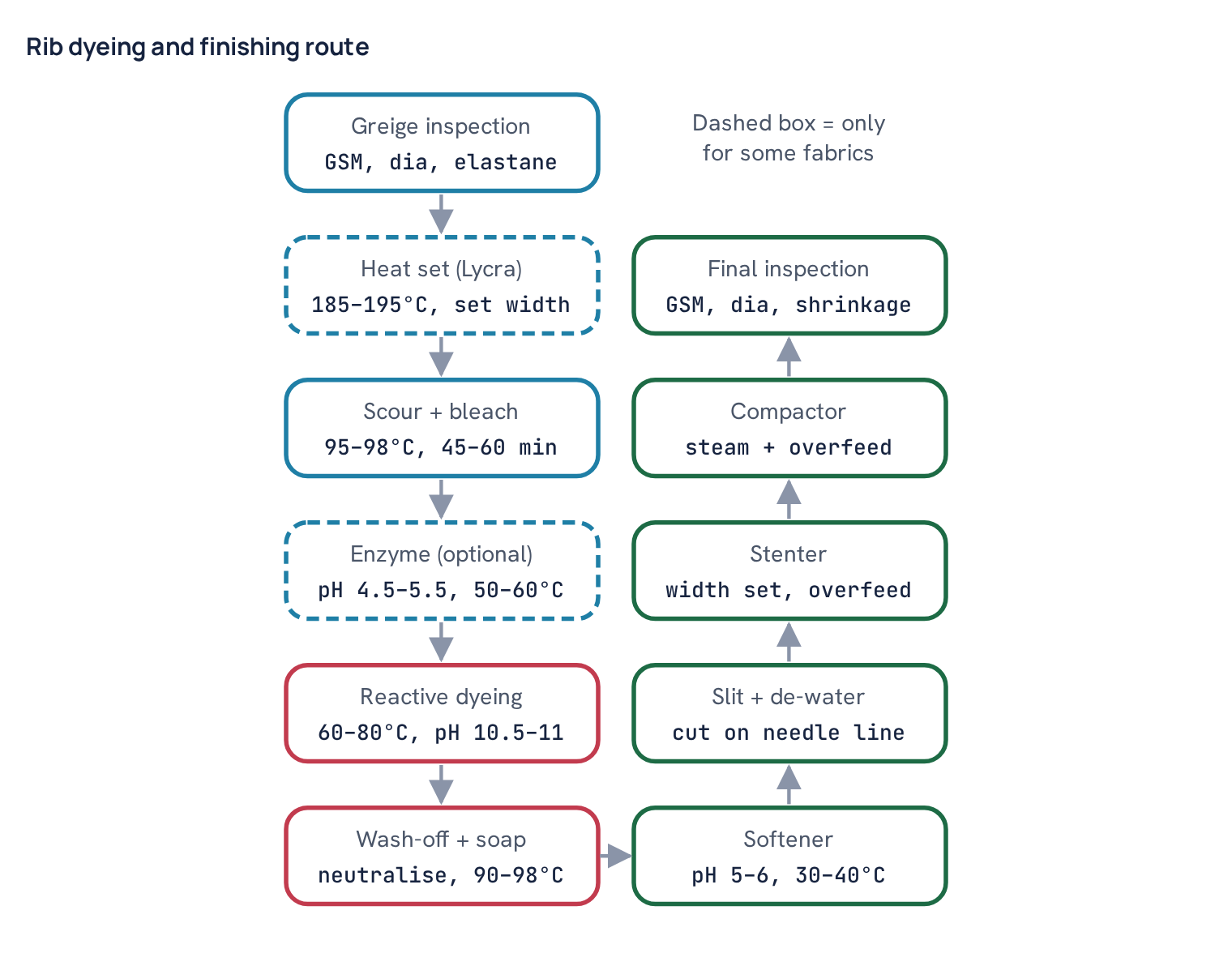
- Heat setting (Lycra rib). The greige is set on the stenter, typically around 185 to 195°C for 30 to 60 seconds, at a planned width. This fixes the elastane at that width so the rib does not shrink in, crease or lose shape in the dyeing machine. For rib this is the most important width decision in the whole route: set too narrow and the rib will finish narrow and heavy; set too wide and it will finish light and may shrink back in width after washing.
- Scouring and bleaching. Caustic soda, hydrogen peroxide, stabiliser and wetting agent, typically 95 to 98°C for 45 to 60 minutes, then hot rinse, neutralise and remove leftover peroxide. Rib is dense, so good wetting and enough liquor flow are needed to avoid a lighter shade inside the cords.
- Enzyme, if required. Acid cellulase at about pH 4.5 to 5.5 and 50 to 60°C, then deactivate. It improves surface and pilling, at the cost of a little weight and strength.
- Reactive dyeing. Salt and alkali dosed in steps, fixation typically at 60°C for most vinyl sulphone and bifunctional dyes, up to 80°C for hotter types, at about pH 10.5 to 11. See how reactive dyes work and, for patchy results, level dyeing and uneven shades. Long rope runs of heavy Lycra rib can mark; see crease marks in knit dyeing.
- Wash-off and softener. Soap near the boil to remove unfixed dye, then softener at about pH 5 to 6 and 30 to 40°C. Wash-off quality decides wet rubbing, which is a weak point on dark rib.
- Slitting, stenter and compactor. Slit on a marked needle line. On the stenter, dry Lycra rib below its heat-set temperature, set the width and give enough overfeed. On the compactor, steam and overfeed relax the length and set the final GSM. Every centimetre of stenter width you add costs GSM.
Hitting finished GSM and width
What our records show
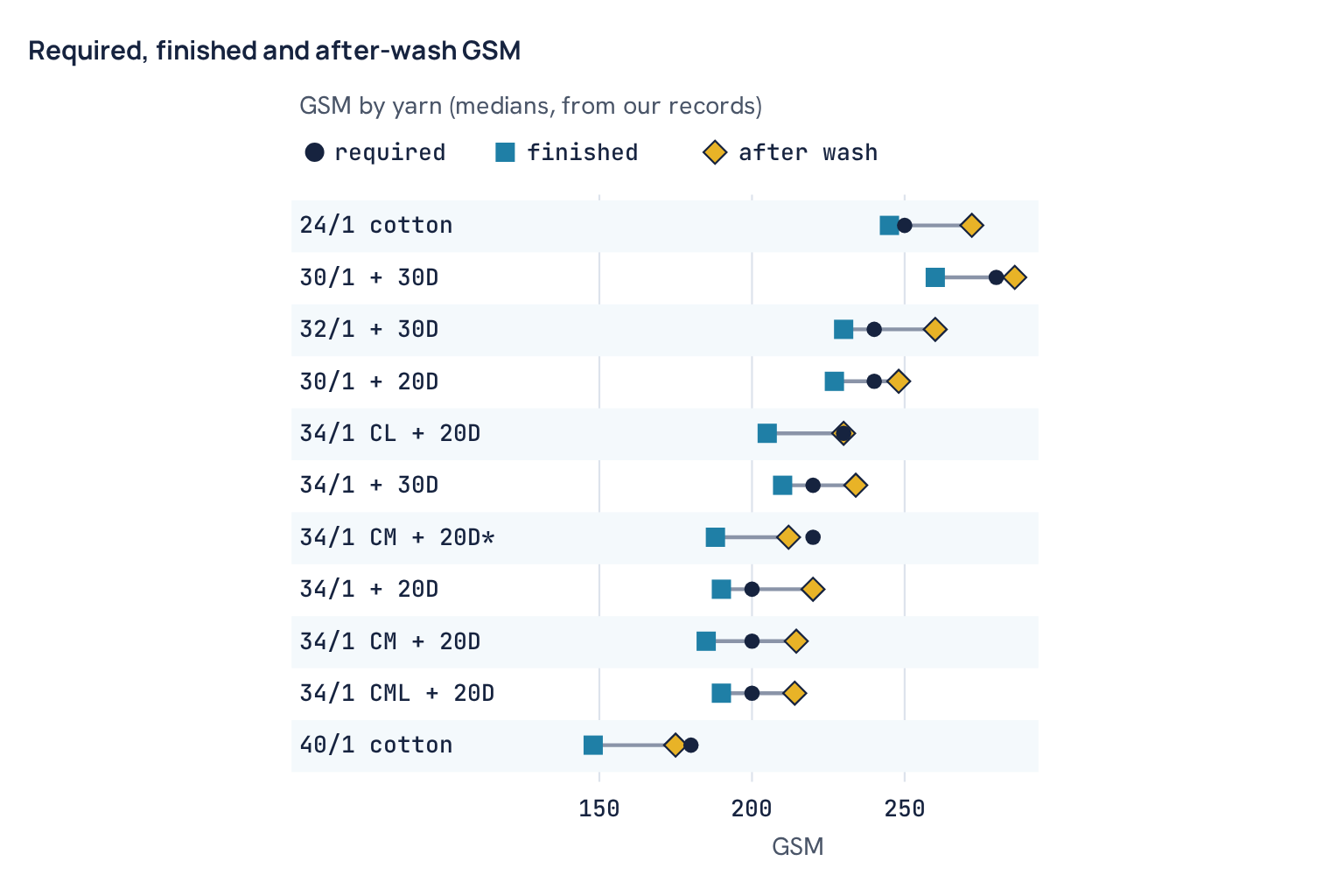
Like single jersey, rib tends to finish light, and by a little more. Across 1,411 rib entries with both values, the median finished GSM is 5.8% below the required GSM. Only 40% finish within ±5% of the requirement, 58% finish more than 5% light, and only 3% finish more than 5% heavy. After the dye-house wash test the GSM rises by a median of 12.2%, clearly more than in single jersey.
The chart above shows what this means for each yarn. For almost every Lycra rib quality, the finished GSM is below the requirement and the after-wash GSM is above it. The cotton with 30 denier elastane on 30/1 goes from 260 finished to 286 after wash against 280 required; 34/1 with 20 denier goes from 190 to 220 against 200. The yarn is there. The rib leaves the compactor held wider and longer than it wants to be, and the wash lets it close up.
Why rib finishes light
- Width held open. Rib has very high width stretch, so the heat set and stenter can hold it far wider than its relaxed width. The wider it is held, the lighter it is when measured.
- Elastane recovery. Elastane keeps pulling after finishing. When the dye house washes the sample, the elastane closes the rib in both directions, so GSM jumps.
- Length not fully compacted. Too little compactor overfeed leaves length stretched in.
- Target set at the edge. If the construction only reaches the target with perfect finishing, normal variation puts half the lots below it.
Width shrinkage is bigger in rib
In single jersey width shrinkage is usually small. In rib our register shows width shrinkage of -3% to -7% in the wash test: -7% for 34/1 cotton with 20 denier, -6% for 34/1 with 30 denier and for 40/1 cotton, and -5% for the 34/1 cotton/modal blend. Length shrinkage runs from -4% to -8.5%. The rib was held wider than its relaxed width, and the wash gives that width back. You can estimate the effect on a cut neckband or cuff with the fabric shrinkage calculator, and a fibre comparison is in our knit GSM and shrinkage by fibre study.
Controlling rib GSM and width
- Start from the record table: yarn, elastane denier, 18 gauge, stitch length and the usual finished dia for that quality.
- Agree the width first. For rib, width and GSM are one decision. If the buyer wants a wider rib at the same GSM, you need more needles (a larger machine) or a heavier construction, not just a wider stenter.
- Plan the heat-set width close to the finished width you need, and keep the stenter width near it. Large width pulls after heat setting give light GSM and high width shrinkage.
- Give enough stenter and compactor overfeed to relax the length.
- Check finished GSM, dia, after-wash GSM and shrinkage together. If finished GSM is low but after-wash GSM is on target, relax more and stretch less. If both are low, shorten the stitch length slightly or move to a heavier elastane or count.
Worked example. A buyer needs a 34/1 cotton Lycra rib at 220 GSM. Our register has two candidates: 34/1 with 20 denier elastane (required 200, finished 190, after wash 220, 140 cm) and 34/1 with 30 denier (required 220, finished 210, after wash 234, 132 cm). The 30 denier quality is the natural start, but it finishes 4.5% light and only 132 cm wide. If the marker needs more width, do not simply open the stenter: each centimetre wider costs GSM and comes back as width shrinkage. Use a larger machine diameter, or accept the narrower width and plan the marker around it.
Matching rib shade to the body fabric
A rib trim that is a shade off the body is one of the most visible faults on a garment, because the two pieces sit side by side at the neck and cuffs. Rib and body rarely come from the same fabric, so they can differ in shade even with the same recipe:
- Different construction. Dense rib, and the shadows between its cords, can look deeper than flat jersey dyed in the same bath.
- Different yarn. Different count, supplier, combing or blend changes dye uptake. Modal and lyocell take reactive dye differently from cotton.
- Elastane. The rib may contain elastane while the body does not, so it is heat-set and may follow a different route.
- Different batch. Trims are small quantities and are often dyed separately from the body.
Practical steps help. Use the same yarn supplier and quality as the body where you can. Where the processes are compatible, dye the rib in the same machine and batch as the body. When it must be dyed separately, match it to the approved body lot, not to the original lab dip. Judge the match after finishing, side by side, under the buyer’s light source, with the rib both relaxed and stretched as it will be in the garment. Make sure the rib meets the same fastness tests as the body, because a trim that bleeds in washing stains the body next to it.
Common mistake: approving rib shade on a relaxed swatch. Once the neckband is sewn and stretched, the cords open, the shade looks lighter and elastane can show through a dark colour.
Testing the developed fabric
Our desk holds 39 rib lab reports. Many were sent because of a problem, so their fail rates are higher than in overall production. Use them to see where the risk lies, not as a production average.
| Test | Typical buyer requirement (varies by buyer) | Our lab reports (rib) |
|---|---|---|
| Dimensional stability (shrinkage) | Often within ±5% L and W after the stated wash | 26 fails in 63 results; median after one wash L -2.1%, W -1.0% |
| GSM | Often ±5% of the required GSM | 17 fails in 39 results |
| Spirality | Often 5% maximum after washing | 1 fail in 59 results; median 0.0%, max 4.0% |
| Bursting strength | A minimum in kPa set by the buyer | 6 fails in 35; median 220 kPa, range 75–509 kPa |
| Pilling | Often grade 3–4 minimum | 0 fails in 35; mostly 4–5 pilling, 4 fuzzing |
| Colour fastness to rubbing | Often dry 4, wet 2–3 or 3 | 4 fails in 29; wet grades seen from 2 to 4–5, most often 3 or 2–3 |
| Colour fastness to washing, water, perspiration | Often 4 change, 3–4 staining | Wash 2 fails in 25; water 2 in 21; perspiration 1 in 28 |
| Fibre content | Within the label tolerance | 3 fails in 27 |
| Light fastness, pH, skew | Per buyer standard | No fails in the few results we hold |
Three points stand out. Shrinkage is the most failed test on rib, 26 fails in 63 results, which fits the high width shrinkage in our register: rib held wide in finishing gives it back in washing. GSM follows, with 17 fails in 39, matching the light finishing pattern. Spirality is almost no risk, with one fail in 59 and a median of 0.0%, as you would expect from a balanced structure.
Bursting strength deserves attention because of its wide range, 75 to 509 kPa. Fibre content fails, 3 in 27, are worth noting for Lycra and blended rib: the elastane share depends on denier, draft and finished width, so check it against the label before bulk. Wet rubbing on dark rib is the colour issue to watch.
- How to test shrinkage of knit fabric and shrinkage test fail: causes and remedies
- How to test GSM of knit fabric and GSM test fail: causes and remedies
- How to test spirality of knit fabric and spirality test fail
- How to test bursting strength and bursting strength fail
- Pilling test: box and Martindale and wet rubbing fastness fail
Development record sheet and troubleshooting
Record sheet template
Use one sheet per trial, with the requested and actual values side by side. For a trim, attach the body fabric’s reference.
| Stage | Record |
|---|---|
| Request | Buyer, style, body or trim (and body reference), rib type, required GSM and tolerance, finished width, composition, shade, wash care, test standard |
| Yarn | Count, type, blend, supplier, lot; elastane denier and feed |
| Knitting | Machine no., diameter, gauge, feeders, gating, needle set-out, stitch length (measured), dial and cylinder cam settings, elastane draft, take-down, speed |
| Greige | Greige GSM, tubular dia, roll weight, faults |
| Heat set | Temperature, time or speed, set width, overfeed |
| Wet process | Machine, batch (with body or separate), pretreatment, enzyme, dye recipe, fixation temperature and pH, wash-off, softener |
| Stenter | Temperature, speed, set width, overfeed |
| Compactor | Overfeed, steam, exit width |
| Finished | GSM, open width, GSM after wash test, shrinkage L/W, spirality, shade against body (relaxed and stretched) |
| Lab tests | Each result against requirement, pass/fail |
| Decision | Approved / adjust; what changes next and why |
Troubleshooting
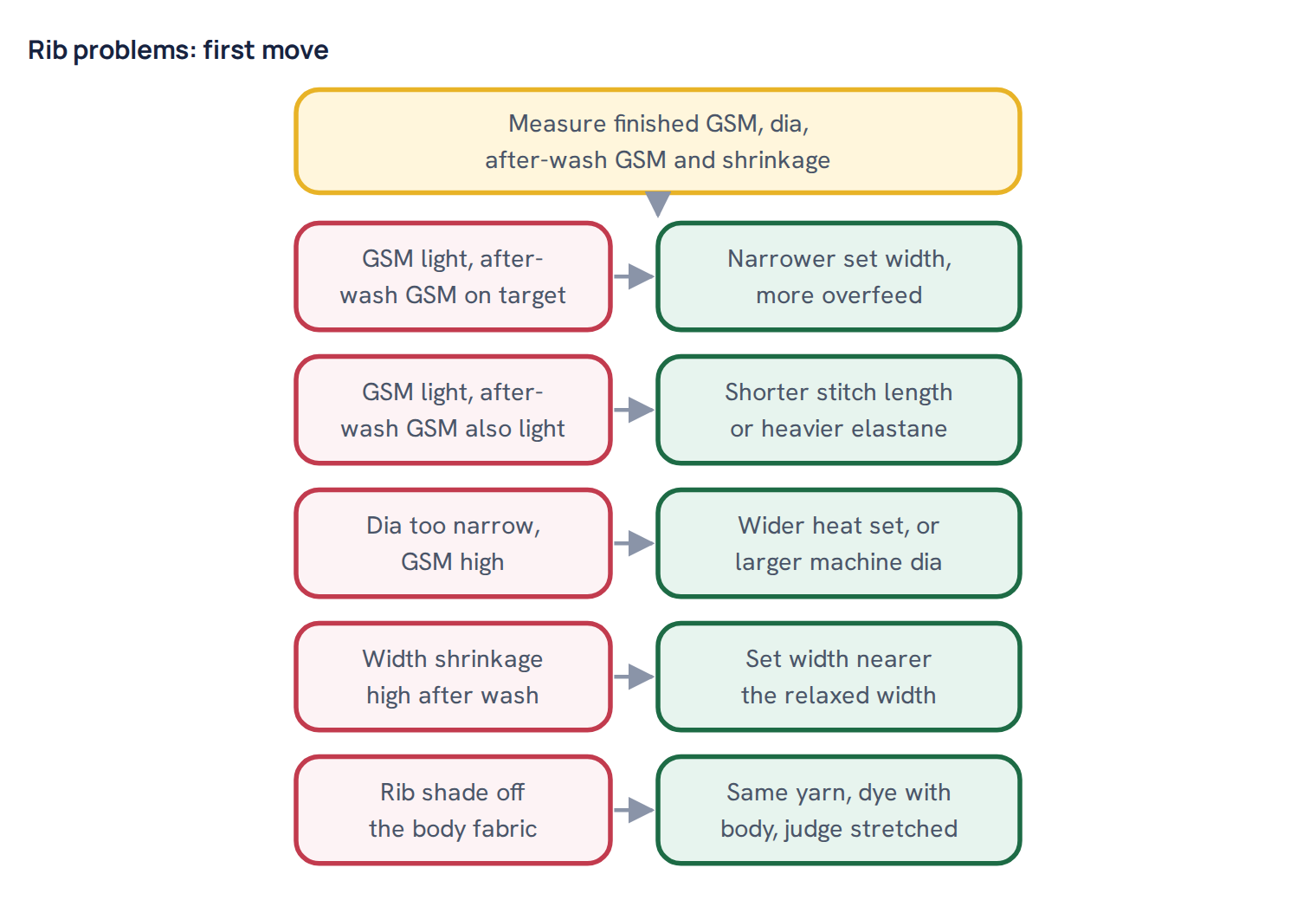
Measure first, then change one setting at a time. The diagram gives the first move for the most common rib problems; the table adds more.
| Problem | Likely cause | What to change |
|---|---|---|
| Finished GSM low, after-wash GSM on target | Rib held too wide; length not relaxed | Narrower heat set and stenter width; more overfeed and compaction |
| Finished and after-wash GSM both low | Stitch length too long; count too fine; elastane too light | Shorten stitch length slightly; coarser count or heavier elastane |
| Width too narrow, GSM high | Heat set too narrow; heavy elastane; small machine | Wider heat set (watch GSM); lighter elastane; larger diameter |
| Width shrinkage high | Rib finished far wider than its relaxed width | Set width nearer relaxed width; check heat-set temperature |
| Neckband loses recovery after washing | Low elastane power; rib over-stretched in finishing; heat set too hot | Heavier elastane or full feed; less width stretch; check heat-set conditions |
| Bars across the rib | Uneven elastane draft; mixed yarn lots | Equalise feeder tension and draft; one yarn lot |
| Rib shade off body | Different yarn, construction or batch | Same yarn source; dye with body; match to body lot, stretched and relaxed |
| Elastane shows on dark rib | Elastane undyed; rib stretched in use | Check stretched; review elastane denier and plating |
| Lighter shade inside cords | Poor wetting or liquor flow in dense rib | Better wetting, pretreatment and liquor circulation |
| Bursting strength low | Fine yarn, light GSM, heavy enzyme | Coarser count or tighter rib; reduce enzyme |
Rib development comes down to one idea: width and GSM move together, and the fabric always wants to go back to its relaxed width. Start from proven yarn, elastane and stitch length pairs, decide the width with the heat setting rather than with the stenter, expect the wash test to close the rib up, and judge the shade against the body in the way the garment will be worn.
Questions
Why is rib fabric so narrow after finishing?
When rib relaxes, the back wales slide behind the face wales and the width closes up, and elastane pulls it in further. That is why rib in our records is knitted mostly on 32 to 44 inch machines yet finishes only about 132 to 170 cm wide.
What is the difference between 1×1, 2×1 and 2×2 rib?
It is the needle set-out. In 1×1 rib every dial and cylinder needle knits; in 2×1 one common set-out uses every cylinder needle and every second dial needle; in 2×2 every third needle is taken out on both beds, giving two face and two back wales.
What gauge and stitch length are used for Lycra rib?
In our register almost all rib is 18 gauge, and the main Lycra rib qualities run at 2.70 to 2.88 mm stitch length. GSM is steered mainly by count, elastane denier and finishing width.
Why does rib GSM rise so much after washing?
Rib is held wider and longer in finishing than it wants to be, and elastane keeps pulling back. In our records rib finishes a median 5.8% light, and GSM rises a median 12.2% after the dye-house wash test.
How do you match rib trim shade to the body fabric?
Use the same yarn source as the body, dye the rib with the body where the processes allow, otherwise match it to the approved body lot. Judge both after finishing under the buyer’s light source, with the rib relaxed and stretched.
What is rib in fabric?
Rib is a knit in which face loops and back loops alternate across the width, made on two sets of needles. The result is raised vertical lines and very high width stretch and recovery, which is why rib is used for cuffs, neckbands and fitted tops.

Textile engineer with 14+ years in dyeing and fabric development. He writes every guide on Dyeing Solution from real production work. Full profile