Yes, rayon is breathable: it absorbs more moisture than cotton and feels cool on the skin. What breathable really means, rayon vs cotton, polyester and linen, rayon in hot weather and for sweating, and how to keep it comfortable.
At a glance
~13%moisture regain
Cooland fluid
Slowto dry
9%median shrinkage
Yes, rayon is a breathable fabric. Rayon (also sold as viscose) is made from wood cellulose, the same basic material as cotton, so it absorbs moisture readily, lets air and water vapour pass through the fabric and feels cool against the skin. In hot, humid weather a light rayon shirt or dress usually feels cooler than polyester and often cooler than a heavy cotton. Its weak points are elsewhere: rayon is weak when wet, wrinkles easily and shrinks more than most fabrics.
This guide explains what “breathable” actually means for a fabric, why rayon breathes well, how it compares with cotton, linen, polyester and modal, whether rayon is good for hot weather and for people who sweat, and what to check on the label so the fabric you buy really does keep you cool. It is written from the dye-house side, where we handle rayon knits every day and see how the fibre behaves in water, heat and washing.
What “breathable” means for a fabric
When people call a fabric breathable they usually mean three different things at once:
- Air permeability: how easily air passes through the fabric. This depends mostly on the construction: open knits, thin yarns and light weights let more air through.
- Moisture absorption: how much sweat the fibre itself can take up. Cellulose fibres such as rayon, cotton and linen absorb a lot; polyester and nylon absorb very little.
- Water vapour transfer: how quickly the moisture near your skin can move out through the fabric and evaporate, which is what actually cools you.
A fabric can score well on one and badly on another. A tight polyester sports knit absorbs almost nothing, but moves sweat along its fibres and dries fast. A heavy cotton fleece absorbs a lot but holds it and stays damp. Rayon’s strength is that the fibre is highly absorbent and, in the light, smooth fabrics it is usually made into, the fabric also lets air and vapour through easily.
Why rayon breathes well
Rayon is regenerated cellulose. Wood pulp is dissolved and pushed through fine holes to re-form as fibre, so chemically it is very close to cotton. Its molecules carry many hydroxyl (–OH) groups that attract water, and its structure is less crystalline than cotton, so water gets in even more easily. That is why rayon:
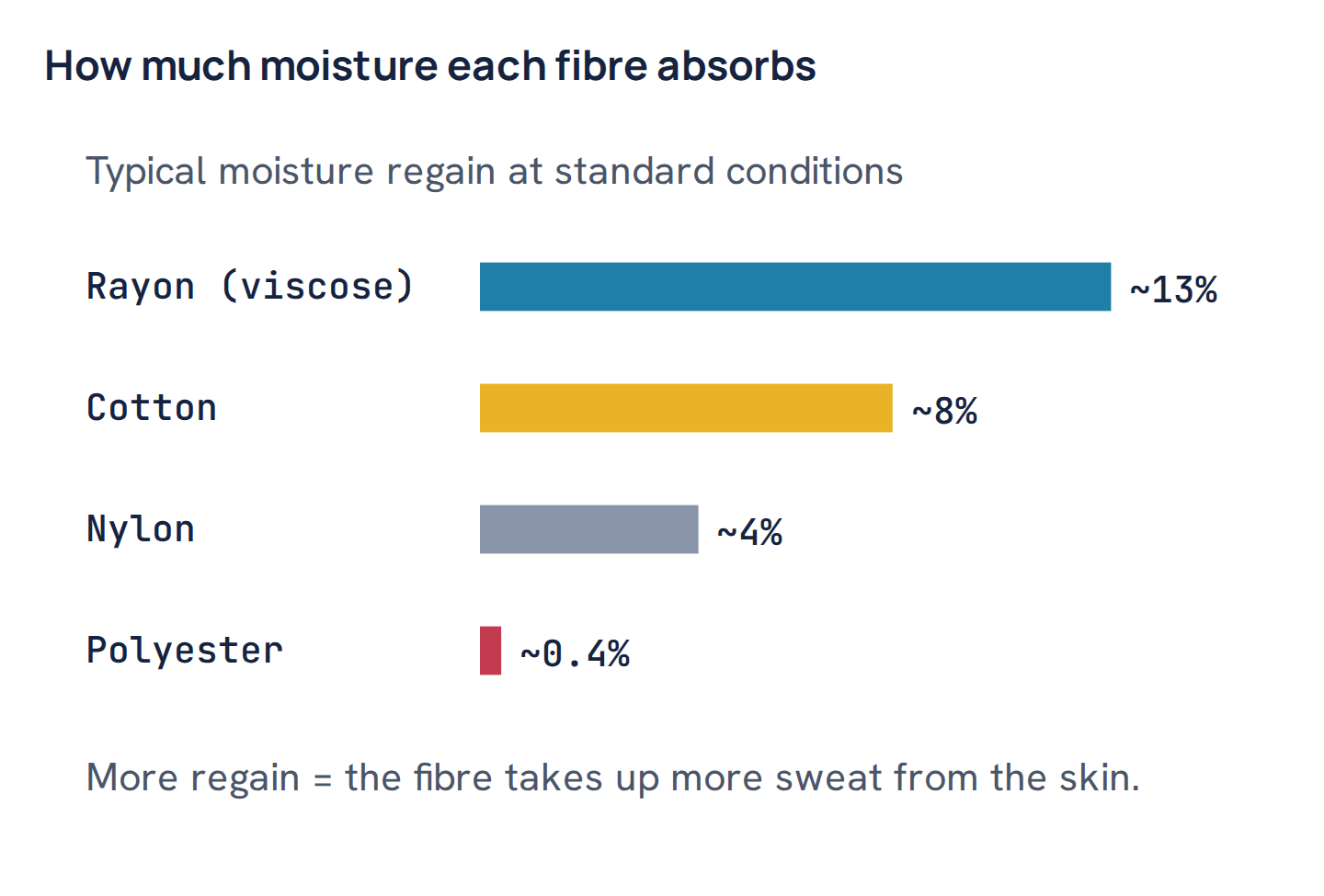
- Absorbs more moisture than cotton. Typical standard moisture regain for viscose is around 11–13%, against roughly 7–8.5% for cotton and only about 0.4% for polyester.
- Feels cool to the touch. Absorbent, smooth fibres draw heat away from the skin as they take up moisture.
- Drapes away from the body. Rayon is heavy and fluid for its weight, so a rayon shirt hangs and moves, letting air circulate instead of clinging.
For a fuller picture of the fibre itself, see what is viscose fabric; rayon and viscose are the same fibre under two names.
Is rayon more breathable than cotton?
Fibre for fibre, rayon absorbs more moisture than cotton and usually feels cooler. In practice the fabric matters as much as the fibre. A thin rayon challis or rayon jersey will feel more breathable than a heavy cotton twill, but a light cotton voile or cotton single jersey can feel just as airy as rayon. The practical differences:
| Point | Rayon | Cotton |
|---|---|---|
| Moisture absorption | Higher | High |
| Feel on skin | Cool, smooth, silky | Soft, slightly drier |
| Drape | Fluid, hangs away from the body | Stiffer, holds its shape |
| Drying speed | Slow | Slow to medium |
| Strength when wet | Low, easily distorted | Good, gets stronger wet |
| Shrinkage (our knit records) | Median 9% in length | Median 6% in length |
So rayon wins on cool, fluid comfort; cotton wins on durability and easy care. Many summer fabrics blend the two to get some of both.
Is rayon good for hot weather?
Yes, rayon is one of the better fabrics for hot and humid weather, which is why it is so common in summer dresses, Hawaiian shirts, beachwear and loose blouses. In heat it helps in three ways: it absorbs sweat instead of letting it sit on your skin, it feels cool to the touch, and its drape keeps it from sticking to you.
There are two catches. First, rayon dries slowly. If you sweat heavily during sport, a rayon shirt will soak up the sweat and stay wet and heavy, where a polyester sports top would wick it away and dry fast. Second, rayon loses much of its strength when wet, so a sweaty rayon garment can stretch out of shape at the elbows, seat and pockets. For everyday heat and humidity, rayon is excellent; for intense exercise, a technical polyester or nylon knit is the better tool.
Rayon vs polyester for breathability
This is the comparison where rayon clearly wins. Polyester is made from oil-based polymer and absorbs almost no moisture. On a hot day a plain polyester blouse can feel clammy because sweat stays between the fabric and your skin. Rayon takes that moisture into the fibre. Modern polyester sportswear gets around this with special yarn shapes and finishes that move sweat along the surface, so a good sports polyester can feel dry during exercise, but for casual wear in the heat most people find rayon far more comfortable.
The trade-off is care: polyester barely shrinks (a median 3% in our knit records), dries fast and does not wrinkle much; rayon shrinks most of any common fibre and creases easily. See does polyester shrink for the polyester side.
Rayon vs linen, modal and lyocell
- Linen is the classic hot-weather fabric. It absorbs well, dries faster than rayon and its stiff, open weave stands away from the skin. Linen feels crisper and wrinkles even more; rayon feels softer and drapes better.
- Modal is a stronger, more stable form of rayon. It breathes in much the same way, keeps its softness after washing and holds its shape better when wet. See what is modal fabric.
- Lyocell is another wood-based cellulose fibre made in a cleaner solvent process. It is breathable and cool like rayon, but much stronger wet. See what is lyocell fabric.
All four are good hot-weather choices. Rayon is usually the cheapest and the most fluid; modal and lyocell cost more but survive washing better.
What makes one rayon fabric more breathable than another
Not every rayon garment breathes equally. When you compare two rayon items, check:
- Weight: light fabrics (around 100–150 GSM for a shirt or blouse) breathe far better than heavy ones. See what GSM means.
- Construction: rayon challis, voile and open single jersey are airy; tight rayon twill, crepe or a dense double knit are warmer.
- Blend: rayon-polyester and rayon-nylon blends breathe less than 100% rayon, because the synthetic part absorbs little. Rayon with a few percent elastane breathes almost as well as plain rayon, but a tight stretch knit sits closer to the skin.
- Fit: a loose rayon shirt lets air move; a fitted rayon-elastane top traps more heat.
- Finish: heavy softeners or coatings can reduce absorbency slightly; most rayon fabrics are only lightly softened.
Common mistake: buying a “rayon” summer dress that is actually a rayon-polyester or mostly polyester blend. The label lists fibres in order of percentage. If polyester comes first, expect a warmer, less absorbent fabric than a 100% rayon dress of the same weight.
Is rayon good for people who sweat a lot?
For everyday sweating in heat, yes: rayon absorbs sweat and keeps the skin feeling drier than polyester. Two cautions apply. Sweat marks can show on some solid rayon colours because the absorbed sweat darkens the fabric until it dries. And repeated soaking and rubbing at the underarms can weaken rayon, so wash sweaty rayon garments promptly and gently. If you sweat heavily during activity, choose a quick-drying technical knit instead.
How rayon behaves in washing
Breathability is one half of the story; the other is how the fabric survives. From our finishing records of 164 viscose knit batches, the median length shrinkage after the dye-house wash test was 9%, the highest of any common fibre, and the worst tenth shrank 14% or more. Rayon swells strongly in water and is weak when wet, so it relaxes and distorts easily. See does rayon shrink for the full data.
In the dye house we treat rayon gently for the same reason: a milder scour, lower dyeing temperature around 60°C and careful handling in the machine. At home the equivalent is a cool, gentle wash and no hot tumble drying.
Worked example. You want a cool shirt for a humid summer holiday. A 100% rayon challis shirt at about 120 GSM, cut loose, will feel cooler and less clammy than a polyester shirt of the same weight. Because rayon can shrink around 9% in length, buy a size with some length to spare, wash it cold, and hang it to dry. If you will also hike in it, pack a light polyester or nylon sports shirt for the active days.
How to care for rayon so it stays comfortable
- Check the label: some rayon is dry-clean only; many modern rayon fabrics can be hand or machine washed cold.
- Wash cold or at 30°C on a gentle cycle, inside out.
- Do not wring; press water out gently.
- Dry flat or on a hanger, out of strong sun; avoid hot tumble drying.
- Iron on medium heat while slightly damp, ideally inside out.
Summary
- Rayon is breathable: it absorbs more moisture than cotton and feels cool.
- It is excellent for hot, humid weather and casual summer clothes.
- It dries slowly and is weak when wet, so it is not the best for intense sport.
- It breathes far better than polyester but shrinks more: a median 9% in our knit records.
- Choose light, loose, 100% rayon fabrics for maximum airflow, and wash cold and gently.
Questions
Is rayon breathable?
Yes. Rayon is made from wood cellulose, absorbs more moisture than cotton and lets air and water vapour pass through, so it feels cool in warm weather.
Is rayon good for hot weather?
Yes. Light, loose rayon is one of the most comfortable fabrics for heat and humidity. It dries slowly, so for intense sport a quick-drying polyester knit is better.
Is rayon more breathable than cotton?
Fibre for fibre, rayon absorbs more moisture and feels cooler. In practice a light cotton can feel just as airy; the weight and construction of the fabric matter as much as the fibre.
Is rayon better than polyester in summer?
For casual wear, yes. Polyester absorbs almost no moisture and can feel clammy; rayon takes up sweat. Polyester dries faster and shrinks far less.
Does rayon make you sweat?
No more than other fabrics. It absorbs sweat well, but it holds it and dries slowly, and sweat marks can show on some colours until it dries.

Textile engineer with 14+ years in dyeing and fabric development. He writes every guide on Dyeing Solution from real production work. Full profile