Anti-pilling fleece is fleece, usually polyester, made and finished to resist pills through better fibre, tighter knitting, controlled brushing and shearing, and heat setting. What anti-pill means, how it is made and tested, what our lab reports show, and how to wash fleece.
At a glance
Resistsnot pill-proof
Shearafter brushing
9 of 16fleece Martindale fails
Coolgentle wash
Anti-pilling fleece is fleece fabric, usually polyester, that has been made and finished to resist forming pills. Ordinary fleece has a brushed, fluffy surface that rubs into small balls of fibre, and because polyester fibres are strong, those pills stay attached. Anti-pill fleece reduces this with a combination of better fibre, tighter construction, controlled brushing and shearing, heat setting and sometimes a finish that locks fibre ends in place. It is not pill-proof, but it stays smooth far longer than standard fleece.
This guide explains what anti-pilling means, why fleece pills, how anti-pill fleece is made, how it is tested and graded, anti-pill vs standard and cotton fleece, how to tell good anti-pill fleece from poor, and how to wash fleece so it stays smooth. It draws on our fleece development register, our dye-house finishing routes and our lab reports, where fleece is the fabric most likely to fail pilling tests.
What does anti-pilling mean?
“Anti-pilling” or “anti-pill” means the fabric has been designed to resist pilling, the formation of small fibre balls on the surface. It does not mean the fabric never pills. In testing terms, an anti-pill fabric should keep a good pilling grade (often 3–4 or better on a 1–5 scale) after a set amount of controlled rubbing, where standard fleece might drop to 2 or 2–3. The term is used for polar fleece, sweatshirt fleece, knitwear yarns and blankets.
Why ordinary fleece pills so much
- Brushed surface: fleece is deliberately brushed to raise a soft pile, which is loose fibre waiting to tangle.
- Soft, bulky yarns: loop yarns are often coarse and lightly twisted for softness.
- Strong polyester fibres: pills cannot break off, so they stay and grow.
- Friction: backpacks, sleeves rubbing the body, seat belts and washing machines.
See why fleece and sweatpants pill for the full mechanism.
How anti-pill fleece is made
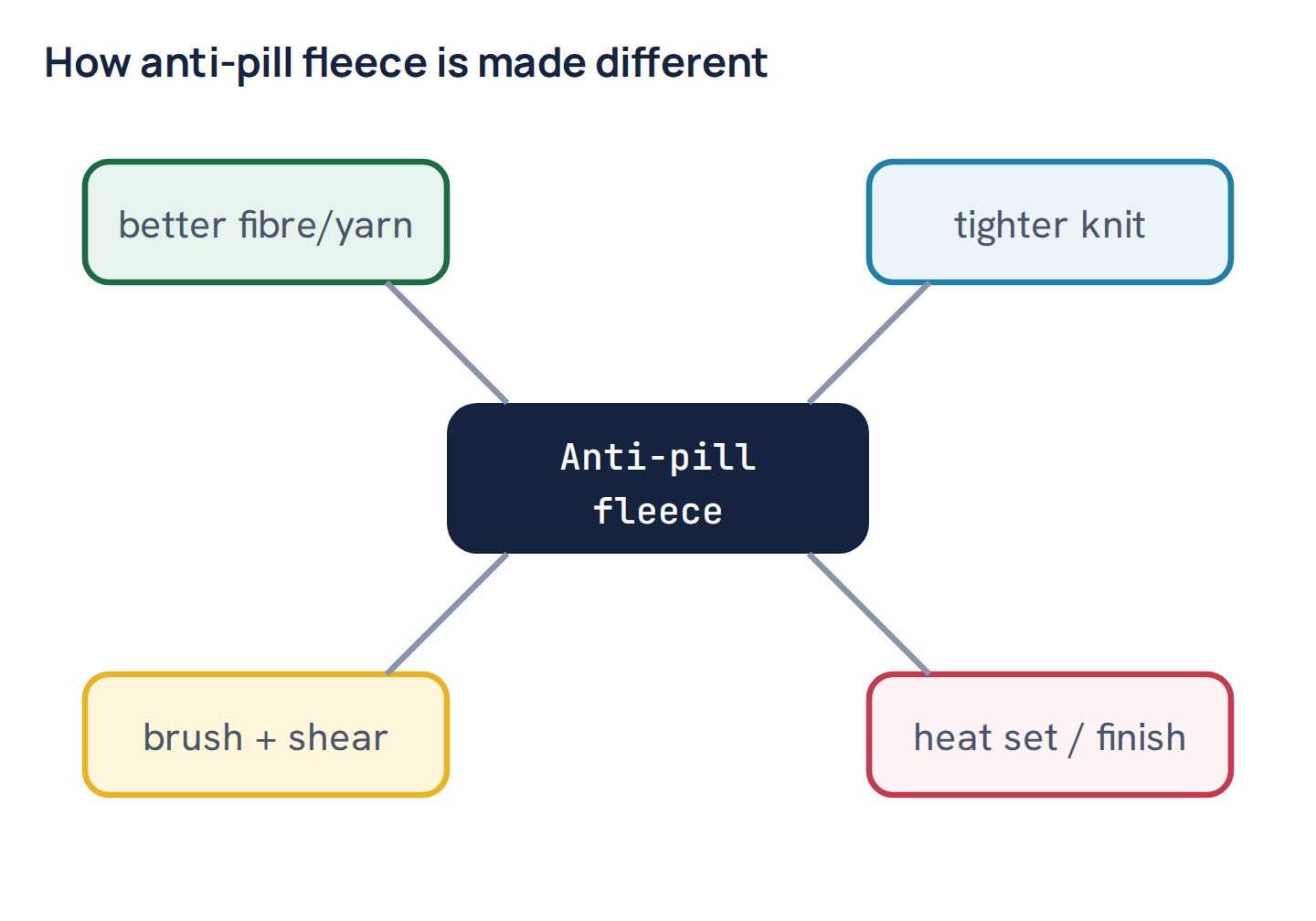
- Fibre and yarn: low-pill polyester fibres, which are made slightly weaker so pills break off, or finer, longer filaments and more tightly spun loop yarn that holds fibres in.
- Knit construction: a denser knit leaves less room for fibres to escape.
- Controlled brushing: raising enough for softness without over-loosening the fibres.
- Shearing: cutting the raised pile to an even, short height removes long, loose fibres that would otherwise tangle into pills.
- Heat setting: polyester fleece is heat set, which helps lock fibres and stabilise the pile.
- Anti-pill finish: a chemical finish that lightly binds fibre ends at the surface.
For cotton-rich fleece, enzyme treatment (bio-polishing) removes loose cotton fibres, and singeing can burn off surface fibres when the face is cotton. Neither works on polyester fuzz. See the fleece dyeing and finishing flowchart.
How pilling is tested
Labs rub fabric samples in a controlled way and grade them against reference photographs from 5 (no pilling) to 1 (very severe). The two common methods are the pilling box, where samples tumble on cork-lined boxes, and the Martindale tester, where samples are rubbed in a figure-of-eight pattern for a set number of cycles. Results depend heavily on the method and the number of rubs.
In our 316 outside lab reports on knit developments, 266 included a pilling result and only 19 failed. But the fails were concentrated in heavy CVC fleece and terry around 330 GSM tested on the Martindale at 2,000 rubs: 9 of 16 such fabrics failed, while none of 54 fabrics tested in the pilling box failed. The same fabric that graded 4–5 at 1,000 cycles could fall to 2–3 at 2,000. In our early reports, none of the failing fleece had been singed or heat set. See how pilling tests work and why fleece fails the pilling test.
Anti-pill vs standard fleece vs cotton fleece
| Point | Anti-pill polyester fleece | Standard polyester fleece | Cotton-rich fleece |
|---|---|---|---|
| Pilling | Low | High, pills stay | Medium, pills wear off |
| Softness | Soft, even pile | Very fluffy at first | Soft, natural |
| Warmth for weight | High | High | Medium |
| Breathability | Moderate | Moderate | Good |
| Drying | Fast | Fast | Slow |
| Price | Higher | Lower | Medium |
Common mistake: brushing a fleece harder at development to make the sample feel softer. The deeper, looser pile wins in the showroom and then pills quickly, and on the Martindale at 2,000 rubs it fails. Softness should come from good yarn and controlled raising with shearing, not from over-brushing.
How to tell good anti-pill fleece
- Even, short pile that springs back when pressed; long, loose fluff pills sooner.
- Dense base: hold it to the light; less light through the base means a tighter knit.
- Rub test: rub a fold against itself for a few seconds; good fleece fuzzes very little.
- Label: “anti-pill” or “anti-pilling” on both sides for polar fleece; check the fibre content.
- Weight: mid-weight fleece is usually more durable than very light, loose fleece.
Polar fleece vs sweatshirt fleece
Two different fabrics share the name fleece. Polar fleece is usually 100% polyester, knitted and brushed on both sides into a thick, lofty pile, then sheared; it is the classic fleece jacket and blanket fabric and the one most often sold as anti-pill. Sweatshirt fleece is a cotton, CVC or polyester knit with a smooth face and a brushed back; it is used for hoodies and joggers. Anti-pill treatments exist for both, but the tools differ: polyester polar fleece relies on fibre choice, shearing and heat setting; cotton-rich sweatshirt fleece can also use enzymes and, when the face is cotton, singeing. See the fleece fabric development guide.
Anti-pill fleece and recycled polyester
Much fleece today is made from recycled polyester, often from PET bottles. Recycled fibre can be made in anti-pill grades just like new polyester, and the same construction and finishing steps apply. The fibre source does not decide pilling; the fibre properties, yarn, knit and finishing do.
Uses of anti-pill fleece
- Fleece jackets, vests and pullovers
- Blankets and throws
- Sweatshirts and joggers
- Hats, scarves and gloves
- Pet beds and baby blankets
How to wash anti-pill fleece
- Wash inside out, cool (30°C), on a gentle cycle.
- Wash with other fleece or soft items; never with jeans, towels or Velcro.
- Use liquid detergent and skip fabric softener, which flattens pile.
- Air dry or tumble on low; high heat can melt and matt polyester pile.
- Shake out and brush gently with a soft brush to restore loft.
Worked example. Two fleece jackets are worn with the same backpack all winter. The standard fleece develops a band of pills across the back and shoulders within weeks; the anti-pill fleece shows light fuzzing that brushes off. Washed inside out on a gentle cycle and dried low, the anti-pill jacket still looks smooth at the end of the season.
Removing pills from fleece
If fleece does pill, a fabric shaver or a fleece comb used lightly on a flat surface removes the pills. Work gently and stop once the surface looks even; over-shaving thins the pile and can expose the knitted base. A soft brush afterwards lifts the pile again. Never pull pills off by hand, which drags more fibre out.
Is anti-pill fleece worth paying more for?
For items that are worn often and rubbed hard, such as jackets worn with backpacks, kids’ fleece and blankets used every day, yes: the difference in appearance after a season is usually obvious. For occasional use, standard fleece may be fine. Quality varies within both groups, so the feel tests above are more useful than the label alone.
Does anti-pill fleece shed fibres?
All fleece releases some loose fibres in the first washes, mostly short ends left from brushing and shearing. Anti-pill fleece usually sheds less over its life because its fibre ends are better anchored and fewer of them work loose. Washing full loads on a gentle cycle, at a cool temperature, and avoiding long tumble drying all reduce shedding further. A wash bag or filter can catch the fibres that do come off.
Summary
- Anti-pilling fleece is designed and finished to resist pills; it is not pill-proof.
- It uses better fibre, tighter knitting, controlled brushing and shearing, heat setting and finishes.
- In our lab reports, heavy fleece and terry at 2,000 Martindale rubs failed pilling in 9 of 16 cases.
- Over-brushing for softness is a common cause of pilling.
- Wash fleece inside out, cool, with soft items, and dry low.
Questions
What is anti-pilling fleece?
Fleece made and finished to resist pilling, using better fibre or yarn, a denser knit, controlled brushing and shearing, heat setting and sometimes a finish.
What does anti-pilling mean?
That the fabric is designed to resist forming pills and keeps a good pilling grade after controlled rubbing. It does not mean it can never pill.
Does anti-pill fleece pill?
Much less than standard fleece, but heavy friction can still raise some fuzz and small pills over time.
Is anti-pill fleece good quality?
Generally yes, especially with an even, short pile and a dense base. It stays smooth longer than standard fleece.
How do you wash anti-pill fleece?
Inside out at 30°C on a gentle cycle with soft items, liquid detergent and no softener, then air dry or tumble low.

Textile engineer with 14+ years in dyeing and fabric development. He writes every guide on Dyeing Solution from real production work. Full profile