Acid wash gives a sharp, high-contrast marbled look, usually made with bleach-soaked pumice stones; mineral wash gives a softer, cloudy, vintage fade. How each is made, look and feel compared, enzymes and garment dyeing, which fabrics suit each, and care.
At a glance
Marbledacid wash
Cloudymineral wash
Bleachnot acid
Garmentprocess
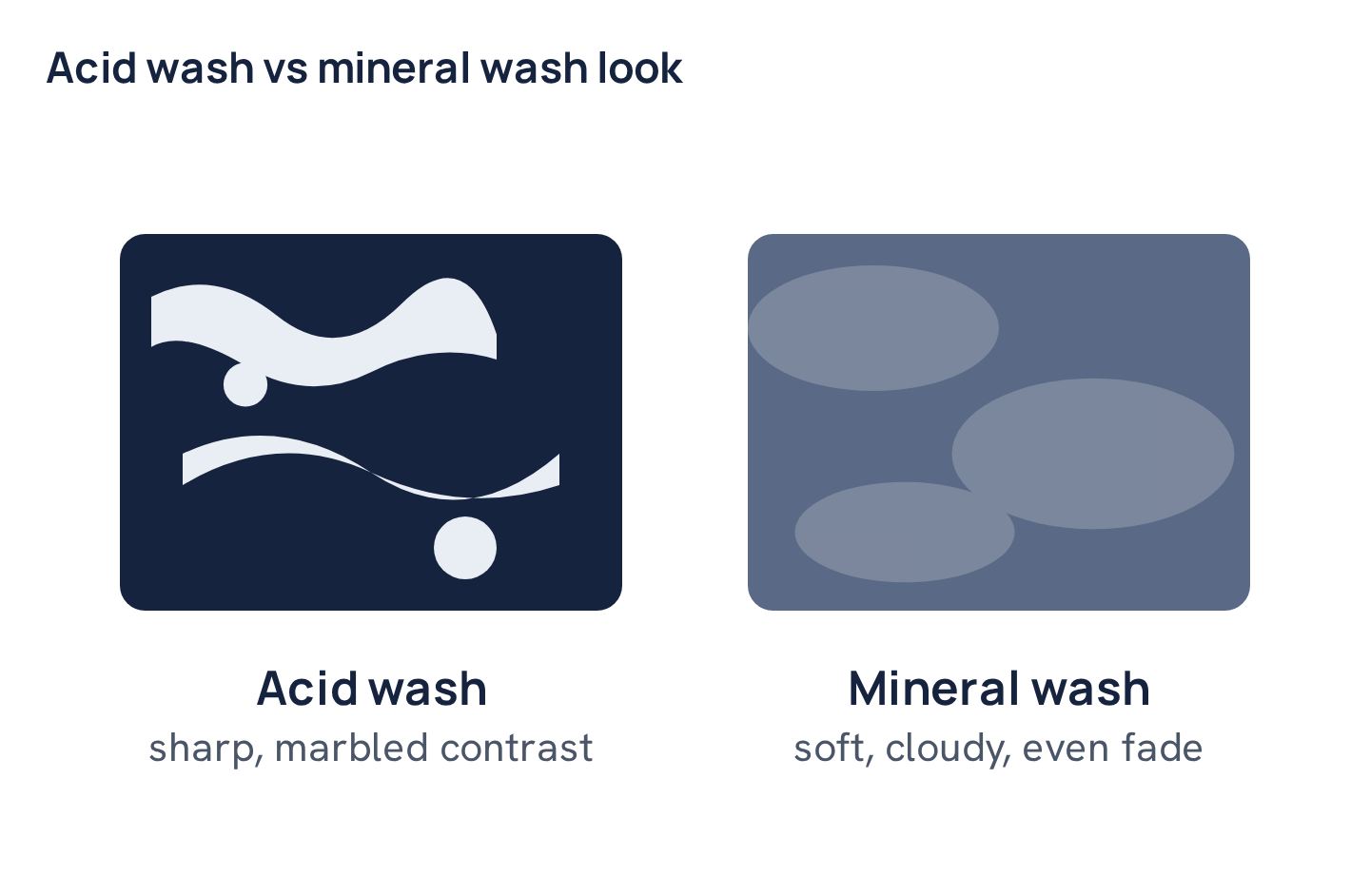
Acid wash and mineral wash are both garment finishes that give a faded, worn look, but they look and feel very different. Acid wash gives a strong, high-contrast marbled pattern of bleached and dark areas, made famous on 1980s denim. Mineral wash gives a softer, more even, cloudy fade with a muted, vintage look, now common on T-shirts, sweatshirts and hoodies. Despite the name, acid wash usually involves no acid: it uses pumice stones soaked in a bleaching agent. Mineral wash describes a gentler wash-down effect created by bleaching, enzymes, stones or garment dyeing techniques.
This guide explains how acid wash and mineral wash are made, how they differ in look, feel and durability, which fabrics suit each, how they relate to garment dyeing and enzyme washing, and how to care for washed garments. It is written from the wet-processing side, where garment washing and dyeing are part of the same family of processes.
What is acid wash?
Acid wash was developed for denim. Pumice stones are soaked in a strong bleaching solution, traditionally potassium permanganate or sodium hypochlorite (chlorine bleach), and tumbled with dry or slightly damp garments in a washing machine without much water. Where the stones hit the fabric, the bleach removes colour; where they do not, the original colour stays. The result is a high-contrast, marbled or streaked pattern. The garments are then neutralised and rinsed to stop the bleaching. The name comes from the harsh look, not from acid chemistry.
What is mineral wash?
Mineral wash is a softer finishing effect, used mostly on cotton knits such as T-shirts, sweatshirts and hoodies. The name is used loosely in the trade, and the effect can be produced in different ways:
- Mild bleaching applied unevenly to a dyed garment, sometimes with stones, for a cloudy fade.
- Pigment dyeing and washing down, where pigment colour is partly washed away for a chalky, faded look.
- Enzyme and stone washing, which abrades the surface and lifts some colour.
- Garment dyeing with special techniques that leave a mottled, uneven shade.
Whatever the route, mineral wash aims for a soft, muted, slightly uneven colour rather than the sharp contrast of acid wash.
Acid wash vs mineral wash compared
| Point | Acid wash | Mineral wash |
|---|---|---|
| Look | High-contrast marbling, white streaks | Soft, cloudy, muted fade |
| Typical fabrics | Denim, heavy cotton | Cotton jersey, fleece, French terry |
| Main process | Pumice stones soaked in bleach | Mild bleach, pigment wash-down, enzymes or stones |
| Feel | Can be harsher, more worn | Soft, broken-in |
| Fabric strength | More loss from strong bleaching and abrasion | Less loss when done gently |
| Uniformity | Every piece very different | Each piece slightly different |
| Style | Bold, 1980s, rock | Vintage, relaxed, washed-out |
How these finishes relate to garment dyeing and washing
Both are garment wet processes: the finished, sewn garment is treated, rather than the fabric roll. That gives each piece a slightly unique look, softer handle and little further shrinkage, because the garment has already been through hot wet processing. Garment dyeing and washing are close relatives: many mineral-wash looks start as garment-dyed or pigment-dyed pieces that are then washed down. See garment dyeing vs fabric dyeing and reactive vs pigment dye.
The role of enzymes
Enzyme washing uses cellulase enzymes that gently digest protruding cotton fibres. On denim it can replace or reduce pumice stones for a softer, cleaner worn look; on knits it removes fuzz and gives a smoother, softer surface. Enzymes are often part of a mineral-wash recipe because they soften the garment and help lift colour evenly. Too much enzyme weakens the fabric and can cause holes. See enzyme washed.
Which fabrics suit each finish
- Acid wash: best on sturdy cotton denim and twill that can take strong bleaching and abrasion. On thin knits it can weaken the fabric and cause holes.
- Mineral wash: best on medium-weight cotton jersey, fleece and French terry. Cotton-rich fabrics respond well; polyester parts do not bleach and stay darker, giving a mottled look on blends.
- Polyester and blends: chlorine bleach does not remove disperse dye from polyester, so washes on blends look patchy unless the effect is designed for it.
Common mistake: trying to acid wash a thin cotton T-shirt at home with neat bleach and stones. Strong bleach weakens cotton quickly, especially at seams and hems, and can make holes within a few washes. Factory processes control concentration, time and neutralisation; at home, dilute bleach heavily and neutralise thoroughly, or choose a ready-washed garment.
Durability and care
Washed garments have already lost some strength through bleaching and abrasion, so they deserve gentle care:
- Wash inside out, cold or at 30°C, with similar colours.
- Expect some further fading over the first washes, especially on mineral-wash pigment pieces.
- Avoid more bleach, which can weaken the fabric further.
- Line dry or tumble low.
- Do not iron directly on printed areas.
Why every washed garment looks different
Because the effect depends on where stones touch, how bleach soaks in and how each garment folds in the machine, no two acid-wash or mineral-wash pieces are exactly the same. That variation is part of the appeal. For brands, it also means approving a range rather than a single exact look, and checking each production lot against a standard so the overall level of fade stays consistent.
Acid wash and mineral wash at home
Home versions exist but are hard to control. A diluted bleach spray or bleach-soaked sponge can create an acid-wash-style pattern on cotton; a diluted bleach soak or a pigment-based kit can give a softer mineral-style fade. Always work on 100% cotton, wear gloves and eye protection, work in a ventilated space, dilute bleach well, rinse thoroughly and neutralise according to the product instructions. Test on a scrap first, and never mix bleach with other cleaning chemicals.
Worked example. A brand wants a vintage-look hoodie collection. Acid wash would give a bold, 1980s marbled look but risks weakening the fleece. A mineral wash on a garment-dyed cotton fleece, with an enzyme step for softness, gives a soft, cloudy, lived-in look that suits the brand better and keeps the fabric strong.
Other washed looks you may see
| Name | What it means | Look |
|---|---|---|
| Stone wash | Garments tumbled with pumice stones, no bleach | Even, softened fade |
| Enzyme wash | Cellulase enzymes replace or reduce stones | Clean, soft, gently faded |
| Snow wash | Another name used for a bleach-stone effect | Speckled, high contrast |
| Vintage or sand wash | Softening and light abrasion | Muted, peach-skin handle |
| Garment dyed | Sewn garment dyed in a drum | Rich, slightly uneven colour at seams |
| Pigment dyed | Pigment fixed with binder, then washed | Chalky, faded, lived-in |
Names are not standardised, so the same term can mean slightly different processes at different suppliers. When buying or developing a product, ask for a physical standard sample rather than relying on the name alone.
How shade and base colour affect the result
Both washes remove colour, so the result depends heavily on the starting shade. Dark navy, black and charcoal give the most visible contrast, because the bleached areas move a long way from the original colour. Mid shades give a gentler, dusty look. Very light colours show little change and can look simply faded or dirty. Base dye class matters too: reactive dyes on cotton bleach to a lighter version of the shade, while pigment colours wash off the surface more gradually. On blends, the polyester part keeps its disperse-dyed colour and the cotton part fades, creating a heathered or mottled effect.
Shrinkage and size after washing
Because acid wash and mineral wash are done on finished garments with water, heat and tumbling, the garment shrinks during the process itself. That is one reason washed garments often keep their size well at home: much of the shrinkage has already happened. Factories size the patterns to allow for this. Cotton knits typically shrink more than denim in this step, so mineral-wash T-shirts and hoodies are usually cut slightly larger before washing. See does cotton shrink.
Summary
- Acid wash gives a sharp, high-contrast marbled look; mineral wash gives a soft, cloudy fade.
- Acid wash usually uses pumice stones soaked in bleach, not acid.
- Mineral wash can come from mild bleaching, pigment wash-down, enzymes or stones.
- Both are garment processes, so every piece is slightly different.
- Wash these garments cool and gently, and avoid extra bleach.
Questions
What is the difference between mineral wash and acid wash?
Acid wash has a sharp, high-contrast marbled pattern; mineral wash has a soft, cloudy, even fade with a muted vintage look.
Does acid wash use acid?
Usually not. Traditional acid wash tumbles garments with pumice stones soaked in a bleaching agent such as potassium permanganate or chlorine bleach.
What is a mineral wash shirt?
A garment, usually cotton, given a soft, cloudy, faded look by mild bleaching, pigment wash-down, enzymes or stones.
Can you mineral wash or acid wash at home?
Home versions are possible with diluted bleach on 100% cotton, but they are hard to control. Use protection, dilute well, rinse and neutralise.
How do you care for washed garments?
Wash inside out, cool, with similar colours, avoid extra bleach and dry low.

Textile engineer with 14+ years in dyeing and fabric development. He writes every guide on Dyeing Solution from real production work. Full profile