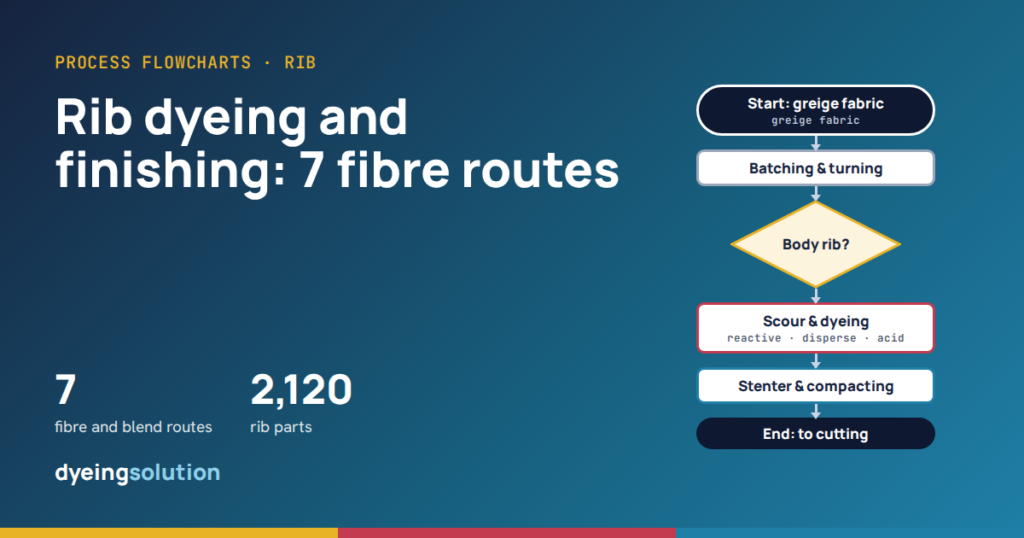
Rib is the second most common knit we dye, and two out of three rib parts carry elastane. Here is the dyeing and finishing route for each fibre, from greige rib to the cutting table, with what our records show about GSM, width and shrinkage.
At a glance
2,120Rib parts in our records
67%Carry elastane
73%Heat set
4%Median width shrinkage
Rib is knitted on two sets of needles, so its face loops show on both sides in vertical ribs: one knit, one purl in 1×1, two and two in 2×2, and so on. That gives it its stretch across the width and its recovery, which is why it is used for cuffs, collars, neckbands, fitted tops and leggings. Heavier and more elastic than single jersey, it is also more often made with elastane: 67% of the 2,120 rib parts in our records.
| Rib type | Parts |
|---|---|
| 2×2 rib | 678 |
| 1×1 rib | 580 |
| Design rib | 359 |
| 2×1 rib | 201 |
| Flat rib | 81 |
| 4×2 rib | 26 |
| Variegated rib | 22 |
Rib by fibre: what our records show
| Fibre or blend | Parts | Median required GSM | With elastane | Within ±5% GSM | More than 5% light | Median length shrinkage | Median width shrinkage | Heat set |
|---|---|---|---|---|---|---|---|---|
| Cotton-elastane | 834 | 240 | 100% | 39% | 58% | 5% | 5% | 96% |
| Cotton + modal / lyocell / viscose | 388 | 200 | 98% | 18% | 80% | 6% | 4% | 98% |
| 100% cotton | 386 | 250 | 0% | 35% | 58% | 7% | 5% | 6% |
| CVC / PC | 305 | 260 | 26% | 52% | 35% | 4% | 3% | 66% |
| Viscose / modal / lyocell | 75 | 230 | 72% | 25% | 69% | 6% | 2% | 69% |
| Polyester-viscose | 52 | 270 | 56% | 48% | 40% | 4% | 2% | 65% |
| Polyester | 35 | 240 | 63% | 32% | 32% | 4% | 2% | 83% |
Rib is heavier than single jersey: a median required GSM of 235 against 180. It also shrinks in width, a median of 4% against 2% for single jersey, because the ribs close up when the fabric relaxes. CVC holds GSM best again, and cotton-modal and cotton-lyocell rib with elastane finishes light most often, four parts in five.
When rib is heat set
Heat setting is done mainly for dimensional stability: so the fabric does not shrink or go out of shape. Preventing crease marks is the second reason. Rib needs it less than single jersey. Its structure is relaxed, its loops are thick and dense, and it normally runs through dyeing as a tube, so it stays fairly stable on its own. That is why only 6% of 100% cotton rib is heat set in our records, even at a median 250 GSM.
What decides it is how the rib is used. Rib for a neckband, collar or cuff on a single jersey, fleece or lacoste garment covers a small area, so it does not need heat setting even with elastane. Rib used as the main body of a garment does: Lycra body rib is always heat set, and so is heavy or tightly knitted rib.
- The main reason for heat setting is dimensional stability: the fabric must not shrink or go out of shape. The second reason is crease marks.
- Rib is relaxed by structure, so it is fairly stable: the loop thickness and density and the yarn interlacement hold it. It also normally runs in tube form, which keeps it stable.
- When rib is used as a neck or collar with single jersey, fleece or lacoste, it is only a small area, so it does not need heat setting, even with Lycra.
- When rib is the main body, Lycra rib must be heat set, and heavy and tightly knitted rib must be heat set too.
Finishing rib: usually as a tube
Rib is usually finished in tube form. After dyeing it goes through the squeezer to remove water, the relax dryer, the turning machine to bring the face back outside, and the tube compactor. When rib is open width, it is slit, set on the stenter and compacted, like single jersey.
- Single jersey and interlock run almost the same process. Rib is different: it is usually in tube form and goes through the tubular finishing route.
- When rib is open, it goes slitting, stenter and compacting like single jersey.
- Rib normally comes in tube form. We can also finish it open.
- There is no fixed rule for tube or open. It depends on the marker design and the buyer requirement.
Controlling rib width in finishing
Finished width is a balance between relaxation, overfeed, compaction and GSM. Chasing width with one setting only moves the problem somewhere else.
- Overfeed on the dryer shortens the fabric and can add width, but too much gives fullness, spirality, high GSM and unstable size after washing.
- For tube rib, set the tube width mechanically and keep the fabric relaxed while drying.
- Order: relax the fabric, set the tube width, dry with controlled overfeed, compact to the required shrinkage and GSM, then check the width after relaxation, not straight off the machine.
- If the width comes out narrow, do not just raise compactor pressure. First check for over-compaction in length, the dryer pulling the fabric in, and the tube width setting.
- Build the finishing recipe against the buyer’s washed width, GSM and shrinkage, not the greige width.
The sequence before the dyeing machine
Every chart below follows the same sequence before dyeing. Steps a fabric does not need simply drop out; they are drawn dashed.
- Greige inspection, then batching. A fabric that stays a tube is turned inside out here.
- If it needs heat setting, singeing or mercerising: slitting first. None of these is ever done on a tube.
- If it needs heat setting: heat setting in open width.
- If it needs singeing: singeing in open width, after checking the flame cannot damage the fabric.
- If it is mercerised: mercerising, then drying.
- If the fabric was opened: back sewing, to make it a tube again with the face side inside (the loop side, for terry).
- Loading into the dyeing machine, then scouring, bleaching and dyeing, single part or double part as the fibre needs.
Flowcharts by fibre and blend
All charts below use the tubular finishing route. For open-width rib, replace the last steps with slitting, stenter and compacting.
- Cotton-elastane (Lycra) rib
- Cotton-modal and cotton-lyocell rib
- 100% cotton rib
- CVC and PC rib
- Viscose, modal and lyocell rib
- Polyester-viscose rib
- Polyester and polyester-elastane rib
Cotton-elastane (Lycra) rib
The biggest rib group. Heat set when it is used as the main body fabric; Lycra rib for collars and cuffs is not. A cooler 80°C scour protects the elastane. In our records: 834 parts, 39% within GSM tolerance, median length shrinkage 5% and width shrinkage 5%. Full process: cotton-elastane dyeing process.
Dyeing and finishing: Cotton-elastane (Lycra) rib
Cotton-modal and cotton-lyocell rib
Almost all of it carries elastane, and it is heat set when it is the body fabric. One reactive bath dyes both fibres: scoured like cotton, washed off like modal. In our records: 388 parts, 18% within GSM tolerance, median length shrinkage 6% and width shrinkage 4%. Full process: cotton + modal / lyocell / viscose dyeing process.
Dyeing and finishing: Cotton-modal and cotton-lyocell rib
100% cotton rib
Rib is a relaxed, stable structure, so 100% cotton rib is rarely heat set: only 6% of parts in our records, even though most of it is heavy. Heavy or tightly knitted rib used as the body is the exception. In our records: 386 parts, 35% within GSM tolerance, median length shrinkage 7% and width shrinkage 5%. Full process: 100% cotton dyeing process.
Dyeing and finishing: 100% cotton rib
CVC and PC rib
Two baths: the polyester part first at 130°C, then the cotton part at 60°C. PC with the polyester dyed is always heat set; CVC when it is heavy or has elastane. In our records: 305 parts, 52% within GSM tolerance, median length shrinkage 4% and width shrinkage 3%. Full process: CVC / PC dyeing process.
Dyeing and finishing: CVC and PC rib
Viscose, modal and lyocell rib
Heat set when it is body rib with elastane, or heavy. A mild scour, nothing above 80°C in wash-off, and the enzyme depends on the fibre. In our records: 75 parts, 25% within GSM tolerance, median length shrinkage 6% and width shrinkage 2%. Full process: viscose / modal / lyocell dyeing process.
Dyeing and finishing: Viscose, modal and lyocell rib
Polyester-viscose rib
The CVC route with a viscose-type scour. Heat set when it is body rib with elastane, or heavy. In our records: 52 parts, 48% within GSM tolerance, median length shrinkage 4% and width shrinkage 2%. Full process: polyester + viscose / modal dyeing process.
Dyeing and finishing: Polyester-viscose rib
Polyester and polyester-elastane rib
Heat set, disperse dyeing at 130°C and reduction clearing on every shade. In our records: 35 parts, 32% within GSM tolerance, median length shrinkage 4% and width shrinkage 2%. Full process: polyester dyeing process.
Dyeing and finishing: Polyester and polyester-elastane rib
Common faults and buyer complaints
- Loose-knit rib is not dimensionally stable. It shrinks and moves after washing.
- Uneven rib width (dia) from roll to roll or along a roll.
- Crease marks when the tube is not placed properly in the dryer.
- Light GSM, above all on cotton-modal and cotton-lyocell rib with elastane.
- Loose-knit rib is often not dimensionally stable.
- The rib dia is sometimes uneven.
- If the rib is not placed properly in the dryer, a crease mark forms.
- These faults mostly show up at the garment stage, in cutting and sewing.

Textile engineer with 14+ years in dyeing and fabric development. He writes every guide on Dyeing Solution from real production work. Full profile