Pants pill in the crotch and inner thighs because the legs rub together with every step. Which trouser fabrics pill most, spun vs filament yarns, fit, how pilling is tested, how to wash trousers to slow pilling, and how to remove pills safely.
At a glance
Innerthigh friction
Spunyarns pill more
Grade 5–1pilling scale
Inside outcool wash
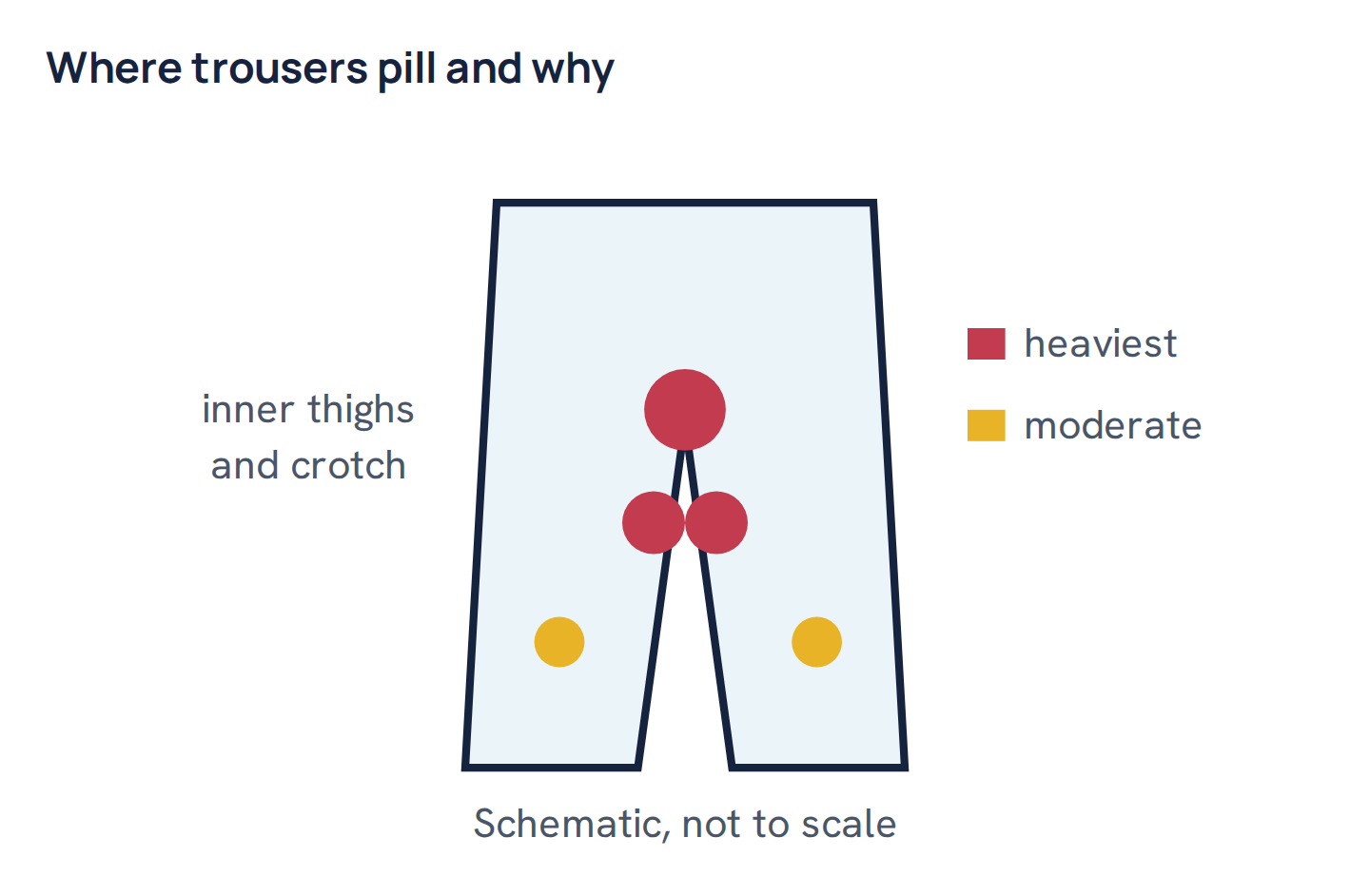
Pants pill in the crotch and inner thighs because that is where the fabric rubs against itself with every step. Walking makes the inner legs slide past each other thousands of times a day, and sitting adds pressure and friction at the seat. That rubbing pulls loose fibre ends out of the yarn and rolls them into small balls, or pills. Pilling is worst on soft, brushed or spun-synthetic fabrics such as polyester-cotton joggers, fleece sweatpants, polyester-viscose trousers and leggings, and on thighs that touch when walking. Better fabrics, a slightly looser fit and gentler washing slow it down a lot.
This guide explains why pilling concentrates in the crotch and inner thighs, which fabrics pill most, how fit and body shape matter, how pilling is tested in the factory, how to wash trousers to reduce it, how to remove pills safely, and when a pilled crotch means the fabric is about to wear through. It is written from the dye-house and testing side, where pilling is one of the most common complaints on knit trousers and fleece bottoms.
Why the crotch and inner thighs pill first
- Fabric-on-fabric friction: the inner legs rub against each other directly, which is one of the harshest kinds of abrasion.
- Repetition: every step is a rub, so a day of walking adds up to thousands of cycles.
- Pressure and heat: sitting presses the seat and crotch, and body warmth and moisture soften fibres and help them tangle.
- Seams: crotch seams create ridges that concentrate rubbing.
Which trouser fabrics pill most
| Fabric | Pilling risk | Why |
|---|---|---|
| Polyester or poly-cotton fleece joggers | High | Brushed surface, strong polyester anchors pills |
| Polyester-viscose suit trousers | High | Spun polyester staple, smooth face shows pills |
| Acrylic or acrylic blends | High | Short fibres, loose yarns |
| Polyester-spandex leggings (spun) | Medium to high | Constant thigh rubbing |
| Cotton French terry | Medium | Cotton pills often break off |
| Filament nylon or polyester leggings | Low to medium | Continuous filaments have few loose ends |
| Cotton denim and twill | Low | Tight weave; wears through rather than pills |
See why fleece and sweatpants pill and does polyester pill.
Spun vs filament yarns
Fabrics made from spun yarns, where short staple fibres are twisted together, have many loose fibre ends that can work out and pill. Fabrics made from continuous filament yarns, as in many smooth leggings and tights, have far fewer ends, so they pill less, though they can snag or fuzz. When a legging or trouser feels soft and “cottony” but is polyester, it is usually made from spun polyester, which pills more than a smooth filament fabric.
Fit and body shape matter
If the thighs touch when walking, the fabric rubs harder and more often. Tight trousers also press fibres together and increase friction. A slightly looser leg, a gusseted crotch, or a fabric with a smoother face can reduce pilling. Some people find that the same trousers pill only in the crotch area for them and nowhere else, simply because of their walking pattern.
How pilling is tested
Factories test pilling by rubbing fabric samples under controlled conditions and grading them from 5 (no pilling) to 1 (severe). The pilling box tumbles samples on cork-lined tubes; the Martindale tester rubs samples in a figure-eight pattern. Results depend heavily on the number of rubs: in our fleece testing, fabrics that graded 4–5 at 1,000 rubs could drop to 2–3 at 2,000 rubs. Of 316 lab reports we reviewed, 266 had a pilling result and 19 of those failed, and nine of sixteen heavy fleece and terry fabrics around 330 GSM failed at 2,000 Martindale rubs. See how pilling is tested and fleece pilling test failures.
What manufacturers do to reduce pilling
- Longer fibres, more yarn twist and compact spinning.
- Tighter knits or weaves.
- Singeing, enzyme treatment (for cotton) and shearing to remove surface fibres.
- Anti-pill finishes that bind fibre ends.
- Reinforced or gusseted crotch construction.
Common mistake: washing joggers and leggings with jeans and towels on a long, hot cycle and tumble drying them. The rough items and tumbling add abrasion exactly where the fabric is already weakest. Wash trousers inside out with similar soft items, on a short, cool cycle, and air dry.
How to wash trousers to reduce pilling
- Turn trousers inside out.
- Wash cool (30°C) on a gentle or short cycle.
- Wash with similar fabrics; avoid towels, denim and items with zips or Velcro.
- Use liquid detergent rather than powder.
- Avoid overloading the drum, which increases rubbing.
- Line dry or tumble on low for a short time.
How to remove pills from the crotch
- Lay the trousers flat and smooth the area.
- Use a fabric shaver or sweater comb lightly, in one direction.
- Avoid pressing hard at seams, where the fabric is thin.
- Snip single pills with small scissors rather than pulling them.
Each removal takes away some fibre, so the crotch slowly thins. Prevention is better than repeated shaving.
When pilling means the fabric is wearing out
Heavy, repeated pilling at the crotch is a sign of abrasion. On some fabrics, particularly thin leggings and polyester-viscose trousers, the area becomes thin and shiny and can eventually wear through or split at the seam. If you can see light through the fabric when stretched, or the area feels thinner than the rest, the garment is near the end of its life.
Worked example. A customer returns grey poly-cotton joggers that pilled heavily between the legs after three weeks. The fabric was a loosely knitted, brushed fleece made from short polyester staple. A replacement in a tighter, combed-cotton-rich French terry, washed inside out on a cool cycle and air dried, shows only light fuzz after the same period.
Leggings pilling between the legs
Leggings are especially prone to inner-thigh pilling because they fit closely, so the fabric surfaces press together hard with each step. Brushed or “buttery soft” leggings are usually made from fine spun polyester or nylon with a peached surface, which feels lovely but has many fibre ends ready to pill. Compressive leggings made from smooth filament nylon-spandex or polyester-spandex pill much less. If your leggings pill quickly between the legs, look for a smoother, firmer fabric and avoid washing them with cotton towels.
Suit trousers and work trousers
Polyester-viscose suit trousers often pill at the inner thigh and seat, and the pills show clearly on a smooth face. Wool and wool-rich trousers usually pill less, and the pills that do form often wear away. A good tailor can also reinforce a thin crotch area with a patch on the inside before it wears through, extending the life of a favourite pair.
Does fabric softener help pilling?
A little conditioner can reduce friction and static on cotton and blended trousers, which may slow pilling slightly. On technical leggings and sportswear, softener blocks wicking and should be avoided. Gentle washing, inside out with similar items, does far more than softener to reduce pilling.
Why the same trousers pill for one person and not another
Pilling depends on use as well as fabric. Someone who walks a lot, cycles, or whose thighs touch when walking will see pilling much sooner than someone who mainly sits or whose legs do not rub. Bags or wallets carried in front pockets and rough car seats also add abrasion. That is why reviews of the same trousers can range from “pilled in a week” to “still like new”.
Crotch pilling vs wearing through
Pilling is surface damage; wearing through is structural. Small pills that come and go are cosmetic. A crotch that feels thinner, looks shiny or shows the backing yarns is close to splitting. Catch it early with a reinforcing patch inside.
Rotating between two or three pairs also gives each pair more rest, which slows wear.
Summary
- Trousers pill in the crotch because the inner legs rub together with every step.
- Spun polyester, fleece, acrylic and polyester-viscose pill most.
- Filament fabrics and tight wovens pill less.
- Fit, washing and drying habits strongly affect pilling.
- Remove pills gently; heavy pilling is a sign of wear.
Questions
Why do my pants pill in the crotch?
Because the inner legs rub against each other with every step, pulling fibre ends out of the yarn and rolling them into pills.
Which pants pill the least?
Tightly woven cotton and denim, and leggings made from smooth filament nylon or polyester, pill less than fleece and spun polyester.
How do you stop leggings pilling between the legs?
Choose filament-yarn leggings, wash inside out on a cool, gentle cycle with soft items, and air dry.
Is pilling a sign of poor quality?
Often. Early heavy pilling usually points to short fibres, loose yarns or a loose knit.
Can you remove pills from the crotch?
Yes, use a fabric shaver lightly on a flat surface, but avoid seams and do not shave too often.

Textile engineer with 14+ years in dyeing and fabric development. He writes every guide on Dyeing Solution from real production work. Full profile