Polyester is flammable but harder to ignite than cotton: it shrinks away from a flame and melts, and molten polyester drips and sticks to skin. Melting point, polyester vs cotton in fire, poly-cotton blends, flame-retardant polyester, children's sleepwear and practical fire safety.
At a glance
250–260°Cmelting point
Meltsand drips
Harderto ignite
FRversions exist
Polyester is flammable, but it behaves very differently from cotton in a fire. Untreated polyester does not catch fire as easily as cotton: when a small flame touches it, polyester tends to shrink away and melt rather than ignite, and it can self-extinguish once the flame is removed. But if it does burn, polyester melts and drips, and the hot molten plastic sticks to skin and can cause severe burns. Polyester melts at around 250–260°C. So polyester is “less likely to ignite, more dangerous when it does” compared with cotton.
This guide explains how polyester behaves in a flame, why it melts, how it compares with cotton, nylon, acrylic and wool, polyester and fire safety rules for children’s sleepwear and furnishings, flame-retardant polyester, the burn test for identifying polyester, and safety tips around cooking and open flames. It is written from the textile side, where fibre behaviour under heat is part of everyday processing, from heat setting to dyeing at 130°C.
How polyester behaves in a flame
- Shrinks from the flame: polyester is thermoplastic, so it softens and pulls away from heat.
- Melts: it turns into a molten, sticky liquid that can drip.
- Burns: if it ignites, it burns with a yellowish, smoky flame.
- Often self-extinguishes: molten polyester can drip away and take the flame with it, so a small flame may go out when removed.
- Leaves a hard bead: when it cools, the residue is a hard, dark, plastic bead.
Polyester vs cotton in fire
| Point | Polyester | Cotton |
|---|---|---|
| Ease of ignition | Harder; shrinks away first | Easier, especially light, fluffy fabrics |
| Burning | Melts and drips, may self-extinguish | Burns steadily, can smoulder |
| Residue | Hard plastic bead | Soft grey ash |
| Burn injury risk | High: molten plastic sticks to skin | High: sustained flame, but no melt |
| Typical melting point | About 250–260°C | Does not melt; decomposes |
See is cotton flammable.
Why polyester-cotton blends can be worse
In a polyester-cotton blend, the cotton can act like a wick or scaffold: it holds the molten polyester in place and keeps burning, while the polyester adds fuel and molten material. This “scaffolding effect” means some poly-cotton fabrics can burn more vigorously than either fibre alone. Blend behaviour depends on the ratio, weight and structure, so blends are tested as finished fabrics.
Fabric construction matters
How a fabric burns depends on more than fibre. Light, open, fluffy or brushed fabrics with a raised surface burn faster because they have more air and surface. Heavy, tight, smooth fabrics burn more slowly. Loose, flowing garments catch fire more easily than close-fitting ones because they hang near heat sources and have air on both sides.
Polyester and children’s sleepwear
Many countries have flammability rules for children’s sleepwear. Polyester sleepwear is often used to meet these rules because untreated polyester tends to shrink away from a flame and resist ignition, and some polyester is inherently flame resistant. Cotton sleepwear for children is usually required to be snug-fitting or flame-retardant treated under such rules. Always follow the labels and local regulations for children’s nightwear.
Flame-retardant polyester
Polyester can be made flame retardant in two ways. Inherently flame-retardant polyester has flame-retardant chemistry built into the polymer, so the property does not wash out. Treated polyester has a flame-retardant finish applied in finishing. Inherent FR polyester is common in curtains, upholstery and public-space textiles where fire codes apply. Even FR polyester still melts at high heat; FR means it resists ignition and flame spread, not that it is fireproof.
Polyester at home: practical fire safety
- Avoid loose polyester sleeves and fleece when cooking over a gas flame.
- Keep polyester curtains, blankets and clothing away from heaters and candles.
- Do not wear synthetic clothing for welding, grinding or around open flames; choose purpose-made flame-resistant workwear.
- If clothing catches fire: stop, drop and roll, and cool burns with water. Do not pull melted fabric from the skin; seek medical help.
Common mistake: wearing a polyester fleece while barbecuing or sitting close to a campfire. A spark that would only scorch cotton can melt a hole in fleece, and a larger flame can make it melt and drip onto skin. Wear cotton, wool or purpose-made flame-resistant clothing near open flames.
Burn test to identify polyester
A careful burn test on a few loose threads can help identify fibres. Polyester shrinks from the flame, melts, burns with a smoky flame and a sweetish chemical smell, and leaves a hard, dark bead that cannot be crushed. Cotton burns quickly with a paper-like smell and leaves soft grey ash. Do this only on a thread, over a non-flammable surface, with water nearby. For reliable results, a lab fibre-content test is better. See how fibre content is tested.
Polyester and heat in processing
Polyester’s thermoplastic nature is useful in the factory. It is heat set at around 180–200°C to fix its size and dyed at about 130°C under pressure, temperatures well below its melting point. It is also why polyester must be ironed on a low setting: too much heat glazes, shrinks or melts it. See heat setting of polyester fabric.
Worked example. A small kitchen fire test compares a cotton apron and a polyester apron touched briefly by a gas flame. The cotton apron ignites and has to be patted out. The polyester apron shrinks and melts a hole but does not keep burning; however, the molten edge is hot and sticky. Neither is suitable as protective clothing; a heavy cotton or treated apron and close-fitting sleeves are safer.
Polyester furniture, curtains and bedding
Furniture fabrics, curtains and mattresses are usually covered by fire-safety regulations in many countries. Upholstery and curtain fabrics made from polyester are often inherently flame retardant or treated, especially for hotels, offices and public spaces. Domestic polyester bedding and fleece blankets are generally untreated, so they should be kept away from heaters, candles and smoking materials. Look for fire-safety labels on furniture and curtains, and follow them.
Recycled polyester and fire
Recycled polyester behaves the same way as virgin polyester in a flame: it shrinks, melts and drips. Recycling does not change the melting point or flammability in any meaningful way for clothing.
How to iron polyester safely
- Use the synthetic or low setting (one dot on many irons).
- Iron on the reverse side or use a pressing cloth.
- Keep the iron moving; do not let it rest on the fabric.
- Use steam rather than high heat to relax creases.
- Test on a hidden area first; a shiny patch means the heat is too high.
Polyester vs nylon vs acrylic in fire
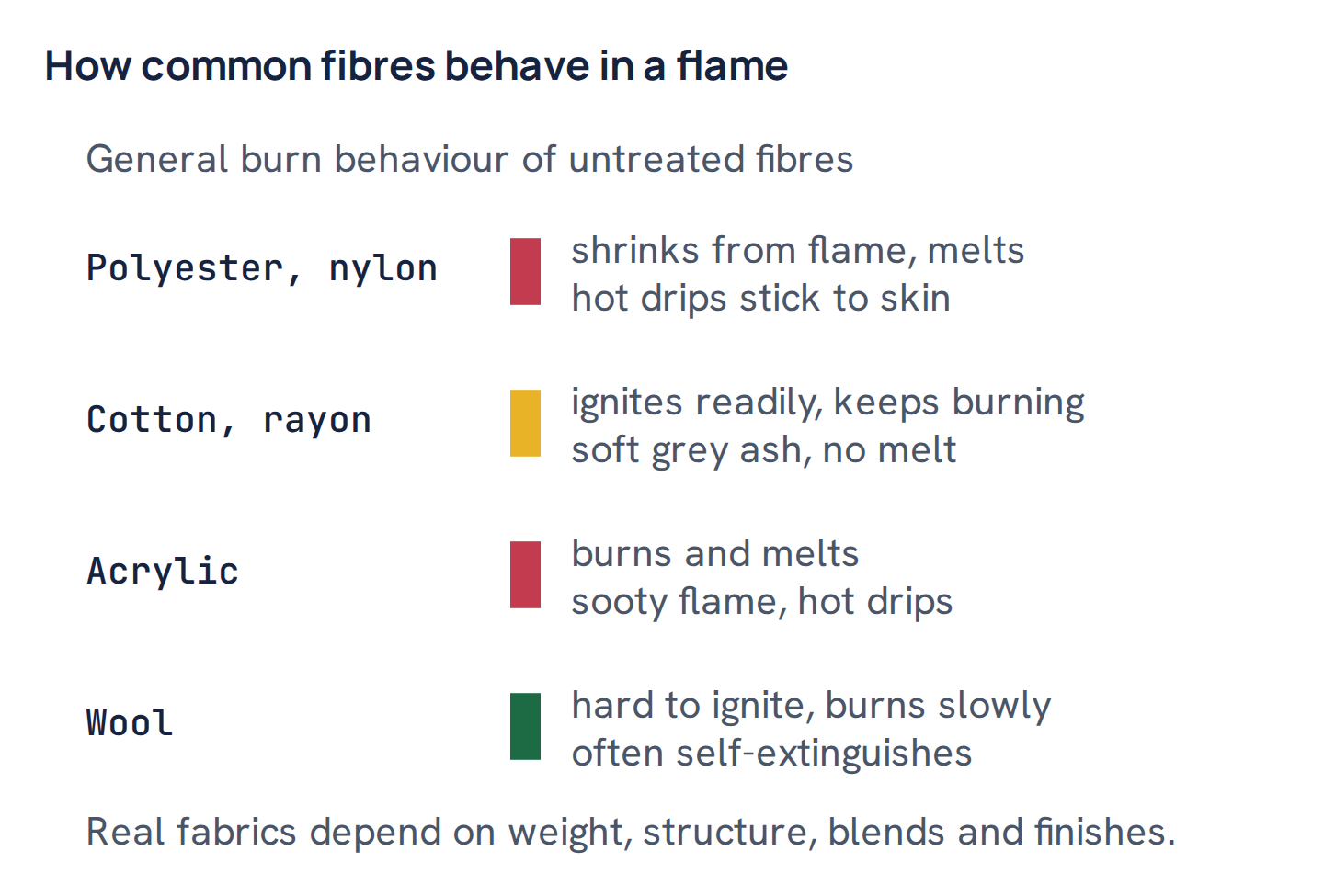
All three are synthetics that soften and melt. Nylon melts at a lower temperature than polyester (nylon 6 at roughly 220°C) and behaves similarly in a flame, shrinking and dripping. Acrylic burns more readily than polyester, with a sooty flame and melting drips, and is generally treated as one of the more flammable apparel fibres. Wool is the least flammable common clothing fibre and is often chosen for safety near flames.
What to look for on labels
Labels may say “flame resistant”, “inherently flame retardant” or show a fire-safety standard. For children’s sleepwear, look for wording such as “flame resistant” or “wear snug-fitting, not flame resistant” where those rules apply. Washing instructions matter for treated fabrics: some flame-retardant finishes can be weakened by bleach, soap or fabric softener, so follow the care label exactly.
Does polyester give off toxic smoke?
All burning materials, natural or synthetic, release harmful smoke, including carbon monoxide. Burning polyester produces dense, dark smoke. In house fires, smoke is often more dangerous than flames, which is why smoke alarms matter far more than the fibre in your clothes. Never burn synthetic fabrics as a way of disposing of them.
Keep a fire blanket in the kitchen, and know how to use it before you need it.
Summary
- Polyester is flammable but harder to ignite than cotton.
- It melts and drips at around 250–260°C, causing severe burns.
- Poly-cotton blends can burn vigorously because of the scaffolding effect.
- Flame-retardant polyester resists ignition but still melts.
- Avoid polyester near open flames and follow rules for children’s sleepwear.
Questions
Is polyester flammable?
Yes, but it is harder to ignite than cotton. It shrinks from a flame and melts, and if it burns, it drips molten plastic.
Does polyester melt?
Yes. Polyester melts at around 250 to 260°C and softens well before that, which is why it must be ironed on low.
Is polyester more flammable than cotton?
Polyester is harder to ignite, but when it burns it melts and sticks to skin, which can make burns worse.
Is polyester safe for children’s sleepwear?
Polyester is often used to meet sleepwear flammability rules. Follow labels and local regulations.
What is flame-retardant polyester?
Polyester with flame-retardant chemistry built into the fibre or applied as a finish, so it resists ignition and flame spread.

Textile engineer with 14+ years in dyeing and fabric development. He writes every guide on Dyeing Solution from real production work. Full profile