How the lab identifies fibres and measures the blend ratio (ISO 1833, AATCC 20A), step by step, with a worked example, the allowances buyers use, and what 67 real lab tests showed.
About this guide. The method below is written from the public ISO and AATCC standards in plain words. The data comes from our own lab reports on 95 new knit developments, each tested by an accredited lab to the buyer’s standard, so you can see what real results look like.
At a glance
67Fibre content tests in our data
88%Passed
±3%Usual allowance on blends
0%Allowance on 100% claims
What the test measures
Fibre content analysis checks that the fibres on the label are the fibres in the fabric, in the declared proportions. It is a legal requirement in most markets, so a wrong label can stop a shipment even when the fabric itself is good.
Two steps: identify, then measure
Identification comes first: the lab looks at the fibres under a microscope (cotton has a twisted, flat ribbon shape; polyester and other filaments are smooth rods), checks how they burn, and how they dissolve in different solvents. Quantitative analysis then measures how much of each fibre there is.
How the quantitative test is done (ISO 1833, AATCC 20A)
- Pre-treat the specimen to remove finishes and non-fibre matter (softener, oil), usually by extraction with a solvent and water.
- Dry and weigh the clean specimen.
- Dissolve one fibre. A chosen reagent dissolves one component and leaves the other: for cotton with polyester, 75% sulphuric acid dissolves the cotton and leaves the polyester; elastane is dissolved with a solvent that leaves cotton and polyester.
- Filter, rinse, dry and weigh the residue.
- Calculate each fibre’s share, applying the small correction factor for any loss of the remaining fibre in the reagent, and the agreed moisture allowance for each fibre.
Worked example. A clean, dry specimen weighs 1.000 g. After the cotton is dissolved, the polyester residue weighs 0.445 g. Polyester is 44.5% and cotton 55.5% (before moisture allowances). Declared 60/40 with ±3% allowance: cotton should be 57–63%, so it fails.
The allowances buyers use
Usually ±3% on each fibre in a blend, and no allowance on a single-fibre claim: “100% cotton” must contain nothing else.
What real results look like
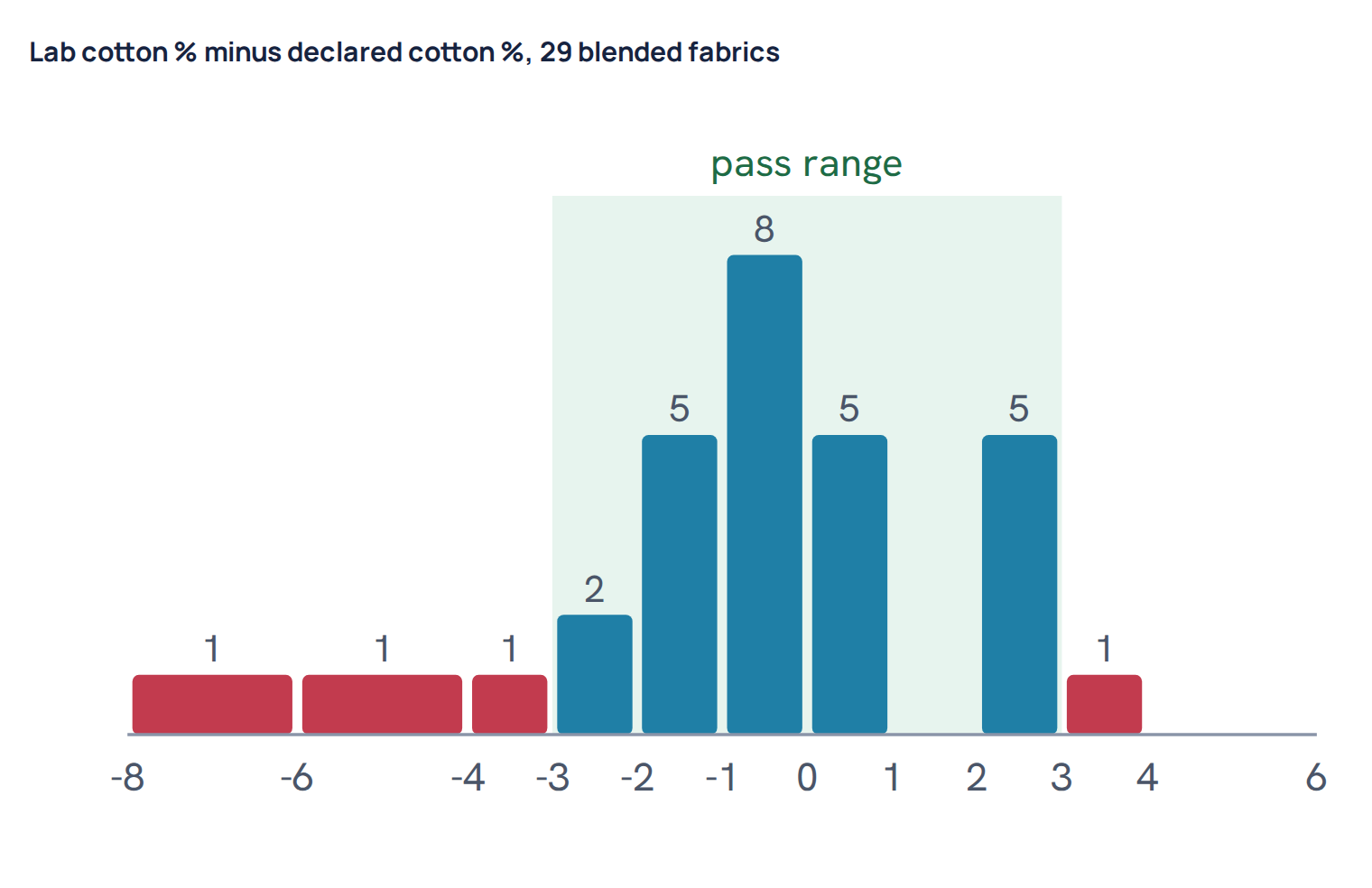
59 of 67 batches passed. In 18 of 29 blends the lab found less cotton than declared: cotton loses weight in scouring and bleaching, polyester does not. The other common fail is a fibre left off the declaration, such as the elastane core of an air-covered yarn or the polyester inside a CVC tie yarn.
Checking the declaration before the lab
Work the composition out from every yarn in the fabric and its share of the fabric weight (from the stitch lengths and counts), include the elastane core of covered yarns and the polyester inside blended yarns, and allow for the cotton lost in scouring. If the result is close to the ±3% edge, send a finished swatch for a fibre test before the bulk test.
If a batch fails, see why knit fabric fails fibre content analysis: 8 real cases.
From the floor
- Fibre content depends on the yarn. It fails when the declaration does not match the actual yarn composition of the fabric.
- Declare the composition from the yarn combination, from what each yarn actually contributes to the fabric, and allow for the weight cotton loses in scouring.
Questions
How is cotton separated from polyester in a fibre test?
75% sulphuric acid dissolves the cotton and leaves the polyester, which is dried and weighed.
What is the tolerance on fibre content?
Usually ±3% on each fibre in a blend, and none on a single-fibre claim.
Why does a CVC fabric test with less cotton?
Cotton loses weight in scouring and bleaching, so the finished fabric has a lower cotton share than the yarn.

Textile engineer with 14+ years in dyeing and fabric development. He writes every guide on Dyeing Solution from real production work. Full profile